by Jim Scarantino | Nov 19, 2018 | General
Once upon a time the Boiler Room was a good thing for teens and Port Townsend. We have all heard the stories of rewarding friendships, of lives changed and lives saved.
But when news of the Boiler Room’s closing made its way around town, we also heard more than a few parents saying, “It should have closed long ago. That’s where my kids learned to do drugs.”
We heard much the same from police: The Boiler Room had become a marketplace for things parents weren’t sending their kids there to get.
Somewhere along the way, the Boiler Room became as lost and confused as the teens it had set out to serve. 
Work on a story regarding conflicts between the Boiler Room and its neighbors was shelved when the Boiler Room announced its closing. Some of the people interviewed had volunteered there, but as they saw and learned more their attitudes changed. They wanted the Boiler Room out of their neighborhood. The didn’t see troubled teens getting help; they saw the problems besetting teens being enabled and ignored. They told us of screaming and fights on the street, of tires slashed, of being accosted at their doors by people drawn to the area by the Boiler Room’s wide-open door and free stuff.
The Boiler Room leadership has admitted that they lost control of their facility. They let their youth service program become a hangout for transients and people no parent would want within arm’s reach of their teenage daughter or son. The Boiler Room leadership could not decide whether it was better to be perceived as “welcoming” and “nondiscriminatory” or take action to preserve and protect its original, laudable mission.
Perhaps if the Boiler Room’s leadership had been able to make that choice it would still be open and doing what it had been created to do.
During the Prop 1 campaign in 2017, a man was arrested for slashing signs in broad daylight along roadways in Port Hadlock. As soon as his name was released, social media spread the word. He was known at the Boiler Room where he had been aggressive towards young women. He had a record of violence. He was described as a stalker, volatile and dangerous. He is man in his fifties.
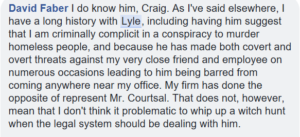
David Faber, President of the Boiler Room, said in comments after this story was published that this man had been excluded from the Boiler Room since 2011. Faber related in comments on the Rural Rebels Facebook page at the time of this man’s arrest that he had threatened to kill at least one person and had severe mental health issues that made him very dangerous. Faber said he was so dangerous that the man had been prohibited from coming “anywhere near” Faber’s law office. Another commenter, who volunteered at the Boiler Room, said his picture had been posted to alert staff if he came inside despite orders to stay away. At the time of this man’s arrest, we had seen social media posts that he had been there more recently. Visits to the Boiler Room were reportedly one of the reasons he came into town from his home in Quilcene. Regardless of when the Boiler Room learned of this man’s dangerous nature, when they decided to keep him out and whether they succeeded without exception, a more consequential question remains unanswered by Mr. Faber and Boiler Room leaders: Why was he ever permitted to spend time inside? Why would the organization let the kids it was supposed to be protecting and helping ever be exposed to anybody like this? To repeat, this is a man in his fifties. He was not a teen looking for help and friendship. [This paragraph has been updated since publication to take into consideration comments and attempts to verify Mr. Faber’s statements. We were unable to verify all that Mr. Faber told us but are including his side, nonetheless].
Even scarier was the man banging on the Boiler Room’s door one morning this past summer. He wanted free coffee before he went looking for someone to kill.
Neighbors had seen and heard him: a frightening presence on their street, drawn to downtown because the Boiler Room was known to admit anyone inside its doors.
Later that day he hunted down a harmless homeless man and nearly stabbed him to death at a spot just two blocks away.
Shortly after, the Boiler Room announced it was closing. It had been losing volunteers. Its financial support had “fallen off a cliff,” in the words of its executive director. Parents did not want their kids there. It traded future teen success stories for a faltering existence as a “day shelter” for transients.
What does this have to do with a comment policy for Port Townsend Free Press? It persuades us to act.
We had allowed unrestricted comments when we were on the Blogger platform before our move to WordPress and our new website. Our Facebook page has always been open to comments. We have been watching and learning as we consider opening the website to comments. What we’ve learned is that we need a comment policy before we activate the comments at ptfreepress.com.
One particular official of the City of Port Townsend has been a prolific commenter on our Facebook page. We like a good debate and encourage contrary points of view. But his contributions rarely rise above insults and abuse. Invitations for civil and substantive discourse are met with more insults and taunts. Profanity in his comments is not uncommon.
In a recent give-and-take around an article on the state of Jefferson County finances, he revealed that his sole purpose all along has been to “f### around in your comments.” He showed himself to be nothing more than a vandal.
We put the decision to our readers as to whether we should block this Port Townsend official from commenting. It was a vigorous discussion. We got a fair share of profanity, abuse and insults from his friends, people he called into the discussion who had never before appeared in our comments. We also heard from others who had blocked this Port Townsend official from their Facebook pages because of his inappropriate behavior. They encouraged us to do the same. And we heard from people of the opinion that excluding anyone, regardless of what they say or how they say it, would make Port Townsend Free Press the antithesis of “free.”.
Several comments by Sky Hardesty of Port Townsend, who is a contributor to PTFP, steered us toward a decision. He observed that the city official was using his “insults, intimidation and relentlessness…to drown out free speech.”
We have readers who will not wade through profanity and threats to follow a thread of serious discussion of local issues. They drop out and do not express their thoughts. They know that if they dare speak up, they, too, might become targets for the profanity and abuse.
The sight of profanity and taunts in comments also can drive away new readers.
We will not by inaction and indecision let such conduct do to our young effort what happened to the Boiler Room.
So we announce our comment policy: “We welcome contrary viewpoints. Diversity of opinion is sorely lacking in Port Townsend, in part because dissenting views are often suppressed, self-censored and made very unwelcome. Port Townsend Free Press was launched to do something about that situation. Insults, taunts, bullying, intimidation and profanity do not qualify as serious discourse. They deter and drown it out. Comments of that nature will be removed and offenders will be blocked.”
Thanks everyone for your input.
by Michael Howard | Nov 9, 2018 | General
It’s a tight fit – strapped in the passenger seat of a Ford Explorer Police Interceptor crammed with radios, radars, computers, keyboards, and both lethal and non-lethal long weapons. Ten-year veteran Jefferson County Deputy Sheriff Brandon Przygocki holds the wheel. I am on a four-hour ride-along. Turning left out of the compound, we’ve barely made it down the road 100 yards when the lights go on, the siren sounds, and “we” have made our first traffic stop.
Przygocki’s demeanor is non-threatening – pleasant even, and empathetic (if not sympathetic). Ten miles over the speed limit, no priors, valid registration, current insurance, and the driver is let go with a warning.
Why a ride-along? Unless you are intimately familiar with law enforcement, or with the opposite extreme of the judicial system, ride-alongs offer access to an “undiscovered country” (to paraphrase Shakespeare) “from whose bourn (most) travelers return, and which can puzzle the will.” Sharing a day in the life of a traffic cop gives citizens a double dose of reality.
Five minutes later, and we are joining a two-car response to a domestic disturbance on Marrowstone Island. Not that I could understand the static-laden instructions relayed from dispatch. It takes special skill sets to decipher the terse reports breaking squelch on three to four channels, while keying the mic to respond, while keyboarding the computer, while whipping the car around 180 degrees, stomping on the gas, engaging the light bar, and goosing the siren as needed to move through traffic at speed. The car-to-car tactical channel confirms an officer ahead of us on the scene as we head to the domestic disturbance on Marrowstone. But now “we” have spotted a car with no front license plate.
A bleep of the siren, a quick check with dispatch, and Officer Przygocki engages the driver. No driver’s license – never had a driver’s license – couldn’t pass the driving test – and no insurance. A quirk in the Washington State Traffic Law codes “driving without a license” as an “infraction” with a $550 fine. Driving with a suspended license is a misdemeanor with a maximum jail sentence of ninety days in jail and a $1000 fine (first-time offenders, not due to gross negligence or DUI). If the suspension was for more serious reasons (multiple offenses or DUI) it is punishable by a fine of up to $5000 and a maximum sentence of 364 days. Police don’t write the laws – but they do enforce them.
We complete the original domestic disturbance call (a dispute between roommates resulting in one moving out) and are sent on our next assignment. A dog has been caught in the tide and is being swept towards Puget Sound. We are called off as the dog manages to paddle its way back to the beach.
Another domestic disturbance call – this one between siblings and the third call of the day to this same address. Again, two cars respond. The officers gently, but firmly de-escalate the conflict and one of the disputants departs the property.
Another traffic stop, thirteen miles over the speed limit – just outside of Port Hadlock. No priors, brand new car, dealer’s plates – the driver acknowledged an unfamiliarity with the new car and was released with a warning. Many, if not most traffic violations come down to driver inattention. If they weren’t paying attention before the traffic stop, chances are they are paying attention now, at least for the near future.
The last stop of the day (at least the last stop of my four-hour shift) provided an adrenalin/dopamine rush that had me wired for hours. Deputy Przygocki spotted a familiar face at the wheel of a car he probably shouldn’t have been driving, on the other side of a four-way intersection. An almost immediate about-face wasn’t enough. When we got across the intersection – there was no sign of the suspicious vehicle. Lights, siren, calls to dispatch, calls on tac channels, ploughing the center lines as traffic on both sides of the road (with varying degrees of alacrity) pulled over to make room, all the while keying the keyboard with his free hand (while I hung on for dear life). It’s amazing how fast and how far a screaming patrol car can go when it’s driven with a will. We quickly reached Port Ludlow but found that the suspect vehicle had turned off. Two can play that game. We clover-leafed through side roads at a more deliberate pace making our way back (without the lights and sound) until we’d all but closed on Port Hadlock – when there, around the corner and just off the waterfront, was that familiar face.
The driver was on a suspended/probationary license, with multiple DUI infractions and a mandated ignition interlock to monitor alcohol intake prior to starting and operating a vehicle. The driver was handcuffed, searched, and placed in the backseat of the police interceptor. A second squad car took charge of the driver’s passenger and vehicle, while we headed to the Jefferson County Sheriff compound, with a prisoner bound for the Jefferson County Jail.
It’s all about safety – public safety, and officer safety. Stopping a car for a few miles over the speed limit might not seem like a high-risk stop, but then again – it might be. Why were they speeding? Were they running from something? Running to something? Was it inattention, or a willful violation? If inattention – was it due to a medical condition? or intoxication? or confusion? If willful, does that display a chronic predisposition to criminal behavior?
Is there a gun in the car? Traffic stops are the leading cause of death for police officers, according to statistics from the Law Enforcement Officers Memorial in Washington, D.C. They report that between 2000 and 2009, 118 officers were killed conducting traffic stops, compared with 82 handling domestic-violence complaints and 74 during disturbance calls.
Officer Przygocki knows the danger inherent in even the most routine traffic stop. He palm prints the back of every vehicle before approaching the driver. He’s putting his fingerprints and DNA on the vehicle to prove this was the last vehicle he had contact with if the stop turns violent and he’s unable to say it with words. His ritual is a grim reminder of how very dangerous his job is.
Ride-along programs offer a powerful bridge to the community. Officers (and their ride-along) are injected into the otherwise private lives of their fellow citizens unexpectedly, often during times of stress, vulnerability and anguish. Every contact has within it the possibility of escalation. To say it was “fun” trivializes the experience. To say the experience was “educational” evokes a noncommittal cliché that communicates nothing. For me? Witnessing even a small slice of a police officer’s job from the “other side of the windshield” was sobering, humbling, and infinitely reassuring.
by Jim Scarantino | Nov 1, 2018 | General
On October 22, 2018, I wrote an editorial, “Sheriff Stanko, Please Stand Down,” about why I believe Dave Stanko should not get another term as Jefferson County Sheriff. In it, I asked “What’s with Republicans?” Though not endorsed by the party, many prominent Republicans are backing the Sheriff’s re-election. Here is a response from Gene Farr, a well-known leader of the Jeffco GOP, who is one of Stanko’s supporters and financial backers. This is his personal opinion and not a statement from the county party organization.
Change is hard. It’s even harder when your Undersheriff gets in the way.
Despite being undermined every step of the way by his former Undersheriff, Sheriff Dave Stanko has made remarkable progress reforming the Jefferson County Sheriff’s Office. Upon election in late 2014, Sheriff Stanko asked Joe Nole to be his Undersheriff. Stanko trusted that Nole’s long tenure as a detective at the JCSO provided ample experience to help the Sheriff bring the department into the 21st Century. His trust could not have been more misplaced.
In public comments made recently during candidate’s forums in Port Townsend, Chimacum, Quilcene, and most recently Port Ludlow, former Undersheriff Joe Nole admitted to insubordination and dragging his feet when it came to following Sheriff Dave Stanko’s orders. After a period of underperformance, on July 21, 2016, Sheriff Dave Stanko asked Joe Nole for a timeline to improve his performance, promising him “You should no longer be under water. support you and will help you continue to be successful as Undersheriff.” Instead of modifying his work habits—a trait well documented since his first performance evaluations in 1995—Joe Nole had this to say about the Sheriff’s orders: “He was asking me to do things that I didn’t believe in… And I drug my feet and I didn’t do those things.” Joe Nole, Port Ludlow League of Women Voters, Candidates Forum, October 11, 2018
Disappointed with his performance, on July 25, 2016, Sheriff Stanko relieved Joe Nole of investigation oversight, reducing his core job responsibilities to three important projects: 1. Lexipol update; 2. Accreditation; and 3. Grant management. Joe Nole has this to say about the period in question: “We started going separate ways and I wasn’t getting done the things he wanted to get done. I was helping other deputies, helping detectives that needed help on cases.” Joe Nole, Quilcene Candidates Forum, August 16, 2018.
If you were Dave Stanko, how would you have reacted to your Undersheriff openly disregarding your direction and helping detectives that needed help on cases after he’d been formally relieved of investigation oversight? Sheriff Stanko did the only responsible thing. In January of 2017, Stanko demoted Nole based on underperformance, inability to multi-task, and manage his time effectively, deficiencies that were previously referenced by two JCSO sheriffs since 1998. Here is how Nole characterized his performance: “I never felt I was given an order by the Sheriff to do things. He asked me things he wanted me to do. I would say that it was borderline insubordination.” Joe Nole, Port Ludlow League of Women Voters, Candidates Forum, October 11, 2018.
If Nole had a problem with Sheriff Stanko’s orders, he could have gone directly to him, or to the County Commissioners, or to the County Administrator, Philip Morley with his concerns and complaints. He did none of these.
Who do you want as your Sheriff? A man who expects his chosen management team to follow direction? Or someone who failed as number two? Joe Nole cannot be expected to lead deputies who’ve witnessed him going his separate way. Dave Stanko is the true change agent in this race. He has an opponent because he holds his employees accountable. That he has been able to accomplish so much in the face of stiff resistance is reason enough to re-elect him.
Stanko has a great record of Community Service
With a decade of serious community service, David Stanko was named “Citizen of the Year.” He served as president of the Homeowners Association in Cape George, president of PT Rotary, drove seniors for ECHHO, and serves on the board of Dove House. It is with this background, plus his 30 years in law enforcement, that he ran and won in the 2014 sheriff’s race.
Stanko has brought to this office professional policing built on the community model recommended by the Obama Task Force. This includes the first ever Citizens’ Advisory Committee. Guided by the LEMAP management program, he’s made operational changes to IMPROVE services to our community. Most important has been his de-militarization of the department–-getting rid of the Hummer and military equipment of a previous administration.
by Jim Scarantino | Oct 25, 2018 | General
How cool is this?
We received this press release from Windward School, one of the excellent enrichment programs run privately in Jefferson County for children and families wanting more than our public schools offer. Here’s the story, then more on Windward School:
Smiles, shovels, and lots of mud were on this week’s learning agenda as students of both the Port Townsend and Sequim locations of Windward School spent the week digging for mastodon bones on a Chimacum farm. Led by teacher Elisa Weiss, the students spent the week before the field trip learning about geology and fossils, and gathered to further their education by searching for real life treasures at the farm of a friend of the school.
Rudy Groussman, Yemma Kubica and Matilda Shaw search the mud for bones
The bones were discovered over the summer when the landowner began excavation for a pond. He kindly gave permission for Windward students to access the dig and put in a few hours making their own discoveries. “One of the great things about these being mastodon bones is that they’re relatively young,” said Weiss, a lead teacher with Windward School. “So we can have young kids digging for them without worrying too much about how delicate they are, unlike if they were dinosaur fossils, millions of years old.” The bones are estimated to be as young as 10,000 years old. Weiss plans to integrate the students’ discoveries into class discussions next week that focus on what life was like for animals and people in our region 10,000 years ago, and how humans can affect species’ existence over time.
Teacher Elisa Weiss talks to students about bones they unearthed. Zeke Banks listens.
“I had a lot of fun digging up the mastodon bones!” said Zeke Banks, age 9. “We found a lot of bones and I hope we get to do it again. Next I want to find out where I can go dig some dinosaur fossils.” In addition to many small bones, the students excavated a tusk, vertebrae, teeth, and several large, still unidentified bones.
Windward originated as an unnamed pilot program at the NW Discovery Lab. NW Discovery Lab is a Port Townsend-based non-profit dedicated to STEM education on the Olympic Peninsula.
Windward formally began operations at Fort Worden in September 2017 and has quickly grown to 80 students, roughly 50 from Port Townsend and 30 from Sequim. The school has two lead teachers, two assistants and project teachers offering afternoon classes in focused subjects such as poetry, science, biology and drama.
The cost is $75 per class day attended. Windward is open to all students regardless of age, gender, or religion. Students range in age from 5 to 12 and in achievement from those still learning to read to college-level readers. In other words, they have some kids at those young ages reading at the level of college students.
Windward is a secular program that partners with 4-H. Port Townsend Free Press previously reported on some of their kids’ helping bees with a project at the Jefferson County Fair. You can read that story by clicking here.
For more information on Windward School contact Danell Swim-Mackey, danell@nwdiscoverylab.org
For more on the cool dig, visit the website for Windward and the NW Discovery Lab: https://news.nwdiscoverylab.org/category/news/windward/
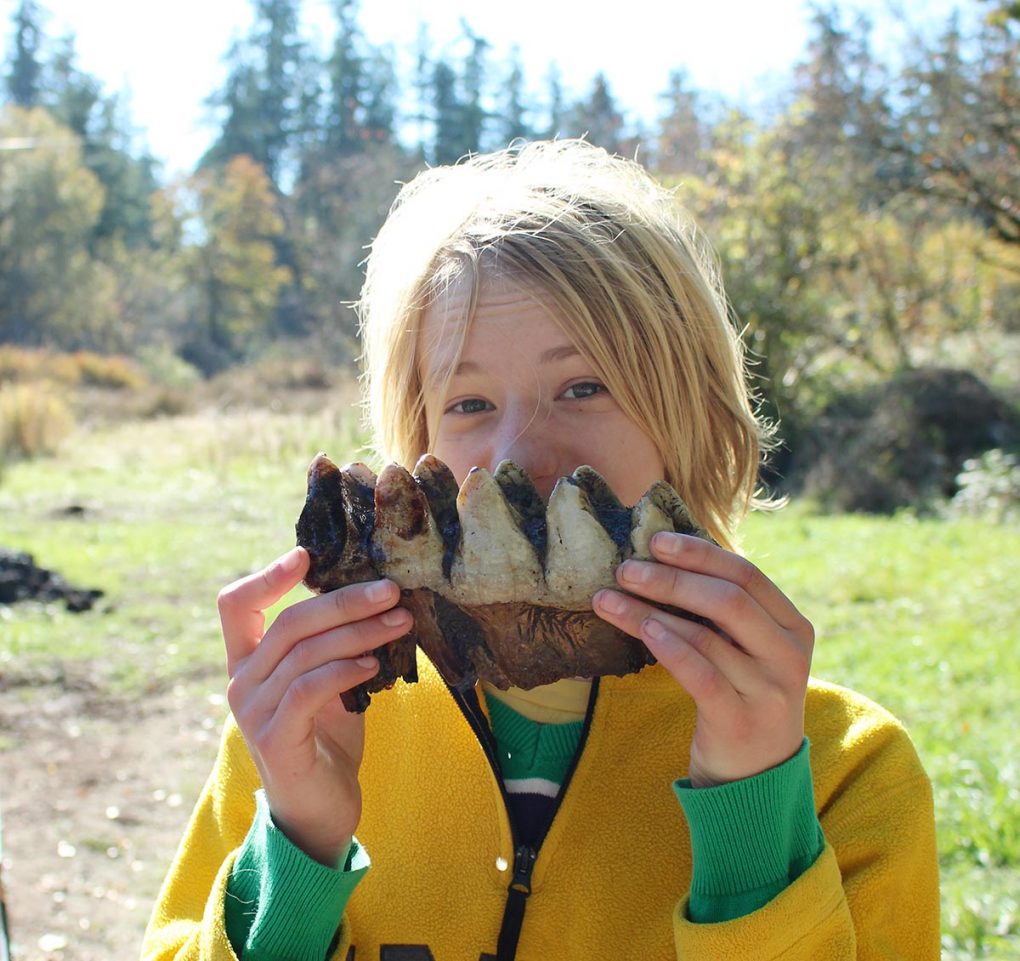
That is Evan Mackey in the lead photo showing the size of a mastodon molar the kids found.
by Michael Howard | Oct 1, 2018 | General
On any given day, fifty-plus young men and women live locked behind bars in the Jefferson County Jail in Port Hadlock. They range in age from twenty to twenty-eight years old. Seventy-five percent are male. All are white. Instead of building careers and raising families – they spend their days in narrow cells and cell blocks, with brief access to an “open air exercise facility.”
Crimes range from theft, to assault, to burglary, to forgery, to drug offenses – but actually – almost all are drug or alcohol-related. Most are committed under the influence of drugs, or to acquire resources to buy, sell, or use drugs. The poison runs the spectrum from OxyContin and Oxycodone to Fentanyl and Methamphetamine, with a wide range of deadly hybrids including Fentanyl-laced synthetic marijuana (K-2), Fentanyl-laced heroin, and even Fentanyl-laced cocaine.
These are not victimless crimes. Desperate cravings and the maddening hunger of withdrawal leads inevitably to broken promises, broken families, broken laws – broken bodies and broken lives. But according to Jefferson County Jail Superintendent David Fortino, for those awaiting sentencing – or those serving time, jail can be a haven of sorts, providing a humane “time-out” for inmates – and the community at large.
Superintendent David Fortino
“We’re not mad at anybody. We’re not here to punish anyone,” said Fortino. “We are committed to providing a safe, secure environment, and care for them while they are here.” But haven or not – jail is bleak.
Jefferson County contracts out for inmate meal service. Two chefs serve up three nutritious meals, typically: a cold breakfast, a hot lunch, and a hot dinner. Jail staff deliver the meals on carts. One tray per person, per meal – no second helpings, exchanges or substitutions. The tray, spork, cup and bowl (if applicable) must be returned immediately following the meal, when trays are collected by jail staff and/or kitchen workers. If you miss the cart, you miss the meal.
At 5:00 a.m. inmate cells are unlocked, and the lights, TV and phones are turned on. From 5:00 a.m. to 6:00 a.m. meds are distributed, and breakfast is served. Superior Court video appearances are scheduled for 11:30 a.m., and lunch is served at noon. Afternoon classes begin at 1:00 p.m. and midday medications are distributed from 1:00 p.m. to 2:00 p.m. District Court video appearances are scheduled after 1:15 p.m. Dinner is served at 5:00 p.m. Evening meds are passed from 8:00 to 9:00 p.m. Lock down at 9:00 p.m. Lights-Out is at 10:00 p.m.
A cell at the “Hadlock Hilton”
On the whole, it’s a pretty drab existence. Yes – a non-denominational group conducts weekly Bible Study Sunday nights. Inmates can request assistance to get a G.E.D. or complete high school. Alcoholics Anonymous, Narcotics Anonymous, and Anger Management programs can assist inmates through personal difficulties. Some inmates may qualify for work crews or inmate worker status. Life Skills classes are held weekly – encouraging healthy ways to cope with life changes and relapse prevention.
Yes – inmates have access to medical and emergency dental services, and necessary medical care is never denied based on inability to pay – but it’s not boutique healthcare by any means.
And yes, the jail provides controlled access to a telephone (collect calls only), and limited visits with friends and family on visiting lists (on either side of glassed partitions with phone handsets on either side).
But there’s not getting around it, life behind bars is grim.
Hollywood and the “entertainment industry” tend to glamorize the world of illegal drug use. Beautiful people with beautiful clothes in beautiful cars – rolling in money and influence. A touch of rebellion, a big dose “sticking it to the man.” There’s none of that in Jefferson County. No one gets rich – or stays “in the money” for long, and the superficial thrill of the first hit hurtles the user inevitably and rapidly towards the terrors of dependency. The drugs are unimaginably addictive and unimaginably destructive. Addicts lose their jobs and families, their health, and too often, their lives.
Cold-turkey detox in initial holding cells offers the inmate a clarity he or she hasn’t experienced for years. But there is little joy. As their minds clear, the severity of their situation sinks in. After a week or so of regular meals, rest, and mandatory hygiene, some of the visible sores, injuries and wounds that are the outward sign of the addict may heal. But the damage caused by prolonged drug abuse leaves lasting scars – external and internal, physical and psychological.
Some wags refer to the Jefferson County Jail as the “Hadlock Hilton.” It’s an unfortunate joke, evoking dark memories of American POWs being abused by the North Vietnamese. There is no abuse – certainly no institutional abuse – at the Jefferson County Jail. Inmate Rights are carefully enunciated and scrupulously enforced. On the other hand, the facility is absolutely no “Hilton,” in any way, shape or form.
According to statistics in the current Jefferson County Sheriff’s Office (JCSO) Strategic Plan, since 2001, 57 percent of inmates have returned to the jail at least once. Veteran corrections deputies have established long-standing professional relationships with many local offenders. This familiarity can help prevent confrontations and reduce the need for use of force – but it is no “Kumbaya” bonding.
l“We try to treat inmates with the maximum degree of compassion, dignity, and even respect possible under the circumstances,” said Superintendent Fortino. “But still, I’ve never had anyone say to me that they can’t wait to see me again next time.”
Even at full strength – the Jefferson County Sheriff’s Office (JCSO) does not enjoy robust staffing – and overtime and extra shifts are common. While competitive salaries are a major goal of current strategic plans, the JCSO has experienced high turnover of patrol and correction deputy staff – and are currently understaffed.
Nonetheless, the JCSO (operations, county jail, civil division and administration) annual budget exceeds $6 million. When linked to peripheral services ranging from lawyers, bail bondsmen, and counselors, to academia, charities, foundations, contractors, and healthcare providers, and Port Townsend and state law enforcement and health expenditures, drug-related crime looms as one of the largest economic drivers in Jefferson County.
Sadly, with recidivism on the rise, and the opiate crisis showing no signs of peaking soon, it has all the trappings of a growth industry.
by Sky Hardesty | Sep 27, 2018 | General
2012 was the year I moved to Port Townsend from Tacoma. While I immediately loved this place, our proximity to nature and the beach, I found myself having difficulty relating to people in my new home town.
It wasn’t that I felt anyone gave off a negative vibe. Most of the people I met in my Uptown neighborhood just seemed like they were worlds apart from my own. I tried volunteering at the Wooden Boat Festival, Film Festival, etc. I spent some time at the Uptown Pub. While I had a good time, I never met anyone I connected with.
I grew up in Federal Way. The people I’d known there and later in Tacoma were, you might say, a bit rougher, grittier, more down-to-earth than the people I was meeting in Port Townsend.
Perhaps strange, I began to feel most comfortable at the Penny Saver, often late at night. Many folks coming in late in the evening were dirty, just ending a long day of work at the boat yard, mill or other blue-collar job. I’d built my own automotive businesses. I knew the dignity and joys of getting dirty in work you love. I found it easy to strike up conversations with this side of Port Townsend.
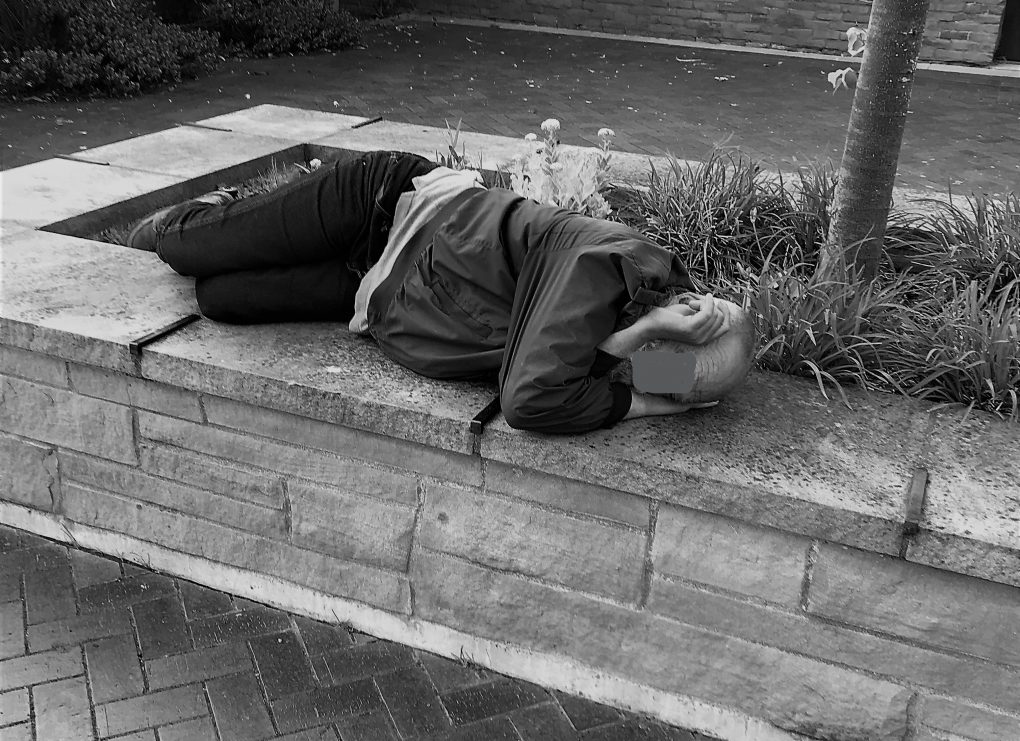
Many of the homeless would come in during the later hours. I was honestly more comfortable talking to the homeless than pretty much anyone at the Co-op and the parties I’d attended since landing here.
I’d been through plenty of highs and lows in life by this time. I’d never been homeless myself, but it was easy for me to relate to these people. I enjoyed listening to their stories. We had shared experiences. I’ve seen things they’ve gone through and I was really at ease around them.
Over the years, I have gotten to know many of the homeless, mostly those who are “from here.” I’ve gotten to know their stories. They’ve shared their struggles and triumphs.
I’ve seen things that bothered me: the people who come out of Penny Saver with a six-pack of beer and give a can or bottle to a homeless person leaning against the wall. Or the teenagers who pay homeless person to go in and buy beer for them.
In all the time I’ve spent with this town’s street people, I have only had a couple uncomfortable experiences. A homeless alcoholic man threatened me and stuck his head and hands in my car through the window. He said, “You better watch you back and hope you have good insurance on your car.” I immediately stepped out of my vehicle and confronted him. He backed down and apologized. The cause for his anger: I refused to give him cash for the sandwich he said he wanted and instead offered to buy him one. I had known any cash in his hands would only be used to get him drunk.
Another time, I found a bicycle in the middle of the road behind McDonalds. This was late at night. The homeless hang out back there in Kah Tai Park or in the landscaping around the parking lot. I got out of my car to move the bike to the sidewalk and someone I couldn’t see started throwing rocks at me. I calmly but loudly shouted, “If this is your bike, please, I was just moving it out of the road.” Instead my car and my person continued to be pelted with rocks.
Each week I will be telling a story about someone who is or has been homeless that I have come to know. I hope my personal experiences can open up the minds of our readers and tie in these experiences to our past article by our anonymous contributor entitled, “Knowing the Homeless.”
It is my intention that by putting a face on the homeless, being realistic about who they are, their problems, and the dangers and problems they pose for the rest of us, my writing might help us have a better informed discussion about things such as a homeless shelter, the increased crime attributed to transients, and the impacts of the homeless on our public resources. We can’t start to address the problem of homelessness unless we know who these people are.


 Rural Rebels Facebook page at the time of this man’s arrest that he had threatened to kill at least one person and had severe mental health issues that made him very dangerous. Faber said he was so dangerous that the man had been prohibited from coming “anywhere near” Faber’s law office. Another commenter, who volunteered at the Boiler Room, said his picture had been posted to alert staff if he came inside despite orders to stay away. At the time of this man’s arrest, we had seen social media posts that he had been there more recently. Visits to the Boiler Room were reportedly one of the reasons he came into town from his home in Quilcene. Regardless of when the Boiler Room learned of this man’s dangerous nature, when they decided to keep him out and whether they succeeded without exception, a more consequential question remains unanswered by Mr. Faber and Boiler Room leaders: Why was he ever permitted to spend time inside? Why would the organization let the kids it was supposed to be protecting and helping ever be exposed to anybody like this? To repeat, this is a man in his fifties. He was not a teen looking for help and friendship. [This paragraph has been updated since publication to take into consideration comments and attempts to verify Mr. Faber’s statements. We were unable to verify all that Mr. Faber told us but are including his side, nonetheless].