by Jim Scarantino | Feb 12, 2020 | General
One segment of the housing market can and should bear higher taxes to generate funding for affordable housing. That is realtors, who take a percentage of the sale price of houses built and maintained by other people. As real estate prices rise, they earn increasingly higher commissions for the same effort. Higher taxes on realtors can alleviate the harm being caused by decades of poor land use and zoning regulations, stifling building codes and regressive, constantly rising property taxes.
Those harmful policies must be reversed, but it will take a sea change in political power and perspective. The current Democrat majorities at state and local levels will, until that change comes, continue to seek sources of funding for affordable housing. The taxes they choose, such as property, real estate excise and sales taxes, only aggravate inequities. Bringing real estate commissions into the mix can generate substantial revenue for affordable housing funds, and contribute greatly to eventful, more meaningful reforms. This can be done without making housing less affordable and less available, serious flaws in the other solutions housing activists have been pursuing.
Readers of this site are likely surprised to see me calling for a tax increase. But back during the Prop 1 campaign in Jefferson County in 2017 (a ballot measure to raise property taxes for affordable housing) I made the same proposal. The need for affordable housing has only gotten worse. I am not talking about housing the itinerant homeless. We are seeing working class people and small business owners unable to live to in our county because they cannot find a place to live. Creative, industrious people that can contribute to our growth and prosperity are departing or avoiding Jefferson County. The ripple effect of their aversion to participating in our community hurts all of us on many levels, now and in future years.
Make no mistake, the decades old policies and ideology of the Democrat monopoly on power is responsible for this situation. They have determined zoning, building codes, land use regulations and tax policy. They seem more averse to achieving substantial corrective policy reforms than they do to raising taxes. Currently, we are seeing housing activists, working with Democrat sponsors, pursuing and achieving increases in sales taxes and appropriations, which, of course, are funded by taxes.
The resistance in Jefferson County to raising property taxes presents an opportunity for considering what should have been to housing activists an obvious, just and simply administered source of tax revenue: real estate commissions.
I would venture that housing activists have not examined this idea because they have been co-opted, if not corrupted, by politically influential realtors and their trade groups. Perhaps I will expand on that observation as this series unfolds.
Consider the alternatives housing activists have been pursuing.
Increasing Property Taxes. Here, in Bellingham, Seattle, Tacoma and elsewhere, they have sought, and sometimes won, property tax hikes in the name of combating homelessness and housing insecurity. But when they have succeeded they have only made housing for everyone more expensive, placed homeownership out of reach for more people, and caused rents to rise.
Extracting Concessions from Homebuilders. Housing activists sometimes simply want to have government require builders to create affordable housing. To the builder, that means spending their resources and time on housing that does not pay its way or earn a positive return as it is sold or rented at below market rates. Putting greater burdens on home builders in the name of increasing the supply of affordable housing makes no more sense than raising property taxes to promote affordable housing. Builders are the people who take the risks to actually build something. They have to make a profit in order to stay in business. Their continued success means that the next house can get built. Set asides–requiring them to restrict the income they can make from a certain percentage of new housing units–is a disincentive to building anything. At the same time they are being hamstrung in their ability to earn income from what they have built, their costs and taxes continue to rise. This is no way to encourage more home building.
Rent Control. Rent controls have been proven to limit the supply of new housing stock. Sure, if you are lucky enough to score a rent controlled unit, you are happy. But squeezing landlords, who are risking their investments and time to provide rental housing, does not encourage investment in more rental units. The overall effect is to stagnate the supply of habitable units as demand increases. Cities that have frozen or slowed rents do not freeze or slow the taxes and underlying costs that erode a landlord’s ability to keep her rental units in good condition. Legislation that ties a landlord’s hands in how they conduct their business–by prohibiting them from ensuring that prospective tenants will not be trouble, or requiring them to house for free deadbeat tenants for prescribed periods of time–do not encourage anyone to take on what is already a difficult and risky way to earn a living.
Realtors Are The Answer. Realtors can be taxed at higher rates and there will be no adverse consequences for the housing and rental markets.
Consider how they make their money. They earn commissions, usually around 6%, when a property for which they have the listing is purchased. They also make money on the other side of the transaction if they are representing the buyer. For a property that sells for $500,000, the realtors in the deal split about $30,000. They could make this amount of money in a few days, as frequently happens in tight markets like we see in Jefferson County.
Realtors earn this hefty amount of money without risking any of their own. They did not invest in that house. They did not fix the septic system. They did not pay taxes and maintain the landscaping. But they may reap a profit equal to what the homeowner spent to put on a new roof.
As real estate prices increase, realtors are not working harder to earn those higher commissions. They pretty much do the same thing for a $500,000 house that they do on a $250,000 house. Additionally, much of the leg work realtors did years ago is being done for them by Zillow, Redfin and similar websites. Taking photographs that make a room look larger than it is in reality may be a new skill for realtors, but it hardly justifies the huge commissions they earn when so much of the screening of a property is done for them remotely on the Internet.
Despite these new technologies, realtor commissions have not appreciably budged. Technology has benefitted consumers in just about every other industry by increasing efficiencies. Why haven’t real estate commissions dropped? We will discuss the anti-competitive legacy and impacts of realtors and their trade associations in keeping transaction costs high and contributing to housing unaffordability.
Currently, realtors in Washington pay a 1.5% tax on their commissions. That is higher than realtors pay in other states. But Washington, particularly western Washington, also has faster rising and generally higher real estate prices and a greater shortage of affordable housing than many other states. The amount of tax realtors pay on their commission is, unfairly, far, far less than the seller pays in real estate excise tax.
That 1.5% tax on a $30,000 commission on a half million dollar house comes to only $450. The realtors in the deal walk away with $29,550
Doubling that tax to $900 would be a drop in the bucket. Realtors would still take the listing. They would still take their photos for Zillow. They would still walk prospective buyers through the house and hand out their cards. The would still be telling the seller to spend more money to make the house more presentable.
And it would make no difference to the supply of housing. I submit that the real estate brokerage tax could be raised to 10% and still make no difference on the availability and price of housing. For the chance at netting $27,000, realtors will take that $500,000 listing. They still could make with a couple days’ work what is a year’s salary for many people in this county.
Next: Realtors’ History of Anticompetitive Practices Contributes to Housing Unaffordability.
by Brett Nunn | Feb 6, 2020 | General
I mentioned in my last opinion piece that the city made a good start by banning the feeding of deer within city limits. In speaking with the city, and state fish and game representatives, it seems that there is more to come. Expect a long process involving public input.
What none of us should want is an expensive process. I have a concern with the recent history of the City Council acting “in good faith” to solve a problem with a solution that seems like a bargain, only to have the price balloon to an extraordinary amount with little or nothing to show for the effort. (See Cherry Street Affordable Housing Project)
In the meantime imagine my surprise when, in the process of researching human/deer conflicts, I discovered that Western Washington is home to the black-legged deer tick that carries Lyme disease. Adding to my newfound knowledge, I stumbled across at least one Port Townsend resident who contracted Lyme disease in the last couple of years from a tick bite received while working in their yard.
Scientists believe the pipeline for Lyme disease operates as follows: As black-legged tick larva mature into nymphs they feed on mice carrying the infectious bacteria, Borrelia Burgdorferi. As the nymphs mature into ticks they feed on larger animals, primarily deer. Deer bring the nymphs and ticks into proximity to humans when they browse through our landscaping and pause for a siesta under the camellia bush. The deer wander off. Nymphs, the size of a poppy seed, and ticks, slightly larger, are left behind to find a human or pet host. This might be you, your kids, or the dog playing in the yard. The ticks find their way onto your skin, latch on in search of a blood meal, and pass on to you the infectious bacteria that causes Lyme disease.
Lyme Disease is a serious, potentially debilitating illness.
The Washington State Department of Health recommends that the best way to protect yourself is to reduce your exposure. If staying indoors doesn’t suit your plans, know that ticks need to be attached for at least 36 hours to transfer the bacteria. You should inspect yourself and your children for evidence of ticks and remove them immediately.
There is no vaccine yet. If you are infected, symptoms usually appear in three days to three weeks. If identified early, Lyme disease can usually be cured with anti-biotics. If you miss the symptoms and discover you have the disease a year later, there is no effective treatment. Arthritis, fatigue, mental issues, and severe headaches are long-term side effects.
The disease is rare in Port Townsend, for now. The County Health Department tells me there have been ten cases of Lyme disease reported in the last ten years, only two of which were verified as originating in Jefferson County. Some experts say climate change could make our region more favorable to deer ticks. The Jefferson County Health department has begun discussing what that may mean for Jefferson County residents. Regardless, if we reduce the number of deer, we reduce the number of tick transports that can spread infection to humans. Yes, Lyme disease rare, perhaps that is reassuring. But what if it is your child an infected tick finds? That one case could mean the world to you and your family. It will not seem like an outlier to you.
It is not just the threat of diseased ticks that pose real hazards. Deer can be killers.
A dog was killed by a deer in November 2019 in Uptown Port Townsend on Clay Street a block from my house. I have learned that it was on a long retractable leash, and was killed by a buck. The local Fish and Game wardens were unable to do much because they could not identify which of the many bucks in this neighborhood might be responsible. Even if they could locate the exact animal they would need evidence of continued aggressive behavior towards the public to justify any action.
Bucks are aggressive during the rut in the fall. Does can be very aggressive in the spring when they have their fawns. Deer kill dogs in urban neighborhoods just about every year. The dog does not have to be aggressive towards the deer to warrant an attack. If you try to protect your dog you may become a target as well.
I welcome the public process and a healthy debate, but I don’t believe we should spend time or money on half measures like deer sterilization or air gun administered birth control. The most immediate and cost effective solution is to harvest these deer on an annual basis. If we had feral dogs wandering around town, they would be removed. If we had wild cows grazing on the courthouse lawn, they would be removed. Feral dogs and cows are not tolerated in Port Townsend. Let’s add deer to the list as well.
by Jim Scarantino | Feb 3, 2020 | General
Jefferson County will be just fine even if the models predicting global warming prove accurate. We will face no inconvenience other than more rain.
Don’t take it from us. Listen to University of Washington meteorologist Cliff Mass. He has been working with a team of very able and qualified researchers, using the best computers, running the most reliable climate change models. He has found that Jefferson County, along with much of Washington State, will be in a “sweet spot” even if the most realistically dire computer scenarios come to pass. “A compelling case can be made that the Pacific Northwest will be one of the best places to live as the earth warms,” he and his team of researchers have concluded. Read their conclusions in more detail here and here.
Mass believes the earth is warming and that increased warmth in the atmosphere will induce a changing climate. But he has stated repeatedly that “we do not face an “existential threat” and that there is no scientific basis for raising alarms about a “climate emergency.”
“There are so many local politicians, media outlets and activist groups painting a depressing, fearful picture of our future regarding global warming. They are wrong.” Dr. Cliff Mass, University of Washington meteorologist
What about dreaded sea level rise? Not a problem for the Olympic Peninsula or most of Washington, the UW team has concluded, except for the area around Long Beach. To the contrary, much of the Washington coast is RISING as we continue to emerge from the last Ice Age and the land springs back.
What about increasing drought and water scarcity? The opposite, increased flooding due to increased precipitation, is what the UW researchers predict. Mass and his team are urging better storm water channeling and construction of larger reservoirs.
What about increasingly “extreme weather”? Not to worry, Mass and his team of researchers assure us. We should not even worry about significantly worse wind storms.
Heat waves and more destructive wildfires? Governor Inslee has raised alarms about the state burning up as it dries out due to runaway temperature spikes and heat waves. But the scientists don’t see what Inslee sees. A cooling Pacific Ocean (it has been cooling for 35 years) will continue to produce moderate temperatures for the Pac NW. Increasing fires are likely only on the eastern slopes, and there the solution, according to Mass & Co., is reversing decades of forest mismanagement and discouraging building close to or within forest boundaries.
Mass and fellow researchers do see temperatures very slowly rising, but not rapidly and only noticeably towards the end of the century.
Local climate alarmists (dare we say, climate alarm manipulators and exploiters) who sit on the Jefferson County Climate Action Committee and the Public Health Board are talking about declaring a “climate emergency.” An emergency declaration could be used to restrict just about every personal and commercial activity, to increase taxes and fees and impose a wide array of regulations on land use and energy consumption.
The City of Everett is considering declaring a climate emergency as a prelude to draconian and unprecedented regulatory measures. Mass has criticized that effort on the grounds that Everett, like all of the Puget Sound, does not face a climate emergency, at least if you bother to consult the best science coming out of the University of Washington’s Department of Atmospheric Sciences.
In 2017 the Jefferson County Commission declared a “housing emergency” as an excuse to seek a property tax increase for the alleged purpose of providing affordable housing. Voters saw through that ruse and soundly defeated the scheme, known as “Prop 1.”
County Commissioner Kate Dean, who pushed the “housing emergency” and Prop 1 campaigns, is playing a central role in promoting a “climate emergency.”. Kees Kolff, chair of the Climate Action Committee, a hospital commissioner and member of the Public Health Board along with Dean, may be pushing even harder in order to accelerate implementation of strict measures called for in a climate action plan he helped draft.
Dean and Kolff intend to roll out their effort over coming months, perhaps culminating about the time of Earth Day with public hearings, a “charette,” that Dean discussed at the last Public Health Board meeting. Even though climate science is against them, they and local activists still seek to use their political power to achieve declaration of a climate emergency, followed by implementation of restrictions on the use of fossil fuels, wood burning, construction, vehicle choice and usage, the mill and marine industries, and a wide range of personal and commercial activities.
We will continue to follow their effort to declare a “climate emergency” in Jefferson County.
In the meantime, it is worth noting that Dr. Mass is not alone in decrying political maneuvering to declare a climate emergency. On September 29, 2019, 500 scientists delivered a letter to the United Nations very clearly stating, “There is no climate emergency.” You can read about that at this link. For the letter itself and list of signatories, click here.
by Brett Nunn | Dec 11, 2019 | General
The City of Port Townsend did something good. On October 7, 2019 ordinance
3233 was added to section 9.08.020 of the municipal code. Human feeding of wild
ducks, geese, gulls and deer within the city limits is now listed as a public nuisance.
The key species here is deer. Everybody has an opinion of what to do and why the city
has been so slow to address this issue. Should be an easy fix right? I mean out in the
county you can just shoot them, in season of course. Cougars deal with the surplus.
So it should be easy. I have delved into the topic. It is not easy. As a public service to
the community, let me share what I have found.
White tail deer in the United States have experienced an unprecedented recovery,
from a low of about 500,000 in the early 1900’s to as many as 30,000,000 today. Natural predators are mostly gone, especially in urban areas. Lawns and gardens provide an abundance of food. We can congratulate ourselves on saving a species. Then I look out our window to see what my neighbor has nicknamed “rats with stilts” devouring our roses, poppies, lettuce, lilacs, grapevines, tulips, raspberries, laurel, and fruit trees while laying down a layer of manure, flea eggs, and ticks where-ever they linger.
This is not a problem unique to our town. It is happening all across the country. Even New York City is dealing with an over-abundance of deer.
Ask a wildlife ecologist to sum up the impact of this success and you will hear the term apocalyptic more often than not. At an estimated rate of 2000 pounds of vegetation consumed per animal, per year, we have a plague of hundred pound locusts clearing forests of everything except for mature trees and the few plants they won’t eat. This devastates habitat for game birds and songbirds, and can affect these environments for centuries. The impact on the human population is equally severe.
“Struck by cars, trucks, motorcycles, more than a million times a year, with
accidents killing more than 100 people annually and causing more than $1
billion in damage, the human toll makes deer deadlier than sharks, alligators,
bears and rattlesnakes combined.” Out Of Control; Deer Send Ecosystems Into Chaos, by Andrew C. Revkin, The New York Times, 2002.
In Port Townsend we have black tail not white tail deer, but that is where the difference ends. Anybody who has witnessed the deer plague develop over the last two decades can see that our homegrown herd has exceeded the carrying capacity of the natural environment and has certainly strained the cultural carrying capacity, the patience of the human population.
Just for reference, U.S. Forest Service Scientists at the Northern Research Station in
Irvine, Pennsylvania have been studying deer impact on forests since the 1940’s. As
a general rule, they found that deer population levels at or below twenty per square
mile allow undergrowth to recover. Port Townsend has a deer density far above that.
Doing nothing is the default. Those of us that drive, garden, and live in Port Townsend can tell you how well that is working. The end result will be all edibles in Uptown gnawed down to bare dirt and up to dead twigs about six feet off the ground, likely to be follow by starvation or disease of the herd. Nobody wants to see that happen.
Capture and release has proven to be ineffective with a high incidence of injury and death to the animals due to the stress of the experience. Sterilization is expensive, short-term results negligible, long-term results hard to quantify, and ineffective unless the herd is contained. Since 2012, Cayuga Heights, New York has spent close to $200,000 to remove the ovaries from 150 does. The animals are captured, one at time, surgically sterilized, and released. City leaders expect only a ten to fifteen percent decline in deer population.
Not far from Port Townsend, authorities in Oak Bay, a suburb of Victoria B.C., have settled on birth control. Deer are captured. Drugs are administered. A booster is required several weeks later so the deer must found a second time and shot with a dart containing additional drugs. Treatments are done on an annual basis. This is happening as we speak so results are yet to be determined. Solid data is probably several years out.
Culling the herd to a manageable level has been used in many locations on the East
Coast. It is the only option that has been proven to be immediately effective, affordable, and can feed the community. Professional hunters are brought in, private contractors or employees with the State Department of Fish and Game. The work is done quietly, and at night. Organic, free range, protein in the form of venison, can be provided to the local food bank.
“Either a community has leadership that drives the decision [to cull] or the
community flounders. When we finish a project, attitudes are the same as well
— people are always astonished by the benefits [of fewer deer].”
Dr. Anthony DeNicola, co-founder of a private, east coast based, non-profit, wildlife
management company.
At this time Washington State has no program for culling deer within city limits. The semi-official stance of the Washington State Department of Wildlife is that humans are encroaching upon deer territory; therefore we must learn to live with wildlife in our midst. Once this message has been delivered you will be referred to the Preventing Conflicts page on the website of the Washington State Department of Wildlife where you will find helpful suggestions such as a recipe for making your own deer repellent, tips for constructing deer fences, and my favorite: “A dog can help keep deer away especially if it is large and awake”.
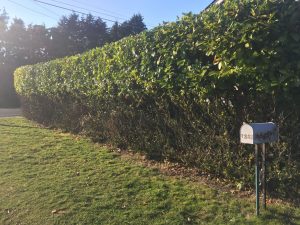
Deer-ravaged hedge near my house
So we are left with repellents, prison camp style fences, and big, lively dogs. I like dogs, but that is where it ends for me. I have had hundreds of dollars of landscaping devoured, fences broken, and hedges left with leaves only above the six-foot mark. The trees and shrubs that aren’t eaten, are damaged by bucks scraping their antlers on them. The pleasure of walking in the green grass of summer is long gone, unless you like the squish of deer feces working it’s way between your toes. I am not asking for anyone to cry a river for me. I am asking for a deer population that is appropriate for the carrying capacity of my neighborhood, like it was when I moved here twenty years ago, before there was a game trail through my front yard.
The city has made a good start with the no-feeding ordinance, but it is just a start.
by Jim Scarantino | Dec 3, 2019 | General
The City of Port Townsend bought and imported at significant cost a nearly 70-year old building that had just failed a Canadian hazardous materials inspection. The presence of asbestos and lead in the troubled building has been disclosed only recently as the group behind the “affordable housing” project seeks a State Environmental Protection Act (SEPA) permit, and the projected costs of completing the building’s eight apartments break the $3 million mark.
This and other information that will be reported in upcoming articles came to light in response to another public records request filed by Port Townsend Free Press. Our past reporting has exposed the soaring costs of the project, subsidies hidden from taxpayers and knowledge by the City and project developers that the amount of the City’s loan to complete the project was inadequate from the start.
Cherry Street “Affordable Housing” To Cost More Than $2 Million, May 28, 2018.
The Tragedy of the Cherry Street Project, December 12, 2018.
What’s Happening With The Cherry Street Project?, October 29, 2019.
Asbestos and Lead
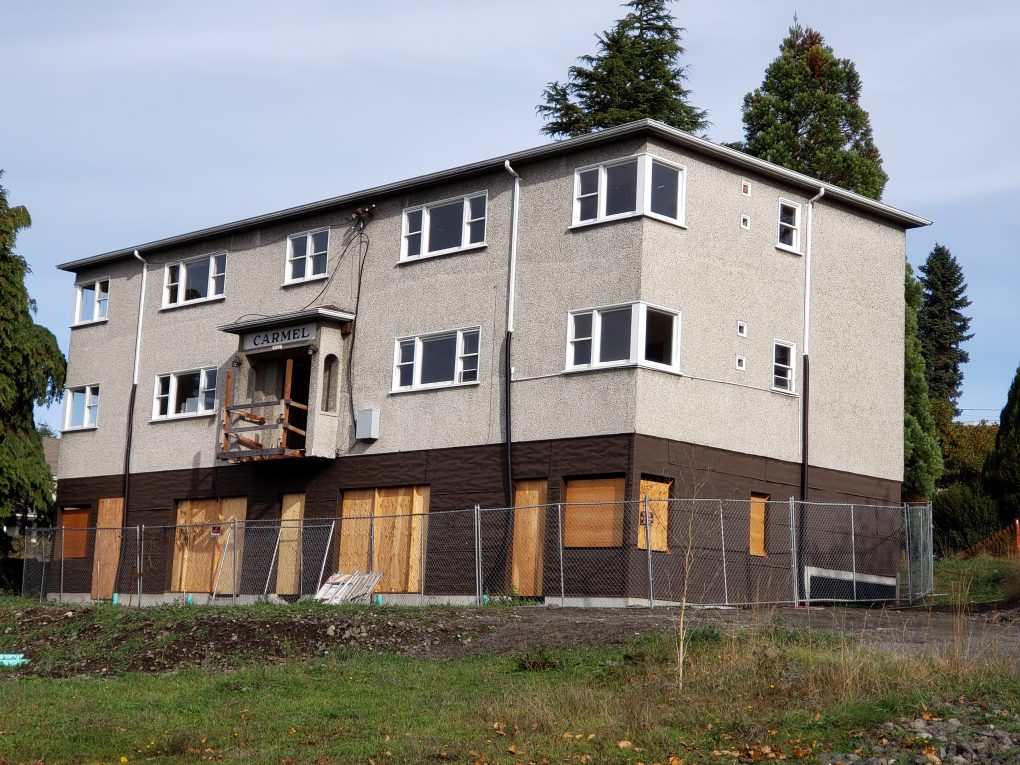
In May 2017, the City of Port Townsend purchased a mid-Twentieth Century wooden building that had been standing in Victoria, B.C. That building was later barged across the Strait of Juan de Fuca and settled onto stacks of wood, known as “cribbing,” off Cherry Street in Port Townsend. It sat on those stacks of wood for over two years until the Summer of 2019 when it was finally provided a permanent foundation.
The City gave more than an acre of land, valued at over $600,000, and a quarter of a million dollars to a non-profit group called Homeward Bound Community Land Trust. It was at the time a defunct organization with only one member. The public was told that the cost of rennovating the building and adding four small single bedroom units at ground level would be less than $500,000. Since then the City has loaned the group $834,000 and provided a nearly $500,000 additonal subsidy and other grants and services free of charge. An upcoming report will detail how the projected cost now exceeds $3 million, more than six times the original stated cost.
Because the building had been slated for demolition, a hazardous materials study was conducted in February 2017 by Island EHS of Victoria, B.C. Their investigation found asbestos insulation on pipes and elbows. Asbestos was also found in kitchen flooring. The levels of asbestos concentration significantly exceeded Canadian standards for environmental exposure. Removal of the flooring was deemed “high risk.”
Lead at unsafe levels was found in the interior wall paint and exterior trim.
When Port Townsend Free Press reviewed the City’s records more than a year ago, this hazardous materials report was not in any of the permit or correspondence files. It was turned over to the City only in September 2019 during the process of obtaining a SEPA permit, a necessary step before further work could proceed. Correspondence reviewed by Port Townsend Free Press shows Homeward Bound only disclosing the findings after being informed that its SEPA application must address any hazardous materials in the building. The report was provided in what appears to have been an attempt to assure the city that hazardous materials were not an issue. But upon receipt of the report, a city building official immediately noticed and informed Homeward Bound that the report indicated the presence of asbestos and lead. At that point, the correspondence in the SEPA permit file ended on this issue and it remains unresolved.
Homeward Bound has not responded to any questions posed by Port Townsend Free Press as to how long it has been aware of the presence of hazardous materials in the building and whether it has any plan for dealing with them. They did not answer our question whether the costs of asbestos and lead mitigation or removal are included in the original or latest budgets.
As of now, Homeward Bound has not submitted a complete SEPA permit request. We did not find any applications for other necessary permits to take the project beyond where it is now–an empty building needing major electrical, plumbing, carpentry, and civil engineering work before it is ready to be occupied.
The scope of work submitted by Homeward Bound in its November 12, 2019, presentation to City Council (see video and related documents by clicking here) states that the building will receive all new plumbing, drywall and kitchens. These are the locations where the dangerous levels of asbestos and lead were found. Demolition of those contaminated features will require special procedures and permitting and will be costly. Their scope of work notes asbestos in the subfloor that will be repaired. The submittal to City Council does not mention that the pipes and elbows to be replaced are all encased in asbestos.
Unsafe Conditions Within
The public has repeatedly been assured that, despite its age, the building is in excellent shape.
Those statements have been misleading, if not false.
During the first week of August 2019, city building official Angela Garcia and Assistant Fire Chief Brian Tracer entered the building and gained access to the upper floors via a ladder they found on site. She reported, according to an email in the City’s files:
“[W]e observed multiple hazardous conditions such as holes in walls and floors large enough for a person to fall into.”
Garcia requested that measures be taken to safeguard the building from unauthorized entry to protect anyone who may wander inside.
Three days after receiving Garcia’s request, Homeward Bound on its Facebook page posted photographs of its Board members putting up plywood sheets across the openings on the ground level. Homeward Bound stated this was being done “because our insurance company needed assurance that it wouldn’t be damaged while we carry on to Phase 2.” No mention was made of the City’s request.
Homeward Bound in its latest presentation to Council stated that it will have to replace floors, all electrical systems, all plumbing, all windows and all drywall–in contradiction to previous representations regarding the building’s condition.
Growing Problems with Neighbors
We have previously reported about problems being caused for the homeowner who lives in front of the building. She told us that Homeward Bound’s plans block her driveway. The SEPA permit file also reveals increasing concerns by Grace Lutheran Church, which has been a supporter of the project since inception.
A two-page, single-spaced letter from Pastor Coe Hutchinson dated September 17, 2019, details multiple inaccuracies in the SEPA application (e.g., getting the grade of slope wrong, pointing out that the planned exterior wheelchair ramp could not be going to the third floor and could not possibly be at a 12% slope). He also raised concerns about erosion that started when the building was moved in and much of the area scraped and excavated. “Water is running off Cass St. and down through the area used for parking by GLC. The runoff is not going into the current catch basin in the Cass St. right-of-way,” he wrote.
Those concerns have not been addressed in the past months. This author upon a recent visit observed the erosion damage from almost three years of failure to appropriately channel runoff.
Pastor Coe also raised concerns with what appears to be inadequate access to the building once it is occupied, including the possibility that a proposed gravel roadway from Cherry Street up the hill would not handle all the building’s anticipated traffic, as well as use by GLC. (The alternative is paving, another considerable expense which does not appear to have been included in existing cost estimates, already grossly inaccurate. Homeward Bound, in its presentation to Council, was hesitant to include “street work” in its latest $1.83 construction estimate. More on that in an upcoming report).
Lastly, Pastor Coe shares that GLC is now facing a “parking dilemma.” Homeward Bound’s plans pose the possibility that they will lose parking they have been using for the past 50 years. This is a similar concern to that raised by the neighbor, mentioned above.
How serious are the issues raised by Grace Lutheran Church in its comments on the SEPA application?
Correspondence from Homeward Bound’s consultants in the city’s files shows an acknowledgment that conflicts with the neighboring church, including an unresolved water line issue, may hold up project permits. The SEPA permit application had been scheduled to be delivered by October 17, 2019. It has not yet been submitted.
A Long Way to Go
In its November 20, 2019, article on the soaring costs of the Cherry Street project, the Port Townsend and Jefferson County Leader reported that the project was “75% complete.” Just the fact that the project lacks at least $1 million with no source of additional funding in sight, should have been enough for the reporter to know this statement was false. But the reporter more likely misunderstood what was said by Paul Rice, Vice President of the Board of Trustees of Homeward Bound, in his November 12 presentation to the City Council. He stated that Homeward Bound was “75% of the way to permitting.”
The files reviewed by Port Townsend Free Press found nothing to substantiate that claim. Indeed, it appears Homeward Bound is already off its own timeline for permit application.
It is no wonder this has been and will continue to remain a troubled project, with no foreseeable upward limit on the taxpayer investment. It is now clear that the City purchased this building blindly, without inspection or a professional estimate of what it would cost to make the old structure up-to-code and habitable. For years, both the City and Homeward Bound have known this project would cost far more than they had been telling the public or The Leader and the Peninsula Daily News.
Homeward Bound is headed for default on its loan from the City. It was granted a two-year grace period at the start of its forty-year loan term during which time it would not be required to make any principal or interest payments. That grace period expires in July 2020. Homeward Bound has not only indicated that it will be unable to make its first payment, but will be back to ask the City Council for $1 million or more in additional funding.
The public may be surprised because they have not been told the truth. But neither City leaders nor Homeward Bound trustees can claim to being caught unawares at this turn of events. They’ve long known this project was in trouble.
City files contain a printout of an email from Monica Bell, a former Homeward Bound Trustee, to her fellow Trustees, all members of City Council and other persons in the homeless services and affordable housing communities. She questioned the “deal” between the city and Homeward Bound and wrote that the person then serving as project manager, the person in the best position to know what lay ahead, had called the numbers then being given for the project’s cost “rushed, slapped together” and “completely bogus.”
Only now are taxpayers learning how true those words are.
by Jim Scarantino | Nov 27, 2019 | General
The tables are set, the turkeys are roasting, volunteers are getting excited about seeing old friends and making new ones. The annual Tri-Area Community Thanksgiving Meal will return starting noon tomorrow and filling bellies and bringing smiles until 3 p.m. Hundreds of people are expected to line the long tables at the Tri-Area Community Center, across S.R. 19 from Chimacum Grange, and next door to Chimacum High School.
I am returning to volunteer as table setter, water pourer, silverware fetcher, table wiper, dishwasher, plate stacker, whatever the dedicated, cheerful team leaders give me to do. My wife and I spent last Turkey Day helping out and seeing our local community with new eyes. A very diverse group comes for what is a surprisingly tasty, perfect Thanksgiving meal. (I can’t cook one whole turkey right. How do they manage to serve hundreds of pounds so well?)
Families, seniors living alone, folks who can’t afford their own celebration, people just looking to connect on this holiday. They were all seated at the tables, happily tucking into the delicious food.
Did I mention the killer pumpkin pie?
Good stuff will be served up: turkey, mashed potatoes, green beans, cranberry sauce and not just pumpkin pie. (I’m hoping to see some of that tasty ham they dished out last year. The food just kept coming and coming).
Last year Chicago Bob and friend provided live music. I hope to see and hear them again.
The Tri-Area Community Meals team, expertly organized and ably led, pulls this off seemingly without effort. Their many, many hours of preparation and work make this holiday celebration something very special, something worth seeing for yourself.
No more volunteers are needed for Thanksgiving! What a wonderful measure of community spirit! But volunteers are needed for Christmas. Contact t Tria Area Community Meals at 360-605-03000 or contact@triareacommunitymeals.org. For more information see their website: https://triareacommunitymeals.org/
Happy Thanksgiving. Please don’t drink and drive.