by Jim Scarantino | Jul 10, 2023 | General
Unsustainable. Higher taxes lie ahead for Port Townsend residents and businesses. But it won’t be basic, critical city services that get the biggest chunk of increased revenues if the recommendations of the City’s Financial Sustainability Task Force are followed.
The proposed aquatic/fitness center could get seven times as much in new tax revenues as would go to fix the city’s failing streets. Parks and forays into becoming a major housing provider would also see huge increases.
Public safety and emergency services would see little change. As for the the city’s aged, failing water and sewer lines, the task force chose to ignore the problem.
A water and sewer system is a core service of every city. “Simply put, without core services, all other initiatives and services suddenly or eventually fail.” That is the definition from the glossary of terms in the task force’s final report. But through a verbal sleight-of-hand, the task force declared it would not consider water and sewer to be core services and, therefore, they were excluded from evaluation of the city’s financial challenges.
Replacing the thirty-mile long, century-old system that brings water to the city from Quilcene will cost more than $114 million, according to the city’s 2019 water plan. Higher utility rates, increased borrowing and other measures will be necessary to cover the costs. Some sewer sections are at the end of their lifespan and require replacement now. A single failed pipe under Water Street is beyond repair and must be completely rebuilt, at the cost of nearly $3 million — which the city must borrow or pull out of its reserves.
It would be a lot harder to persuade taxpayers to approve high taxes for a new pool if they knew they were also facing staggering increased utility rates and other charges to repair and replace the sewer and water lines under the city’s crumbling streets. The price tag for that proposed new aquatic center, by the way, starts at $37 million and tops out above $52 million, along with an annual operating subsidy of about $900,000.
Rendering of the Mountain View complex to house proposed new aquatic center, from the consultants’ PowerPoint presentation. Multiple pools — a swimming pool, activities pool and therapy pool — are illustrated in the image at the top of the article.
Skewed priorities don’t stop there. The city’s pool consultants are enjoying a $175,000 contract, which is more than the city budgeted in recent years for road maintenance. It is more than the city has allocated to study the seismic stability of the Lord’s Lake dam, the principal source of the city’s drinking water. State authorities have warned that the dam is in very poor condition and could require $4 million in repairs — money the city doesn’t have. Not a word in the task force report about that.
Water for swimming got a lot of ink; drinking water got none.
But heavily taxing city residents to pay for a new pool — running up their property taxes by hundreds of dollars per year, on top of other recommended tax increases — isn’t enough. The Task Force, echoing the city manager and Port Townsend’s pool consultants, want to tax county residents to fund PT’s aquatic center. A project that cannot be sustained by city taxpayers has been proclaimed possibly sustainable if maybe county residents can also be taxed to pay for a new pool to replace one they don’t use now.
Fewer than 34 Jefferson County residents outside city limits use the existing Mountain View pool on a monthly average. That data was gleaned from the 2022 annual report from the YMCA, which manages the pool for the city. The same data shows that only 174 city residents use the pool on an average monthly basis.
Window Dressing for Higher Taxes, Expanding City Government
Council created the task force in November 2022 to address the city’s impending financial crisis. It carries an impressive title, but was little more than a handful of citizens hearing from and reading materials provided by City Manager John Mauro and his staff.
Five citizens were appointed but only four served. Troy Surber, PT’s former acting police chief, resigned his appointment before the first meeting. The other members were former city councilor and mayor Catharine Jackson, John Nowak, Rick Jahnke and Earll Murman. Earll Murman is married to Rena Murman, Treasurer of Jeffco Aquatic Coalition, the group spearheading the campaign to build a new aquatic center (more on that apparent conflict of interest below).
The task force had no chairperson. City manager Mauro ran its meetings. He and his staff set the agenda. The city manager determined what the group would talk about, who the speakers would be, and what materials would be considered. As far as I can tell, the city manager and his staff were responsible for writing the task force’s final report and recommendations.
There was good reason to create a task force, one that could investigate why Port Townsend’s finances have turned negative. The city is heading over a fiscal cliff. It has recently started to eat into reserves. We examined this impending dive into red ink in our May 25, 2023 report, “City Finances ‘Falling Off Cliff’ as Cherry Street Project Enters Seventh Year.”
But the task force did not dig. It did not inquire into waste in City Hall, ways current spending and staffing could be cut, or which programs and services could be scaled back. In fairness, such an undertaking would be an unreasonable expectation of citizen volunteers with no independent staff of their own. They met only a few times for about 2-2.5 hours each session.
The meeting videos reveal that the citizen volunteers were fed materials drafted by City Manager Mauro and his staff. None of those materials offered an austerity option, ways to shrink city government to fit the city’s limited financial resources. It was the city manager who labelled any course of action that did not include raising taxes to fund a new pool and other ambitious amenity projects as the “do nothing” solution. This derisive label was incorporated into the task force’s working materials.
Only those courses of action for continuing to expand city government made the cut in the final recommendations to city council.
Instead of meaningful inquiry into cutting waste and fat at city hall, the task force report tossed around vapid verbiage. It never got beyond bland statements like, “Finding efficiencies is a critical element for any pathway forward,” and “The need for efficiencies is eternal.” Rest assured, dear taxpayers, city hall has already engaged in “lean thinking” (page 19 of the report).
Repeatedly, task force discussions turned to how to sell higher taxes to a skeptical, tax-weary public.
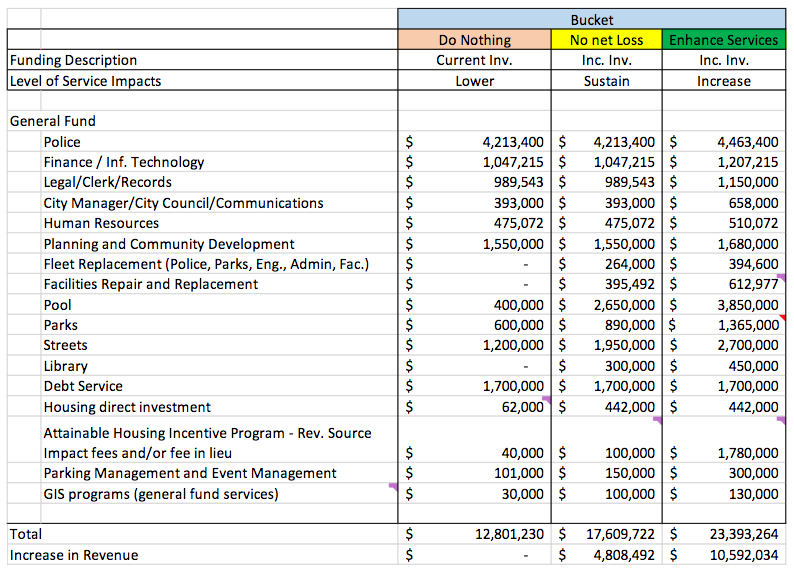
Yes, plans to fix the streets are in there. New taxes have been recommended, anywhere from $0.10/$1000 to $0.20/$1000 of assessed value to start a thirty-year effort to keep Port Townsend from continuing to have the worst streets in the state. But the tax increase recommended for the aquatic center is seven times higher, $0.70/$1000 if the tax is imposed only on city properties. If county properties are “captured” (the city’s pool consultant’s term) and share the burden, the recommended tax hike would be $0.42/$1000.
No course of action was advanced that would increase funding to complete street repairs in under three decades.
No options allocated all revenue from higher taxes to critical, core municipal services only — streets, water and sewer, public safety.
No course of action was discussed that did not include the aquatic center. From the task force’s initial meeting onward the aquatic center was considered a “priority initiative.”
Conflict of Interest?
As mentioned, Earll Murman, one of the four task force members, is married to Rena Murman, Treasurer of Jeffco Aqautic Coaliton (JAC), the advocacy group spearheading the push for the new pool. Rena Murman is also the registered agent for JAC. That group originated in 2007 under the name “Make Waves in PT.” In 2012 Earll Murman became the group’s president and chairman of the board. In that year it changed its name to “Jeffco Aquatic Coalition.” Annual reports filed with the Washington Secretary of State show him as the JAC President from 2012-2017. In the 2018 amended annual report he was listed as one of four JAC governors. In 2022, just a few months before Earll Murman was appointed to the city’s Financial Sustainability Task Force, Rena Murman filed and signed the annual report for JAC, identifying herself as one of three governors and the group’s treasurer. A quick search of public filings with the Washington Secretary of State revealed this information.
More and More Taxes
The task force recommended other tax increases and ways to bring more money into the city. Annexing Glen Cove and grabbing its property and sales tax base from the county is central to long range plans. The drop in the city’s utility tax scheduled for the end of this year would be reversed and further increased by about 9%. Property tax rates would be raised across the board. And the task force is recommending another hike in the local sales tax.
To generate tax revenue for the proposed aquatic center, the task force recommends creating a Metropolitan Park District to tax city properties or a Regional Park District to capture county properties. This would require formal action by council and a public vote. If the borders of the taxing district extend beyond city limits, the county commissioners would also have to be on board. A park district can impose a property tax of up to $0.75/$1000 assessed value. An effort to create a park district to fund the Sequim pool was defeated in 2015.
There is also a lot in the report about funding the city’s foray into becoming a major housing provider and remaking the golf course, and how the city’s budget must increase accordingly. We will take a closer look at the these issues in future reports.
City Council is scheduled to act on the task force’s recommendations in coming months. The task force’s 53-page final report may be read at this link.
by the Editors | Jul 1, 2023 | General
In the spirit of offering Letters to the Editor as a traditional platform for lively, wide-ranging conversations in the public square, we invite you to write about whatever is on your mind.
Because we require comments under articles to be “on topic”, we found that readers who want to speak to other important issues, events and concerns that our small crew can’t cover don’t have a place for that. This Off Topic! feature allows readers to bring up other subjects, post news flashes, announce community events, or express concerns outside of the selected topics we write about.
A new Off Topic! forum is posted monthly. The post is open throughout the month for new letters and your responses.
How this works:
Submit your letter in the white box below Comment Guidelines at the bottom of the page containing the muted prompt “Enter your comment here…”
Either provide your own title to the letter as a top line or we will title it for you.
To respond to someone else’s post, hit the REPLY button under that specific letter or comment you wish to respond to.
by Jim Scarantino | Jun 29, 2023 | General
Dave Timmons has had enough. The former Port Townsend City Manager (at left above, speaking to the city council at their June 12 meeting) came out of retirement in 2020 in response to requests he step in to save a collapsing Fort Worden Public Development Authority (PDA). He gave his contractually required 90-day notice to the PDA’s Board at its June 27 meeting. Ninety days out is also just about the time the PDA’s financial team says it will run out of money.
Timmons cannot be accused of fleeing from a sinking ship. He jumped onto one in 2020, only to learn that the PDA’s hull was riddled with rot and worm holes. As I wrote after watching his heroic efforts in that year, he worked miracles. He managed to steer away from the shoals an organization hobbled by nearly a decade of incompetent and less-than-honest management. He let it be known that the PDA was “a house of cards” ready to collapse from the weight of debt burdens impossible to bear and the misuse—as well as outright theft—of funds by former management and a senior employee now facing criminal prosecution.
He crafted a spin-off of the hospitality arm of Fort Worden’s operations, the only way the operations could survive. His leadership attracted incredibly generous donations. He secured additional credit from lenders already facing millions in losses. He persuaded vendors to be patient about being paid.
Before he stepped onboard to lend an assist and then to helm the PDA that organization had never—never—received a passing audit from the State Auditor. Timmons inherited incomprehensible financial records. He oversaw the gargantuan task of converting from accrual to cash-basis reporting. He did all this with a skeleton staff who joined him in working miracles.
But it may have been a hopeless cause all along. The costs of maintaining ancient, obsolete buildings, heating and electrical systems and plumbing has always been a millstone. Revenues have never been enough to keep up. And something major always breaks. The costs of repairs keep rising. There’s never enough money.
As PDA Board Chairman David King (in blue shirt in top photo) told Port Townsend’s city council on June 12, 2023, “We are not currently sustainable.” The maintenance costs are crippling. and the PDA has “no revenue source for debt” incurred by the prior PDA Board and Timmons’ predecessor.
This is a critical time for the PDA, but Timmons has decided he must leave the organization he has worked so hard to keep alive. It is clear from his letter of resignation and other comments that the impetus for his departure is a deteriorating relationship with Port Townsend City Manager John Mauro and City Council.
“We have reached the threshold that cooperation doesn’t exist,” he told council and Mauro at council’s June 12 meeting.
Inheriting a Nightmare
I went back and read my reports from 2020 about Timmons’ rescue mission. I had forgotten the details about the daunting challenges he faced.
“Fort Worden Out of Money…” led the headline for an article I wrote in December 2020. The opening paragraph explained:
“We really don’t have a future if we try to remain status quo,” David Timmons, Acting Executive Director of the Fort Worden Public Development Authority told its Board of Directors at their December 9, 2020, special meeting.
“The PDA will run out of money in several weeks. It needs over $1.5 million to cover operating and capital costs over the next six to seven months, and then it will face over $1 million a year in maintenance costs while the hospitality industry, its major source of funds, recovers from COVID lockdowns.”
Timmons found a way to keep PDA breathing another 2.5 years.
“Fort Worden Finances Plagued With Problems From Beginning” was the headline of a November 2020 article.
“Its financial reports have never been reliable, according to all the audits conducted of the Fort Worden Public Development Authority by the State Auditor. Every audit since the FWPDA opened its doors has found inaccuracies, omissions and failures to comply with required accounting practices. Recent discoveries, which will be addressed in upcoming audits, have uncovered massive malfeasance and irresponsibility that jeopardize the organization’s continued existence.”
Two other articles from 2020 reminded me of how bad was the mess that Timmons took on: “Fort Worden’s Promised Financial Oversight Never Happened,” and “Criminal Investigators Called Into Fort Worden PDA Mess.”
Then there was the laughable $2 million “glamping” fiasco Timmons inherited: “Fort Worden Glamping A Soggy Mess.”
$125,000 per “luxo tent”! None have ever been rented, not a dime has come back to the PDA.
There was probably no one else in our community up to the challenge.
What’s changed now to prompt Dave Timmons suddenly to submit his resignation?
Mauro versus Timmons
Timmons was Port Townsend’s first city manager. (Michael Hildt was the first “City Administrator.” Timmons was the first to hold the title “City Manager.”) According to a 2019 Peninsula Daily News (PDN) article reporting Timmons’ retirement as PT’s city manager, he graduated from Michigan State University with a degree in environmental studies, then went to work with the Michigan Department of Natural Resources as a zoning manager. In 1978 he was chosen as a city department manager for a town in Michigan’s Upper Peninsula then moved on to be the first township manager. He later declined an offer to be Marquette, Michigan’s first city manager and moved to Cochester, Vermont where he served as city manager for 12 years. In 1997 he consulted with FEMA to help the state with four disaster events and was nominated by then Vermont governor Howard Dean to be the state’s secretary of labor. In 1999 he was hired as Port Townsend’s city manager and served continuously for the next 20 years.
At the same time Timmons was asked to come out of retirement to save Fort Worden, John Mauro was stepping into Timmons’ shoes as PT’s second city manager.
Based on information presumably provided by Mauro, the PDN reported that he was coming to Port Townsend from a high-level, high-responsibility job for the City of Auckland, New Zealand. “Mauro currently reports to the Auckland Council CEO,” the PDN related. “He is directly responsible for 20 employees and has a budget of $211 million.”
That wasn’t true, as I reported in an October 2020 article (“Who Is John Mauro?“), I had contacted the city of Auckland seeking confirmation of the PDN story. The response contradicted these claims about Mauro’s qualifications. Auckland’s mayor had referred my inquiry to the Auckland Council CEO in whose line of command Mauro’s position would have been. Through a spokesperson he told me that Mauro did not report directly to the Auckland Council CEO. He was a mid-level bureaucrat in the planning department under a General Manager. He was not “directly responsible for 20 employees and a budget of $211 million.” Half that number of employees reported to him and the budget for which he was “directly responsible” was $1 million. That was in New Zealand dollars, which is about the equivalent of just over $600,000 US.
Mauro’s job in Auckland was “sustainability officer.” He and his small team, as a New Zealand publication reported, “provide thought leadership, drive strategic direction and champion change.” Change in terms of addressing climate change.
Mauro didn’t build anything, maintain or build roads and sewers or oversee police. He provided “thought leadership.”
Fast forward to 2023. The city now managed by Mauro, as we reported May 25, 2023, is heading over a financial cliff. Mauro overspent his current budget by millions due to hiring consultants for projects the city admits it cannot afford (e.g., a new $50 million aquatic center, a remake of the golf course, and the Evans Vista development). The city is eating into reserves and cannot maintain its failing streets. I recently learned from a source in the Sheriff’s Office that county law enforcement is still covering patrols for a city department lacking adequate staffing to do the job.
Mauro publicly defends the city’s “solid financial position” to continue providing basic services. But with Mauro’s unique hold on the English language, in the same breath he qualifies that the financially-solid city’s “ability to continue to do so is hindered by increasing costs in excess of revenues and a steady erosion of services and level of service.” Translated from Maurospeak, the city is heading “over a cliff,” the exact, unvarnished words used by the city’s Financial Sustainability Taskforce.
Mauro had followed his wife to Auckland where she had secured a teaching job. Before that he had been a bicycle activist in Seattle.
Power Play
Mauro wants more control and power over Timmons and the PDA.
The PDA has been slow on churning out financial reports to meet the city’s deadlines. This is being used as a reason to subject the PDA to direct city manager control over its financial affairs, strategic direction and other matters. The hook being used is the 2022 financial report. Under city code, it was due three months after the end of the fiscal year, in March. It was delivered in June. Other complaints have been raised, but in the “Draft Corrective Action Plan” written by Mauro and his staff, it is the annual report being 2-3 months behind that is the main justification for increasing city control over the PDA.
The financial reports provided to the PDA Board are matters of public record and easily available to Mauro and his staff, as well as members of the public. Financial reports were provided to the State Auditor. No request for information has been stonewalled.
Timmons operates with a skeleton staff. The woman described as “critical” to their accounting and reporting had been battling cancer and recently passed away, leaving a huge hole in the organization’s capabilities. As Timmons explained at his June 12 City Council dressing-down, the rest of his staff consists of a clerk at 32 hours/week, an administrative assistant at 32 hours/week, an accountant at 24 hours/week, and a contract CPA providing 10 hours of services weekly.
This is the entirety of Timmons’ staff for all PDA’s administrative, executive and accounting tasks. There is no money to hire anyone else. The services of the communications and public relations contractors, PDA Chair David King told Council, were ended because there is no money to pay them.
Mauro has also faced staffing shortages. He has filled gaps by hiring expensive outside consultants. City Council approved a $4.7 million supplemental budget to cover his overruns. Tax increases are looming ahead to get more money to run city operations. The PDA has no taxing authority. It cannot just demand that citizens give it more money, and it has no reserves to cover “supplemental” budget increases.
The PDA is currently required to provide quarterly and annual financial reports. Mauro is demanding that the PDA now provide monthly financial reports. At the June 12 Council meeting, Timmons explained that they do not have the staff to do that, unless those few staff people are taken off the other work they must do. Mauro was dismissive of the limited resources Timmons has, and somewhat mocked his vulnerability to losing any staff time.
(It must be noted that while Timmons was struggling with lingering problems from ten years of mismanagement and facility crises plus the loss of the full contribution of a key team member who was fighting cancer, Mauro took himself off on a five-week vacation after enjoying recent significant increases to his compensation package.)
Mauro’s “Draft Corrective Action Plan” would require the PDA to provide financial reports a week in advance of city oversight meetings, blaming past failures to do so on “struggles preparing the materials due to a lack of process and efficient financial reporting structure/form [that has been] hindering the FW PDA to meet required timelines.” Timmons and King tried to explain that the city’s meeting schedule does not align with the PDA’s own financial reporting schedules and creates huge problems for an understaffed accounting team. Their explanation fell on closed ears.
John Mauro (top left) responds to David King and Dave Timmons (at the podium) on June 12.
The rest of Mauro’s “Draft Corrective Action Plan” turns to inserting city staff in the business operations of the PDA. It would have the city get involved in utility cost allocation and negotiations with the “partners” (the tenants) at Fort Worden. The city would also direct the PDA in resolving billing disputes with the hospitality spinoff.
The PDA was recently forced to increase its line of credit to cover shortfalls caused by delays in the receipt of expected grants. Henceforth, under Mauro’s plan, the city will decide whether the PDA can increase its line of credit.
Mauro is demanding that the city have authority to approve or disapprove capital projects and capital planning.
Mauro wants the city to “monitor and coordinate on future PDA grant applications.” He wants to participate as a partner in strategic planning in order to “right-size the structure to meet future needs.”
Mauro wants to increase the PDA board to 9 members, with the mayor appointing at least three additional members.
All this to “correct” an annual report being delivered a few months late, even though nothing in the provided report was called out as being false, incomplete or incorrect.
It appears that the late financial report is being used as pretext, or at least an opportunity, to increase the city manager’s control over the PDA and its executive director. As Timmons pointed out to the Council on June 12, these are not “corrective measures. This is an enforcement action. We have reached the threshold that cooperation doesn’t exist.”
Timmons Resignation Letter Says More
Timmons submitted a lengthy letter of resignation. He reflected on his 45 years of public service and the challenges at the PDA that he, his staff and Board confronted together. He thanked the local institutions that stood by PDA and helped keep the ship from sinking. In that long letter, he provides more insight into his motivation for leaving now. He did not have much reason to recognize the city’s contribution to the fight.
Compared to the Herculean efforts of others, and the votes of confidence from lenders and vendors, the support of the City of Port Townsend pales in comparison. Banks extended hundreds of thousands of dollars in new credit. Private individuals donated half a million dollars. Lawyers donated valuable time. Architects, plumbers, construction companies, electricians and fuel suppliers did not act on overdue billings and “never wavered in supporting us with their patience….”
Jefferson County provided two grants, one for $378,000 to help secure debt restructuring and another of $150,000 towards restoring a critical building.
The Washington Department of Commerce helped the PDA secure and close out several grants, the last in the amount of $697,000.
The city, for its contribution, awarded “a competitive grant of $5,000 … and were cooperative with late utility billings.” But unlike the other players in this drama, the city acted to make life more difficult for the Fort Worden PDA, when “they passed code revisions more suitable to provide punishment for the past situation, not necessarily supportive of our current needs.”
Towards the end of his letter, Timmons said that he had learned in his long career not to take the path others would have you take when you know that is not the right path. “I believe we have reached the point where our paths are no longer in agreement.” For the “past several weeks,” indicating that this was a recent decision, he says he had been having discussions with some of the Board about “my desire to begin the process to transition to new leadership in the role of Executive Director.” He remains “open to discussions about serving in a limited role as an advisor to pass on institutional knowledge. But other events keep derailing this critical conversation while we continue putting out the most recent fire.” (Author’s emphasis.)
The PDA Board had nothing but effusive praise for Timmons, whose last day will be September 28, right about the time the PDA runs out of money. The hearing on Mauro’s plans to increase his control over the PDA is scheduled for August 21. A public hearing must be held before the plan can be voted on by Council.
For the video of the June 27 PDA Board of Directors meeting in which Timmons submitted his resignation, click here. The agenda packet for that meeting, containing Mauro’s Draft Corrective Action Plan and Timmons’ resignation letter may be viewed at this link. The resignation letter is attached as the very last document in the agenda packet.
by the Editors | Jun 1, 2023 | General
In the spirit of offering Letters to the Editor as a traditional platform for lively, wide-ranging conversations in the public square, we invite you to write about whatever is on your mind.
Because we require comments under articles to be “on topic”, we found that readers who want to speak to other important issues, events and concerns that our small crew can’t cover don’t have a place for that. This Off Topic! feature allows readers to bring up other subjects, post news flashes, announce community events, or express concerns outside of the selected topics we write about.
A new Off Topic! forum is posted monthly. The post is open throughout the month for new letters and your responses.
How this works:
Submit your letter in the white box below Comment Guidelines at the bottom of the page containing the muted prompt “Enter your comment here…”
Either provide your own title to the letter as a top line or we will title it for you.
To respond to someone else’s post, hit the REPLY button under that specific letter or comment you wish to respond to.
by Jim Scarantino | May 25, 2023 | General
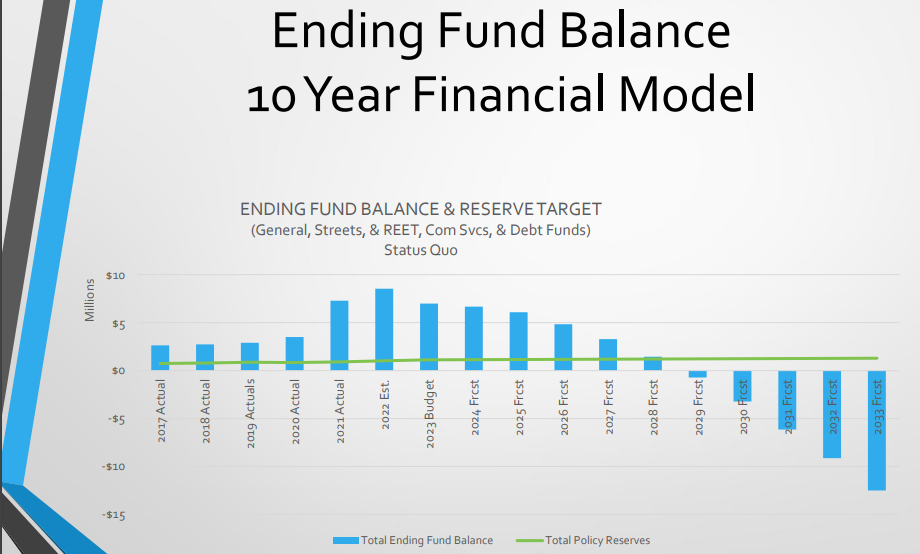
Unsustainable. In less than five years, Port Townsend will burn through its reserves and be unable to maintain its current level of services. Its finances will “fall off a cliff.” Those exact words were used by city staff in its presentation to the joint session of City Council and its Financial Sustainability Taskforce on May 8, 2023.
The graph at the top of this article shows what’s coming. Starting this year, the city will begin consuming its reserves. The burn rate accelerates each subsequent year until in 2028 the city starts dropping through the “policy level” that represents its ability to maintain existing services. You might notice that the graph shows a significant peak during the past couple of years. Those were years of a massive infusion of federal and state money and savings due to cutting staff during the pandemic lock downs. It was an unreal time of external munificence that won’t be repeated
The unpleasant and, for many people, painful solution will necessarily involve raising existing taxes and the imposition of new taxes. This will make the cost of living in Port Townsend rise even faster, hastening the shrinking of the city’s middle class and making life ever harder for workers. Taxes get passed through to everyone one way or another. Port Townsend already is not a family-friendly place; things are going to get worse for households on limited budgets trying to raise children. A higher cost of living exacerbates conditions already faced by employers who cannot attract workers or keep on their payrolls younger people who are forced to choose a community that better fits their paychecks. Higher costs in Port Townsend have also driven out some of the creative class. An older, wealthier demographic emerges, including a greater concentration of people moving here to spend their last years and those with surplus money capable of acquiring second homes.
An alternative would be to put ambitious, costly plans on hold and immediately impose austerity measures. This will be the involuntary consequence anyway if, very quickly, something “radical” is not done. That was the message of Steve King, the city’s public works director. He shared hard truths I can’t remember hearing at any previous city council meeting. He informed council that, “Our tax structure absolutely requires growth.” He said that a “radical” change was needed to achieve a significant rate of growth not seen here in recent memory.
The necessary growth would mean, he said, something like building 75 new homes annually — an unheard of accomplishment under the city’s difficult-to-build regulatory regime. Not discussed at the meeting was radically promoting growth by making Port Townsend much more business friendly in order to attract new employers that would create better jobs than those the tourist trade generates. That requires relaxing business and environmental controls, governing with a very light regulatory touch, and dramatically reducing the cost of doing business here — the opposite of our current high taxation, tightly controlled, closely planned, anti-growth dominant culture.
Five years to go before the city launches off that cliff. It took six years to take a first stab at loosening city codes that were making it difficult to add ADUs — even though the need for housing was declared a “crisis” back in 2017. That same year, the city, with the enthusiastic support and advocacy of its current mayor and deputy mayor, began wasting a pile of money, staff time and public resources on the fiasco of the Cherry Street Project. This supposedly “affordable housing” endeavor has sucked up over $2 million in city funds, bond capacity and land. Entering its seventh year, the project provides housing only to rats, raccoons and the squirrels that I have observed entering the building through holes chewed in the building’s eaves. It is also a publicly-funded place for kids to party and do who-knows-what-else inside the vandalized derelict on the hill over the golf course.
“Lean Thinking”
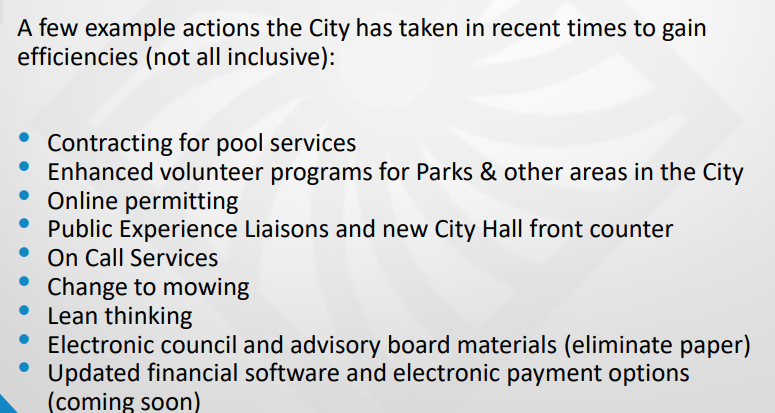
The May 8 meeting partially focused on how to craft a message to persuade taxpayers to accept a higher tax burden. One slide boasted of steps that have been taken to slow the impending launch into a fiscal abyss.
King informed council it would take at least another $1.5 million annually over future decades to start to turn around the city’s dire streets problem. It will take another $750,000 annually just to keep things from getting worse. The touted “efficiencies,” as anyone with some sense of proportion will realize, are insignificant. The cliff up ahead has been visible since at least the time the current city manager began employment. That’s three years ago, yet this is all that can be claimed in the way of meaningful efforts to cut costs.
Notice that “lean thinking” is cited as an example of an efficiency achieved. What is “lean thinking”? Some kind of thought experiment? An image of an unhealthy overweight person imagining a fit, trim twin in the mirror comes to mind.
At the same time it confronts an impending fiscal crisis, city leaders are spending scarce resources on dreams of a grand new pool and exercise facility. Just a basic pool alone, as was stated during the May 8 meeting, will cost $25 million. Opsis, the Portland, Oregon consultant working for the city, pegs the minimal cost at more than $30 million and running as high as $52.7 million.
The city is also tossing around ideas for remaking the golf course, though it has no money to do anything (already needing volunteers to trim the grass).
And even as a poison hemlock forest again engulfs the Cherry Street Project the city is moving forward on its largest housing project ever – the Evans Vista development. The land was acquired with grants, but the city has shelled out at least $500,000 on consulting services while also using considerable costly staff time for a project that may be a decade away from making the faintest impression on the city’s housing market.
In an act that cannot qualify as “lean thinking,” in October 2022 council approved a large increase in compensation for the city manager, John Mauro. They boosted his salary by 10% and threw in a “retention bonus” of $12,500. They also increased his vehicle allowance and doubled the city’s contractual obligation to provide severance pay from 6 to 12 months. Not long after this act of municipal generosity, Mauro went on a five-week vacation.
Mauro’s base salary is now $189,297, up from his starting salary mid-2020 of $156,000. In addition to his base salary, he also gets 13% of his salary contributed to his retirement account, almost $25,000 annually at his current rate of pay. When he was hired, he received a $20,000 relocation allowance to move him here from New Zealand. His current automobile allowance of $6,600 is equivalent to driving more than 10,000 miles, at the current IRS business mileage rate. One could reasonably wonder how and why the city manager is driving more than 10,000 miles annually on city business. How is that possible? For background on Mr. Mauro, please see our report, Who is John Mauro, Port Townsend City’s Manager?, in which his previous employer in Auckland contradicted published claims about the job Mauro held as an employee of that city.
Just three days before the meeting with the Financial Unsustainability Taskforce, city council had to admit it was going to blow its 2023 budget. It approved a “supplemental” budget that recognized the need for an additional $4.7 million above what had been anticipated. Bills from consultants drove the budget-busting, er, supplemental measure. These consultants are being used to advance the Mountain View pool/rec center and golf course projects. Council was also told that expensive consultants were doing work normally done by staff engineers, as the city has been shorthanded in that department.
At the same time it was claiming it needed more money to pay consultants to fill holes in its engineering department (not to be confused with filling holes in the streets), the city hired a new marketing manager. She will work on “engaging the public,” according to a Peninsula Daily News report, on “decisions including the Port Townsend Golf Course, an aquatics center, streets, housing and…” (get this) “financial sustainability.” In other words, she will be working on selling the public on projects the city acknowledges it cannot currently afford and trying to convince taxpayers to accept tax increases for the sake of “sustainability.”
Recently the city sought to recruit a Director of People and Performance, with a salary ranging from $107,00 to just over $130,000. Desperately needed licensed engineers with a minimum of 6 years experience, meanwhile, were being offered jobs starting at under $75,000, with a top range of $92,000. The opening for Director of People and Performance position has been closed. The city is still looking for three engineers and a Deputy Public Works Director/City Engineer. In the meantime, more expensive consultants are doing those jobs and/or services are being curtailed.
As for that Cherry Street Project, in August 2022 it looked like the city would sell the building and property. City staff projected the sale might net $320,000. City council was going to decide whether to impose conditions on the purchaser that required them to build a certain number of “affordable” units, or unload the property for the best deal that could be had. The city has already passed up a $1 million cash offer. City Manager Mauro blew off Keith and Jean Marzan of Morgan Hill who offered to bail the city out of the mess it had created for itself and pledged to build affordable housing on the site (see our report). When Mauro presented the history of the Cherry Street Project to city council last year, he failed to mention that he had rejected this cash offer, which was about three times more than the city could hope for now. I spoke with a council member immediately after the meeting. She said she had never been informed of the $1 million cash offer that Mauro dismissed.
(On May 15, the City Council during its business meeting went into executive session to discuss a real estate sale or lease. The property in question was not identified during the meeting.)
Whether it sells the property or not, until 2040 the city will be making annual payments of $61,896 on its $1.4 million bond principal and interest obligation assumed to rehab the 70-year building barged across the Strait of Juan de Fuca from Victoria, B.C. Netting $320,000 from a sale would be swallowing about a $2 million loss (the land alone was valued at $600,000 by the city in 2017).
.
Cherry Street Project, May 2023. Top two photos, back of building; bottom photo, front view.
Taxes and More Taxes
Even with the annual 1% increase in property taxes city council always imposes, in five years the city heads into “red ink,” in the words of Mayor David Faber. Just treading water — not demanding more from taxpayers already paying high taxes — means red ink washes ashore very soon. Streets will continue to deteriorate and services will decline. Intermittently and futilely patching crumbling streets guarantees even more costly repairs down the road. Public Works Director King said in the May 8 meeting that replacing a failed street, as Lawrence Street has become, costs 4-5 times more than required to properly maintain a street. He said that F Street and San Juan Avenue “are next” for failure. “We will,” he said, “continue to see those streets go down, and pretty much [then] the whole town is shot, not just the side streets.”
The kind of growth King intimated is necessary to prop up the city’s existing fiscal structure is not going to happen in the time remaining before the edge of the cliff is under city leaders’ toes.
If the city sold all available disposable land identified by city staff, an option discussed at the meeting, it could raise maybe $2 million. The Cherry Street Project was not identified as one of those properties. But even adding the possible proceeds from sale of that failed project, it is still not enough to avert the upcoming cliff dive.
An idea was floated to lease space at City Hall and charge a rental fee for the pool, raising maybe – maybe – $150,000 annually. That’s a big if and would put the city in competition with private landlords for some uses. As mentioned, getting streets into sound condition will cost $1.5 million a year for a long time. The aquatic center city leaders want will require, according a May 10 Leader article, an annual subsidy of $750,000 “for the base option.”
Some “efficiencies” were suggested, along the lines of the “efficiencies” listed above. Let’s be serious. None of this would make much of an impact. Not on the list, by the way, are salary freezes or more modest annual raises. The trajectory off that fast-approaching precipice incorporates maintaining annual 4.5% to 5% raises for staff.
That leaves raising or adding taxes. The Sustainability Task Force and city staff have plenty of ideas on how to get more out of homeowners, shoppers, business owners, renters… everybody.
Those ideas include the obvious: raising property taxes. A proposal was discussed to raise property taxes by $.50 for every $1,000 of assessed value, and adding this to the basis for annual 1% overall property tax increases. That would mean a $250 increase in the first year for a property assessed at $500,000, which would then increase annually thereafter. This would be a permanent tax increase.
Other ideas for bringing in more money to city coffers: raising the water, sewer and stormwater utility tax; increasing taxation of electric and telephone services; a higher B&O tax; charging parking fees on 500 parking spaces (which requires additional enforcement and administrative costs); increasing user fees; imposing a “transportation benefit district” sales tax; imposing a “transportation benefit district” license fee; imposing a $5,000 per housing unit impact fee; enacting a metropolitan park district property tax; imposing a parks and recreation district levy; imposing a parks and recreation service area levy; collecting a public facilities district sales tax; adding an affordable housing sales tax; and raising development service fees.
This was one of the most important city council sessions in years. It received decent coverage by Peter Seagall of the Peninsula Daily News. It was ignored by the city’s own newspaper. Staff’s PowerPoint presentation is here. You can view and hear the entire 2.5 hour meeting at this link. You will hear city leaders laughing and joking. Yet the situation is so serious that having the county take over the city’s police department, parks, library, planning and engineering services was presented for consideration.
Here is the full list of our reporting on the Cherry Street Project since our first article:
Unhappy Birthday: Cherry Street Project Turns Five Years Old 5/9/22
The Tragedy of the Cherry Street Project, 12/12/18
What’s Happening With the Cherry Street Project? 10/29/19
“Completely Bogus” Numbers–More Problems and Delays for Cherry Street Project, 12/2/19
Multi-Million Dollar Fraud on Taxpayers: The Cherry Street Project Unmasked, 6/27/20
Cherry Street Welcomes First Tenants, 2/28/20
Default the Cherry Street Project Now, 4/22/20
Latest Cherry Street Giveaway Hits Taxpayers Harder, 10/2/20
Cherry Street Project Handover “Not a Done Deal,”10/19/20
Accomplished Developer Will Donate Time and Services for Cherry Street Project, 10/20/20
Cherry Street Handover: Red Flags About Bayside Housing, 3/3/21 (and related articles)
Happy Fourth Birthday, Cherry Street Project! 5/10/21
Cherry Street Project Costs Soar in Bayside Housing Proposal, 6/23/21
New Majority on Council Should Kill the Cherry Street Project, 11/27/21
Cherry Street Project Vandalized, 1/4/22
“Incredibly Expensive” Housing Project Follows Cherry Street Debacle, 1/6/22
Mayor Faber (Almost) Opens Up on Cherry Street Project Failure, 4/23/22
by Annette Huenke | May 21, 2023 | General
“The transgender rights movement has gone well beyond seeking equal rights. It seeks to liberate women without their consent from the legal protections associated with birth sex and even from the recording of birth sex… I have changed my mind with regard to certain transgender demands, including access to women-only spaces, after listening to women. Men are rarely, if ever, affected by transgender demands, so it is easy to say ‘yes.’ We must always try to imagine ourselves in the changing rooms, hospital wards, and prisons of lesbian, bisexual and heterosexual women.”
Professor Robert Wintemute, original Yogyakarta Principles signatory
————————————-
In 1964 or so, my pal Leah and I hatched a scheme to outwit the dress code enforcers in our small elementary school in a rural farming community of southern New Jersey. As was demanded by sex stereotypes at the time, girls were required to wear dresses/skirts, all logic against that tradition be damned, not the least of which was cold autumns and freezing winters. The school featured a playground with a basketball court, baseball diamonds, swings, a big slide and old-fashioned monkey bars… everything an active kid could possibly want. What young girls didn’t want was other kids (or adults) seeing up our dresses.
Leah and I were rough-and-tumble girls with lots of brothers. We were as fast and strong as any of the boys at that prepubescent age, but modesty prohibited our participation in a sport we both loved — baseball. One day we appeared at school with shorts under our dresses, and proceeded to head out to the diamond with the boys. It wasn’t long before our ruse was discovered. That afternoon, we each carried a note home from the teacher to our parents. Our scheme fizzled out before the sun set that night.
A few years later, as a young teenager, again I was sidelined as spectator, enviously watching my brothers and their mates enjoy Little League baseball to their hearts’ content. To assuage my longing, my brothers allowed me to catch practice pitches behind the backstop. It would be some years before the 1972 Title IX civil rights law paved the way for females’ access to sports spaces that males had previously dominated. We didn’t want entry into boys and mens locker rooms and showers. We wanted to enjoy the commons, which our parents’ tax dollars incidentally helped fund to provide for healthy lifestyles.
I could not have imagined that I would live to see the day when males would be not only welcomed, but lauded, for insinuating themselves into women’s sports and private spaces. The banner supporting males identifying as females is being carried by many of the very same women who were themselves forbidden by institutional policies and patriarchal norms from participating in a full range of sports not so long ago. Now they’re facilitating turning Title IX inside out to accommodate what are fundamentally misogynist urges — the emotions of males are more important than the intrinsic value of women’s sports and the physical safety of females.
In 1967, the first woman to enter the Boston Marathon was attacked from behind by a race official as she was running with a group of men. Fifty-five years later, I and numerous other women were attacked from behind by a body builder who identifies as a woman, who was trying to prevent real women from speaking in public. Cowardice appears to be characteristic of these fellows, and even that is welcomed and celebrated by the woke contingent that has possessed our society in general — for the moment.
Pennylvania Quakers’ swimmer Lia Thomas (Brett Davis-USA TODAY Sports)
Lia (William) Thomas, the now infamous biological male swimmer who imagines he is female, was a mediocre competitor among his own sex. His fortune changed last year. The news was so shocking, it made headlines around the world. “Thomas ruffled feathers last season as the swimmer set pool, school, and Ivy League records. Thomas competed for three years on the men’s team and was ranked 462 as a male swimmer, but shot up to number one after being allowed to join the women’s team last season.”
What does it say about this man’s character that he never stood a chance placing tops among males, but would relish purloining valuable awards in competition against women?
This chicanery is occurring in many women’s sports these days — cycling, skateboarding, volleyball, weightlifting, track, rugby and martial arts — I’m sure I’ve missed some.
Sports are an important part of our culture — teaching confidence and team-building, providing physical exercise and valuable win/lose life lessons, and opportunities for modest to spectacularly lucrative career opportunities, to name a few examples. But sports shouldn’t dominate the discussion around the so-called ’transgender’ issue because of their popularity. This article will consider other crucial aspects of the debate, including institutional collusion and identity-politics activists’ manipulation.
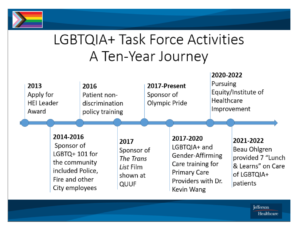
HEI Leader Award slide from Transgender Navigator Jackie Levin’s 2/28/23 Jefferson Healthcare Board of Commissioners’ meeting
Celebrating a decade of “gender-affirming medical care”
At the February 28th Jefferson Healthcare hospital (JH) board meeting, Patient Advocate/Transgender Navigator Jackie Levin presented a slideshow (pps. 71-80) that spoke in glowing terms of the hospital’s progress in the last decade promoting and supporting the ‘LGBTQIA community.’ JH first applied in 2013 for the Healthcare Equality Index (HEI) Leaders award, sponsored by the American LGBT-interest activist group Human Rights Campaign (HRC), and has “achieved that every year since.”
Levin reported increasing numbers of people from the “transgender community” seeking medication and medical services providers:
We’ve done a lot with sponsoring events in the community and attending events in the community as well as bringing in physicians and other trainers for our staff, for our providers and we now have ten providers who are trained to help our transgender patients with their hormone replacement therapy. And we’ve got some real advocates in our OBGYN department. So it really feels like it’s really grown, we’ve made some strong connections with people in the community and I think that’s one of the things that’s really important.
An internal audit of patient charts was conducted last year, which Levin said “noted that legal sex is there… but somebody’s sex assigned at birth is [only] at 40% gender identity… pronouns are barely put in our Epic medical record, and so we’re going to be doing that for this year.”
Increasing complaints to the hospital about misgendering are particularly worrying:
Right pronouns are part of our access [to hospital services] — folks don’t feel seen if we don’t use their proper pronouns… It’s how we identify ourselves and if I mis-pronoun you, you’ll correct me and if I mis-pronoun you again, you may begin to wonder if I see you. And if I continue to mis-pronoun you, you’re gonna be wondering if you can trust me.
She paused to reinforce the importance of this convention:
Oh, I did want to add that there is a risk of, great, much greater, I mean like uh, 40% higher risk of suicide in youth if we’re not using the transgender persons appropriate pronouns.
That’s quite a distortion of the oft-cited, though poorly supported, claim that “transgender” people are at least 40% more likely to have attempted suicide in their lifetime than the non-trans population. For some time I have been curious about where that figure came from, and exactly which suicide statistics it referenced, so I set about to find out. More on that later… for now we continue our dive into JH’s keen interest in the HEI.
Human Rights Campaign (HRC) and party politics
HRC was founded in 1980. You may be familiar with the logo — a yellow equal sign (=) on a blue background.
Influence Watch, a project of The Capital Research Center, describes the organization this way:
The Human Rights Campaign (HRC) is the nation’s largest LGBT-interest activist organization and a prominent force in left-of-center politics. Together with the affiliated Human Rights Campaign Foundation charitable arm and super PAC, HRC has built relationships with powerful mostly Democratic Party politicians and major corporations, and has taken a leading role in Democratic Party politics and left-leaning activism. The group has faced criticism from the left over the years for insufficient zeal in securing its social-liberal agenda. …
HRC has leveraged its position as the largest advocate for LGBT interests to pressure major corporations, law firms, hospitals, and local governments into implementing and expanding socially liberal policies, supporting HRC financially, and withdrawing support from conservative and religious organizations through implicit threats of low scores on its Corporate Equality Index, Healthcare Equality Index and Municipal Equality Index “scorecards.”
Writing for the Free Beacon on May 15th, 2023, Aaron Sibarium penned an edifying analysis of the insidious tactics employed by HRC to coerce compliance within U.S. hospital systems —
Meet the Healthcare Equality Index, the Human Rights Campaign’s scorecard for hospitals that purports to measure the “equity and inclusion of their LGBTQ+ patients.” The index, which uses a 100 point scale, is [in part] funded by Pfizer and PhRMA, the trade association that lobbies on behalf of large pharmaceutical companies…
To earn a perfect score, hospitals must display LGBT symbols, solicit and use patients’ preferred pronouns, and conduct trainings on LGBT issues approved by the [HRC], according to the scoring criteria. They must also provide the same treatments for gender dysphoria that they provide for other medical conditions—meaning a hospital that uses puberty blockers to treat precocious puberty cannot withhold the drugs from children who say they’re transgender. And though the index does not mention medical conscience exemptions explicitly, it does penalize hospitals for allowing “discriminatory treatment that is in conflict with their non-discrimination policy.”
Once again, here we find direct involvement by pharma shills in the development of policies that require use of their products, in a manner that closely resembles blackmail. Don’t want to play ball? No “points” for you, and we’ve got the budget to make sure your reputation suffers for it. HRC also receives funding from major labor unions, Planned Parenthood and the Soros Fund Charitable Foundation. HRC and its Foundation reported revenue in excess of $65.56 million in 2020. A lot of societal pressure can be brought to bear with those considerable sums. Author Sibarium continues, describing the extent of the arm-twisting:
The most coercive part of the index is its “Responsible Citizenship” deduction. Hospitals can lose as many as 25 points for any behavior the [HRC] deems “discriminatory,” an expansive category that includes statements made by hospital doctors and policies that restrict access to gender medicine, including puberty blockers.
Last year, for example, the [HRC] deducted points from two Texas hospitals… because they stopped using puberty blockers to treat gender dysphoria but continued to use them to treat precocious puberty—the blockers’ original purpose.
That “amounts to discrimination against transgender youth,” the [HRC] argued in a press release.
What it really amounts to is a private organization’s social credit scoring system having potential legal impact, should activists get fired up and sue for not performing what HRC insists is “medically necessary affirmative care” such as hysterectomies and double mastectomies. “To cover mastectomies for breast cancer but not gender dysphoria … discriminates on the basis of diagnosis.” Wisconsin now requires their Medicaid agency to fund these procedures, the outcome of a 2019 court ruling.
Sibarium adds
Beyond the veiled legal threat, critics say the scorecard creates reputational incentives to defer to activists instead of medical science, which on transgender issues is increasingly in flux. Hospitals that do well on the index typically incorporate it into their marketing materials, issuing press releases about the quality of their LGBT care.
Our little hospital here in Port Townsend has been swallowed whole by this ideology.
The 40% myth
The most recent survey of gender self-identified persons was conducted in 2022 by the National Center for Transgender Equality (NCTE) — aka TransEquality — however its contents have not yet been distilled. Their latest published survey is now eight years old —
The 2015 U.S. Transgender Survey (USTS) is the largest survey examining the experiences of transgender people in the United States, with 27,715 respondents from all fifty states, the District of Columbia, American Samoa, Guam, Puerto Rico, and U.S. military bases overseas. Conducted in the summer of 2015 by the National Center for Transgender Equality, the USTS was an anonymous, online survey for transgender adults (18 and older) in the United States, available in English and Spanish. The USTS serves as a follow up to the groundbreaking 2008–09 National Transgender Discrimination Survey (NTDS), which helped to shift how the public and policymakers view the lives of transgender people and the challenges they face.
The 2008-09 survey (results published in 2011) pegged the lifetime attempted suicide rate at 41%; this latest 2015 survey, with more than four times the respondents, pegs it at 40%.
The 2015 summary also notes significant progress compared to the earlier survey in terms of community and family approval:
Respondents’ experiences also suggest growing acceptance by family members, colleagues, classmates, and other people in their lives. More than half (60%) of respondents who were out to their immediate family reported that their family was supportive of them as a transgender person. More than two-thirds (68%) of those who were out to their coworkers reported that their coworkers were supportive. Of students who were out to their classmates, more than half (56%) reported that their classmates supported them as a transgender person.
We are told that lack of affirmation of this group is causing a genocide. If that is the case, why has the significantly accelerating support for these people only yielded a one per cent improvement in that suicide stat? Could that figure be little more than hot air?
As with the ’08-’09 outreach, the 2015 survey utilized convenience sampling, a study design of the lowest quality with high bias probability. Respondents were self-identified. The survey was conducted by a highly-motivated activist group rather than an independent pollster, and hosted online by a consultant that “specializes in assisting education institutions in maximizing equity and inclusion…” (Survey questions can be found beginning on page 247 of the 2015 full report.)
A March 2023 peer-reviewed article titled “Suicide-Related Outcomes Following Gender-Affirming Treatment” speaks to the quality of the USTS, and other surveys like it. This is the most thorough review of the literature on the subject so far, revealing that shoddy research practices continually plague the field. The author says “the literature to date suffers from a lack of methodological rigor that increases the risk of type I [false positive conclusion] error.”
This June 2022 study found:
a 14% increase in suicide rates among young people by 2020 in states that have a provision allowing minors to access care without parental consent relative to states that do not. Easier access to puberty blockers and cross-sex hormones by minors actually exacerbated suicide rates.
Not to be deterred, Governor Inslee signed a new bill on May 9th that will allow minors to shelter within “host” homes while they seek “gender-affirming care,” without knowledge or consent of their concerned parents (who are termed “estranged” in this legislation).
When Transgender Navigator Levin invoked the trans lobby’s questionable approximation of 40%, she neglected to add the critical qualifier of “lifetime attempted” to the word “suicide.” Then she really upped the ante by crediting the simple factor of misgendering with causal relationship. This is no trifling error on the part of a hospital employee who was essentially educating administrators and board members about these matters. It’s reasonable to assume that participants of that board meeting went away believing that using wrong pronouns increases “trans” suicide risk by 40%. Levin’s interest in advancing the goals of “gender-affirming care” is undoubtedly well-intentioned, but clearly misguided by propaganda that gets further distorted with each retelling.
The age-old chicken and egg dilemma
According to the American Academy of Child & Adolescent Psychiatry (AACAP):
The majority of children and adolescents who attempt suicide have a significant mental health disorder, usually depression. Among younger children, suicide attempts are often impulsive. They may be associated with feelings of sadness, confusion, anger, or problems with attention and hyperactivity.
Among teenagers, suicide attempts may be associated with feelings of stress, self-doubt, pressure to succeed, financial uncertainty, disappointment, and loss. For some teens, suicide may appear to be a solution to their problems.
A Gallup poll published this week reveals record-breaking depression rates across America. Twenty-nine per cent of adult respondents reported depression throughout their lifetime. That’s nearly one third of the country, and it doesn’t include the youth — America has a mental health problem.
I doubt I’m the only one who views the populations described above as ripe for influence by a well-funded lobby that tells them they can be happy if they become someone else. Social contagion is real, and peer pressure is tremendously powerful.
So which came first — the mental health disorder or the gender dysphoria?
TransEquality would have us believe that their “community” is uniquely persecuted — that discrimination, mis-gendering, bigotry, threats of violence and other forms of rejection of individuals’ perceived identities are to blame for their elevated suicide risk. But is that really the case? Their 2015 survey design does not enable a view from outside the lens of gender-identity victimhood.
We have no idea how many of the 40% who claimed to have attempted suicide in their lifetime
- did so completely unrelated to gender issues
- had pre-existing mental health issues that they were or were not being treated for
- were on psyche drugs that increase suicidal ideation
- were plagued by chronic health issues as a result of “gender-affirming” medications
- did so because their “transition” did not ultimately make their lives better
- did so because their “transition” required surgery after surgery — not at all uncommon
- did so because their “transition” left them with ongoing post-surgical pain, wounds that didn’t heal properly, or non-functioning new body parts — also not uncommon
- did so because of regret for what they’d done to their bodies
Encouraging children, teenagers and young adults to hyper-focus on sexuality, themselves, their subjective “identity,” their looks and how they’re perceived by others, promises cultivation of entitled narcissists who are the center of their own universe. We’re raising generations of perpetual adolescents. Coddling in this manner is not the path to a healthier community.
Interestingly, the survey reports a 29% poverty rate among respondents, despite an 84.2% “some college” through M.D./J.D. level education. The fact is, not everybody is willing to work for a living. Association of gender identity with mistreatment in the workplace can be misplaced.
Employees who are hair-triggered for the next micro-aggression are less-than-ideal contributors, often too busy self-obsessing and keeping score to apply themselves fully to the task at hand. I’ve met some of them.
This is a huge problem in the employment sector right now. I’ve spoken to numerous employers who are deeply frustrated, and quite hamstrung, by the dearth of skilled, mature candidates to select from to sustain their businesses.
What will this scenario look like in twenty years?
All is not well in the land of the Gender Unicorn
Has “gender-affirming care” (GAC) made life better for the “transitioners?”
The Tavistock Centre gender clinic in the UK has been shuttered and is now facing class-action lawsuits from more than a thousand former patients, many of whom say they were pressured by the medical community. Alarmingly, their female referrals had grown 5,000% in 7 years between 2010 – 2017. (“Trans” proponents insist social contagion is not a thing.) Lawsuits against GAC medical practitioners in the US are looming as well.
Lack of fully informed consent is one reason the ranks of “detransitioners” is growing by the day. The Detransition SubReddit page currently has 47.3k members. This is a big problem for the ideologues pushing the “trans” agenda, similar to that presented by defectors from religious cults.
I will leave you with the memorable discussion below that took place at the Genspect “Bigger Picture” conference in Ireland just last month. I’ll be back soon with a report on the local impacts of this movement’s oppressive institutional elements that have infiltrated healthcare, education and every other system that orders American society today.
“A panel of detransitioned young people spoke about their lives, the context in which they came to identify as transgender, about the process of falling for what Stella O’Malley called “perhaps the most bewitching line in the world: that you can be a different person.” They talked about their interactions with a medical system that ultimately harmed them when they needed help instead, and how the stories they told themselves about transition fell apart. They talked about what real help might have looked like. “I realized that I didn’t have to live up to those expectations [of womanhood],” one young woman said, “and someone should have told me that when I was 14.”
















 HRC was founded in 1980. You may be familiar with the logo — a yellow equal sign (=) on a blue background.