by the Editors | Sep 4, 2023 | General
In the spirit of offering Letters to the Editor as a traditional platform for lively, wide-ranging conversations in the public square, we invite you to write about whatever is on your mind.
Because we require comments under articles to be “on topic”, we found that readers who want to speak to other important issues, events and concerns that our small crew can’t cover don’t have a place for that. This Off Topic! feature allows readers to bring up other subjects, post news flashes, announce community events, or express concerns outside of the selected topics we write about.
A new Off Topic! forum is posted monthly. The post is open throughout the month for new letters and your responses.
How this works:
Submit your letter in the white box below Comment Guidelines at the bottom of the page containing the muted prompt “Enter your comment here…”
Either provide your own title to the letter as a top line or we will title it for you.
To respond to someone else’s post, hit the REPLY button under that specific letter or comment you wish to respond to.
by Jim Scarantino | Aug 25, 2023 | General
Self-sufficient, profitable, a benefit to the community. That can be the future of the Port Townsend golf course, says the city’s consultant in a May 24, 2023 report that has started receiving serious consideration only within the past week or so.
The city’s consultant says the golf course can be turned around, double its revenue in four years and actually produce income for the city. Why in all the furor at city council meetings over the golf course’s future have we not heard about this consultant’s optimism and pragmatic plan of action?
David Hein, a golf course professional with more than 40 years experience managing golf course operations, maintenance, and business operations, was hired by the city as part of its “Envisioning the Port Townsend Golf Course” project, which needed “an updated evaluation … to accurately assess and understand the current status” of the golf course, including “a thorough review of the existing conditions and factors that have impacted the financial performance of the golf course over the past 5 years under the current Lessor/Lessee agreement.”
He concluded:
“Port Townsend has a very manageable asset in the golf course that could one day in the near future be a self-sufficient and valuable asset to the community. With the correct lease and management structure in place along with an operating plan and appropriate oversight, the Port Townsend Golf Course can support the golf and recreation needs of the immediate community as well as those visiting Port Townsend.”
He departs from an early assessment of the golf course by the National Golf Foundation. He does not see a need to invest the nearly $1.3 million in capital improvements the NGF recommended. He identifies as the first priority evaluating, repairing and improving the greens and irrigation system, with a starting budget of $150,000. That may seem like a lot for a cash-strapped city that is heading over a financial cliff.
But Hein’s estimate of a budget to repair and improve the greens — the critical feature of any golf course — is less than it is spending on “public engagement.” Carrie Hite, the contract employee given the title of Parks and Recreation Strategy Director is being paid $130,000 to lead the push to remake the golf course and put a tax measure on the ballot to fund a new aquatic center. She is being paid more than the city pays engineers and police officers. Groundswell Landscape Architecture, the firm participating in public engagement and drafting proposals for a golf course remake has a contract costing the city at least $125,000. Their combined $255,000, which has produced not one golf course improvement, is significantly more than Hein’s first step in getting the golf course to where it is self-sufficient and shares profits with the city.
The rest of his priority items — landscaping, equipment repair and acquisition, and clubhouse improvements — would require expenditures of $165,000, for a total of $315,000.
Hein’s total projected expenditures come in well below the $4.4 million required for the so-called “hybrid plan” presented to city council by the Groundswell Landscape Architecture — a huge sum the city does not have.
Hein recommends raising greens fees and expanding food and beverage operations. He sees ways to generate additional income from facilities, while also accommodating community interest in using the course for activities other than golf. Some holes might need to be relocated, buildings need to be cleaned out, management has to up its game. He does not see any financial viability for golfing if the course is reduced to an executive or par 3 course.
“I don’t foresee,” Hein writes, “a scenario where the golf course is materially reduced in size and scope that would accommodate all of the needs of the community and still attract golfers that would pay the required green fees to cover minimal capital improvements and the maintenance expense of the property.”
To reach his conclusions he examined the grounds and its buildings, even basements, which he believes can be converted into income-generating meeting and event spaces. He interviewed current management and golfers, and also contacted comparable 9-hole courses in Washington and obtained financial information from them for points of comparison.
Golf course supporters are encouraged by Hein’s report and have been crafting proposals to the city to implement his ideas so that the city need not subsidize operations and maintenance, as it does now, and will receive a percentage of gross receipts.
Hein’s 23-page report can be read in full at this link.
The city council is scheduled to tour the golf course and Mountain View commons on Monday, August 28, 2023 at 6pm with discussion to follow.
by Jim Scarantino | Aug 24, 2023 | General
The closer you look, the more problematic a new Port Townsend aquatic center appears. Operating costs would greatly exceed initial projections, according to the feasibility study prepared to boost the city’s promotion of a new aquatic/fitness center. The estimated annual operating expenditure of almost $2.1 million is more than twice the cost once projected by the city’s Sustainability Task Force and more than six times current operating costs for Mountain View pool.
To have any hope of avoiding financial failure, the new aquatic center would have to generate revenues as much as seventeen times greater than current operations, and hit that mark as soon the second year of operation.
And still a new P.T. aquatic center would run annual deficits of around $400,000.
Its projected operating costs would be greater than those of the Sequim YMCA and the Shore Aquatic Center in Port Angeles, and yet its revenue would be less.
These are just a few of the red flags that abound in the feasibility study for a new $38-$53 million aquatic/fitness center for Port Townsend. I discussed some of the problems with this document in “Drowning in Red Ink: Mountain View Pool and Proposed Aquatic Center.” Here I will delve deeper into why this “feasibility study” is a clanging alarm bell that should stop any responsible and prudent decision maker in her tracks.
A View of Port Townsend from the Rocky Mountains
The feasibility study was prepared for the city and its aquatic center steering committee by Ballard King & Associates of Highland Park, Colorado. They did not conduct any market research in and around Port Townsend or the rest of the county. Based on their report, it’s easy to conclude that they’ve never even been here. Their 69-page analysis exclusively uses census data and other exogenous statistical information, then extrapolates those statistics to our area.
They required pages of data, charts and graphs to reach the conclusion that we are an unusually old, childless and poor community, something we already know too well. Yet, despite heavy doses of data on demographics and economic conditions, they manage to say not one word about what is recognized here as our number one problem: our affordable housing crisis.
Anybody who had spent a little time on the ground here would know that our affordable housing crisis is driving demographics and economic challenges. It pushes young people and families away, and deprives employers of workers, depressing economic activity and stifling growth. Yet, not a peep about our biggest problem from these consultants in the picture they paint of Port Townsend’s population, economy and culture. Addressing that towering problem would push the pool way down the priority list of our immediate needs, and leave little money for the costly amenity of a new aquatic/fitness center.
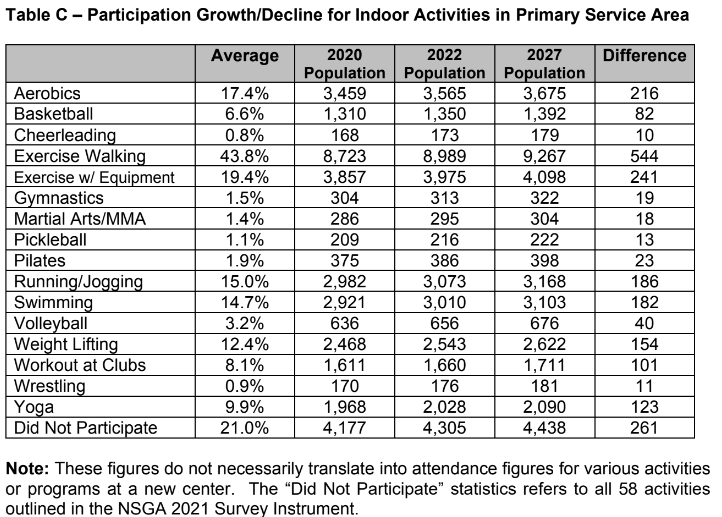
Some of Ballard King’s statistical extrapolation produced manifestly absurd results, such as concluding that in 2022 the Port Townsend area likely had 1,305 people engaged in basketball, 173 adults participating in cheerleading, and 313 adults doing gymnastics. Other absurdities riddle their computations.
At the same time that they were crunching numbers to tell us how our community recreates and exercises, they ignored bicycling completely. Notice there is no entry for biking in the above table. Yet, we have one of the premier biking trails in the nation in the Olympic Discovery Trail and the gem of the Larry Scott Trail running from the Boat Haven to Four Corners. Those trails see heavy bicycle use every day, as do our roads and streets. But, again, not a peep from consultants sitting at their desks in Colorado trying to guess how we spend our time and stay fit.
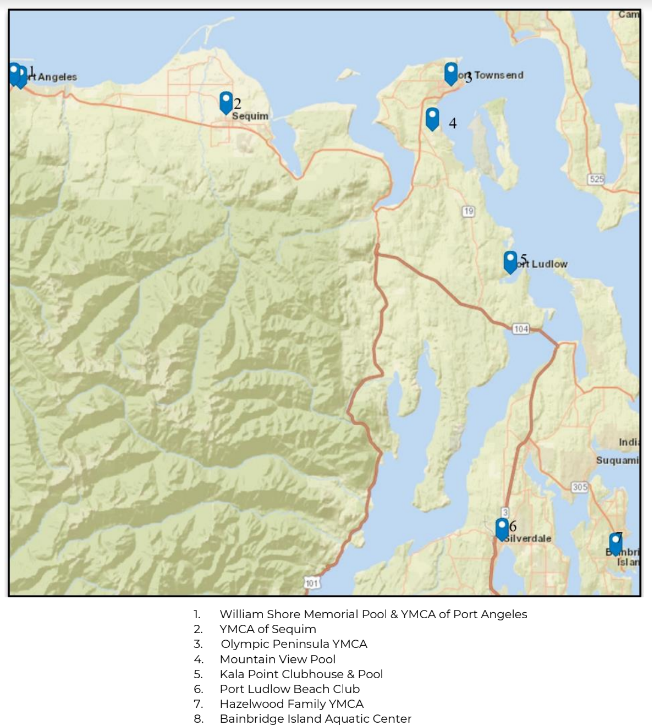
They purported to exhaustively survey existing swimming pools in the area. But somehow they missed the fact that Cape George has its own pool and they placed the Mountain View Pool at Kala Point. Then they put the Kala Point pool in Port Ludlow. The Port Ludlow pools they relocated to Silverdale. This map also indicates two pools in Port Angeles, when there is only one, the William Shore Aquatic Center.
Map of area pools from page 41 of Ballard King feasibility study.
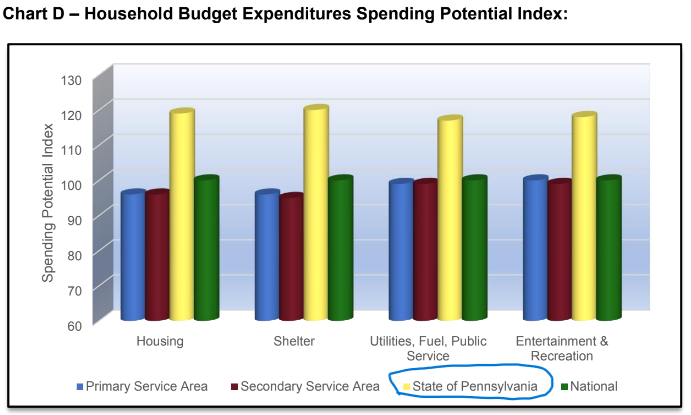
So detached are they from reality in Port Townsend, that on page 13 the Colorado consultants compared us to the State of Pennsylvania. One has to wonder if their report mixed us up with work they were doing for a community in the Keystone State instead of on the Quimper Peninsula, and where else in their report they confused us with other communities. This following graph, by the way, was used to make the case that our community is capable of spending quite a bit more money on recreational activities because the level of our expenditures for necessities — such as our very affordable housing — is below the national level and below that of… Pennsylvania(?)
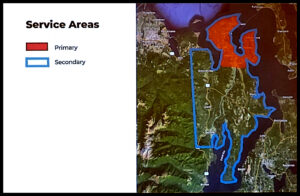
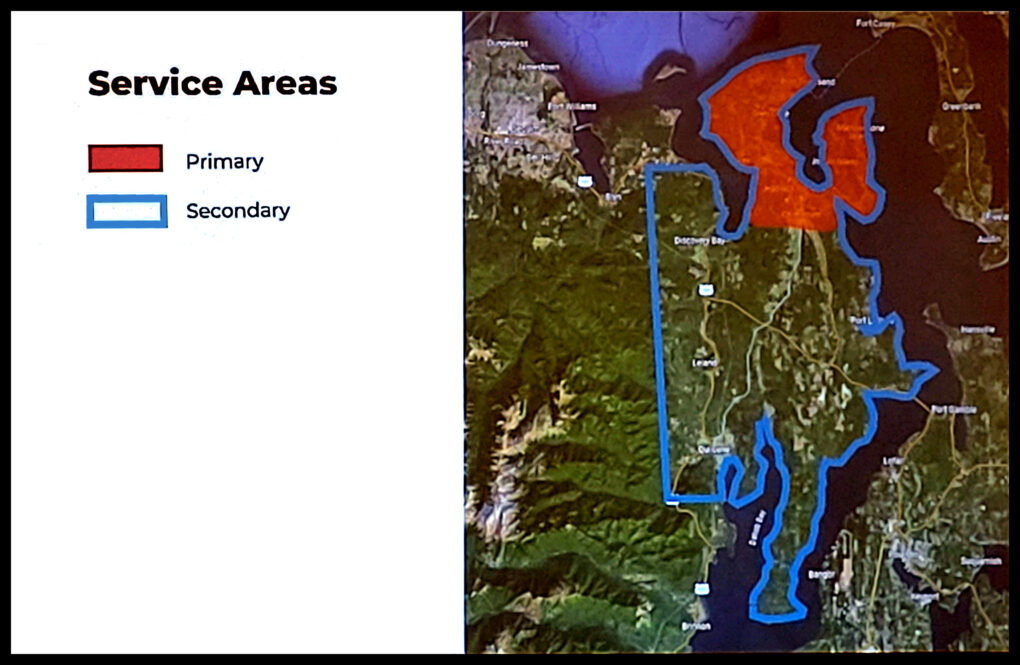
The “primary service area” in this graph is Port Townsend, Cape George, Discovery Bay, the Tri-Area, Kala Point and Marrowstone; the “secondary service area” is everything in Jefferson County to the south of Chimacum.
Ballard King & Associates of Highland Park, Colorado, also concluded that over a thousand residents around Port Townsend and from the south county go to Planet Fitness and LA Fitness.
Table from page 30 of Ballard King report showing percentage of population they claim belong to fitness clubs.
The percentages in this table apply to the “primary service area” around Port Townsend. Ballard King estimated the population of that area at 21,551, meaning they believe that in and around Port Townsend, 884 people (4.1% of the population) patronize Planet Fitness and 280 (1.3% of the population) go to LA Fitness. There is, of course, neither a Planet Fitness nor an LA Fitness in Jefferson County. The nearest Planet Fitness would require a ferry ride to Oak Harbor or a drive to Bremerton. There are no LA Fitness outlets on this side of Puget Sound.
But there are two fine full-service gyms, Port Townsend Athletic Club and Evergreen Fitness. Ballard King didn’t bother to inquire as to the membership and usage of those facilities.
How much were they paid to churn this stuff out?
Risky Business
Several versions of a future aquatic center have been proposed: the “basic” model (pool only); the “basic plus gym”; and the Full Monty, a large swimming facility with several pools, gym, exercise rooms, meeting rooms, etc. — something on the scale of a large urban YMCA. Ballard King projected that the annual operating costs of the Full Monty would be nearly $2.1 million, with revenues of about $1.7 million and a deficit requiring public subsidy of about $350,000.
The subsidy for any aquatic/fitness short of a Full Monty would be somewhat higher because it would have fewer profit centers, e.g., weight room, yoga studio, etc. As I reported in my first article on this feasibility study, Ballard King recognizes that the many private gym and exercise studios existing in our community already, from full service gyms, to yoga and pilates studios, pose a “challenge” for the financial success of an aquatic/fitness competitor.
Herb Cook, a current Director and Past President of the Olympic YMCA, weighed in on the financial feasibility of aquatic centers in a Nextdoor comment on this issue. He wrote that the Sequim YMCA in 2019 (the last year before the pandemic lockdowns) had “more than 3,000 membership units (family and single) and 6,000 total members. Total revenue was slightly less than $2.2 million, total expenses slightly more than $1.8 million, net operating surplus more than $300,000.”
The Sequim YMCA is a Full Monty and then some. It offers a “six lane lap pool, a shallow family pool, hot tub, dry sauna, gymnasium, racquetball courts and wellness area.” It also offers basketball and volleyball and personal training and a steam room.
6,000 total members, 3,000 “membership units” make the Sequim YMCA feasible, according to Cook. Ballard King’s projections for the number of individual “membership units” for a Port Townsend aquatic/fitness center don’t come close. They project only 1,435 purchases of monthly and annual passes, 485 ten-visit pass sales, 55 daily passes per month.
The Sequim YMCA’s financial picture is the opposite of what Ballard King projects for a potential full-scale PT aquatic/fitness center. Where the Sequim YMCA brought in $2.2 million in revenue, PT’s top model is projected to bring in $1.7 million. On the expense side, PT’s projected operating costs would be almost $2.1 million versus just over $1.8 million for the Sequim YMCA. The amount of the projected PT aquatic/fitness center’s loss would be almost what the Sequim YMCA has seen as an operating surplus.
Proponents of a new PT aquatic center like to point to the William Shore Aquatic Center in Port Angeles. In my prior report, I showed that the projected admission fees for a new PT facility would be almost twice those charged at Shore. The Shore center relies heavily on property taxes to cover the difference between its operating costs and earned revenues.
Shore was built in the same era as the Mountain View pool and has undergone much maintenance, renovations, upgrades and expansions. It is now a very modern, attractive facility with several aquatic recreation offerings and a few “dry land” programs like yoga and personal fitness classes. It is situated in a younger community with a population more than twice the size of Port Townsend’s.
Yet it still requires a public subsidy of about $1.7 million annually, according to its 2022 budget. Those funds are collected through property taxes imposed by a metropolitan park district.
The Shore center’s 2022 budgeted operating costs were $1,622,715. This is a number generated with years of learning from actually operating the facility. The Ballard King projections for the comparable PT facility are $1,268,557, significantly below what the Shore center has found it needs to operate.
But we are supposed to believe that a PT aquatic/fitness center with higher operating costs, in a smaller community, with a very old and poor population, will need a subsidy only a quarter of the size of Shore’s? To hit that target, Ballard King assumes the aquatic/fitness center will enjoy a geometric jump in revenue that requires our old and poor population to pay admission fees about twice as high as those charged at the Shore Aquatic Center.
At least Ballard King, on page 50, near the end of their study, tells us not to take their projections to the bank. They disclaim any guarantee that their numbers may be relied upon fully. Do so at your own risk.
We Can Do That
No engineering analysis of what it would cost to upgrade and/or keep the Mountain View pool going as it is currently built was conducted before the push for a new aquatic/fitness center became public. Carrie Hite, the city’s Director of Parks and Recreation Strategy, stated in an email that, “We have opted not to spend close to $100K on a current full systems and structural analysis.” I have seen nothing to suggest that the city sought competitive bids for such an analysis. Hite could be pulling that number out of the air.
A full systems analysis was done for the city in 2001 by The ORB Organization, architects-planners-engineers, of Redmond, Washington. That analysis concluded, “The existing pool is quite adequate for basic instruction, training and aerobics,” but was not suitable for competitive swimming or diving. ORB examined all aspects of the pool and concluded it could be upgraded to meet current code requirements for $167,714 and its life extended for another 30 years–to 2031–for $355,113.
The roof does require replacement. Hope Roofing of Port Townsend conducted an inspection that found significant leakage and structural issues, such as soft spots where it would be unsafe to stand. City council recently had the option of fixing the roof properly, with a long-lasting, multi-decade solution, at the cost of $1 million. It opted for a temporary membrane fix that will last only a few years.
Hite wrote in her email that, “Parts for the pool are not manufactured anymore, so the pool is one breakdown away from closure.” We have also heard this at the town halls from Opsis, the Portland, Oregon architectural firm responsible for the conceptual illustration at the top of this article. They claim that parts for Mountain View’s pumps and filters cannot be purchased, so the pool only has a few years left before it must be scrapped.
But that is not necessarily true.
Workers at the Port Townsend Foundry
“We can fabricate anything for the pool,” Pete Langley, owner of the Port Townsend Foundry told me. His business is a custom and production nonferrous foundry in operation since 1983. They fabricate products from architectural castings to industrial castings to maritime hardware to antique replacements.
“I can build a pump from scratch. The equipment for a pool is not complicated. We can make anything the pool needs right here. We are a maker’s community,” Langley said. I was standing with him outside his operation in Glen Cove. He waved at other businesses that design and build sophisticated equipment and machinery. His “we” referred to his neighbors as well as his own highly skilled workers.
Langley is a current board member and the 2022 chairperson of the city’s Maritime Trades Association. “Look, we build boats. Some of the machinery in the mill is a hundred years old. The people in this town can fix a pool.”
Port Townsend’s annual Wooden Boat Festival is around the corner. The Port Townsend Foundry and other businesses here keep those magnificent classic boats going. They fabricate the hardware and parts “that are not manufactured anymore.” A pool’s simple filter and pumps are a lot less complicated and demanding than anything that heads out to the open ocean.
I have written Hite to ask if the city has consulted with Langley about fabricating locally any parts needed for the Mountain View pool. I am still awaiting a reply.
A Rigged Game
A decision was made by someone that a completely new aquatic center is going to be built. Opsis was brought in from Portland not to critically evaluate whether the existing pool could be renovated and upgraded, as the Shore Aquatic Center has been, but to promote a new pool through highly orchestrated “town halls.”
Opsis stands to land a lucrative architectural contract if the city gets the funding to build one of the versions of a new aquatic/fitness center.
At these “town halls” Opsis handed out colored circles with adhesive backing. Audience members were instructed to vote their preferences by sticking the dots on the artist conception of a new facility and selected features they liked (see our January 2023 article). Opsis did not make available any “No new aquatic center” option.
When questions were raised about the feasibility of addressing Mountain View’s needs, Opsis dismissed them out of hand. It was either go with one of the Opsis renderings of a new aquatic/fitness center or go without a pool — a stark choice that alarmed many of the frequent, elderly users of the pool who attended these “town halls.”
In the latest on-line survey people could vote only for which taxing method they like to raise the funds to pay for a new aquatic/fitness center. A “no new tax” option was not offered. At the last town hall held at Fort Worden on July 13, 2023, in response to a question from the audience Hite revealed that only about 150 people had been participating in the survey that was providing direction to the process.
“The Mountain View pool is nearing the end of its life,” has been the drum beat from Opsis and city manager John Mauro. That is an urban myth unproven by any engineering analysis. It is a talking point, and a talking point only, to drive people towards approving taxes to build a completely new, and vastly more expensive facility with implausible financial viability.
A responsible approach would have been to do a full engineering systems analysis at the beginning of this process. Instead, someone in City Hall launched a campaign to go after $38-53 million in new taxes to build a new aquatic/fitness center on a scale seen in larger urban areas.
The first installment was the $175,000 paid to Opsis for its drawings and “town halls” and whatever was paid to Ballard King for their “feasibility study.” Throw in the six-figure salary being paid to contract employee Hite whose job as “Strategy Director” is promoting the new pool (and a remake of the golf course), and all the time spent by city employees and others on the town halls and behind-the-scenes meetings to secure taxes for a new pool. We will never know what could have been accomplished with those funds if instead they had been invested in addressing Mountain View’s needs and finding a way to keep what we’ve got as they did in Port Angeles… and also Anacortes, by the way.
Opsis presents its final recommendation to City Council on September 5, 2023. Hite has said the goal is to get a proposed tax measure on a special election ballot in February 2024. The two tax measures under consideration are a property tax hike that would hit properties in Cape George, Discovery Bay, Irondale, Port Hadlock and Chimacum (and areas to the south), Marrowstone Island, and Kala Point, as well as Port Townsend. The other tax measure being considered is a county-wide sales tax.
by Jim Scarantino | Aug 14, 2023 | General
Unsustainable. Without massive city subsidies, the Mountain View pool would be closed. No one knows how much larger the subsidies must be to sustain a much larger new aquatic center. All we have are predictions based on projections which are based on assumptions.
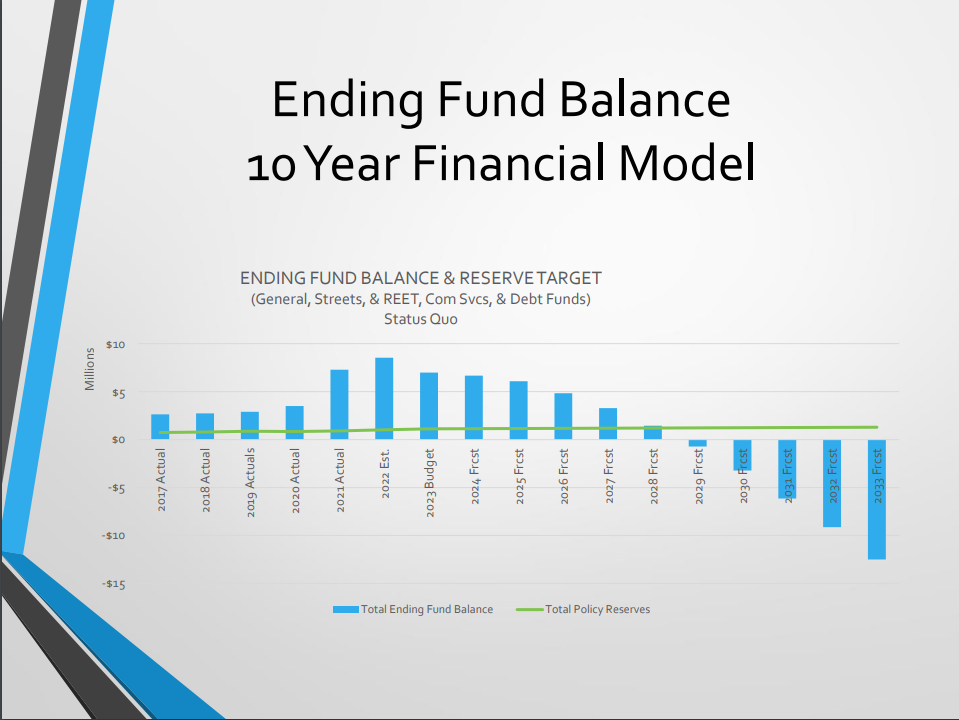
In every scenario, large subsidies continue for decades to come. The weight of these subsidies are contributing to pulling Port Townsend’s finances over a fiscal cliff, starting now, as it eats into reserves and cuts back on core city services.
We previously reported on how few people use the pool and how very, very few of them live in the county outside city limits. See “Mountain View Pool–By The Numbers.” This report will focus on numbers preceded by dollar signs.
Somebody Call a Lifeguard
The YMCA manages the pool under contract with the City of Port Townsend, which in turn leases the facility from the Port Townsend School District. The annual report for 2022 submitted by the Y shows a natatorium (swimming pool) awash in red ink. Any other operation would have drowned by now. But huge city subsidies keep this one breathing.
The city budgets $400,000 annually to subsidize the pool. It makes a large payment directly to the Y, which is then used to cover shortfalls and give the Y a nice profit for its services. It also picks up the tab for repairs. For instance, city council recently voted for a cheapie ($75,000) slap-dash sort of roof repair that will be good for only a few years, instead of properly repairing the roof with a multi-decade shield against weather.
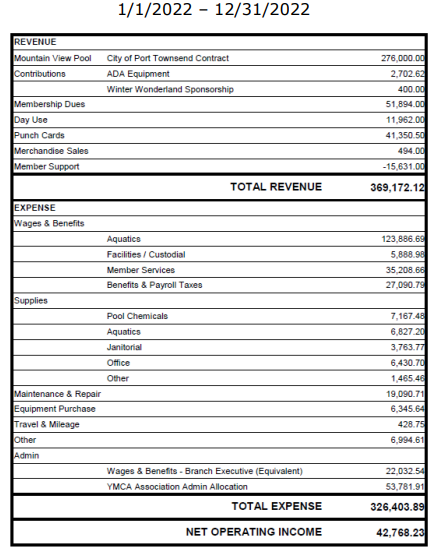
The pool’s enormous losses are starkly revealed by backing out the city’s subsidy paid directly to the Y in the amount of $276,000. We can then see actual earnings from sales of passes, daily admissions and merchandise. These are the pool’s earnings.
The 2022 report from the Y also includes a couple of months’ results from the end of 2021 following reopening of the pool at the end of the pandemic lockdowns. Those results, covering operations from October 24 to December 31, 2021, show $51,308 paid to the Y. For the last quarter of 2021 the pool earned only $14,837. Against this paltry amount, the pool’s expenditures totaled $55,868. Minus the city’s subsidy, the pool lost about $41,000 in this period.
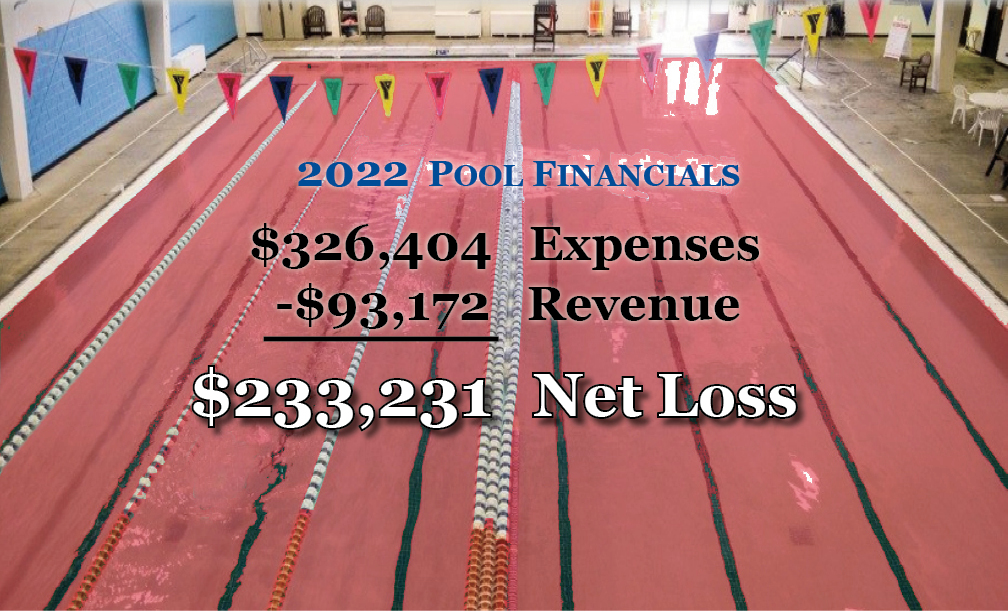
2022 saw the the pool’s financial health worsening. The pool’s expenses of $326,404 exceeded its $93,172 in earnings by $233,231.
The following table in the Y’s 2022 report shows a positive net operating figure. That positive figure is created by including the city’s subsidy, which is not earnings. It is an unearned infusion of cash. If the city’s subsidy of $276,000 is backed out, the pool’s earnings versus expenses is negative — the $233,231 loss highlighted above.
The Y spent less than $20,000 on maintenance. It purchased very little new equipment and supplies ($6,345). But $53,781 went to the Y for “YMCA Association Administrative Allocation.” This is not a payment for salaries. It is not an investment in the pool. It is in the nature of an additional fee extracted by the YMCA for its involvement in operating the pool. This is effectively the Y’s profit.
The YMCA Association Administrative Allocation for the last quarter of 2021 was almost $15,000. For the first half the Y took about $14,000, a number which may not reflect payments made in July for the first 6 months’ full “YMCA Association Administrative Allocation.”
The 2023 numbers reported by the Y, even with the slight uptick in usage, show more red ink. Expenses totaled $166,537 against earnings of $72,451, for a loss of $94,086. Only $4,619 was spent on maintenance. (It is possible annual passes are renewed/purchased in the first half of the year, creating a bump in first half revenue not repeated in the second half. As we reported in our earlier article, use of the pool peaks in the first half, then declines substantially the remainder of year.)
The Y’s Profits Eclipse Investments in Maintenance and Repairs
The Y takes more in profit — its Association Administrative Allocation — than it spends on maintenance and cleaning of the pool. Not only has it spent very little on maintenance and repairs, its facilities and custodial payroll for the first half of 2023 was less than $7,000. It spent less than $1,600 on janitorial supplies. In 2022 it spent less than $7,000 for an entire year on its facilities and custodial payroll.
Anyone who has owned an old pool knows that failing to address issues as they arise guarantees bigger problems and larger bills down the road. These financial reports suggest that the Y has decided to “let things go.” We can only speculate what could have been accomplished by investing in repairs and maintenance the $82,000 extracted by the Y as its profit during these periods of time.
Bigger Pool, Subsidies Forever
No one knows how large the subsidies will have to be to sustain a larger, new aquatic center. The city’s Financial Sustainability Task Force, on page 32 of its final recommendations, estimates annual costs of operation at $890,000, more than three times what it costs to operate the existing pool — not including the Y’s “Association Administrative Allocation.” Under state governing Metropolitan Park Districts, the junior taxing district being considered as the vehicle to raise property taxes for the pool, the city will be required to continue its annual $400,000 subsidy.
Will a shiny new aquatic center ever attract enough users to cover its expenses? Nobody expects that to happen, even the new pool’s most ardent advocates. Projections shared at the public meetings by Opsis Architecture of Portland, Oregon, the consultant working for the aquatic center’s task force, projects annual losses at $350,000 to $400,000. These figures, we have learned, come from a “feasibility study” prepared by Ballard King & Associates of Highland Park, Colorado. Opsis is being paid $175,000. (I cannot report at this time whether the fees paid to Ballard King are included in the OPSIS contract or are covered in an additional consulting contract with additional expenditures.)
I hope to write separately on the Ballard King report. I’m not sure they have been to Jefferson County. There are some glaring errors and omissions in their work, some of which are embarrassing and should give pause to any decision maker who would rely on this document to justify tying taxpayers to a project that will cost $38-$53 million, not including overruns and contract adjustments.
Ballard King’s financial projections for all the versions of the pool that have been discussed at the public gatherings presided over by OPSIS show deficits in the hundreds of thousands of dollars as far as the eye can see. These projected deficits, Opsis has pointed out at the public meetings, are about the same as the (broke) city of Port Townsend is spending now. To make the future financial picture for hugely more expensive, more complicated, and much larger aquatic facilities look not much worse than what the city is bearing now, Ballard King went out on a shaky limb.
Ballard King’s calculations rely on fantastically increased revenues.
Remember, currently the Mountain View pool has been earning less than $100,000 a year. To keep the required losses close to the current losses and the current level of subsidy, revenue must not only double or triple, but come at a level seventeen times higher. To lose only $352,572 a year, the “full build out” $53 million version would have to earn $1,763,761 annually. The “base and gym” model, to which it seems the city and task force are leaning, would have to earn 12 times more ($1,214,795) than the existing pool to keep losses at $403,015. Even the “base” model, coming in at a paltry $38 million, would have to see revenues increase eight-fold to $834,466 in order to keep losses at $434,091.
“If you build it they will come,” was a memorable line from a screen play by an author with a fertile imagination. It is hardly a prudent foundation on which to launch a $38 to $53 million construction project with tripled annual operating costs.
An “Aggressive Estimate” of Future Revenues
Ballard King admits that its projections are based on a “reasonably aggressive estimate of revenues generated from admission fees and passes.” How reasonable?
A lot more people would have to pay to use the pool and they would have to pay a lot more. Ballard King acknowledges that Jefferson County is poor and old, much more so than state and national levels. (How much were they paid to reach that conclusion?) As we have shown, only 174 Port Townsend residents and 34 county residents (outside city limits) used the pool on an average monthly basis in 2022. Ballard King’s calculations require that out of our poor and old population, about 1,106 people would have to use the pool on a monthly basis to make the “base” model projections work. Those numbers include 264 households, meaning the required individual usage would be even higher.
For the favored “base and gym” version, usage would have to soar to 1,413 users, which includes 524 households. To keep losses on the “full build out” version to the level of current subsidies, 1,974 user units (including 718 households) would have to decide to use the pool…
…and pay…
…and pay…
…and pay some more.
How Much Will It Cost to Use the New Aquatic/Fitness Center?
A lot.
Proponents of a new PT aquatic/center like to point to the Shore Aquatic Center in Port Angeles as an example of what may be possible here. Okay, let’s do that.
The Shore Aquatic Center charges $389 for an adult annual membership, $229 for youth and seniors, and $540 for families. What would PT’s new facility have to charge to keep losses around $400,000 annually?
Let’s start with the apparent favorite, the “base and gym” version. For an annual pass, an adult would have to pay $630, youth $265, seniors $420, and families $945 — close to double Shore Aquatic’s fees in most categories.
For a 10-day pass adults would have to pay $68, youth $50, and seniors $59. Families could not buy a 10-day pass, meaning each family member would have to pay separately, making a family visit quite costly. The Shore Aquatic Center, in contrast, charges $67 for a 12-day adult pass and $44 for youth and seniors. Families (with up to 10 members) can buy a 12-day pass for $133.
Ballard King’s report contains no discussion of whether the old and poor people of Jefferson County would resist paying such high prices.
How poor is Jefferson County? Household income in the designated “primary service area” of Port Townsend, Kala Point, Cape George, Marrowstone, Port Hadlock, Chimacum and Irondale is $20,000 per household below the comparable state level.
Projected “Primary Service Area” shown in red.
How old are we? “Much higher” than state and national levels and getting older, according to Ballard King. By 2027 the percentage of the population above 65 years is projected to increase from 58% to 75%.
Excerpt from Ballard King conclusions on Jefferson County demographics.
For Consultants’ Projections to Pencil Out, Existing Local Businesses Must Suffer
Where will all these new users come from?
Start with pulling people from existing gyms and studios.
“Within Port Townsend itself as well as the immediate surrounding area, there is a number of private fitness clubs and smaller boutique type providers. The private sector is the greatest provider of fitness space in the market,” writes Ballard King on page 43 of its report.
Ballard King openly admits what Opsis has danced around. Opsis has been asked repeatedly whether a new taxpayer-funded aquatic facility with an exercise component would compete with existing local exercise and recreation options. They have said more than “no.” To the contrary, Opsis has said that local gyms and fitness studios would benefit because they would gain more business. If this seems hard to swallow, it should be. This is like a Walmart developer assuring small retailers they will benefit by having a Supercenter open in their community.
Ballard King, on the other hand, recognizes that any version of an aquatic/fitness center will compete with existing local businesses. On pages 44-45 they admit the obvious: the existence of private providers in the area is “a challenge” to a future aquatic/fitness center.
In other words, a public facility that needs to pull 12-17 times the revenue of the existing pool would do better without our existing fitness providers continuing in operation. Local athletic centers and fitness studios might be put out of business in order to make this ambitious new aquatic center pencil out at “only” a $400,000 loss.
What About Likely Cost Overruns?
Has there been a public works project that has come in on time and on budget? Ballard King’s projections do not disclose any contingency for cost overruns. How much more could the pool finally cost? How would added construction costs be covered? Will greater public subsidies to cover cost overruns require more tax hikes?
Of course, the consultants offer no guarantees that their projections will prove correct, or even within some guaranteed margin of error. If their “reasonably aggressive” scenarios prove unreasonable and overly aggressive for Jefferson County, it is taxpayers who will pay for their errors.
But these are highly respected and highly paid consultants, you might say. Can’t we take their projections to the bank? At the same time we should ask, is there an incentive for consultants to come back with answers their clients want? As I will hopefully show in a follow-up report, Ballard King makes huge leaps from census data to the conclusion that the county’s old and poor population will gladly pay more and drive miles to experience a new Port Townsend aquatic center.
But for now, Ballard King’s own extrapolations from data should give reason to be skeptical about all their prognostications.
Consider the set of projections from the Colorado consultants. From afar, they looked at census data, recreational industry national studies and other exogenous data then applied it to Jefferson County. One example of this sort of desktop analysis resulted in the following table.
Their detached statistical analysis tells them that in 2022, Port Townsend and its nearby areas likely had 173 adult cheerleaders and 1,350 adult basketball players. Does anyone here know these 173 cheerleaders? Where do the 1,350 adult basketball players shoot hoops? How about those 176 adult wrestlers: where are they grappling on mats? Those 313 adult gymnasts: where can we watch them on the high bars?
They also concluded the area likely had 3,010 adults participating in swimming. Those are mere statistical projections. Real-world head counts from the manager of the Mountain View pool found only 174 adults in the Port Townsend area engaged in swimming on a monthly basis in all of 2022.
It is clear that these out-of-state consultants did their work from afar and did not actually spend much time talking to people here or observing how we live and recreate. Their study completely overlooks biking as recreation, labels the Kala Point pool as Mountain View pool on a map, and ignores the existence of the Cape George pool.
But, hey, they think there are 173 active adult cheerleaders and 1,305 adults in some sort of basketball league no one else knows about.
If you believe these numbers, then, by all means, believe that their construction and operating cost projections are rock solid and will come in on target. But before you commit, did you catch their CYA disclaimer in the fine print at the bottom of that table? “These figures do not necessarily translate into attendance figures for various activities or programs at a new center.”
Do tell.
The Y’s Cut… and Loose Ends
The best-case scenarios for containing losses close to where they are now kick in only in the second year of full operation. Unstated are the presumably much larger losses in the first year of operations.
Also not factored into Ballard King’s analysis is the fact that in addition to paying significantly higher charges to use the pool, everyone in the “primary service area” would be also be paying higher taxes to build and subsidize operation of the pool. That family that would have to pay $900 for an annual pass, could be paying an additional $400 in higher property taxes under a metropolitan recreational district tax, a sum of $1,300 each year (and increasing as assessments rise).
I discovered a glaring inconsistency between Opsis and Ballard King in their projections. Ballard King’s report does not assume there will be any payments to the YMCA for managing the facility. Yet, the slides projected by Opsis at the town halls show the same projected expenditures and losses, stating they are assuming that the Y will manage the pool and will be paid for its services. The Y, as seen above, is currently taking about $52,000 annually for its “Association Administrative Allocation.” This figure would likely be significantly higher for a larger, expanded aquatic/fitness center operation. If the new pool is targeting revenues 8 to 12 times higher than Mountain View pool, how much more will the Y be paid, and how much larger will be the deficits requiring taxpayer subsidies?
In conclusion, haven’t we seen this movie before? Where else in recent memory have we seen consultants painting rosy pictures based on specious projections for costly projects that result in gouging taxpayers for years on end?
The object lesson of the failed Cherry Street Project is still with us.
————————————-
Top image of swimming pool with red ink adapted from a photo by
Lewis Geyer/Digital First Media/Boulder Daily Camera via Getty Images.
by Jim Scarantino | Aug 5, 2023 | General
How many people use the Mountain View pool and who are they? With numbers like $53 million being batted around — the projected cost of building a brand new aquatic center — more than anecdotal information is called for. To answer those questions we now have 18 months of post-pandemic data from the Olympic Peninsula YMCA, which manages the pool under contract with the City of Port Townsend, provided by the 2022 annual report and a just-completed report for the first 6 months of 2023.
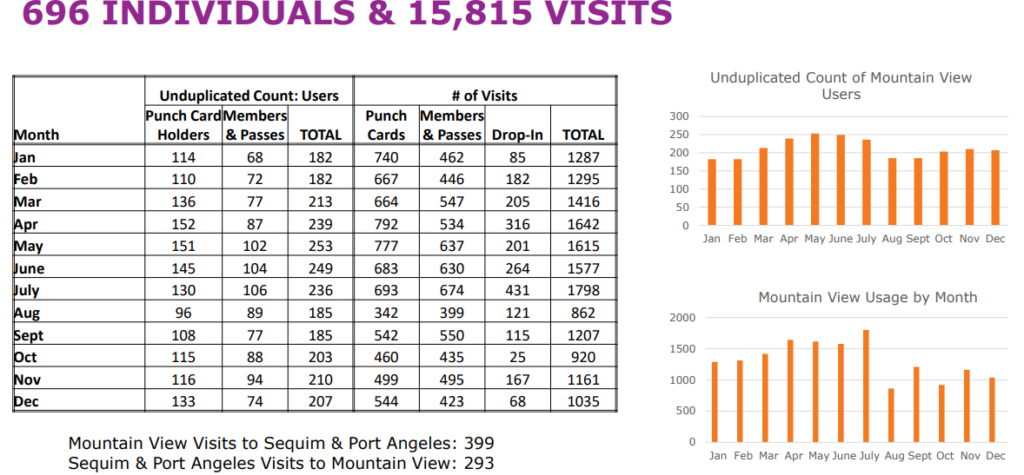
In 2022, according to the annual report from the Y, Mountain View pool saw an average of 212 individual users each month. That number is calculated by adding together all individual users reported for each month of the year and dividing by 12.
Quite a few of these individuals use the pool a lot. For instance, in January 2022, 182 individuals were responsible for 1,287 total visits to the pool, or an average of just over seven visits per individual. Some of those 182 people may have used the pool only once. The Y reported 85 “drop-in” uses for January 2022. It is thus possible that fewer than 100 people (182 minus the number of drop-in visits) generated over 1,200 visits.
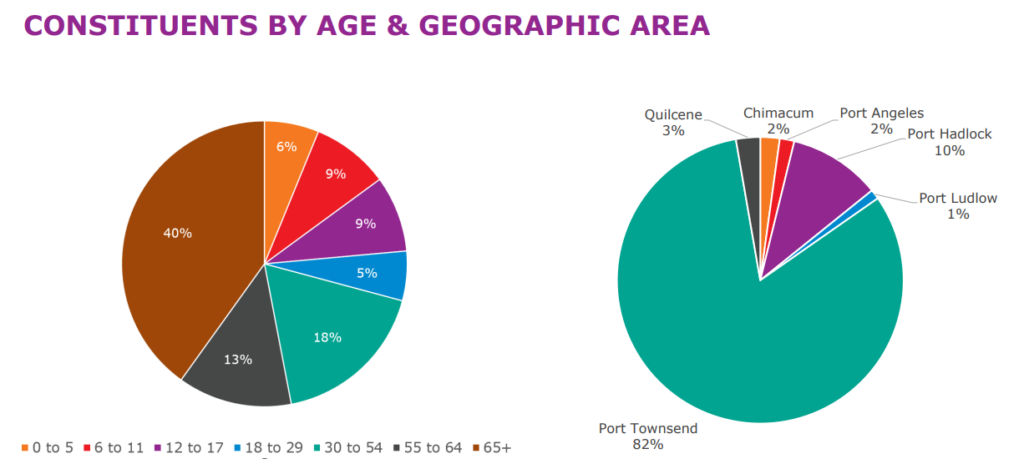
The Y tracked visitors by age and geographic area: 53% of users were older than 55; the largest single category of users was those over age 65 (40%). Less than a quarter of the users were under age 17.
Unsurprisingly, the vast majority of users live relatively close to the pool, within Port Townsend city limits. 82% of users in 2022 lived in Port Townsend; 16% in Jefferson County outside the city; and 2% traveled from Port Angeles to use the Mountain View pool. Applying these percentages to the average monthly usage, we can see that only 174 Port Townsend residents used the pool each month. Only 34 county residents outside city limits used the pool.
The data shows considerable use of Sequim and Port Angeles Y pools by people who also use the Mountain View pool. Those other cities reported 399 visits over the year from Mountain View swimmers.
The Y reported a total of 696 individual visits to the Mountain View pool in all of 2022. Clearly, some of those were one-time-only visits, as the monthly average of individuals using the pool is less than a third of that number. Mountain View saw a total of 15,815 visits for all of 2022. By comparison, the Fidalgo Pool in Anacortes, which is almost as old as the Mountain View pool, nearly matches Mountain View’s entire annual usage in just over two months. Anacortes has a population of just under 18,000; Port Townsend has just under 11,000.
The 212 average monthly users of the pool represent about 0.6% of the 33,000 people who live in Jefferson County. The 174 average monthly users who live in Port Townsend represent less than 2% of the city’s population. The 696 individuals who visited the pool at least once over the course of 12 months in 2022 represent 2.1% of Jefferson County’s population. The 571 individuals who live in Port Townsend who used the pool at least once over the course of 2022 represent a little more than 5% of the city’s population.
The graphs show that usage rose in the first half of the year, peaking in July. October usage was only 51% of July’s usage. December 2022 usage was 58% of July’s usage.
2023 Visits Up Somewhat
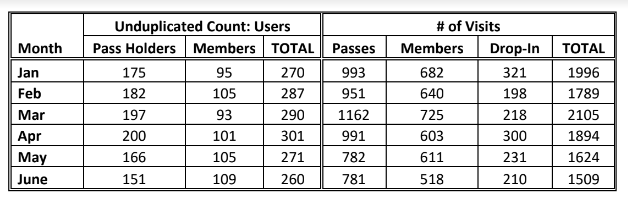
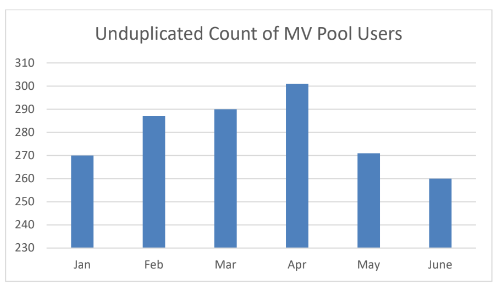
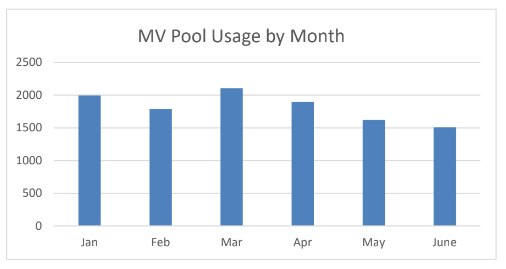
The Y provided a semi-annual report to the city on July 31, 2023, covering the first six months. It was not as detailed as the 2022 annual report. Significantly, it did not break out individual users by age and geographical area. The monthly average for individual users for the first six months of 2023 was 280. The monthly average for the first 6 months of 2022 was 220.
This number cannot be extrapolated for all of the 2023. Usage in 2022 dropped off significantly after July. This pattern may repeat in 2023. Data shows that usage peaked earlier, in April 2023 versus July 2022.
The total number of visits, on the other hand, remain fairly steady regardless of monthly differences in the number of individual users, suggesting that as in 2022 a smaller group of users account for most of the pool’s usage. But even their level of usage dropped as the year wore on.
A City Pool, Not Truly a Regional Pool
The steering committee behind the push to build a new aquatic center talks about Mountain View as a “regional pool.” A geographical area that includes all of Marrowstone Island, Cape George, Kala Point, Irondale, Port Hadlock and Chimacum, as well as areas to the south, is described as the pool’s “primary service area.”
The consultant from OPSIS Architecture of Portland, Oregon, who is working for the steering committee and who has led the town hall discussions and presentations to City Council and the Board of County Commissioners, has used the phrase “capture areas” to describe these areas of the county. He has done so in the context of reaching beyond city limits in order to find more money for the pool’s construction and operation. He and City Manager John Mauro have made it clear that taxing those “capture areas” is necessary to raise the tens of millions of dollars the city needs to build a new aquatic center.
But the Y’s report clearly shows that Mountain View is a city pool, not a regional pool. Only 25 monthly pool users live in the “capture areas,” according to the percentages shown in the 2022 pie chart pictured above. I asked Wendy Bart, CEO of Olympic Peninsula YMCA, if the same percentages of city versus county users has held into 2023. She has not responded.
Carrie Hite, the city’s contract worker who carries the title of “Director of Parks and Recreation Strategy,” and who is charged with driving the city’s quest for a new aquatic center as well as a reworking of the golf course, has expressed disappointment at how very few people attended the aquatic center town hall in the Chimacum High School Auditorium on April 27, 2023. That may be due to the fact that virtually no one in the “capture areas” uses the pool. It is considered the city’s pool — not Chimacum residents’ issue and none of their business.
Chimacum High School groups, according to the Y’s two pool reports discussed here, have not been using the pool, though classes from Salish Coast and Blue Heron in Port Townsend do. And until recently, when “No P.T. Pool Tax” signs started appearing along streets and roads, few in the “capture areas” had any idea that city leaders were eyeing their homes, farms and businesses, as well as their purchases at stores, for significant tax increases to fund the city’s dreams of a brand new, enormously expensive aquatic center.
The steering committee is led principally by city of Port Townsend employees but includes representatives from the PT school district, the port, the Y and county government. It is considering two taxing options:
- One would be creation of a “regional recreational district” that could lead to a property tax hike of up to $0.75/$1,0000 of assessed value. This tax would be imposed on the “primary service area” shown within the red-shaded area on an image displayed at the last town hall and reproduced below.
- The other option being floated by the steering committee is a county-wide sales tax increase.
Both options require public votes. The consultants and steering committee will present their final recommendation to the Port Townsend City Council on September 5, 2023.
Service Areas to create a “regional recreational district” for new taxation to fund the proposed aquatic center, as displayed at the last town hall. Red (Primary) delineates Port Townsend and county “capture areas” — Marrowstone Island, Cape George, Kala Point, Irondale, Port Hadlock and Chimacum. The blue line (Secondary) delineates boundaries for a potential county-wide sales tax increase.
by Julie Jaman | Aug 1, 2023 | General
This laid back Victorian seaport and artist colony has long been funkily charming, attracting visitors from around the world to enjoy architecture, birding, boating, weekend getaways and the impressive array of weekend-long festivals. Some are so enchanted they consult realtors on the first visit, thinking this would be a great place to live out retirement. This small peninsula town is bound by water and mountains, trails and natural features inviting all manner of recreation, no city investments needed. This was a key consideration for planning as envisioned in the “City of Port Townsend Comprehensive Plan,” given lip service by the town’s ambitious administrators.
At the July 17, 2023 City Council meeting it became very clear that they intend to transform the town through contriving public consent that will ultimately cost millions in tax dollars, inflating city debt to the bursting point.
On this night, council was being directed to act on the agenda item City Council presentation on the Envision community discussion:
“Action: City Council will receive the final recommendation on the future decision of the Envision the Port Townsend Golf Course and Mountain View Commons and be asked to make a decision.”
You are not alone in trying to understand what the above “action” means. In fact, any comments directed at Mountain View Commons were not acceptable, so directed the mayor. This discussion was strictly limited to the future of the Port Townsend Golf Course. Council’s vote on this action would box the community into the administrators’ plan to close down the one hundred year old golf course and usurp the 58 acres for uses mostly unwanted, according to the majority of public responses garnered over this last year.
And here’s how the magic of manufacturing consent is implemented.
The “Envision Port Townsend Golf Course and Mountain View Commons” is a project overseen by Carrie Hite, a short-term contracted Director of Parks & Recreation Strategy; consultant Chris Jones, principal architect of Groundswell; plus four other contracted consultants. The genesis of this project was the 2020 Parks Recreation Open Space (PROS) Plan focused on management of the golf course and exploring the feasibility of alternate uses of the golf course lands. It included 830 responses to a survey. Only thirty indicated an interest in housing; none of the more than 800 respondents suggested a dog park.
Stacking the Deck
Sometime during lockdown, newly-hired city manager John Mauro contracted Carrie Hite and then multiple consultants, thus the Envision project got underway. The exploration involved such things as open house events at the Fort, online surveys, recommendations by a city-appointed stakeholder group and by the Parks, Recreation, Trees and Trails Advisory Board (PRTTAB).
Three open house events were held. On January 11, 2023 the consultants reported 291 people placed 1,985 dots on 23 project boards with 3 interactive stations. The one picture offering to maintain the existing golf course got the most dots. Port Townsend Free Press contributor Brett Nunn attended that meeting and reported on it shortly after.
Project boards from the January 2023 open house. Attendees showed the greatest support for “Golf Course As-Is,” followed by maintaining the property for “Habitat”. Photo: Brett Nunn
The April 26 meeting drew 207 attendees. At the June 22 meeting the consultants amended the options adding 36 housing units, with 103 attendees viewing the proposed housing pictured in the wild habitat at the NE edge of the golf course land. The wording of the online surveys nudged participants toward preferred outcomes. As the process moved along, the option of restoring the golf course disappeared.
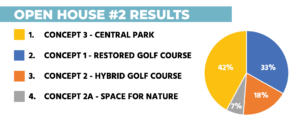
The last survey that included keeping the golf course as is, with restoration. Despite “Restored Golf Course” receiving nearly twice the votes as “Hybrid Golf Course,” it was eliminated from future options as seen below.
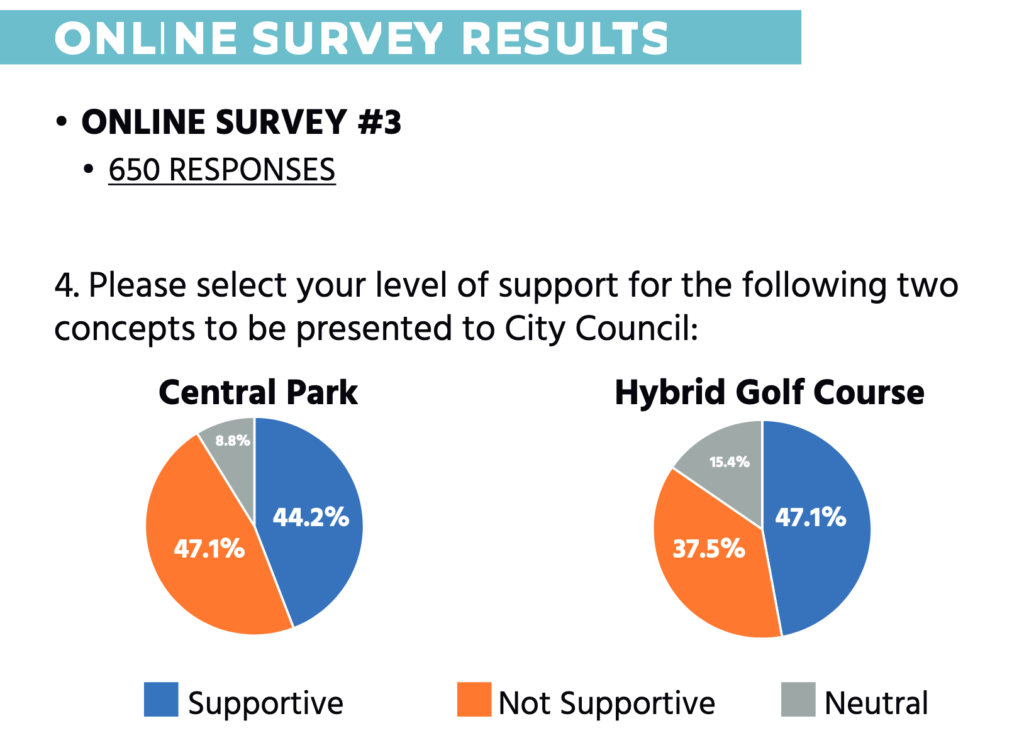
With the popular “Restored Golf Course” strategically eliminated as a choice, people were given only two options in Survey #3. Forced to choose between just those two, the majority supported a hybrid golf concept.
The inner workings of the Envision project relied on appointed stakeholders, starting with 21, eventually dwindling to 13 people. Carrie Hite set their agenda, directing which options they could vote on such as housing, a dog park, trails, concert space, restaurant/brew pub, miniature golf. Maintaining the existing golf course with planned improvements was not an option.
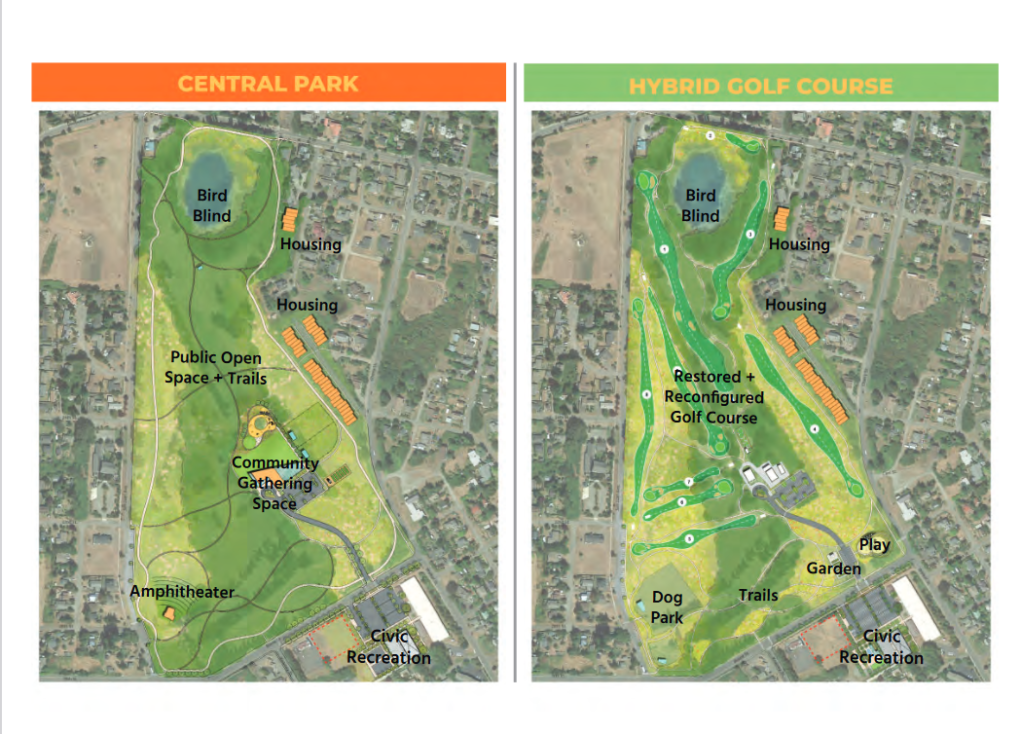
The stakeholders met several times, reviewing public input as interpreted by the consultants, finally voting on two concepts — a central park with no golf course and a hybrid park reducing the golf course and eliminating the driving range. Both options projected investments of $2-$3+ million just for the recreation components.
The consultants provided no projections about potential housing costs — for starters, opening and widening streets, sidewalks, parking, lighting, bike lanes, striping, and signage, all essential for future real estate development in a quiet neighborhood zoned Residential II, single family (RII,SF).
It is as yet unknown how such housing would be affordable.
Engineering Outcomes
On June 14, 2023 Hite presented to City Council a review of the “Envision“ process and a preview of the formal presentation to come on July 17 by Chris Jones of Groundswell.
On July 17, 2023, Jones presented two options to Council. He included a fleeting reference to the July 11, 2023 special meeting with the PRTTAB and their recommendation against leveling and paving wild habitat for housing. Their considerations included the interests of thousands of avid birders and the need to protect wildlife corridors from human impacts.
Groundswell’s “Central Park” and “Hybrid Golf Course” Concept Renderings
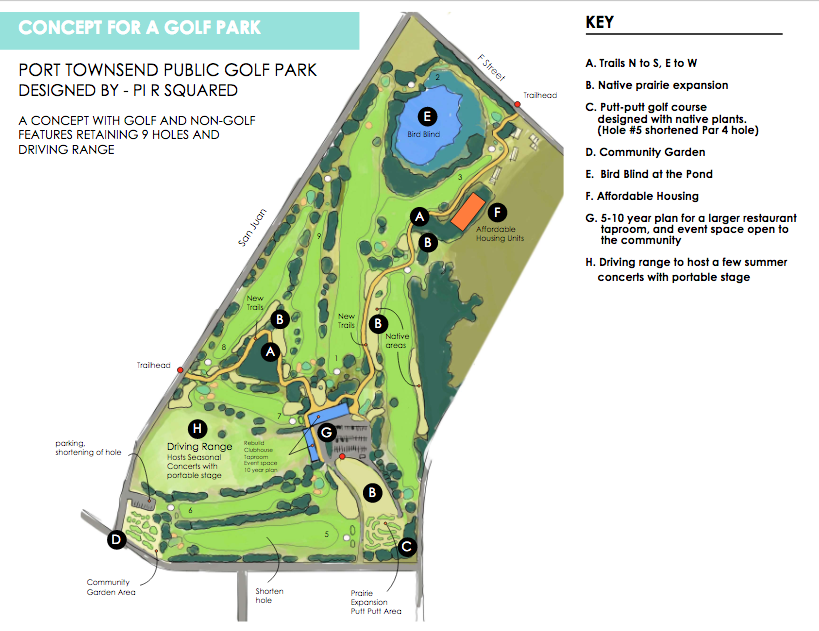
Local designer Robert Horner submitted a plan that members of the Port Townsend Golf Club (PTGC) described as thorough and well-conceived, saying Horner’s “…design honors history and it has practical solutions” and was “a win-win compromise.” It provides room for many of the ideas in the Jones hybrid plan, including trails north to south and east to west; native prairie expansion; putt-putt golf course; bird blind at the pond; community garden; affordable housing; a 5-10 year plan for a larger restaurant/taproom and event space; and a driving range to host a few summer concerts with a portable stage. All things brought forward by the consultant at the open house events except housing, which was added on later.
Robert Horner/Pi R Squared concept, June 30, 2023
Key to the Horner plan was that the historic nine-hole golf course and driving range would remain and be maintained. The cost of this plan is under $1 million, with Horner’s expertise volunteered and free to the community.
Jones declared that it was submitted too late.
“Golf Is Dead”? Not So Fast!
Jones’ Central Park option eliminating the golf course telegraphed the mayor’s pronouncement that “golf is dead.”
The 2018 National Golf Foundation (NGF) business analysis reported that over 8% of the general population play golf an average of 18 times per year; those over 65 play an average of 36 rounds per year. More than 20% of the PT population is over 65 and aging in place. Another 1400 people are projected to increase the population by 2036. Casual data indicates that currently 200 or so people, including many retirees, play golf on this course each month during the season—similar to pool usage (a saga yet to come).
During public comment, local people provided specific knowledge regarding the history and development of this golf course, conceived by a premier course designer from Scotland in the 1920s. Golfers report it is a well planned and challenging course. Many recognize it as an irreplaceable historic open space with mature trees, ponds and wildlife habitat corridors in the middle of town — a treasure.
But when it came time after two hours of public comment for the council to take action, they faltered. Mayor Faber urged a decision sharing his anecdotal experience — his feeling when walking by the golf course that barbed wire was keeping him out.
Faber has determined that the community needs trails crossing the golf greens, new recreation activities, no golf, more prairie meadows, concerts, and housing on the driving range to fill the bill. But council members dithered until after 10pm. They simply could not bring themselves to vote on the preferred “Hybrid Option.” But they did vote down a motion to maintain the legacy golf course. Their stated priorities were financial viability, public access, affordable housing, amenities for children and families, possibly a dog park, and trail connectivity.
In part, Council’s equivocation was the result of the lack of data about demand and use of existing private and public amenities throughout town, including the community center, Fort Worden and the fairgrounds. These assets offer miles of trails and sidewalks, biking infrastructure, a skateboard park, picnic areas, venues for indoor and outdoor events, and restaurants/brew pubs.
Why Housing at the Golf Course?
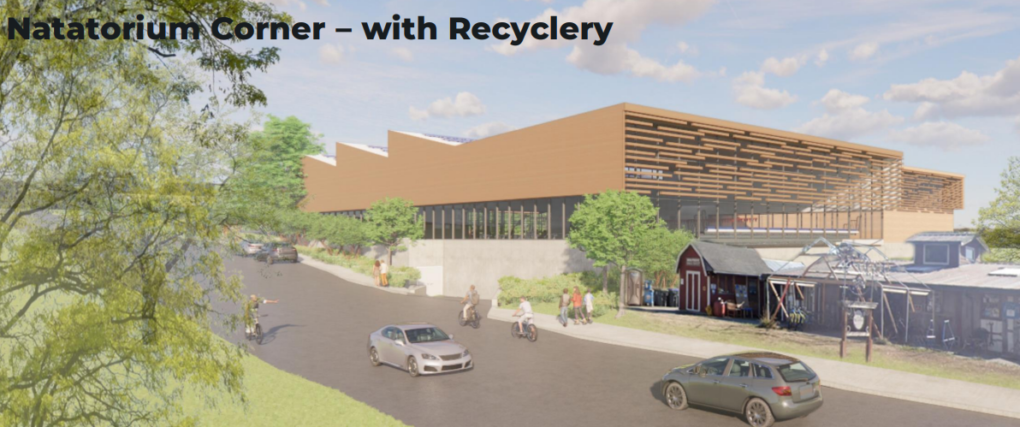
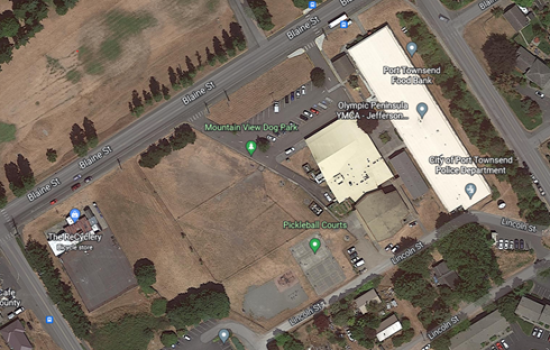
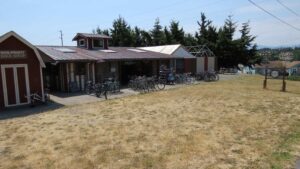
Mayor Faber at one point suggested housing should go on Blaine Street where infrastructure and bus lines already exist. An alternative to the Jones hybrid and Horner alternative proposals would be to site apartments on the school tennis courts on the corner of Blaine and Kearney, relocating the Recyclery to the “community garden” corner of the golf course on 19th and San Juan at the foot of the golf park. The Recyclery is a subsidized non-profit community bike project used by about 70 people each month during the season. A permitted building with bathrooms would replace its clever shed array.
Aerial view of Mountain View property, the abandoned tennis courts with Recyclery at bottom left. At top left is the golf course driving range bordering Blaine Street where the mayor suggests housing should go.
Housing is the least financially viable component of the options — claimed to be affordable but with no definition. The consultants focused on golf course land, considering no other locations to meet the recognized need for affordable and low income housing. However, Olycap has provided a good model — the new Seventh Haven apartments, adjacent to QFC, has 43 low income studio to three bedroom apartments with parking and child care on 0.54 acres, about 4 city lots plus the right-of-way. Filled within a month of opening, there is a waiting list.
Factoids about the Seventh Haven apartments:
- Handicapped Accessible;
- Single Parents, Veterans, Elderly Accommodated;
- Financing: about $11 million;
- Peninsula Housing Authority, Dept of Commerce, H.U.D.;
- About six years from start to finish;
- Current unmet demand is for studio and 1 bedroom apartments.
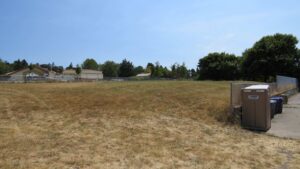
The Mountain View tennis court footprint is about 110′ x 170′ with another chunk of school land and the unopened Gaines Street easement, pushing an acre or more. It is centrally located and practically shovel ready. The site has city infrastructure and is on flat land near another apartment structure. It is readily accessible to bus lines, Co-op, pool, playground, food bank, sidewalks, golf park, Kah Tai park, and the Recyclery.
The Recyclery on the old tennis courts including surrounding school and Gaines Street land – a shovel ready housing idea. Photos: Julie Jaman
The city could partner with the School District, Peninsula Housing Authority and Olycap in this endeavor. Together they possess a wealth of experience and expertise. It might be possible to have such housing available by 2030 to dent the already existing demand of low income workers. Affordable and low income housing needs more focused community effort rather than simply trading away open space parks.
Win-Win Alternatives Getting the Bum’s Rush
Council members are aware that the majority of participants in this Envision process are not favorable to eliminating the historic, well-planned golf course. Some propose that golfers, including the high school team, drive the 20 mile round trip to the old Chevy Chase golf course beyond Cape George. Golf is not a dying game. Tiger Woods and other great players have helped golf grow as a national sport in the 21st century.
The decision to spend another month or so reworking the Hite/Jones hybrid idea opens the way to take into consideration the Horner golf park design that has strong support from the community and is financially viable. The housing element in both plans is inappropriate and far from affordable.
It has been suggested that the food bank be relocated up to the industrial park. This would be more convenient and accessible with ample parking. It would also alleviate the jammed parking on Wednesdays and Saturdays at the Mountain View campus. No data so far on how many people use the parking area and food bank each month, but demand seems to be growing as the economy becomes more tenuous.
On July 27, 2023, KPTZ aired an interview with city manager John Mauro and strategist Carrie Hite. When asked about the Horner alternative Hite said that she rejected it because, “it does not allow for other public desires.” Apparently her choices as the hired authority are the only ones the stakeholders are allowed to consider rather than the other way around.
Hite seemed almost adamant about moving the dog park onto golf land to make way for a huge parking area in the future, although the parking needs at Mountain View (current and future) are unaddressed at this time. There is no data on how many people bring their dogs to the Mountain View dog park, but it likely needs to grow. Alternatively it could move to the fairgrounds (already used for dog exercise) where community members are ready to assist in its relocation if the county would consider such an option.
Mauro quipped on KPTZ about the “new evolution of thinking” as an aspect of the envision process. Unless he means thinking coming from the top down, the Horner alternative is exactly the sort of evolution of thinking the community is interested in.
This project has already cost well over $200,000 with City Manager and staff time, multiple contracted consultants and more to come. Strategist Carrie Hite assured Council she could secure grant monies from Washington Recreation and Conservation funds to further the undoing of Port Townsend’s golf course, and likely the big enchilada — the $30 to $50 million aquatic center.
The legacy golf course is under extreme threat from ill-conceived agendas. If the City Council were to honor the civic efforts, sentiments and needs of the community, maintain the continuity provided through the Comprehensive Plan, and recognize the growing burden on taxpayers, it would be beneficial for all to consider the Horner win-win alternative as appropriate evolution for the treasured golf course.
———————————————-
Top photo shows the “save our golf course” yard sign (inset)
now displayed throughout Port Townsend.
Photos: Julie Jaman