by Julie Jaman | Aug 1, 2023 | General
This laid back Victorian seaport and artist colony has long been funkily charming, attracting visitors from around the world to enjoy architecture, birding, boating, weekend getaways and the impressive array of weekend-long festivals. Some are so enchanted they consult realtors on the first visit, thinking this would be a great place to live out retirement. This small peninsula town is bound by water and mountains, trails and natural features inviting all manner of recreation, no city investments needed. This was a key consideration for planning as envisioned in the “City of Port Townsend Comprehensive Plan,” given lip service by the town’s ambitious administrators.
At the July 17, 2023 City Council meeting it became very clear that they intend to transform the town through contriving public consent that will ultimately cost millions in tax dollars, inflating city debt to the bursting point.
On this night, council was being directed to act on the agenda item City Council presentation on the Envision community discussion:
“Action: City Council will receive the final recommendation on the future decision of the Envision the Port Townsend Golf Course and Mountain View Commons and be asked to make a decision.”
You are not alone in trying to understand what the above “action” means. In fact, any comments directed at Mountain View Commons were not acceptable, so directed the mayor. This discussion was strictly limited to the future of the Port Townsend Golf Course. Council’s vote on this action would box the community into the administrators’ plan to close down the one hundred year old golf course and usurp the 58 acres for uses mostly unwanted, according to the majority of public responses garnered over this last year.
And here’s how the magic of manufacturing consent is implemented.
The “Envision Port Townsend Golf Course and Mountain View Commons” is a project overseen by Carrie Hite, a short-term contracted Director of Parks & Recreation Strategy; consultant Chris Jones, principal architect of Groundswell; plus four other contracted consultants. The genesis of this project was the 2020 Parks Recreation Open Space (PROS) Plan focused on management of the golf course and exploring the feasibility of alternate uses of the golf course lands. It included 830 responses to a survey. Only thirty indicated an interest in housing; none of the more than 800 respondents suggested a dog park.
Stacking the Deck
Sometime during lockdown, newly-hired city manager John Mauro contracted Carrie Hite and then multiple consultants, thus the Envision project got underway. The exploration involved such things as open house events at the Fort, online surveys, recommendations by a city-appointed stakeholder group and by the Parks, Recreation, Trees and Trails Advisory Board (PRTTAB).
Three open house events were held. On January 11, 2023 the consultants reported 291 people placed 1,985 dots on 23 project boards with 3 interactive stations. The one picture offering to maintain the existing golf course got the most dots. Port Townsend Free Press contributor Brett Nunn attended that meeting and reported on it shortly after.
Project boards from the January 2023 open house. Attendees showed the greatest support for “Golf Course As-Is,” followed by maintaining the property for “Habitat”. Photo: Brett Nunn
The April 26 meeting drew 207 attendees. At the June 22 meeting the consultants amended the options adding 36 housing units, with 103 attendees viewing the proposed housing pictured in the wild habitat at the NE edge of the golf course land. The wording of the online surveys nudged participants toward preferred outcomes. As the process moved along, the option of restoring the golf course disappeared.
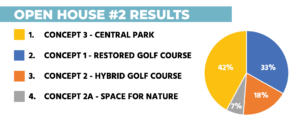
The last survey that included keeping the golf course as is, with restoration. Despite “Restored Golf Course” receiving nearly twice the votes as “Hybrid Golf Course,” it was eliminated from future options as seen below.
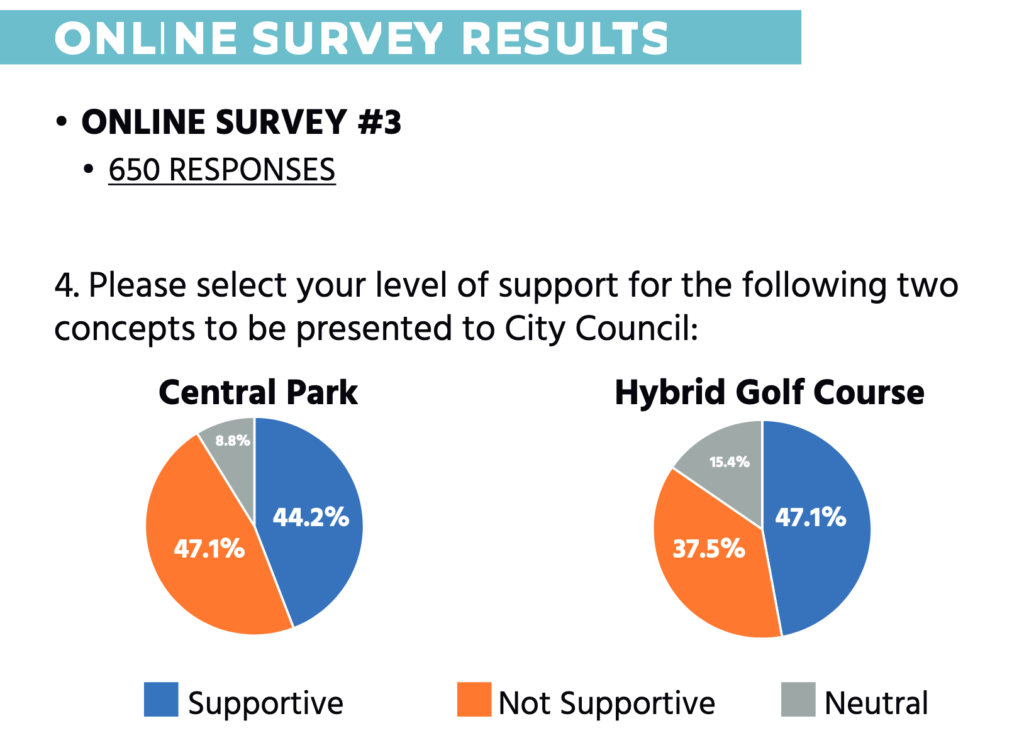
With the popular “Restored Golf Course” strategically eliminated as a choice, people were given only two options in Survey #3. Forced to choose between just those two, the majority supported a hybrid golf concept.
The inner workings of the Envision project relied on appointed stakeholders, starting with 21, eventually dwindling to 13 people. Carrie Hite set their agenda, directing which options they could vote on such as housing, a dog park, trails, concert space, restaurant/brew pub, miniature golf. Maintaining the existing golf course with planned improvements was not an option.
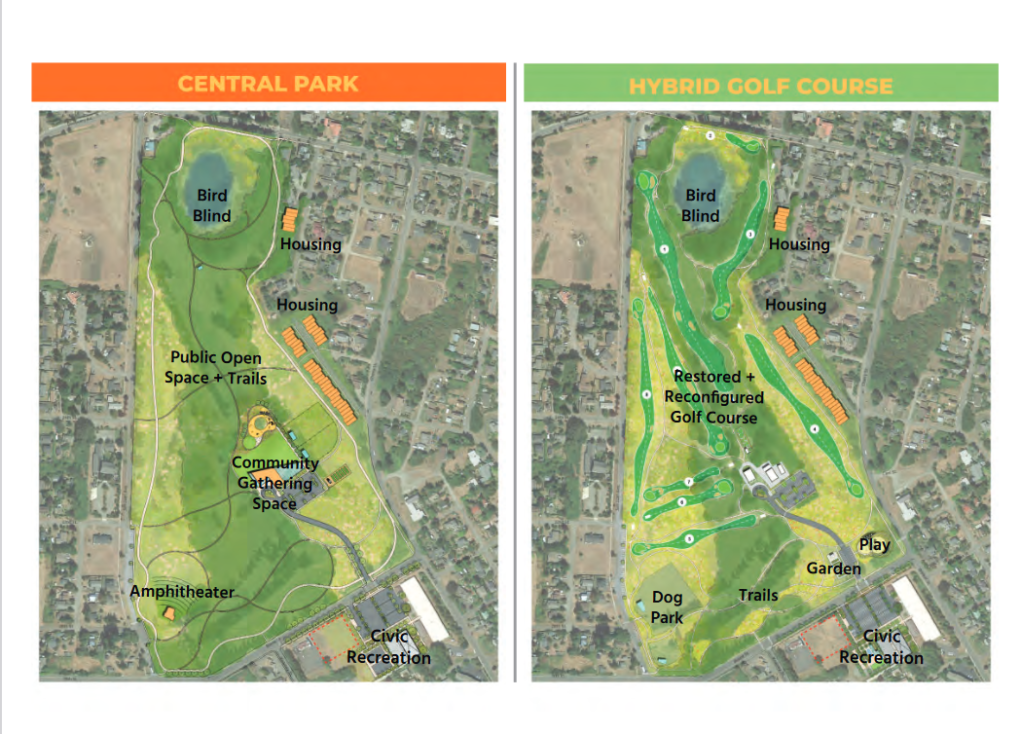
The stakeholders met several times, reviewing public input as interpreted by the consultants, finally voting on two concepts — a central park with no golf course and a hybrid park reducing the golf course and eliminating the driving range. Both options projected investments of $2-$3+ million just for the recreation components.
The consultants provided no projections about potential housing costs — for starters, opening and widening streets, sidewalks, parking, lighting, bike lanes, striping, and signage, all essential for future real estate development in a quiet neighborhood zoned Residential II, single family (RII,SF).
It is as yet unknown how such housing would be affordable.
Engineering Outcomes
On June 14, 2023 Hite presented to City Council a review of the “Envision“ process and a preview of the formal presentation to come on July 17 by Chris Jones of Groundswell.
On July 17, 2023, Jones presented two options to Council. He included a fleeting reference to the July 11, 2023 special meeting with the PRTTAB and their recommendation against leveling and paving wild habitat for housing. Their considerations included the interests of thousands of avid birders and the need to protect wildlife corridors from human impacts.
Groundswell’s “Central Park” and “Hybrid Golf Course” Concept Renderings
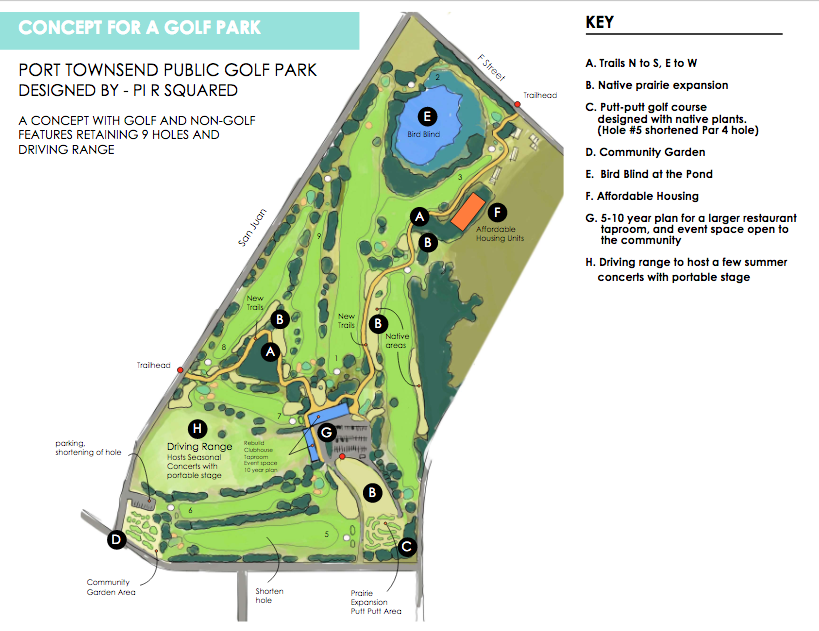
Local designer Robert Horner submitted a plan that members of the Port Townsend Golf Club (PTGC) described as thorough and well-conceived, saying Horner’s “…design honors history and it has practical solutions” and was “a win-win compromise.” It provides room for many of the ideas in the Jones hybrid plan, including trails north to south and east to west; native prairie expansion; putt-putt golf course; bird blind at the pond; community garden; affordable housing; a 5-10 year plan for a larger restaurant/taproom and event space; and a driving range to host a few summer concerts with a portable stage. All things brought forward by the consultant at the open house events except housing, which was added on later.
Robert Horner/Pi R Squared concept, June 30, 2023
Key to the Horner plan was that the historic nine-hole golf course and driving range would remain and be maintained. The cost of this plan is under $1 million, with Horner’s expertise volunteered and free to the community.
Jones declared that it was submitted too late.
“Golf Is Dead”? Not So Fast!
Jones’ Central Park option eliminating the golf course telegraphed the mayor’s pronouncement that “golf is dead.”
The 2018 National Golf Foundation (NGF) business analysis reported that over 8% of the general population play golf an average of 18 times per year; those over 65 play an average of 36 rounds per year. More than 20% of the PT population is over 65 and aging in place. Another 1400 people are projected to increase the population by 2036. Casual data indicates that currently 200 or so people, including many retirees, play golf on this course each month during the season—similar to pool usage (a saga yet to come).
During public comment, local people provided specific knowledge regarding the history and development of this golf course, conceived by a premier course designer from Scotland in the 1920s. Golfers report it is a well planned and challenging course. Many recognize it as an irreplaceable historic open space with mature trees, ponds and wildlife habitat corridors in the middle of town — a treasure.
But when it came time after two hours of public comment for the council to take action, they faltered. Mayor Faber urged a decision sharing his anecdotal experience — his feeling when walking by the golf course that barbed wire was keeping him out.
Faber has determined that the community needs trails crossing the golf greens, new recreation activities, no golf, more prairie meadows, concerts, and housing on the driving range to fill the bill. But council members dithered until after 10pm. They simply could not bring themselves to vote on the preferred “Hybrid Option.” But they did vote down a motion to maintain the legacy golf course. Their stated priorities were financial viability, public access, affordable housing, amenities for children and families, possibly a dog park, and trail connectivity.
In part, Council’s equivocation was the result of the lack of data about demand and use of existing private and public amenities throughout town, including the community center, Fort Worden and the fairgrounds. These assets offer miles of trails and sidewalks, biking infrastructure, a skateboard park, picnic areas, venues for indoor and outdoor events, and restaurants/brew pubs.
Why Housing at the Golf Course?
Mayor Faber at one point suggested housing should go on Blaine Street where infrastructure and bus lines already exist. An alternative to the Jones hybrid and Horner alternative proposals would be to site apartments on the school tennis courts on the corner of Blaine and Kearney, relocating the Recyclery to the “community garden” corner of the golf course on 19th and San Juan at the foot of the golf park. The Recyclery is a subsidized non-profit community bike project used by about 70 people each month during the season. A permitted building with bathrooms would replace its clever shed array.
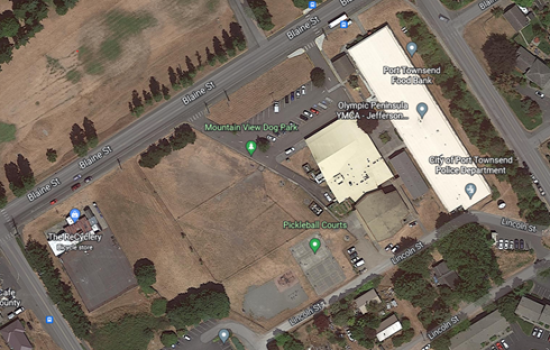
Aerial view of Mountain View property, the abandoned tennis courts with Recyclery at bottom left. At top left is the golf course driving range bordering Blaine Street where the mayor suggests housing should go.
Housing is the least financially viable component of the options — claimed to be affordable but with no definition. The consultants focused on golf course land, considering no other locations to meet the recognized need for affordable and low income housing. However, Olycap has provided a good model — the new Seventh Haven apartments, adjacent to QFC, has 43 low income studio to three bedroom apartments with parking and child care on 0.54 acres, about 4 city lots plus the right-of-way. Filled within a month of opening, there is a waiting list.
Factoids about the Seventh Haven apartments:
- Handicapped Accessible;
- Single Parents, Veterans, Elderly Accommodated;
- Financing: about $11 million;
- Peninsula Housing Authority, Dept of Commerce, H.U.D.;
- About six years from start to finish;
- Current unmet demand is for studio and 1 bedroom apartments.
The Mountain View tennis court footprint is about 110′ x 170′ with another chunk of school land and the unopened Gaines Street easement, pushing an acre or more. It is centrally located and practically shovel ready. The site has city infrastructure and is on flat land near another apartment structure. It is readily accessible to bus lines, Co-op, pool, playground, food bank, sidewalks, golf park, Kah Tai park, and the Recyclery.
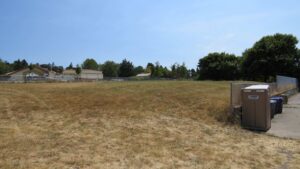
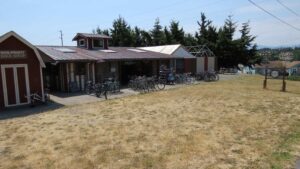
The Recyclery on the old tennis courts including surrounding school and Gaines Street land – a shovel ready housing idea. Photos: Julie Jaman
The city could partner with the School District, Peninsula Housing Authority and Olycap in this endeavor. Together they possess a wealth of experience and expertise. It might be possible to have such housing available by 2030 to dent the already existing demand of low income workers. Affordable and low income housing needs more focused community effort rather than simply trading away open space parks.
Win-Win Alternatives Getting the Bum’s Rush
Council members are aware that the majority of participants in this Envision process are not favorable to eliminating the historic, well-planned golf course. Some propose that golfers, including the high school team, drive the 20 mile round trip to the old Chevy Chase golf course beyond Cape George. Golf is not a dying game. Tiger Woods and other great players have helped golf grow as a national sport in the 21st century.
The decision to spend another month or so reworking the Hite/Jones hybrid idea opens the way to take into consideration the Horner golf park design that has strong support from the community and is financially viable. The housing element in both plans is inappropriate and far from affordable.
It has been suggested that the food bank be relocated up to the industrial park. This would be more convenient and accessible with ample parking. It would also alleviate the jammed parking on Wednesdays and Saturdays at the Mountain View campus. No data so far on how many people use the parking area and food bank each month, but demand seems to be growing as the economy becomes more tenuous.
On July 27, 2023, KPTZ aired an interview with city manager John Mauro and strategist Carrie Hite. When asked about the Horner alternative Hite said that she rejected it because, “it does not allow for other public desires.” Apparently her choices as the hired authority are the only ones the stakeholders are allowed to consider rather than the other way around.
Hite seemed almost adamant about moving the dog park onto golf land to make way for a huge parking area in the future, although the parking needs at Mountain View (current and future) are unaddressed at this time. There is no data on how many people bring their dogs to the Mountain View dog park, but it likely needs to grow. Alternatively it could move to the fairgrounds (already used for dog exercise) where community members are ready to assist in its relocation if the county would consider such an option.
Mauro quipped on KPTZ about the “new evolution of thinking” as an aspect of the envision process. Unless he means thinking coming from the top down, the Horner alternative is exactly the sort of evolution of thinking the community is interested in.
This project has already cost well over $200,000 with City Manager and staff time, multiple contracted consultants and more to come. Strategist Carrie Hite assured Council she could secure grant monies from Washington Recreation and Conservation funds to further the undoing of Port Townsend’s golf course, and likely the big enchilada — the $30 to $50 million aquatic center.
The legacy golf course is under extreme threat from ill-conceived agendas. If the City Council were to honor the civic efforts, sentiments and needs of the community, maintain the continuity provided through the Comprehensive Plan, and recognize the growing burden on taxpayers, it would be beneficial for all to consider the Horner win-win alternative as appropriate evolution for the treasured golf course.
———————————————-
Top photo shows the “save our golf course” yard sign (inset)
now displayed throughout Port Townsend.
Photos: Julie Jaman
by Jim Scarantino | Jul 10, 2023 | General
Unsustainable. Higher taxes lie ahead for Port Townsend residents and businesses. But it won’t be basic, critical city services that get the biggest chunk of increased revenues if the recommendations of the City’s Financial Sustainability Task Force are followed.
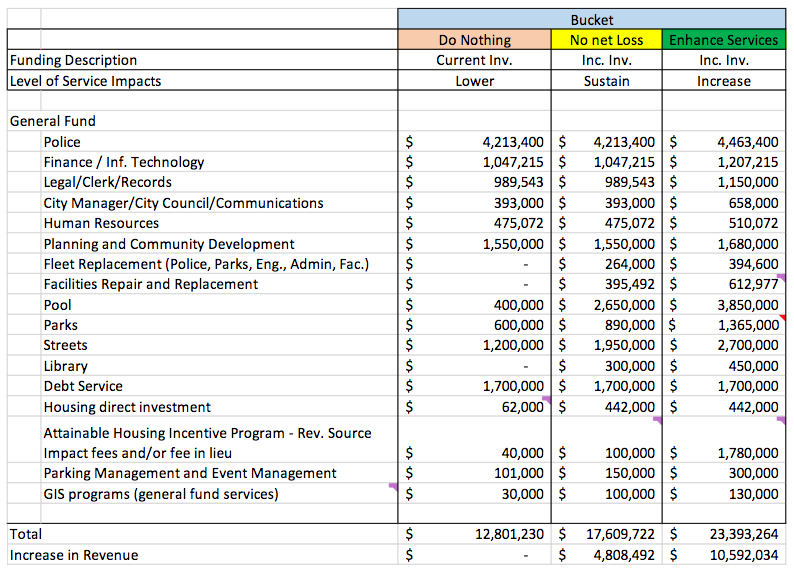
The proposed aquatic/fitness center could get seven times as much in new tax revenues as would go to fix the city’s failing streets. Parks and forays into becoming a major housing provider would also see huge increases.
Public safety and emergency services would see little change. As for the the city’s aged, failing water and sewer lines, the task force chose to ignore the problem.
A water and sewer system is a core service of every city. “Simply put, without core services, all other initiatives and services suddenly or eventually fail.” That is the definition from the glossary of terms in the task force’s final report. But through a verbal sleight-of-hand, the task force declared it would not consider water and sewer to be core services and, therefore, they were excluded from evaluation of the city’s financial challenges.
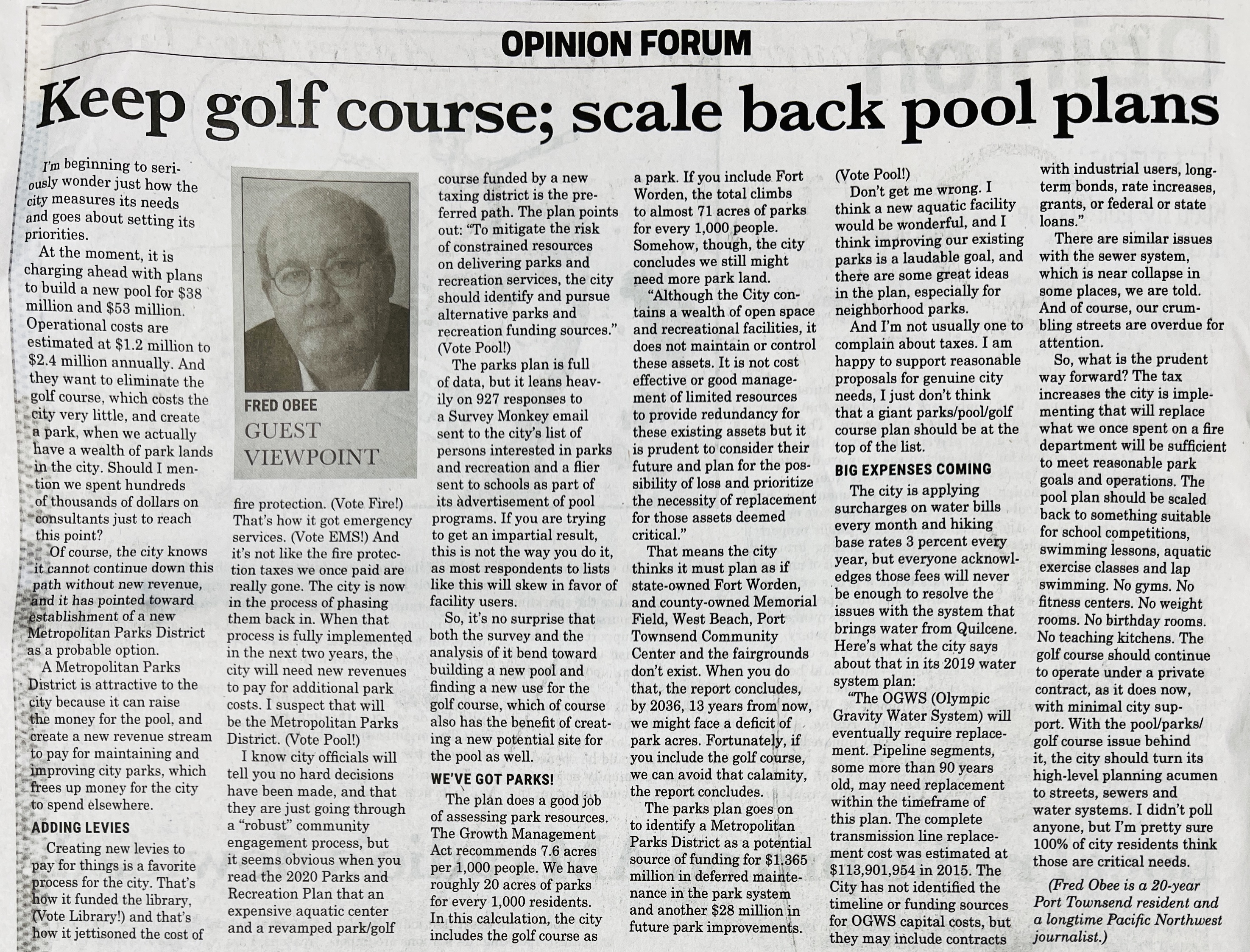
Replacing the thirty-mile long, century-old system that brings water to the city from Quilcene will cost more than $114 million, according to the city’s 2019 water plan. Higher utility rates, increased borrowing and other measures will be necessary to cover the costs. Some sewer sections are at the end of their lifespan and require replacement now. A single failed pipe under Water Street is beyond repair and must be completely rebuilt, at the cost of nearly $3 million — which the city must borrow or pull out of its reserves.
It would be a lot harder to persuade taxpayers to approve high taxes for a new pool if they knew they were also facing staggering increased utility rates and other charges to repair and replace the sewer and water lines under the city’s crumbling streets. The price tag for that proposed new aquatic center, by the way, starts at $37 million and tops out above $52 million, along with an annual operating subsidy of about $900,000.
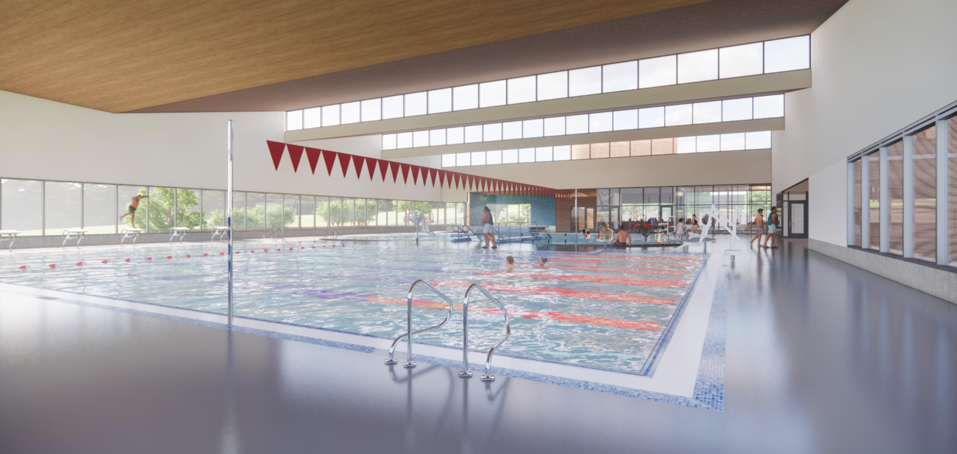
Rendering of the Mountain View complex to house proposed new aquatic center, from the consultants’ PowerPoint presentation. Multiple pools — a swimming pool, activities pool and therapy pool — are illustrated in the image at the top of the article.
Skewed priorities don’t stop there. The city’s pool consultants are enjoying a $175,000 contract, which is more than the city budgeted in recent years for road maintenance. It is more than the city has allocated to study the seismic stability of the Lord’s Lake dam, the principal source of the city’s drinking water. State authorities have warned that the dam is in very poor condition and could require $4 million in repairs — money the city doesn’t have. Not a word in the task force report about that.
Water for swimming got a lot of ink; drinking water got none.
But heavily taxing city residents to pay for a new pool — running up their property taxes by hundreds of dollars per year, on top of other recommended tax increases — isn’t enough. The Task Force, echoing the city manager and Port Townsend’s pool consultants, want to tax county residents to fund PT’s aquatic center. A project that cannot be sustained by city taxpayers has been proclaimed possibly sustainable if maybe county residents can also be taxed to pay for a new pool to replace one they don’t use now.
Fewer than 34 Jefferson County residents outside city limits use the existing Mountain View pool on a monthly average. That data was gleaned from the 2022 annual report from the YMCA, which manages the pool for the city. The same data shows that only 174 city residents use the pool on an average monthly basis.
Window Dressing for Higher Taxes, Expanding City Government
Council created the task force in November 2022 to address the city’s impending financial crisis. It carries an impressive title, but was little more than a handful of citizens hearing from and reading materials provided by City Manager John Mauro and his staff.
Five citizens were appointed but only four served. Troy Surber, PT’s former acting police chief, resigned his appointment before the first meeting. The other members were former city councilor and mayor Catharine Jackson, John Nowak, Rick Jahnke and Earll Murman. Earll Murman is married to Rena Murman, Treasurer of Jeffco Aquatic Coalition, the group spearheading the campaign to build a new aquatic center (more on that apparent conflict of interest below).
The task force had no chairperson. City manager Mauro ran its meetings. He and his staff set the agenda. The city manager determined what the group would talk about, who the speakers would be, and what materials would be considered. As far as I can tell, the city manager and his staff were responsible for writing the task force’s final report and recommendations.
There was good reason to create a task force, one that could investigate why Port Townsend’s finances have turned negative. The city is heading over a fiscal cliff. It has recently started to eat into reserves. We examined this impending dive into red ink in our May 25, 2023 report, “City Finances ‘Falling Off Cliff’ as Cherry Street Project Enters Seventh Year.”
But the task force did not dig. It did not inquire into waste in City Hall, ways current spending and staffing could be cut, or which programs and services could be scaled back. In fairness, such an undertaking would be an unreasonable expectation of citizen volunteers with no independent staff of their own. They met only a few times for about 2-2.5 hours each session.
The meeting videos reveal that the citizen volunteers were fed materials drafted by City Manager Mauro and his staff. None of those materials offered an austerity option, ways to shrink city government to fit the city’s limited financial resources. It was the city manager who labelled any course of action that did not include raising taxes to fund a new pool and other ambitious amenity projects as the “do nothing” solution. This derisive label was incorporated into the task force’s working materials.
Only those courses of action for continuing to expand city government made the cut in the final recommendations to city council.
Instead of meaningful inquiry into cutting waste and fat at city hall, the task force report tossed around vapid verbiage. It never got beyond bland statements like, “Finding efficiencies is a critical element for any pathway forward,” and “The need for efficiencies is eternal.” Rest assured, dear taxpayers, city hall has already engaged in “lean thinking” (page 19 of the report).
Repeatedly, task force discussions turned to how to sell higher taxes to a skeptical, tax-weary public.
Yes, plans to fix the streets are in there. New taxes have been recommended, anywhere from $0.10/$1000 to $0.20/$1000 of assessed value to start a thirty-year effort to keep Port Townsend from continuing to have the worst streets in the state. But the tax increase recommended for the aquatic center is seven times higher, $0.70/$1000 if the tax is imposed only on city properties. If county properties are “captured” (the city’s pool consultant’s term) and share the burden, the recommended tax hike would be $0.42/$1000.
No course of action was advanced that would increase funding to complete street repairs in under three decades.
No options allocated all revenue from higher taxes to critical, core municipal services only — streets, water and sewer, public safety.
No course of action was discussed that did not include the aquatic center. From the task force’s initial meeting onward the aquatic center was considered a “priority initiative.”
Conflict of Interest?
As mentioned, Earll Murman, one of the four task force members, is married to Rena Murman, Treasurer of Jeffco Aqautic Coaliton (JAC), the advocacy group spearheading the push for the new pool. Rena Murman is also the registered agent for JAC. That group originated in 2007 under the name “Make Waves in PT.” In 2012 Earll Murman became the group’s president and chairman of the board. In that year it changed its name to “Jeffco Aquatic Coalition.” Annual reports filed with the Washington Secretary of State show him as the JAC President from 2012-2017. In the 2018 amended annual report he was listed as one of four JAC governors. In 2022, just a few months before Earll Murman was appointed to the city’s Financial Sustainability Task Force, Rena Murman filed and signed the annual report for JAC, identifying herself as one of three governors and the group’s treasurer. A quick search of public filings with the Washington Secretary of State revealed this information.
More and More Taxes
The task force recommended other tax increases and ways to bring more money into the city. Annexing Glen Cove and grabbing its property and sales tax base from the county is central to long range plans. The drop in the city’s utility tax scheduled for the end of this year would be reversed and further increased by about 9%. Property tax rates would be raised across the board. And the task force is recommending another hike in the local sales tax.
To generate tax revenue for the proposed aquatic center, the task force recommends creating a Metropolitan Park District to tax city properties or a Regional Park District to capture county properties. This would require formal action by council and a public vote. If the borders of the taxing district extend beyond city limits, the county commissioners would also have to be on board. A park district can impose a property tax of up to $0.75/$1000 assessed value. An effort to create a park district to fund the Sequim pool was defeated in 2015.
There is also a lot in the report about funding the city’s foray into becoming a major housing provider and remaking the golf course, and how the city’s budget must increase accordingly. We will take a closer look at the these issues in future reports.
City Council is scheduled to act on the task force’s recommendations in coming months. The task force’s 53-page final report may be read at this link.
by the Editors | Jul 1, 2023 | General
In the spirit of offering Letters to the Editor as a traditional platform for lively, wide-ranging conversations in the public square, we invite you to write about whatever is on your mind.
Because we require comments under articles to be “on topic”, we found that readers who want to speak to other important issues, events and concerns that our small crew can’t cover don’t have a place for that. This Off Topic! feature allows readers to bring up other subjects, post news flashes, announce community events, or express concerns outside of the selected topics we write about.
A new Off Topic! forum is posted monthly. The post is open throughout the month for new letters and your responses.
How this works:
Submit your letter in the white box below Comment Guidelines at the bottom of the page containing the muted prompt “Enter your comment here…”
Either provide your own title to the letter as a top line or we will title it for you.
To respond to someone else’s post, hit the REPLY button under that specific letter or comment you wish to respond to.
by Jim Scarantino | Jun 29, 2023 | General
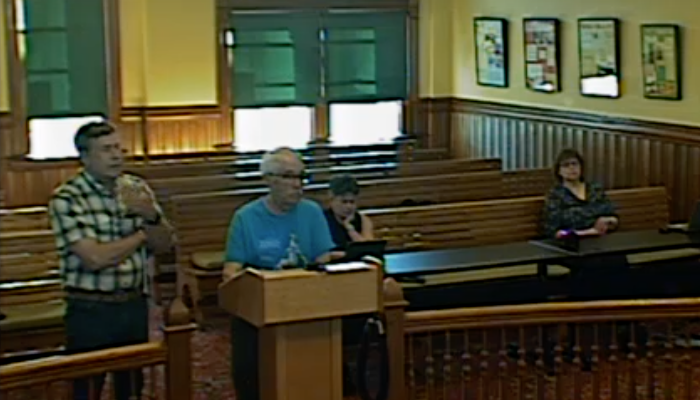
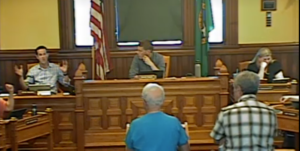
Dave Timmons has had enough. The former Port Townsend City Manager (at left above, speaking to the city council at their June 12 meeting) came out of retirement in 2020 in response to requests he step in to save a collapsing Fort Worden Public Development Authority (PDA). He gave his contractually required 90-day notice to the PDA’s Board at its June 27 meeting. Ninety days out is also just about the time the PDA’s financial team says it will run out of money.
Timmons cannot be accused of fleeing from a sinking ship. He jumped onto one in 2020, only to learn that the PDA’s hull was riddled with rot and worm holes. As I wrote after watching his heroic efforts in that year, he worked miracles. He managed to steer away from the shoals an organization hobbled by nearly a decade of incompetent and less-than-honest management. He let it be known that the PDA was “a house of cards” ready to collapse from the weight of debt burdens impossible to bear and the misuse—as well as outright theft—of funds by former management and a senior employee now facing criminal prosecution.
He crafted a spin-off of the hospitality arm of Fort Worden’s operations, the only way the operations could survive. His leadership attracted incredibly generous donations. He secured additional credit from lenders already facing millions in losses. He persuaded vendors to be patient about being paid.
Before he stepped onboard to lend an assist and then to helm the PDA that organization had never—never—received a passing audit from the State Auditor. Timmons inherited incomprehensible financial records. He oversaw the gargantuan task of converting from accrual to cash-basis reporting. He did all this with a skeleton staff who joined him in working miracles.
But it may have been a hopeless cause all along. The costs of maintaining ancient, obsolete buildings, heating and electrical systems and plumbing has always been a millstone. Revenues have never been enough to keep up. And something major always breaks. The costs of repairs keep rising. There’s never enough money.
As PDA Board Chairman David King (in blue shirt in top photo) told Port Townsend’s city council on June 12, 2023, “We are not currently sustainable.” The maintenance costs are crippling. and the PDA has “no revenue source for debt” incurred by the prior PDA Board and Timmons’ predecessor.
This is a critical time for the PDA, but Timmons has decided he must leave the organization he has worked so hard to keep alive. It is clear from his letter of resignation and other comments that the impetus for his departure is a deteriorating relationship with Port Townsend City Manager John Mauro and City Council.
“We have reached the threshold that cooperation doesn’t exist,” he told council and Mauro at council’s June 12 meeting.
Inheriting a Nightmare
I went back and read my reports from 2020 about Timmons’ rescue mission. I had forgotten the details about the daunting challenges he faced.
“Fort Worden Out of Money…” led the headline for an article I wrote in December 2020. The opening paragraph explained:
“We really don’t have a future if we try to remain status quo,” David Timmons, Acting Executive Director of the Fort Worden Public Development Authority told its Board of Directors at their December 9, 2020, special meeting.
“The PDA will run out of money in several weeks. It needs over $1.5 million to cover operating and capital costs over the next six to seven months, and then it will face over $1 million a year in maintenance costs while the hospitality industry, its major source of funds, recovers from COVID lockdowns.”
Timmons found a way to keep PDA breathing another 2.5 years.
“Fort Worden Finances Plagued With Problems From Beginning” was the headline of a November 2020 article.
“Its financial reports have never been reliable, according to all the audits conducted of the Fort Worden Public Development Authority by the State Auditor. Every audit since the FWPDA opened its doors has found inaccuracies, omissions and failures to comply with required accounting practices. Recent discoveries, which will be addressed in upcoming audits, have uncovered massive malfeasance and irresponsibility that jeopardize the organization’s continued existence.”
Two other articles from 2020 reminded me of how bad was the mess that Timmons took on: “Fort Worden’s Promised Financial Oversight Never Happened,” and “Criminal Investigators Called Into Fort Worden PDA Mess.”
Then there was the laughable $2 million “glamping” fiasco Timmons inherited: “Fort Worden Glamping A Soggy Mess.”
$125,000 per “luxo tent”! None have ever been rented, not a dime has come back to the PDA.
There was probably no one else in our community up to the challenge.
What’s changed now to prompt Dave Timmons suddenly to submit his resignation?
Mauro versus Timmons
Timmons was Port Townsend’s first city manager. (Michael Hildt was the first “City Administrator.” Timmons was the first to hold the title “City Manager.”) According to a 2019 Peninsula Daily News (PDN) article reporting Timmons’ retirement as PT’s city manager, he graduated from Michigan State University with a degree in environmental studies, then went to work with the Michigan Department of Natural Resources as a zoning manager. In 1978 he was chosen as a city department manager for a town in Michigan’s Upper Peninsula then moved on to be the first township manager. He later declined an offer to be Marquette, Michigan’s first city manager and moved to Cochester, Vermont where he served as city manager for 12 years. In 1997 he consulted with FEMA to help the state with four disaster events and was nominated by then Vermont governor Howard Dean to be the state’s secretary of labor. In 1999 he was hired as Port Townsend’s city manager and served continuously for the next 20 years.
At the same time Timmons was asked to come out of retirement to save Fort Worden, John Mauro was stepping into Timmons’ shoes as PT’s second city manager.
Based on information presumably provided by Mauro, the PDN reported that he was coming to Port Townsend from a high-level, high-responsibility job for the City of Auckland, New Zealand. “Mauro currently reports to the Auckland Council CEO,” the PDN related. “He is directly responsible for 20 employees and has a budget of $211 million.”
That wasn’t true, as I reported in an October 2020 article (“Who Is John Mauro?“), I had contacted the city of Auckland seeking confirmation of the PDN story. The response contradicted these claims about Mauro’s qualifications. Auckland’s mayor had referred my inquiry to the Auckland Council CEO in whose line of command Mauro’s position would have been. Through a spokesperson he told me that Mauro did not report directly to the Auckland Council CEO. He was a mid-level bureaucrat in the planning department under a General Manager. He was not “directly responsible for 20 employees and a budget of $211 million.” Half that number of employees reported to him and the budget for which he was “directly responsible” was $1 million. That was in New Zealand dollars, which is about the equivalent of just over $600,000 US.
Mauro’s job in Auckland was “sustainability officer.” He and his small team, as a New Zealand publication reported, “provide thought leadership, drive strategic direction and champion change.” Change in terms of addressing climate change.
Mauro didn’t build anything, maintain or build roads and sewers or oversee police. He provided “thought leadership.”
Fast forward to 2023. The city now managed by Mauro, as we reported May 25, 2023, is heading over a financial cliff. Mauro overspent his current budget by millions due to hiring consultants for projects the city admits it cannot afford (e.g., a new $50 million aquatic center, a remake of the golf course, and the Evans Vista development). The city is eating into reserves and cannot maintain its failing streets. I recently learned from a source in the Sheriff’s Office that county law enforcement is still covering patrols for a city department lacking adequate staffing to do the job.
Mauro publicly defends the city’s “solid financial position” to continue providing basic services. But with Mauro’s unique hold on the English language, in the same breath he qualifies that the financially-solid city’s “ability to continue to do so is hindered by increasing costs in excess of revenues and a steady erosion of services and level of service.” Translated from Maurospeak, the city is heading “over a cliff,” the exact, unvarnished words used by the city’s Financial Sustainability Taskforce.
Mauro had followed his wife to Auckland where she had secured a teaching job. Before that he had been a bicycle activist in Seattle.
Power Play
Mauro wants more control and power over Timmons and the PDA.
The PDA has been slow on churning out financial reports to meet the city’s deadlines. This is being used as a reason to subject the PDA to direct city manager control over its financial affairs, strategic direction and other matters. The hook being used is the 2022 financial report. Under city code, it was due three months after the end of the fiscal year, in March. It was delivered in June. Other complaints have been raised, but in the “Draft Corrective Action Plan” written by Mauro and his staff, it is the annual report being 2-3 months behind that is the main justification for increasing city control over the PDA.
The financial reports provided to the PDA Board are matters of public record and easily available to Mauro and his staff, as well as members of the public. Financial reports were provided to the State Auditor. No request for information has been stonewalled.
Timmons operates with a skeleton staff. The woman described as “critical” to their accounting and reporting had been battling cancer and recently passed away, leaving a huge hole in the organization’s capabilities. As Timmons explained at his June 12 City Council dressing-down, the rest of his staff consists of a clerk at 32 hours/week, an administrative assistant at 32 hours/week, an accountant at 24 hours/week, and a contract CPA providing 10 hours of services weekly.
This is the entirety of Timmons’ staff for all PDA’s administrative, executive and accounting tasks. There is no money to hire anyone else. The services of the communications and public relations contractors, PDA Chair David King told Council, were ended because there is no money to pay them.
Mauro has also faced staffing shortages. He has filled gaps by hiring expensive outside consultants. City Council approved a $4.7 million supplemental budget to cover his overruns. Tax increases are looming ahead to get more money to run city operations. The PDA has no taxing authority. It cannot just demand that citizens give it more money, and it has no reserves to cover “supplemental” budget increases.
The PDA is currently required to provide quarterly and annual financial reports. Mauro is demanding that the PDA now provide monthly financial reports. At the June 12 Council meeting, Timmons explained that they do not have the staff to do that, unless those few staff people are taken off the other work they must do. Mauro was dismissive of the limited resources Timmons has, and somewhat mocked his vulnerability to losing any staff time.
(It must be noted that while Timmons was struggling with lingering problems from ten years of mismanagement and facility crises plus the loss of the full contribution of a key team member who was fighting cancer, Mauro took himself off on a five-week vacation after enjoying recent significant increases to his compensation package.)
Mauro’s “Draft Corrective Action Plan” would require the PDA to provide financial reports a week in advance of city oversight meetings, blaming past failures to do so on “struggles preparing the materials due to a lack of process and efficient financial reporting structure/form [that has been] hindering the FW PDA to meet required timelines.” Timmons and King tried to explain that the city’s meeting schedule does not align with the PDA’s own financial reporting schedules and creates huge problems for an understaffed accounting team. Their explanation fell on closed ears.
John Mauro (top left) responds to David King and Dave Timmons (at the podium) on June 12.
The rest of Mauro’s “Draft Corrective Action Plan” turns to inserting city staff in the business operations of the PDA. It would have the city get involved in utility cost allocation and negotiations with the “partners” (the tenants) at Fort Worden. The city would also direct the PDA in resolving billing disputes with the hospitality spinoff.
The PDA was recently forced to increase its line of credit to cover shortfalls caused by delays in the receipt of expected grants. Henceforth, under Mauro’s plan, the city will decide whether the PDA can increase its line of credit.
Mauro is demanding that the city have authority to approve or disapprove capital projects and capital planning.
Mauro wants the city to “monitor and coordinate on future PDA grant applications.” He wants to participate as a partner in strategic planning in order to “right-size the structure to meet future needs.”
Mauro wants to increase the PDA board to 9 members, with the mayor appointing at least three additional members.
All this to “correct” an annual report being delivered a few months late, even though nothing in the provided report was called out as being false, incomplete or incorrect.
It appears that the late financial report is being used as pretext, or at least an opportunity, to increase the city manager’s control over the PDA and its executive director. As Timmons pointed out to the Council on June 12, these are not “corrective measures. This is an enforcement action. We have reached the threshold that cooperation doesn’t exist.”
Timmons Resignation Letter Says More
Timmons submitted a lengthy letter of resignation. He reflected on his 45 years of public service and the challenges at the PDA that he, his staff and Board confronted together. He thanked the local institutions that stood by PDA and helped keep the ship from sinking. In that long letter, he provides more insight into his motivation for leaving now. He did not have much reason to recognize the city’s contribution to the fight.
Compared to the Herculean efforts of others, and the votes of confidence from lenders and vendors, the support of the City of Port Townsend pales in comparison. Banks extended hundreds of thousands of dollars in new credit. Private individuals donated half a million dollars. Lawyers donated valuable time. Architects, plumbers, construction companies, electricians and fuel suppliers did not act on overdue billings and “never wavered in supporting us with their patience….”
Jefferson County provided two grants, one for $378,000 to help secure debt restructuring and another of $150,000 towards restoring a critical building.
The Washington Department of Commerce helped the PDA secure and close out several grants, the last in the amount of $697,000.
The city, for its contribution, awarded “a competitive grant of $5,000 … and were cooperative with late utility billings.” But unlike the other players in this drama, the city acted to make life more difficult for the Fort Worden PDA, when “they passed code revisions more suitable to provide punishment for the past situation, not necessarily supportive of our current needs.”
Towards the end of his letter, Timmons said that he had learned in his long career not to take the path others would have you take when you know that is not the right path. “I believe we have reached the point where our paths are no longer in agreement.” For the “past several weeks,” indicating that this was a recent decision, he says he had been having discussions with some of the Board about “my desire to begin the process to transition to new leadership in the role of Executive Director.” He remains “open to discussions about serving in a limited role as an advisor to pass on institutional knowledge. But other events keep derailing this critical conversation while we continue putting out the most recent fire.” (Author’s emphasis.)
The PDA Board had nothing but effusive praise for Timmons, whose last day will be September 28, right about the time the PDA runs out of money. The hearing on Mauro’s plans to increase his control over the PDA is scheduled for August 21. A public hearing must be held before the plan can be voted on by Council.
For the video of the June 27 PDA Board of Directors meeting in which Timmons submitted his resignation, click here. The agenda packet for that meeting, containing Mauro’s Draft Corrective Action Plan and Timmons’ resignation letter may be viewed at this link. The resignation letter is attached as the very last document in the agenda packet.
by the Editors | Jun 1, 2023 | General
In the spirit of offering Letters to the Editor as a traditional platform for lively, wide-ranging conversations in the public square, we invite you to write about whatever is on your mind.
Because we require comments under articles to be “on topic”, we found that readers who want to speak to other important issues, events and concerns that our small crew can’t cover don’t have a place for that. This Off Topic! feature allows readers to bring up other subjects, post news flashes, announce community events, or express concerns outside of the selected topics we write about.
A new Off Topic! forum is posted monthly. The post is open throughout the month for new letters and your responses.
How this works:
Submit your letter in the white box below Comment Guidelines at the bottom of the page containing the muted prompt “Enter your comment here…”
Either provide your own title to the letter as a top line or we will title it for you.
To respond to someone else’s post, hit the REPLY button under that specific letter or comment you wish to respond to.
by Jim Scarantino | May 25, 2023 | General
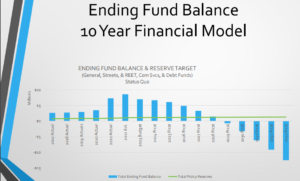
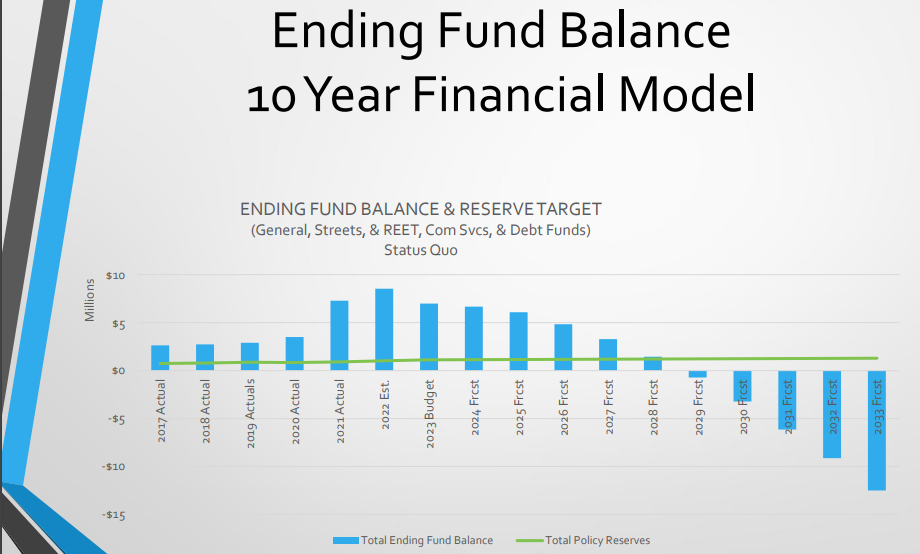
Unsustainable. In less than five years, Port Townsend will burn through its reserves and be unable to maintain its current level of services. Its finances will “fall off a cliff.” Those exact words were used by city staff in its presentation to the joint session of City Council and its Financial Sustainability Taskforce on May 8, 2023.
The graph at the top of this article shows what’s coming. Starting this year, the city will begin consuming its reserves. The burn rate accelerates each subsequent year until in 2028 the city starts dropping through the “policy level” that represents its ability to maintain existing services. You might notice that the graph shows a significant peak during the past couple of years. Those were years of a massive infusion of federal and state money and savings due to cutting staff during the pandemic lock downs. It was an unreal time of external munificence that won’t be repeated
The unpleasant and, for many people, painful solution will necessarily involve raising existing taxes and the imposition of new taxes. This will make the cost of living in Port Townsend rise even faster, hastening the shrinking of the city’s middle class and making life ever harder for workers. Taxes get passed through to everyone one way or another. Port Townsend already is not a family-friendly place; things are going to get worse for households on limited budgets trying to raise children. A higher cost of living exacerbates conditions already faced by employers who cannot attract workers or keep on their payrolls younger people who are forced to choose a community that better fits their paychecks. Higher costs in Port Townsend have also driven out some of the creative class. An older, wealthier demographic emerges, including a greater concentration of people moving here to spend their last years and those with surplus money capable of acquiring second homes.
An alternative would be to put ambitious, costly plans on hold and immediately impose austerity measures. This will be the involuntary consequence anyway if, very quickly, something “radical” is not done. That was the message of Steve King, the city’s public works director. He shared hard truths I can’t remember hearing at any previous city council meeting. He informed council that, “Our tax structure absolutely requires growth.” He said that a “radical” change was needed to achieve a significant rate of growth not seen here in recent memory.
The necessary growth would mean, he said, something like building 75 new homes annually — an unheard of accomplishment under the city’s difficult-to-build regulatory regime. Not discussed at the meeting was radically promoting growth by making Port Townsend much more business friendly in order to attract new employers that would create better jobs than those the tourist trade generates. That requires relaxing business and environmental controls, governing with a very light regulatory touch, and dramatically reducing the cost of doing business here — the opposite of our current high taxation, tightly controlled, closely planned, anti-growth dominant culture.
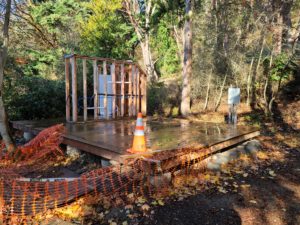
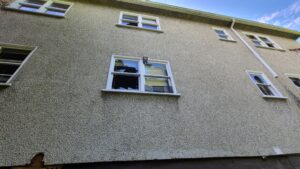
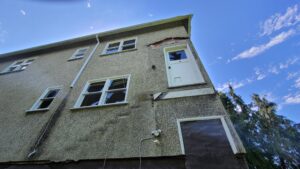
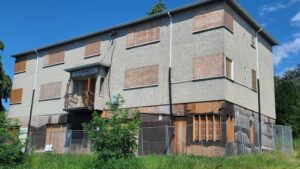
Five years to go before the city launches off that cliff. It took six years to take a first stab at loosening city codes that were making it difficult to add ADUs — even though the need for housing was declared a “crisis” back in 2017. That same year, the city, with the enthusiastic support and advocacy of its current mayor and deputy mayor, began wasting a pile of money, staff time and public resources on the fiasco of the Cherry Street Project. This supposedly “affordable housing” endeavor has sucked up over $2 million in city funds, bond capacity and land. Entering its seventh year, the project provides housing only to rats, raccoons and the squirrels that I have observed entering the building through holes chewed in the building’s eaves. It is also a publicly-funded place for kids to party and do who-knows-what-else inside the vandalized derelict on the hill over the golf course.
“Lean Thinking”
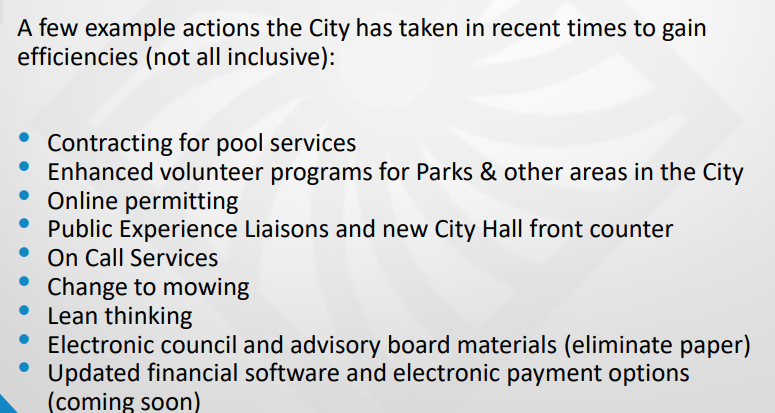
The May 8 meeting partially focused on how to craft a message to persuade taxpayers to accept a higher tax burden. One slide boasted of steps that have been taken to slow the impending launch into a fiscal abyss.
King informed council it would take at least another $1.5 million annually over future decades to start to turn around the city’s dire streets problem. It will take another $750,000 annually just to keep things from getting worse. The touted “efficiencies,” as anyone with some sense of proportion will realize, are insignificant. The cliff up ahead has been visible since at least the time the current city manager began employment. That’s three years ago, yet this is all that can be claimed in the way of meaningful efforts to cut costs.
Notice that “lean thinking” is cited as an example of an efficiency achieved. What is “lean thinking”? Some kind of thought experiment? An image of an unhealthy overweight person imagining a fit, trim twin in the mirror comes to mind.
At the same time it confronts an impending fiscal crisis, city leaders are spending scarce resources on dreams of a grand new pool and exercise facility. Just a basic pool alone, as was stated during the May 8 meeting, will cost $25 million. Opsis, the Portland, Oregon consultant working for the city, pegs the minimal cost at more than $30 million and running as high as $52.7 million.
The city is also tossing around ideas for remaking the golf course, though it has no money to do anything (already needing volunteers to trim the grass).
And even as a poison hemlock forest again engulfs the Cherry Street Project the city is moving forward on its largest housing project ever – the Evans Vista development. The land was acquired with grants, but the city has shelled out at least $500,000 on consulting services while also using considerable costly staff time for a project that may be a decade away from making the faintest impression on the city’s housing market.
In an act that cannot qualify as “lean thinking,” in October 2022 council approved a large increase in compensation for the city manager, John Mauro. They boosted his salary by 10% and threw in a “retention bonus” of $12,500. They also increased his vehicle allowance and doubled the city’s contractual obligation to provide severance pay from 6 to 12 months. Not long after this act of municipal generosity, Mauro went on a five-week vacation.
Mauro’s base salary is now $189,297, up from his starting salary mid-2020 of $156,000. In addition to his base salary, he also gets 13% of his salary contributed to his retirement account, almost $25,000 annually at his current rate of pay. When he was hired, he received a $20,000 relocation allowance to move him here from New Zealand. His current automobile allowance of $6,600 is equivalent to driving more than 10,000 miles, at the current IRS business mileage rate. One could reasonably wonder how and why the city manager is driving more than 10,000 miles annually on city business. How is that possible? For background on Mr. Mauro, please see our report, Who is John Mauro, Port Townsend City’s Manager?, in which his previous employer in Auckland contradicted published claims about the job Mauro held as an employee of that city.
Just three days before the meeting with the Financial Unsustainability Taskforce, city council had to admit it was going to blow its 2023 budget. It approved a “supplemental” budget that recognized the need for an additional $4.7 million above what had been anticipated. Bills from consultants drove the budget-busting, er, supplemental measure. These consultants are being used to advance the Mountain View pool/rec center and golf course projects. Council was also told that expensive consultants were doing work normally done by staff engineers, as the city has been shorthanded in that department.
At the same time it was claiming it needed more money to pay consultants to fill holes in its engineering department (not to be confused with filling holes in the streets), the city hired a new marketing manager. She will work on “engaging the public,” according to a Peninsula Daily News report, on “decisions including the Port Townsend Golf Course, an aquatics center, streets, housing and…” (get this) “financial sustainability.” In other words, she will be working on selling the public on projects the city acknowledges it cannot currently afford and trying to convince taxpayers to accept tax increases for the sake of “sustainability.”
Recently the city sought to recruit a Director of People and Performance, with a salary ranging from $107,00 to just over $130,000. Desperately needed licensed engineers with a minimum of 6 years experience, meanwhile, were being offered jobs starting at under $75,000, with a top range of $92,000. The opening for Director of People and Performance position has been closed. The city is still looking for three engineers and a Deputy Public Works Director/City Engineer. In the meantime, more expensive consultants are doing those jobs and/or services are being curtailed.
As for that Cherry Street Project, in August 2022 it looked like the city would sell the building and property. City staff projected the sale might net $320,000. City council was going to decide whether to impose conditions on the purchaser that required them to build a certain number of “affordable” units, or unload the property for the best deal that could be had. The city has already passed up a $1 million cash offer. City Manager Mauro blew off Keith and Jean Marzan of Morgan Hill who offered to bail the city out of the mess it had created for itself and pledged to build affordable housing on the site (see our report). When Mauro presented the history of the Cherry Street Project to city council last year, he failed to mention that he had rejected this cash offer, which was about three times more than the city could hope for now. I spoke with a council member immediately after the meeting. She said she had never been informed of the $1 million cash offer that Mauro dismissed.
(On May 15, the City Council during its business meeting went into executive session to discuss a real estate sale or lease. The property in question was not identified during the meeting.)
Whether it sells the property or not, until 2040 the city will be making annual payments of $61,896 on its $1.4 million bond principal and interest obligation assumed to rehab the 70-year building barged across the Strait of Juan de Fuca from Victoria, B.C. Netting $320,000 from a sale would be swallowing about a $2 million loss (the land alone was valued at $600,000 by the city in 2017).
.
Cherry Street Project, May 2023. Top two photos, back of building; bottom photo, front view.
Taxes and More Taxes
Even with the annual 1% increase in property taxes city council always imposes, in five years the city heads into “red ink,” in the words of Mayor David Faber. Just treading water — not demanding more from taxpayers already paying high taxes — means red ink washes ashore very soon. Streets will continue to deteriorate and services will decline. Intermittently and futilely patching crumbling streets guarantees even more costly repairs down the road. Public Works Director King said in the May 8 meeting that replacing a failed street, as Lawrence Street has become, costs 4-5 times more than required to properly maintain a street. He said that F Street and San Juan Avenue “are next” for failure. “We will,” he said, “continue to see those streets go down, and pretty much [then] the whole town is shot, not just the side streets.”
The kind of growth King intimated is necessary to prop up the city’s existing fiscal structure is not going to happen in the time remaining before the edge of the cliff is under city leaders’ toes.
If the city sold all available disposable land identified by city staff, an option discussed at the meeting, it could raise maybe $2 million. The Cherry Street Project was not identified as one of those properties. But even adding the possible proceeds from sale of that failed project, it is still not enough to avert the upcoming cliff dive.
An idea was floated to lease space at City Hall and charge a rental fee for the pool, raising maybe – maybe – $150,000 annually. That’s a big if and would put the city in competition with private landlords for some uses. As mentioned, getting streets into sound condition will cost $1.5 million a year for a long time. The aquatic center city leaders want will require, according a May 10 Leader article, an annual subsidy of $750,000 “for the base option.”
Some “efficiencies” were suggested, along the lines of the “efficiencies” listed above. Let’s be serious. None of this would make much of an impact. Not on the list, by the way, are salary freezes or more modest annual raises. The trajectory off that fast-approaching precipice incorporates maintaining annual 4.5% to 5% raises for staff.
That leaves raising or adding taxes. The Sustainability Task Force and city staff have plenty of ideas on how to get more out of homeowners, shoppers, business owners, renters… everybody.
Those ideas include the obvious: raising property taxes. A proposal was discussed to raise property taxes by $.50 for every $1,000 of assessed value, and adding this to the basis for annual 1% overall property tax increases. That would mean a $250 increase in the first year for a property assessed at $500,000, which would then increase annually thereafter. This would be a permanent tax increase.
Other ideas for bringing in more money to city coffers: raising the water, sewer and stormwater utility tax; increasing taxation of electric and telephone services; a higher B&O tax; charging parking fees on 500 parking spaces (which requires additional enforcement and administrative costs); increasing user fees; imposing a “transportation benefit district” sales tax; imposing a “transportation benefit district” license fee; imposing a $5,000 per housing unit impact fee; enacting a metropolitan park district property tax; imposing a parks and recreation district levy; imposing a parks and recreation service area levy; collecting a public facilities district sales tax; adding an affordable housing sales tax; and raising development service fees.
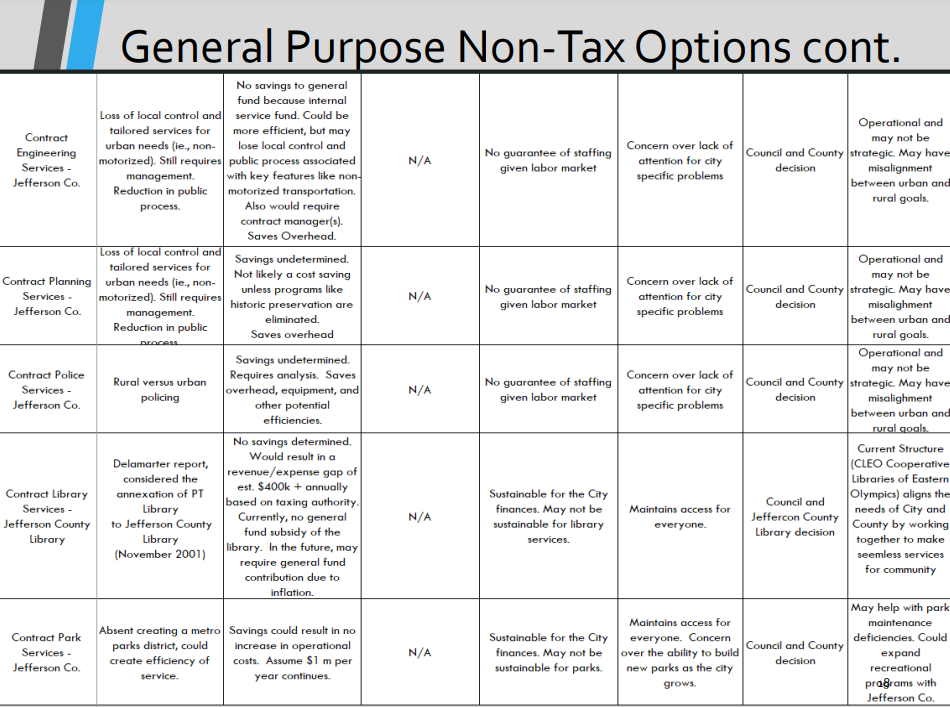
This was one of the most important city council sessions in years. It received decent coverage by Peter Seagall of the Peninsula Daily News. It was ignored by the city’s own newspaper. Staff’s PowerPoint presentation is here. You can view and hear the entire 2.5 hour meeting at this link. You will hear city leaders laughing and joking. Yet the situation is so serious that having the county take over the city’s police department, parks, library, planning and engineering services was presented for consideration.
Here is the full list of our reporting on the Cherry Street Project since our first article:
Unhappy Birthday: Cherry Street Project Turns Five Years Old 5/9/22
The Tragedy of the Cherry Street Project, 12/12/18
What’s Happening With the Cherry Street Project? 10/29/19
“Completely Bogus” Numbers–More Problems and Delays for Cherry Street Project, 12/2/19
Multi-Million Dollar Fraud on Taxpayers: The Cherry Street Project Unmasked, 6/27/20
Cherry Street Welcomes First Tenants, 2/28/20
Default the Cherry Street Project Now, 4/22/20
Latest Cherry Street Giveaway Hits Taxpayers Harder, 10/2/20
Cherry Street Project Handover “Not a Done Deal,”10/19/20
Accomplished Developer Will Donate Time and Services for Cherry Street Project, 10/20/20
Cherry Street Handover: Red Flags About Bayside Housing, 3/3/21 (and related articles)
Happy Fourth Birthday, Cherry Street Project! 5/10/21
Cherry Street Project Costs Soar in Bayside Housing Proposal, 6/23/21
New Majority on Council Should Kill the Cherry Street Project, 11/27/21
Cherry Street Project Vandalized, 1/4/22
“Incredibly Expensive” Housing Project Follows Cherry Street Debacle, 1/6/22
Mayor Faber (Almost) Opens Up on Cherry Street Project Failure, 4/23/22