by Jim Scarantino | Apr 11, 2020 | General
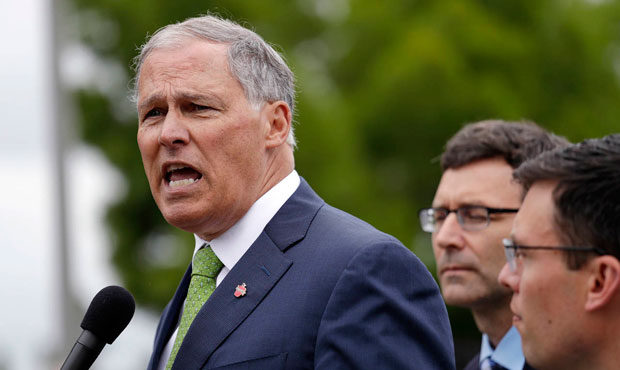
We face great dangers to life and liberty, not just from a novel virus, but also from political leaders who too quickly embrace the role of dictator and abuse their power. That’s how it goes with dictators. And that’s how it’s going with Jay Inslee.
On one hand, Inslee has done some things right, though his delay in responding to the COVID-19 crisis and his administration’s lack of preparation cost lives and allowed the virus to spread. An in-depth review of events by the Seattle Times shows that Inslee’s initial steps were grave missteps.
“How the coronavirus overwhelmed Washington’s early steps to contain it,” Seattle Times, April 5, 2020.
Inslee’s decision to order a statewide emergency, and trigger his emergency powers, had the desired impact. He got the state’s undivided attention which had been missing, in part due to Inslee’s own downplaying of the threat from the virus, as the Seattle Times reports.
Finally, on March 23, Governor Inslee issued his stay-at-home order, accompanied by his list of businesses he deemed essential, with the consequence that all those that did not make his list had to cease operations.
Dictator For How Long?
Inslee has begun unilaterally to expand his emergency powers beyond those permitted by state law, RCW-43.06.220.
His order extending the statewide stay-at-home order to May 4 goes beyond the thirty days voters approved when they agreed to subject themselves to a temporary dictatorship during a state of emergency. Inslee has said he might give himself an even a longer term as dictator. The law required consultation and consent of legislative leaders to any extension of time. By claiming the extension unilaterally he has put legislative leaders into a position where they either acquiesce or are forced to take action to preserve the rule of law. The Legislature and courts are in Democrat control. Inslee likely faces no serious challenge to ruling by fiat. Especially, since as is next discussed, Inslee has been using his powers to favor Democrat interests and constituencies while harming those that fall into the Republican camp.
Inslee has also ordered all public and private schools to close for the remainder of the school year, another action extending dictatorial powers beyond the time period to which voters consented.
Playing Favorites
A close analysis of Inslee’s essential business designations shows he’s been playing political favorites. Because his list produces ludicrous results, we should ask hard questions about what is going on.
Under Inslee’s decree, you can build a pot shop, but not a house. Because Inslee has decreed that marijuana retail is an essential activity–but not residential housing construction–remodeling, or expansion of a pot shop is permitted.
The state gets huge tax revenues from marijuana farming and retail, and the marijuana lobby is a well-funded, influential lobby solidly in Inslee’s column.
You can organize unions. You cannot oppose them.
Inslee has deemed unions and “worker advocacy organizations,” and everything they do, as essential activities. Union organizers can continue to organize and play politics. But employers and their lawyers, even workers who don’t want to be unionized, can’t come out of their houses. Inslee has shut them down. Along the same lines, a union can hold meetings of members, but a church congregation cannot gather to sing songs outside in a parking lot, even if everyone stood twenty feet apart.
Surgical abortions may continue, but many cancer patients have been told their procedures are canceled indefinitely. So the cancers inside these patients continue to grow, and they and their families are left to worry and pray. Limited and strained resources that could be used save lives, Inslee has permitted to be used instead to end lives.
You are likely already providing the explanation yourself: Inslee and the Democrat Party are pro-abortion and strongly supported by abortion activists and businesses that make money killing unwanted human beings. Those powerful interests contribute heavily to Inslee and Democrats, directly and through their own political action committees.
Realtors can show and sell houses and earn real estate commissions, but new houses can’t be built. Realtors can meet with clients, title companies, prospective purchasers, conduct home showings and closings. But carpenters can’t work at opposite ends of a new house, a plumber can’t work alone under the house, a painter can’t be on a ladder outside. Multi-million dollar homes and condos can be bought and sold, but a low income family cannot buy a new manufactured home, because those are not sold by realtors. But they can buy a used one, as long as a realtor is in the deal getting a commission. FSBOs are non-essential under Inslee’s central planning.
Realtors spend tons of money on politicians, mostly Democrats. They have powerful political action committees, and trade organizations with lobbyists who know their way around Olympia and have the phone number for the Governor and his chief of staff.
Inslee has hit rural counties disproportionately hard. Some of these counties were already suffering Applachia levels of despair and unemployment. They have seen very few, even no COVID-19 cases or deaths. Inslee has hammered their struggling communities by making them subject to the same restrictions needed in King County.
Rural Washington did not put Inslee in the Governor’s mansion and he’s not counting on rural Washington to keep him there.
Some of this nonsense can be attributed to central planners who just aren’t very good at what they’re doing. But some of these bizarre situations are no doubt due to political favoritism.
Projects Inslee supports go forward. Those he doesn’t care or know about are stopped dead. People working on the Key Arena construction, Sound Transit projects and government funded housing can keep working. He sees these things. He doesn’t see the small businesspeople who work alone, or with family members or the small teams of people who build much of the affordable housing in this state. If workers on publicly financed housing can continue without spreading the virus, why can’t they? The answer won’t be found in science or medicine. The answer lies in politics because nothing else makes sense.
Inslee has also benefitted himself politically by shutting down his opposition.
It is impossible to follow the news and not see Inslee’s daily press conferences, sometimes more than one appearance on camera per day. Inslee has been out and about, doing photo ops, delivering speeches, cutting ribbons and being seen with health care workers, business leaders, and other political figures. Much of it is plain old campaigning. There’s no reason for Inslee to be there, except to get his face on television. Having declared himself, his staff and all he does as “essential,” he can dominate the evening news every night. He can monopolize media attention. And he can work on his campaign for re-election.
The people seeking to replace him this election year? Non-essential according to Inslee. He is all Washington needs. All those other guys have to stay home.
by Jim Scarantino | Apr 3, 2020 | General
We need a Smarter Stay-At-Home Order. Gov. Jay Inslee’s current version is causing avoidable collateral damage.
We get it. Flatten the curve, maintain social distance, wash your hands, don’t touch your face and wipe down frequently touched surfaces.
Sure, some people don’t get it and the hunker inside order was necessary. Canceling mass gatherings, getting people out of crowded bars, not requiring people to work in close proximity–an overall throttling back was a good move.
But Jay Inslee has shown that in exercising unprecedented emergency powers he is a very poor central planner.
Let me correct that: he has shown he is just like all other central planners who believe they can run entire economies by deciding what is and is not essential and who should win and lose.
Governor Inslee needs to start getting more of Washington back to work even as he extends his stay-at-home order to May 4. A sick, sputtering economy that devastates businesses and lives for years is looming before us because he has made some quite bad decisions.
In extending his order Governor Insleee did not modify the list of essential businesses, or take any steps toward permitting closed businesses to start resuming or preparing to resume operations. That was a huge mistake. Businesses cannot turn themselves on with the flip of a switch on May 5 and return to the level where they were. They need to start gearing up now.
Anybody who has run a business would know this. Jay Inslee has never run a business, created jobs or steered a business through rocky times.
Take, for instance, construction, one of the most significant sectors of the economy. It has an enormous multiplier effect, positive when doing well, severely negative for everybody in a downturn. And this is not a downturn: it is a suicidal government-mandated nosedive. It’s like Japanese generals chaining pilots to the steering wheels of kamikaze planes. Inslee is the Japanese general; many of the rest of us are chained in our seats on a plane he has ordered to crash.
Governor Inslee could have modified his ban on almost all construction activity by permitting crews limited in size to perform tasks to preserve the job site and work already completed, and prepare for rapid resumption of full activities. Some work can be performed by small teams who need not be in close proximity. Much construction work is done outdoors, where the risk of spreading the virus is much lower than in office settings or Amazon warehouses and pot shops where he is permitting some businesses to continue to operate.
We’ve heard from Inslee that we have a dire housing emergency. But he has shut down all residential construction. Only residential construction funded by government may continue. How does that make sense when the driving rationale is supposed to be stopping the spread of the virus? How is a publicly funded housing project more sterile than one funded by a future homemowner or a bank? Workers do the same tasks, Governor Inslee. But workers on projects he perhaps supports more than others get to continue working.
As projects sit idle, the consequences cascade and multiply. Weather and the turn of seasons are not obeying a huddle-in-place order. “Make hay while the sun shines,” a common sense principle, has been made a criminal violation by Jay Inslee, but not for publicly funded construction work. Or hockey arenas. (You think the Key Arena construction project might have a little more political clout than hopeful homeowners and small contractors?)
Time is money, both in terms of financing and in construction projects’ critical paths, which have now been thrown off course. Skilled labor can be lost if it is not used. Heavy equipment rented for now idled projects can be moved to places where work continues.
Inslee has taken a sledgehammer to construction work. He is imposing maximum damage that use of a scalpel could have avoided.
And it makes no sense.
A person working a piece of heavy equipment is not cheek-to-jowl with another worker. They are alone and isolated in their excavators and cranes and bulldozers. There is no reason for them to be sitting at home while their employer faces bankruptcy.
A man digging a trench is no threat to anyone.
A carpernter on a roof is no threat to anyone.
A plumber crawling under a house is no threat to anyone.
But an economic shutdown that will inflict lasting damage is a threat to everyone.
Look, the Governor is allowing realtors to show properties as long as the house is empty and they are taking only one person at a time. If a couple wants to view the home, one stays outside while the other goes in with the realtor, then they switch. (Realtors and their associations, hmm, who do they support with their vast political contributions?)
Jay Inslee says that buying and selling existing homes, and earning real estate commissions, is an essential activity. But building new homes and apartments is not–unless he’s paying for it.
If Governor Inslee can work out a solution for those buying and selling houses, he can do the same for what is actually a far more critical sector of our economy, one that creates wealth by creating housing from sticks and bricks.
It is easy to take shots at industries and activities the Governor has not shut down, to argue they are not really all that essential, or that they are somehow being favored by the Governor. It is easy because Inslee has made it easy. The point is not to shut them down. If their business can be safely conducted, and they can stay up and running and keep people employed–great, no questions asked.
But I am asking questions about other shutdowns that make no sense, and there are plenty. Inslee’s errors in judgment are hurting people and will continue to do so for long after he lifts his order.
by Jim Scarantino | Apr 2, 2020 | General
U.S. Represenative Derek Kilmer is sponsoring legislation that would have prevented President Trump from banning travel from China and Europe to slow the spread of the COVID-19 virus and would have overturned bans on travel from Iran and other nations the President deemed a danger to the United States.
Kilmer’s proposed legislation is known as the “No Ban Act.” It would have set up a series of procedural hurdles and an indefinite time line before the President could have enacted a ban on travel from virus hotspots. It would have required additonal action by the State and Homeland Security Departments to intentionally prevent quick action by the President and Congressional hearings before and again within 48 hours after the ban was imposed. It would also have required immediate dissolution of any ban if Congress felt it had not been received sufficient information.
Kilmer’s act would also have held up travel bans in endless litigation. It would have created a legally enforceable presumption against any ban and given lawyers the right to challenge a travel ban, even if deemed critical to the nation’s security and welfare by the President, the Secretary State and the Department of Homeland Security. Litigation could be brought in the name of individuals or as class actions. Those lawsuits could have resulted in temporary restraining orders against travels bans while the litigation was pending, thus effectively nullifying any emergency action by the President to protect the American people from spread of the disease.
Kilmer’s legislation, if enacted, would have overturned all travel bans ordered by President Trump, from those imposed to protect the nation from terrorism as well as to protect it from spread of the coronavirus.
Kilmer’s legislation was advancing through the House, and the coronavirus threat was growing, while the Congress was occupied with impeachment proceedings. The Administration, though, was ramping up its efforts to fight virus. The coronavirus outbreak in China had become an international health and security issue by late December 2019 (the CDC had organized its COVID-19 Incident Management system by January 7, 2020 and was working toward vaccines and cures). As impeachment proceedings consumed the House and Senate, the White House organized its own task force on January 27, chaired by the President at the same time as he defended himself against removal from office. On January 31, the President declared a national health emergency and banned travel from China. That ban brought charges of racism and xenophobia from Democrats such as the Speaker of the House Nancy Pelosi, Joe Biden and Kilmer’s fellow sponsors of the “No Ban Act.” Kilmer did not dissent from those attacks on the China travel ban.
During this time, it has recently been reported that President Trump had been holding regular COVID-19 discussions with some legislators, such as Sen. Tom Cotton, who had to leave impeachment proceedings to work on the emerging coronavirus threat.
The Democrat controlled House did not address the coronavirus pandemic until after the President’s acquittal by the Senate. On February 5 the House Subcommittee on Foreign Affairs finally took up the issue. None of the committees on which Kilmer sits took any action on the pandemic until weeks later, though his “No Ban Act” was moving forward to full consideration by three committees.
Kilmer ignored the COVID-19 pandemic until February 4, 2020, when he joined in a letter requesting the CDC to distribute rapid diagnostic tests to states with confirmed COVID-19 cases. The letter cited the need to contain the spread of the virus and complimented the CDC for its leadership and success thus far. One of the actions of containment supported by the CDC and deemed critical to containing the virus was the very ban on travel from China and Iran that Kilmer was seeking to overturn.
As late as March 5, Kilmer’s effort to overturn the President’s travel bans was seeing action in the House of Representatives and moving through committees.
His “No Ban Act” has suddenly, and quietly, slid off the radar since it became clear that travel bans have been necessary to slow the spread of the virus and dozens of nations have enacted them to protect their citizens. Kilmer and his cosponsors, however, have not withdrawn the bill and it may be resurrected at any time.
Kilmer has not responded to our questions on whether he has reconsidered his legislation to overturn the President’s travel bans.
Kilmer was urged to support the legislation by, among other groups, the Jefferson County Immigrants Rights Advocates. On September 23, 2019, they held a protest in Port Townsend against the President’s travel bans and urged Rep. Kilmer to sign onto the legislation. He subsequently agreed to be a cosponsor. The Jefferson County Immigrants Rights Advocates have not responded to questions on whether they continue to seek a reversal of the President’s restrictions on travel into the country and whether, in light of the need to slow and contain the current global pandemic, they continue to support the “No Ban Act.”
by Jim Scarantino | Mar 29, 2020 | General
Some people are not doing so well handling the pandemic.
In one sad case, a Port Townsend woman was heard screaming through her open back door. A teenage girl called out to ask if she were okay. The screaming woman answered, “Yes! I’m just letting out anger. I hope all Trump supporters die!”
As documented on Facebook (and preserved by this author in screen shots), an elected Jefferson County official and other, I guess you would call them progressives or liberals, celebrated news that Senator Rand Paul had tested positive for the novel coronavirus. “Karma!” they gloated. With witty twists of the knife they shared their fondest hope that Senate Majority Leader Mitch McConnell would be the virus’s next victim. This incident negatively impacted others. Some of us who saw the exchange contracted a case of disappointment in a man we had thought was better than that. Others suffered aggravation of preexisting conditions of maliciousness and immaturity.
It is possible these people may have overdosed on agitprop and outright lies from MSNBC and CNN, as well as achieving toxic levels of echo chamber feedback with others suffering similar symptoms from similar causal factors.
But people taking the right medicine seem to be doing much better.
There is the case of a friend who came to our door to collect scraps for his pig farm. He had been depending on restaurant food waste to make his operation pencil out. With so many restaurants closing or scaling back, he was in a bind. But due to a helping hand from people across the area, he was doing better than expected. All it took was the insignificant effort of redirecting kitchen scraps into a bucket instead of the garbage.
He was struggling. He was having to work harder than ever to feed his livestock. But he was smiling.
In what could be considered a longitudinal study, New Life Church of Port Townsend has organized outreach teams. One is working its way through the membership and friends list calling everyone to see if they are okay and let them know they are not alone. Another is ready to do chores or buy groceries and run errands for people who can’t get out, or who are afraid to go out. All indications are that participants in this field test of compassion and selflessness are exhibiting signs of good mental and spiritual health. Other churches reportedly have similar efforts in place and are experiencing similar encouraging results.
I came across a woman on her way to give blood at St. Mary Star of the Sea. A plasma collection outfit comes to Port Townsend once a month and was in town. She didn’t want to miss this chance to help. She displayed a positive, optimistic affect highlighted by a big smile.
I conducted an experiment on myself. I think I’m doing pretty good, though, like everyone else, there have been some dark clouds scudding across my horizons. I had heard that the new owners of Elevated Ice Cream were quite concerned about the sudden drop-off in business dashing their hopes for starting a new life here in Port Townsend. I bought a cold armful of quarts of ice cream and, except for the Salted Chocolate Caramel Swirl (mine, all mine!) distributed them to a couple neighbors. We all smiled.
Hoping to validate the experiment by duplicating results, I dug around in my garage and found an unopened package of N95 respirator masks. I took them to the hospital and gave them to the woman working the front door with her sanitizer and thermometer and questions about recent travel to China, Iran or Italy. They need more masks, she said. Maybe I have some deeper down in those old file cabinets supporting my work bench. Maybe they can use ones from opened packages I have laying around.
Oh, and we both smiled as I handed over the masks.
My wife joined in the experiment. She downloaded instructions from Providence St. Joseph’s on how to make surgical masks and set up her sewing machine and cutting board. When she was ready, I drove her to the San Juan Commons senior facility where they needed masks for residents. She was smiling when she got back in the car.
Another field test is underway. A volunteer Pony Express to deliver COVID19 vaccine trial samples from Jefferson Healthcare to the testing lab is forming. Every morning at 6:30 a.m. we’ll pick up specimen packages at the hospital and drive them to Discovery Bay where another team coming from further west will take them through the next leg of their journey.
We need more experiments and more participants. I spoke with a scheduler at Swedish Hospital in Seattle who had the sad job of calling patients to tell them their surgeries had been cancelled indefinitely because beds were or might be needed for COVID19 patients. I felt terrible for her. She said the only way she could get through this challenging time was to look for ways to help other people.
That seems to be the key, and what distinguishes those doing well from those who aren’t. We might not yet have a medical answer for the virus, but we have some mighty strong medicine against the pandemic’s side effects. Thinking of others, finding creative ways to help in spite of restrictions on our lives–that’s a sure-fire cure. The supplies of this amazing antidote are plentiful, limited only by self choice. Wonderfully, unlike pharmaceuticals, there’s no danger whatsoever it will be hoarded. You see, this miracle medicine doesn’t work unless you give it away.
Now, for this cure’s next big test: I need to learn what kind of ice cream the screaming woman likes.
by Jim Scarantino | Mar 5, 2020 | General
Homeowners don’t have cash to pay higher property taxes. It is tied up in their homes. Homebuyers need all their cash for downpayments and higher mortgages. Home sellers have cash only briefly. The proceeds from the sale of their home go towards buying a new place to live, and those places are also more expensive as real estate prices rise across the board.
But realtors have cash sitting on the table at every closing.
If we are going to tax anybody for affordable housing programs, tax realtors. They have money on hand and it is money that doesn’t build, buy or maintain housing.
Consider a sale I just watched in my neighborhood. A home was listed with a realtor. The owners did a lot of work getting it ready. The property received many views on Zillow and Redfin, but we saw very little activity in terms of showings. Indeed, I don’t recall ever seeing the realtor there.
Then one day the house sold to out of state buyers. It went for about $700,000. After closing costs, the state excise tax, and realtor’s commission, the owners had about $650,000. They needed all of that for their new home, the costs of moving and setting up a new residence and to recover the substantial cost of improvements over the years in the dwelling they just sold. The realtor got roughly $42,000.
$42,000 for what exactly? For advertising on Zillow and Redfin, mostly. For posting a sign at the street. For a few showings. For phone calls. For getting paperwork to the title company that really does most of the work on closing the sale.
The realtor paid the small 1.5% broker’s tax, $630, and still had more than $41,000 cash left. I have proposed a ten percent tax on real estate commissions, with the existing 1.5% going to the state and the additional 8.5% retained here in Jefferson County for affordable housing, or to tackle our homelessness needs. In the case of this transaction, that would translate to $3,570 for local housing programs from the sale of just one house. The realtor would still pocket $37,800 for not much work. For most families in our county, it takes a year of full-time labor to earn that much.
That amount of money is still plenty of incentive for realtors to continue to list $700,000 properties. They may try to increase their commission rate, but homeowners are chaffing at paying 6% and would likely resist. There may be enough competitive pressure building with on-line marketing options to prevent realtors from simultaneously raising their commission rates, in effect, engaging in illegal price fixing. As we discussed in a previous article in this series, realtors are already under scrutiny for their anti-competitive practices, practices which contribute inexorably to higher real estate prices.
Why Haven’t Housing Activists Looked at Realtor Commissions as a Funding Source?
It seems so obvious. The money is right there, on the table at every closing. It is an enormous pot of money. In 2019 Americans forked over about $75 billion in realtor commissions. That is 7.5 times the amount of commissions paid to Wall Street for stock and bond trading, even though the value of real estate traded was 2.5 times less. (Some of the statistics cited here come from a 2/15/2020 Economist article, “Tearing Down the House: Technology is Poised to Upend America’s Property Market.“)
Activists continue to seek increases in property taxes to fund housing programs, with the result that they make housing more expensive and also contribute to rising rents. Property tax increases for affordable housing have been defeated in several communities around Washington state, and are increasingly unpopular even in Seattle. The harsh reality is that Washington homeowners are close to breaking under the weight of constantly heavier property taxes.
Housing activists certainly are aware of the enormous amount of money coming out of property sales and going to realtors. They know these commissions could fund affordable housing. But they have chosen not to go there.
For one thing, many housing activists are too dependent on funding from certain realtors. Realtor trade groups also provide funding to housing activists. Considering how realtors behave as a cartel, driving prices up by restraining competition and information, their token support for housing activism could be viewed as a public relations stunt. If they were serious, they would be driving down commissions and closing costs and embracing, rather than fighting, technological innovation.
Realtors and their trade groups also possess a good deal of political influence. There are 2 million realtors in the United States. The National Association of Realtors is the nation’s largest trade group and displays its power with an impressive high rise headquarters in Washington, D.C.
Locally, some realtors not only have great political influence, they are also influential politicians and office holders. Many of Port Townsend’s problems have been caused by regulations and infrastructure strategies that favor higher end real estate to the detriment of work force housing, and blue-collar jobs. The net result biases the market toward higher real estate prices, which makes it easier for realtor/politicans to earn higher commissions with the same amount of effort.
Housing activists run the risk of losing what political clout they enjoy by suggesting that realtors should be paying more to address the crisis they have helped to create. Rather than take on realtors, activists often target property owners, a group lacking equivalent political organization and power.
One salutrary effect of taxing realtors would be motivating them to use their considerable influence to see that their tax dollars were applied with maximum cost-effectiveness. A sunset provision, say of ten years, would give realtors a target date for demanding real results so that the higher tax rate on their commissions need not be renewed.
Instead of settling for the few crumbs realtors cast their way, housing activists, perhaps gaining some insights and motivation from this series and articles we have linked, may realize that a more rational and more progressive source of funding should be seriously considered.
Related:
Tax Realtors to Fund Affordable Housing: A Proposal for Housing Activists
Realtors’ Anti-Competitive Practices Inflate Housing Costs
by Jim Scarantino | Feb 28, 2020 | General
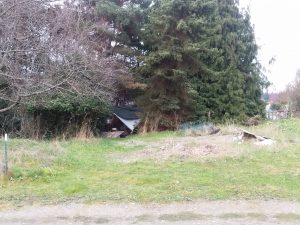
After three years and a budget of $3.2 million, the Cherry Street Project welcomed its first tenants. Not in the 70-year old building contaminated with asbestos and lead. No, these tenants are living al fresco in a homeless encampment.
The photograph for this story was taken February 27, 2020. It shows a trashed out camp in the trees just below the empty building that was barged from Victoria, B.C. nearly three years ago. The grounds are now full of trash–a discarded tire, broken gate, plastic, construction waste–and showing signs of severe erosion. The encampment itself is a heap of soggy sleeping bags, discarded clothing, loose garbage, bags of unknown items, and what appeared to be drug paraphernalia. More than one person has set up camp in the heart of what was once a very nice neighborhood.
Property values of surrounding houses were no doubt already in decline due to the proximity of the unfinished building and the neglected lot. It is unlikely the building will ever be completed. Our last report detailed how Homeward Bound Community Land Trust, the group behind the building–which already has nearly $2.2 dollars of taxpayer commitment through a loan from the City of Port Townsend and the gift of $600,000 in land–is going to default when its first payment is due this summer. They have been burning through the grace period that was supposed to have seen completion and rental of the building so that the group could start earning income with which to pay back the taxpayers. We explained more than a year ago how the loan package was doomed to result in default. See our December 12, 2018 report, “The Tragedy of the Cherry Street Project.”
The last word from the group behind the project, as we reported previously, was they needed at least another million dollars to finish the project.
A letter to the Port Townsend and Jefferson County Leader from former Port Townsend City Councilor Bob Gray, published after our last report, explained that nothing is happening to move the project forward because neither Homeward Bound nor the city has the money the project needs so that it can be rehabilitated, brought up to code and rented.
Who is responsible for this mess? Who should be held accountable? On one side is Homeward Bound, the group that has received generous taxpayer funding but in three years has failed produce any shelter except for this homeless camp. Kate Dean, a Jefferson County Commissioner, has been deeply involved in Homeward Bound for the past three years and is one of their longest serving board members. On the city’s side, Mayor Michelle Sandoval was the most vocal supporter of the project at its start when she boasted it would be “a demonstration project.” Our upcoming report will focus on the role these two officials have played in this fisaco.




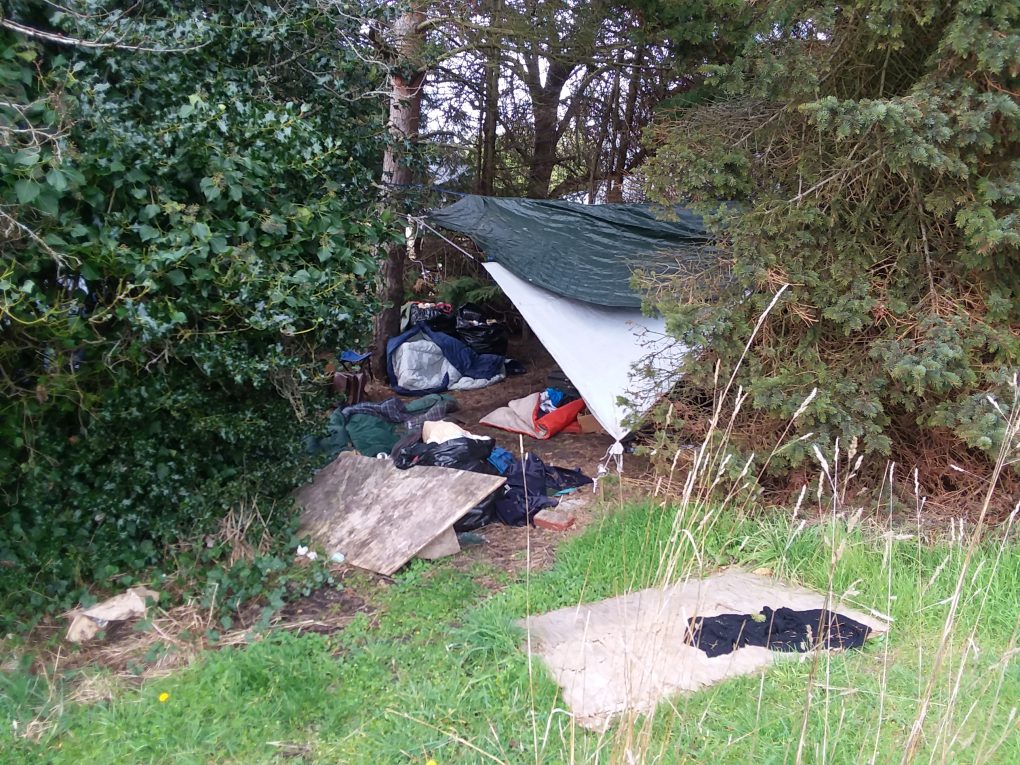
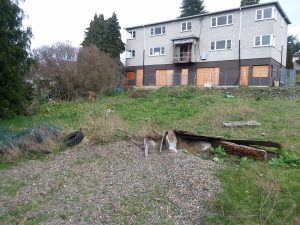 now full of trash–a discarded tire, broken gate, plastic, construction waste–and showing signs of severe erosion. The encampment itself is a heap of soggy sleeping bags, discarded clothing, loose garbage, bags of unknown items, and what appeared to be drug paraphernalia. More than one person has set up camp in the heart of what was once a very nice neighborhood.