by Ana Wolpin | Feb 20, 2021 | General
“Locke…is concerned about a Jefferson County group that may be spreading misinformation concerning the accuracy of the tests, claiming incorrectly that up to 90 percent of COVID-19 tests provide false positives.” [Peninsula Daily News, 2/7/21]
“Public naysaying on the spread of COVID-19 continued at Monday’s meeting of the board of county commissioners, with the public comment period being marked by more claims of false positive COVID-19 tests by some Jefferson County residents… ‘That kind of denialism is becoming more dangerous,’ Locke said.” [The Port Townsend & Jefferson County Leader, 2/3/21]
Who are these citizens being called dangerous by Jefferson County’s Health Officer, Dr. Thomas Locke? They are concerned citizens being censored by all media on the peninsula except the Port Townsend Free Press.
I am among them.
Dangerous Misinformation?
Over the past year, a group of local researchers has diligently examined data and analyzed information driving the global policies now devastating our world. Independent of our efforts, Stephen Schumacher was also deeply researching, coming to similar conclusions that much of the fear narrative being broadcast didn’t hold up to scrutiny.
In July 2020, Schumacher submitted a letter to the Port Townsend Leader citing statistics related to COVID-19 (Covid) lockdowns. His letter was withheld from publication for nearly a month, but eventually ran.
The following month, the Leader flatly refused to print his next letter. Unable to participate in the community opinion forum which “welcome[s] letters from our readers,” Schumacher then paid $500 to purchase ad space to share his information. A second ad, at the end of August, costing $550, warned about problems with the now-infamous discredited models Dr. Locke was citing to justify lockdowns. This was followed by two more ads regarding lockdowns in September and October.
In November, the Leader took censorship to the next level. After first accepting a paid ad about concerns over PCR tests, the publisher emailed Schumacher to inform him that they would not be running it. His ad featured a graph from a Harvard epidemiologist, and cited the Journal of the American Medical Association, the CDC, and other mainstream sources. In an email exchange asking why he was being censored, the publisher wrote, “We need to make decisions based on the best interest of our business.”
Was the payment Schumacher offered to exercise his right for freedom of expression insufficient when weighed against the newspaper’s role as a propaganda arm of Dr. Locke?
Schumacher took his rejected ad to the Peninsula Daily News. The PDN first agreed to accept his $530, then balked. The ad ultimately ran on Nov. 22. Several weeks later he attempted to buy ad space there a second time, but was told the publisher had rejected it. “When I asked if there was something specific I could have tweaked to make the ad acceptable, the answer was negative,” he said. “The content was verboten.”
PCR tests come into focus
While local censorship was ramping up, many scientists were expressing concerns that the PCR tests, responsible for exploding “case” counts and continued lockdowns, were not reliable. In some experts’ words, they are “not fit for purpose.” Most of this information was also being suppressed.
But on August 29, 2020, the New York Times published the story, “Your Coronavirus Test Is Positive. Maybe It Shouldn’t Be.” It quoted Harvard epidemiologist Dr. Michael Mina: “from 85 to 90 percent of people who tested positive in July with a cycle threshold [Ct] of 40 would have been deemed negative if the threshold were 30 cycles.”
Evidence mounted that cycle thresholds are critical, confirming the New York Times story.
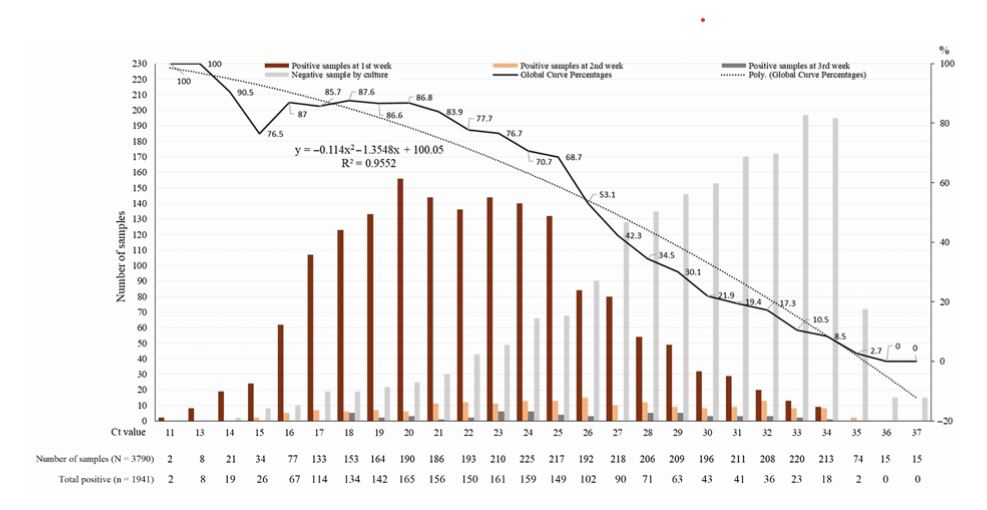
In a September article in Clinical Infectious Diseases, a French team looked at more than 100 studies on PCR tests. All studies found that above 30 cycles “patients could not be contagious as the virus is not detected in culture above this value.” They then performed 3790 of their own tests, reporting similar findings—of the samples that tested positive after 35 PCR cycles, 97% were negative upon viral culture. And of samples testing positive after 37 or more cycles, 100% were culture negative.
The lack of PCR reliability was reinforced in November by an international group of experts who formally challenged these tests as a valid diagnostic tool for identifying Covid cases. In their extensive report—“External peer review of the RTPCR test to detect SARS-CoV-2 reveals 10 major scientific flaws at the molecular and methodological level: consequences for false positive results”—the authors contend that serious defects in the test have “led to worldwide misdiagnosis of infections.” They conclude that the test is “completely unreliable” and “unsuitable as a specific diagnostic tool to identify the SARS-CoV-2 virus.”
In December, an Italian team documented that when the Covid PCR test is positive only at a high Ct value, the incidence of false positivity is at least 70%. Their article in the Journal of Clinical Virology warns that the detection of viral RNA at a high cycle threshold “needs to be interpreted with caution.”
Revised guidelines from the World Health Organization followed in January. All parties agree that beyond 30-35 cycles, the PCR test cannot reliably provide accurate identification of a Covid case, calling into question case figures worldwide.
Is this incontestable global consensus—that at high cycle thresholds PCR tests yield mostly false positives—the “misinformation” that Locke speaks of in the PDN quote above?
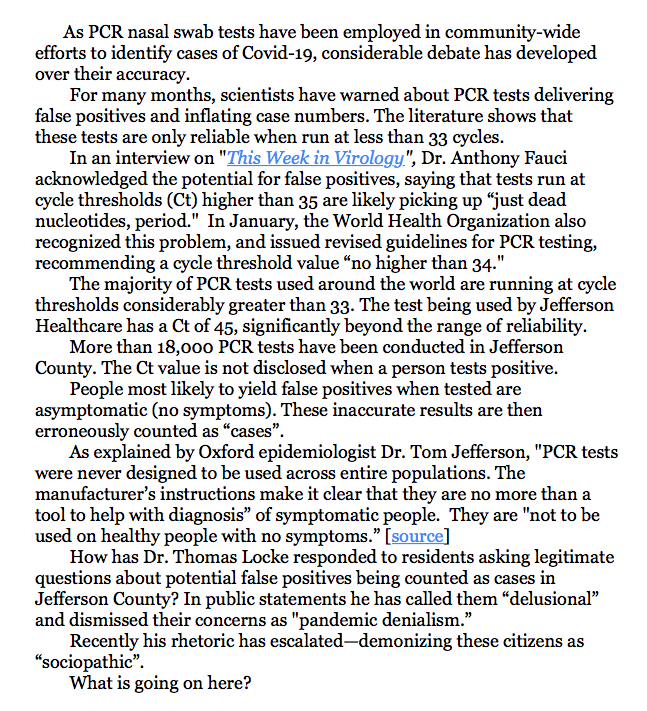
As revealed by Annette Huenke in her Port Townsend Free Press article, “Is Jefferson County Health Department Overstating COVID Case Numbers?,” the cycle threshold of the PCR test being used in Jefferson County is not 30 or 35 or even 40. It is 45. No scientist disputes that with a positive result at 45 Ct, the chance of infection is zero.
Our test results do not report the cycle count; they merely declare a binary positive or negative. Without the Ct information there is no way to judge viral load, or if the test simply picked up dead viral debris; if the person is contagious, or if the result is a false positive.
Locke has yet to disprove any of this information.
Censorship and Demonization: the New Normal
For several months I have been among the citizens writing to our county commissioners about this concern. In response, the commissioners repeatedly defer to their expert, Locke. He waves off any responsibility, passing the buck to state authorities—not my problem—while insulting the citizens bringing these issues to light.
Locke’s attacks have grown increasingly shrill and aggressive towards residents challenging his pronouncements. In a response to a brief request from Annette Huenke asking for data he had referenced in a weekly report broadcast on KPTZ, Locke concluded his email with:
“And no amount of data will convince people who are consumed by pandemic denialism and wish to rationalize their pseudoscientific, sociopathic beliefs.”
In addition to the “pandemic denialism” pejorative he has been using for months, the county’s Public Health Director is now calling citizens who ask relevant, important questions “sociopaths”. It is no wonder that increasing divisiveness is pervading our community.
Our voice is censored by all local media except this online publication. When some of us raised the issue with our county commissioners of free speech being denied by the mainstream press, Commissioner Greg Brotherton rationalized that it was important to have “a unified approach” in messaging the public. That is a euphemism for “official propaganda only.”
The newspapers not only refuse to investigate valid citizen concerns, they allow no right of rebuttal to Locke’s messaging and name-calling.
On February 10, I submitted this letter to the Leader:
To date, the Leader has not run my letter.
12/23/20 protest outside office of PT Leader
Nor has a letter about PCR tests from Dr. Robert Rennebohm been published, submitted a week prior to mine. An MD who has extensively researched Covid issues, Rennebohm stresses the importance of disclosing Ct values in reporting new Covid cases, underscoring the need for and responsibility of public health departments to change course:
“Medically, morally, and ethically—individuals with positive PCR tests, as well as physicians, epidemiologists, public policy makers, and the public—deserve to know, and need to know, the Ct value at which a SARS-CoV-2 PCR test is positive. Without Ct information, interpretation of the number of “new COVID cases,” “new COVID hospitalizations” and “new COVID deaths” is severely compromised, as is public policy and the care of individual patients.”
Rennebohm’s detailed explanation of Ct values can be read in the Port Townsend Free Press article, The Importance Of Knowing The Ct Value At Which SARS-CoV-2 PCR Tests Are Positive.
But not even a credentialed physician, one who I daresay has greater understanding of PCR’s uses and limitations than Locke, is permitted to offer a professional perspective in the Leader if it diverges from Jefferson County’s Public Health Director. Rather than requesting interviews or promoting healthy debate on an issue that is profoundly impacting every one of us, there is only the silencing of any viewpoint that does not support the official narrative. A “unified approach.”
Valid, scientifically confirmed concerns should generate robust public discussion in our community. Instead, county residents are deluged with one-sided information that is often inaccurate and falls significantly short of adequately educating the public. Area newspapers, the local radio station, and other media provide a bully pulpit for Locke to disseminate what many scientists around the world would argue is misinformation.
Reporting all sides of a story is the fundamental purpose of journalism, the recognition that a fully informed citizenry is the foundation of democracy. That has been suspended in our New Normal. Allowing diverse voices to engage in civil discourse is deemed dangerous.
Cycle threshold values are only a small part of the PCR story, the one that has gotten the most attention. Equally critical is the clear instruction—in accordance with the PCR test’s authorized labeling—that its use should be limited to symptomatic individuals… not inflicted across entire communities of people who, for the most part, are not sick.
On January 4, the Food and Drug Administration released “Risk of False Results with the Curative SARS-Cov-2 Test for COVID-19: FDA Safety Communication.” The FDA’s direction to healthcare providers, patients and caregivers is that PCR test use should be “limited to individuals within 14 days of COVID-19 symptoms onset.” Use on asymptomatic people or outside the two-week window was likely to produce false results, or at least inadequately interpretable results.
The story in Jefferson County
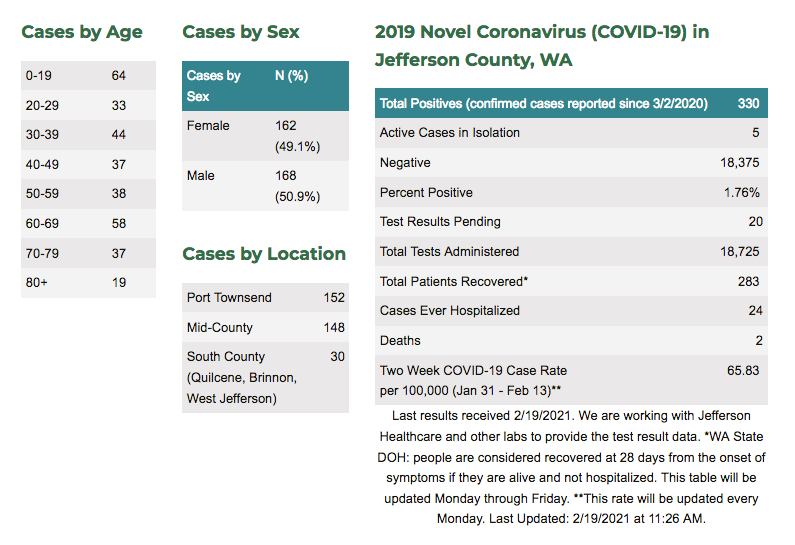
Of more than 18,700 tests administered in Jefferson County since March 3, 2020, over 300 cases have been identified as “positive” to date.
This includes symptomatic people—those with Covid symptoms like fever, body aches, and sore throat—who may have been tested within the 14-days-of-onset window.
It also includes people tested who had NO Covid symptoms—those who are in facilities or jobs that require testing; who go to the hospital for unrelated elective procedures; who are admitted to the ER after a heart attack, stroke, or accident; and those who ask to be tested out of fear, or curiosity—some of them getting multiple tests. None of these meet the criteria of showing symptoms in a 14-day window. Most of those tests are inadvisable and prone to false positives.
The only people with positive tests who can arguably be called legitimate cases are the first group—those who presented with Covid symptoms. As Dr. Tom Jefferson, the FDA and others have warned, PCR tests were not designed to be used randomly across general populations.
And these tests are not always reliable even in diagnosing symptomatic people. Without knowing the cycle threshold values of tests conducted, we have no clear data to identify true cases.
Over nearly a year, only two dozen of our Covid “cases” have been hospitalized. And even the people in that category likely included false positives. If a person was admitted to the ER due to a heart attack or stroke but tested positive for Covid, they were added to the county “case” tally and put in the Covid ward.
What is the real picture of Covid in our community? Of the 330 “cases” who received only a yes/no result from a PCR test that ran up to 45 cycles, how many test results were false positives? If the majority of people tested here were asymptomatic, how many of those with positive results were actually contagious?
Based on testing data the New York Times obtained from three states, only a tenth of the people counted as cases were true Covid positives; 90% were unnecessarily forced to isolate and submit to contact tracing. Jefferson County’s percentage of false positives may not be quite as high as those in Massachusetts, New York and Nevada. But without reviewing the Ct values of our test results, we simply do not know.
Why accurate case counts matter
In practical terms, being erroneously identified as a Covid case can have serious consequences. A false positive could result in your healthy teenager being quarantined for no reason, leading to suicidal ideation. Suicide rates have risen dramatically, especially among youth, since lockdowns were imposed.
Your own false positive might mean lost wages or damage to your business. Perhaps most harmful, though, is being stigmatized as a threat to other people’s safety. I know of people who felt perfectly healthy, but tested positive—likely false positives—and even after two weeks of quarantine, were treated like lepers by friends and co-workers afraid to be around them.
In a Daily Mail article, Dr. Tom Jefferson of the internationally acclaimed Cochrane Collaboration gives many examples of how people’s lives are being ruined by a similar testing regime in the UK:
“Last week I received an email from someone whose results have flip-flopped from positive to negative four times over two months, and another from a man who has been unable to see his elderly mother, isolated in a care home, because she continues to test positive week after week.” People, he says, “are at their wits’ end because they are testing positive for Covid-19 despite having recovered from their symptoms. Some never had symptoms in the first place but are still being told they have the virus long after any possible infection. They are anxious and confused. Their lives are on hold.”
At the extreme, being wrongly labeled a Covid case can kill you.
Say you are the person described earlier with no Covid symptoms and you have broken a bone. You are rushed to the ER and required to have a PCR test. A false positive result at a 45 cycle threshold places you in the Covid ward next to a contagious true-Covid-positive patient. Whereas your only actual medical issue is from your broken bone, you are now at risk of contracting Covid. And of dying— like the 80-year-old woman being counted as a Jefferson County Covid death. She was put in a Seattle hospital for complications due to surgery and is reported to have died from catching the virus there.
What has all this cost?
How much time, energy and resources have been spent for this massive testing program and the relentless propaganda campaign of ever-rising case numbers used to keep the public in fear?
What has been the true cost in Jefferson County? Much more than the money expended on 18,000+ tests and all the personnel involved. The impact on our community’s mental health, economic stability and social fabric is incalculable.
Dr. Tom Jefferson calls this deeply flawed testing program a “hugely expensive blunder”:
“I’d have to conclude that the official coronavirus figures have been grossly overstated, with all the damage that entails. Where appropriate we should carry out tests, but only in the context of symptoms, the date they first emerged, a history of recent contacts and any pre-existing medical conditions. I believe that Britain’s new-found testing mania is a retreat from properly conducted clinical medicine as well as from common sense. And that we are witnessing a triumph of herd thinking – an expensive one at that.”
Citizens have been terrorized week after week with alarming headlines about new case numbers, urging them to get their tests. Officials who have promoted this fear are deeply invested in the false story they have spun and the resources that have been wasted. No one wants to hear that they are responsible for such a massive error.
So the response is to shoot the messenger. Voices revealing the truth are censored, insulted, and vilified. In Jefferson County that is a coordinated effort between local media, the board of health, and our public health director.
We are now being told that censorship—the prohibition of free and open dialog—is justified. It’s for the greater good. These people are dangerous. And the more indefensible the narrative becomes, the more the censorship and attacks intensify.
PCR tests are being misused “to justify excessive measures such as the violation of a large number of constitutional rights,” writes Belgian physician, author and public health analyst Dr. Pascal Sacré. The assumption that a “positive RT-PCR test means being sick with Covid” is misleading, he says. Falsely equating positive tests with Covid cases is “the starting postulate, the premise of all official propaganda, which justifies all restrictive government measures: isolation, confinement, quarantine, mandatory masks, color codes by country and travel bans, tracking, social distances in companies, stores and even more importantly, in schools.” [source]
Are our leaders going to permit this misguided testing program to continue to fuel fear and inflict untold harm in our county? It is long past due for our local officials to put an end to this costly mistake.
by Dr. Rob Rennebohm | Feb 7, 2021 | General
As a pediatrician and pediatric rheumatologist who has published peer-reviewed articles on COVID-19, I would like to comment on the importance of knowing the Ct value at which a SARS-CoV-2 PCR test becomes positive. [The Jefferson County Health Department is not releasing this information. See our earlier article at this link. The Editor]
The PCR test for the SARS-CoV-2 virus is a good test when it is properly manufactured, properly conducted, used in an appropriate setting (e.g., in the evaluation of inpatients with COVID-like clinical features), and properly interpreted by carefully and fully taking Ct values into account.
It is not a reliable test when used in the screening of asymptomatic (or only mildly and non-specifically symptomatic) individuals, if the test is positive only after 33 or more cycles of amplification and this full information is not reported to patients and their physicians.
Ct = Cycle threshold; Ct = the number of amplification cycles needed before the test detects presence of viral material in a specimen. The higher the number of amplification cycles needed before detection of viral material occurs (i.e., the higher the Ct number), the lower the viral load and the less sick and contagious the person is likely to be.
If a test becomes positive after only 12 amplification cycles (i.e., positive at a Ct of 12), the viral load is very high—approximately 100,000,000 copies per microliter. [1-3] If the test becomes positive after 22 cycles (at a Ct of 22), the viral load is approximately 2,500,000 copies/mL. [4-5] If the test becomes positive only after 37, 40, or 45 amplification cycles, the result most likely represents either a false positive, or a true positive due to only a trace amount (less than 100 copies, even just 1-3 copies) of inert, non-contagious, “dead” SARS-CoV-2 viral debris (assuming the test is truly capable of always accurately identifying such a tiny amount of viral debris). [2, 6, 7]. Rarely, a positive test at a high Ct is identifying an asymptomatic person who has very recently become infected and might soon have a high viral load (low Ct), but this possibility can be evaluated by carefully following the person and repeating the test within 3-4 days, to see if symptoms develop and/or the Ct drops.
Unfortunately, it is very difficult to know with certainty whether a positive result at a Ct of 33 or higher represents a false positive or an accurately identified trace amount of SARS-CoV-2 viral material. The test was not designed to be reliably accurate after so many amplification cycles. When the test is used in an appropriate setting and the test is positive at a Ct of 30 or less, the false positivity rate is probably less than 4% (perhaps only 1-2%, as the test manufacturers claim). However, when the test is used in a surveillance setting and is “positive” at a Ct of 33 or higher (particularly at 37 or higher) the exact false positivity rate is currently unknown and likely to be quite high—probably as high as 70%. [6, 7]
Based on what is currently scientifically known, it is best (most accurate) to label any test result that is “positive” at a Ct higher than 32 as an “inadequately interpretable” result. It is not scientifically sound and, in fact, is misleading and harmful, to label people with a positive test at a Ct of 33 or higher as a “new COVID-19 case.” More accurately, they are people with an “inadequately interpretable” result who, furthermore, are unlikely to be infectious [2, 8]. Regarding this latter point, please see Graph 1 (after the References section), which points out that it is extremely unlikely that a person with a positive test at a Ct >35 is infectious.
For the above reasons, experienced PCR scientists recommend stopping the PCR test after 30 (or 32 at the most) amplification cycles, because positive results obtained after 32 or more cycles are unreliable (inadequately interpretable) [2] and are not associated with contagiousness [2, 8].
Unfortunately, to date, SARS-CoV-2 PCR tests have been reported only as being positive or negative, with no indication of how strongly or weakly positive. Although Ct results have always been available for each individual test (since the beginning of the pandemic), Ct results have not been routinely reported or used for clinical or epidemiological purposes. This has been the case throughout the USA and most of the world.
It has also been unfortunate that most SARS-CoV-2 PCR tests are set to perform 40, 45, even 50 amplification cycles in their effort to detect viral material. (This varies from one test kit to another—see Table 1 after References.) That is, if a person’s specimen is negative after 30 amplification cycles, further cycles are, nevertheless, performed (up to 50 cycles with some tests), looking for evidence of tiny amounts of viral material. Only if no viral material is detected after 40, 45, or 50 cycles (whichever number the test system sets as the stop point) is the test declared negative. Even if a test becomes positive only after 45 or 50 amplification cycles, it is declared a positive test (without any mention of the Ct value) and the person tested is declared a “new COVID case.”
The Jefferson Healthcare Lab uses the XpertXpress SARS-CoV-2 PCR test, which is set to perform 45 amplification cycles before stopping its effort to detect SARS-CoV-2 viral material.
When a person is told they have a positive SARS-CoV-2 PCR test, they deserve to know how strongly positive their test is and what their result means. Does their result mean they are carrying a huge viral load, are very contagious, and should be very worried about themselves and those with whom they have been in contact? Or are they carrying only a tiny amount of dead, non-contagious viral debris that represents no threat to them or others? Or are they in a pre-symptomatic phase, with a low viral load that could soon accelerate? Or does their result represent a false positive?
The Ct value at which a person’s test is positive can shed considerable light on the above critically important questions. But, again, to date, Ct values of positive tests have not been made available to patients, physicians, public servants, or the public.
Having emphasized the importance of knowing the Ct value at which a test is positive, it is important to also emphasize that there are limitations to the information provided by the Ct value. The Ct value is not a true quantitative test of viral load; it just provides a rough and indirect (but, nevertheless, very helpful) estimate (a good, educated guess) of what the viral load might be. It is true, too, that if the same specimen is tested with 3 different COVID PCR tests each might be positive at a different Ct value (e.g., at a Ct of 16 in one test, 20 in another test, and 22 in the third—but not at 37 or 45 in one of the three). For these reasons Ct values need to be interpreted with caution and in clinical context, particularly until more data on Ct values of positive tests have been collected and fully analyzed.
In the meantime, it is far better to have a COVID PCR test report that includes the Ct value at which the test was positive, than to have a report that only says positive (or negative) without any Ct information provided. Though imperfect, the estimate of viral load offered by the Ct value is far more valuable than no estimate at all, especially if the Ct value is carefully interpreted and placed into clinical context.
When in early November the CDC reported that 100,000 “new COVID cases” (meaning new instances of a person having a “positive” SARS-CoV-2 PCR result) were occurring per day in the USA, neither the individuals with the positive tests, their physicians, their public health departments, the CDC, the NIH, WHO, Johns Hopkins University, or the public knew what percentage of those 100,000 tests were positive at a Ct >32 and what percentage were positive at a Ct of 30 or lower—because, to date, the Ct values at which tests have been positive have not been reported or taken into consideration.
It would be enormously beneficial if we, as a nation, were to report, study, clinically use, learn from, and base public dialogue and public policy (at least in part) on the Ct values of positive tests. This would include retrospective and prospective reporting of the Ct values of all positive tests. We could at least start doing this in Jefferson and Clallam counties and, thereby, lead the nation in doing so. We would be doing the nation a great service.
Medically, morally, and ethically— individuals with positive PCR tests, as well as physicians, epidemiologists, public policy makers, and the public— deserve to know, and need to know, the Ct value at which a SARS-CoV-2 PCR test is positive. Without Ct information, interpretation of the number of “new COVID cases,” “new COVID hospitalizations” and “new COVID deaths” is severely compromised, as is public policy and the care of individual patients.
From now on, when a person is told that their SARS-CoV-2 PCR test is positive, they and their physicians would be wise to ask, “At what Ct value was the test positive?” And when the public is told that 100,000 new COVID cases have been occurring per day, the public and their public servants would be wise to ask, “What percentage of those 100,000 were positive at a Ct of 33 or higher (particularly a Ct of 37 or higher)?”
Such questions and their honest answers would facilitate healthy public dialogue and stimulate much-needed critical thinking—both of which are essential for successful resolution of the COVID-19 pandemic. True science and true democracy depend on such critical thinking and healthy, informed, public dialogue.
For further, more detailed discussion of Ct values, including caveats about Ct information, please see my original article, “The Importance of Knowing the Ct Value at which COVID PCR Tests are Positive,” which may be found on the “Notes from the Social Clinic” website: https://notesfromthesocialclinic.org/the-importance-of-knowing-the-ct-value-at-which-covid-pcr-tests-are-positive/
REFERENCES:
- Tom MR, Mina MJ. To Interpret the SARS-CoV-2 Test, Consider the Cycle Threshold Value. Clin Infect Dis. 2020 May 21: ciaa619. Published online 2020 May 21. doi: 10.1093/cid/ciaa619
- TWiV 640: Test often, fast turnaround, with Michael Mina. https://youtu.be/kDj4Zyq3yOA
- Your Coronavirus Test is Positive. Maybe it shouldn’t be. Interview with Michael Mina, MD. Published August 29, 2020; Updated September 17, 2020. https://www.nytimes.com/2020/08/29/health/coronavirus-testing.html
- Bryan A, Fink SL, Gattuso MA, et al., SARS-CoV-2 viral load on admission is associated with 30-day mortality. Open Forum Infect Dis. 2020 Dec; 7(12): ofaa535. Published online 2020 Nov 3. doi: 10.1093/ofid/ofaa535
- Perchetti GA, Nalla AK, Huang ML, et al. Validation of SARS-CoV-2 detection across multiple specimen types. J Clin Virol. 2020; 128:104438. doi: 10.1016/j.jcv.2020.104438
- Francesca F, et al. Detection of SARS-COV N2 Gene: Very low amounts of viral RNA or false positive? J Clin Virol. 2020 Dec; 133: 104660. Published online 2020 Oct 14. doi: 10.1016/j.jcv.2020.104660.
- Katz AP, et al. False positive reverse transcriptase polymerase chain reaction screening for SARS-CoV-2 in the setting of urgent head and neck surgery and otolaryngologic emergencies during the pandemic: Clinical implications, Head Neck 42 (7) (2020) 1621–1628, https://doi.org/10.1002/hed.26317
- Jaafar R, Aherfi S, Wurtz N, et al. Correlation Between 3790 Quantitative Polymerase Chain Reaction–Positives Samples and Positive Cell Cultures, Including 1941 Severe Acute Respiratory
Syndrome Coronavirus 2 Isolates, Clinical Infectious Diseases, ciaa1491, https://doi.org/10.1093/cid/ciaa1491
GRAPH 1: Percentage of positive viral culture of SARS-CoV-2 PCR positive naso-pharyngeal samples from COVID-19 patients. No sample that was positive at a Ct >35 had a positive culture. (Reference 18: Jaafar R, Aherfi S, Wurtz N, et al. Correlation Between 3790 Quantitative Polymerase Chain Reaction–Positives Samples and Positive Cell Cultures, Including 1941 Severe Acute Respiratory).
TABLE 1:
The number of amplification cycles that various commercial SARS-CoV-2 PCR Tests are set to perform in their effort to detect viral material:
- Gnomegen: 39 cycles
- GK: 40 cycles
- In Bios-Aires: 45 cycles
- Xpert Xpress: 45 cycles
- Luminex: 45 cycles
- Quest: 50 cycles
by Jim Scarantino | Feb 6, 2021 | General
The public has a right to know whether they can trust the COVID test results being used to destroy businesses and jobs, to curtail educational, community and religious activities and to exacerbate many of our already serious social ills, including substance abuse, domestic abuse, crime and suicides. An arrogant, “Because I say so,” is no longer acceptable. We are seeing public health officials and county commissioners finally speak against Governor Inslee’s arbitrary and unscientific dictates.
Citizens have the right to know how solid or flimsy is the testing data being used to extend lockdown orders now recognized as unfair and not based on sound science.
As explained in an article here by Annette Huenke, Jefferson Healthcare is using testing protocols that can return, in lay terms, practically meaningless positive COVID test results. We are not being told how many cycles were run on each reported positive “case.” Anything above 32-33 cycles or so is recognized as producing meaningless results (again, in lay terminology). Jefferson Healthcare employs a protocol that can run as many as 45 cycles on a sample until it gets a result or the cycles are completely run through, raising unanswered questions about how many of our “cases” were little more than meaningless test results.
It matters because people with only trace (again in lay terms–read the article for more precision) evidence of COVID, and with no symptoms or risk of transmission are being added to our numbers, Each additional “case” is used as justification to continue to inflict injury on our community and individuals with a senseless extension of the Governor’s ever-changing-but-never-expiring lock down order.
Private citizens have the right to ask these question. Disclosure of this information is routine in some states. It is mandatory in Florida. Stephen Schumacher is well qualified as an investigator of what should be a matter of public record. He understands data and knows the questions to ask. He graduated with honors in Mathematics from Harvard College and programmed funds transfer systems between Wall Street banks and the Federal Reserve before moving to Port Townsend in 1983. He has served as an officer for various community organizations such as the Food Co-op, Jefferson Land Trust, and the Northwest Nutritional Foods Association. He co-created The Port Townsend and Jefferson County Leader’s original online newspaper and programs shipboard stability software used by naval architects. He is a careful, rigorous researcher.
He has been asking important questions of Dr. Thomas Locke, Jefferson County Health Officer, for months, with no response at all. Recently, after publication of several articles here, Dr. Locke communicated with Mr. Schumacher, but still is not answering these questions. For that matter, neither is the Washington Department of Health. What we are getting is deflection and, at times, ad hominem jabs. This happened last year when Gov. Inslee was confronted with evidence that COVID death statistics included instances where people clearly died from other causes, such as being murdered. He deflected questions about these facts and insulted the research foundation that had uncovered this information in the DOH’s own records.
We are publishing the full exchange thus far of correspondence between Dr. Locke and Mr. Schumacher. The Board of County Commissioners has sometimes been in the middle of this exchange. The Clallam County Health Department has also been receiving the correspondence.
To fully grasp the importance of the details being discussed, we suggest reading Ms. Huenke’s article and Mr. Schumacher’s article published by Port Townsend Free Press, and the sources linked in each of those articles.
Mr. Schumacher to the Board of County Commissioners, a response and critique of Dr. Locke, 2/6/2021
Dear Jefferson County Commissioners,
I received the following emails from Dr. Locke responding to my
questions to you about PCR tests with high Cycle Thresholds.
Dr. Locke says the county doesn’t set “standards for what is
considered a positive PCR test” so “if you have an issue with Ct
values you should take it up with Washington DoH or the FDA.”
This passes the buck while ignoring things the county CAN do, such as
(1) direct Jefferson Healthcare to look for a PCR test with Ct cutoff
below 35 cycles instead of 45; (2) obtain the Ct value for each
positive test through PCR labs’ customer support when Ct is not
routinely reported as Florida DoH requires; (3) include Ct values
with case statistic reports, so our county can know how many cases
occurred at each Ct level.
Dr. Locke says Cts “add little of value to … the diagnosis of
active SARS-CoV-2 infection [since] they are more reflective of
specimen quality, viral load, and variations of lab technology.”
But “viral load” is directly relevant to infection diagnosis! The
hundred million virus copies per microliter at low Ct are far more
indicative of a true positive diagnosis than the trace viral debris
identified at Ct of 45. Even if the negligible quantity was due to
“specimen quality”, high Ct indicates a re-test is needed before
counting a positive test result as a COVID case.
Dr. Locke says “false positive tests … appear to be quite
infrequent with PCR testing, especially when a person has a
COVID-like illness”.
This may be true when Ct is low, but consider that “in three sets of
testing data that include cycle thresholds, compiled by officials in
Massachusetts, New York and Nevada, up to 90% of people testing
positive carried barely any virus… from 85 to 90% of people who
tested positive in July with a cycle threshold of 40 would have been
deemed negative if the threshold were 30 cycles”.
https://www.nytimes.com/2020/08/29/health/coronavirus-testing.html
Dr. Locke says false positives are infrequent because “we focus PCR
testing on people who are symptomatic”. But where is the data
showing most of our nearly 18,000 tests to date were on people having
relevant symptoms? Many asymptomatic county residents have sought
tests out of fear, and every hospital patient is required to be
tested even if their issues are not COVID-related.
It may also be that our county case count is as high as it is because
routine testing of many asymptomatic people has led to many high Ct
positive tests. The only way to know for sure is by reporting the
percentage of cases exhibiting symptoms and the Ct associated with
positive tests.
Though the estimate of viral load provided by Ct may be imperfect, it
is far more helpful than a bare positive or negative test
result! How could getting no information about viral load (or a wild
guess) be better than the rough estimate (or educated guess) provided
by a Ct value interpreted cautiously in a clinical context? People
have a right to know and should be trusted to know.
Yours truly,
Stephen Schumacher
Dr. Locke’s immediately preceding correspondence to Mr. Schumacher, copied to BOCC and others, 2/2/2021
Mr. Schumacher,
Hopefully, the bulk of your concerns were addressed in my response to
your long list of questions yesterday. Your notion that Jefferson
County case rates might somehow be reduced by applying a new
definition to PCR positivity is fanciful, at best, and delusional, at
worst. CT values are only one of many factors used to interpret PCR
test results. CT is merely a measure of the degree of amplification
of the viral genetic material present in the clinical specimen. As
previously mentioned, many factors can affect the amount of virus on a
swab. Additionally, labs vary in terms of protocols and testing
equipment and CT values can vary from lab to lab, even on identical
specimens. Far more important, from a standpoint of separating “true
positives” from “false positives” is the pretest probability of
infection. Most diagnostic tests will yield false positive if done on
people with very low risk of having the condition being tested for
(low pretest probability). The converse is true as well, if performed
on people with high pretest probability of infection, the positive
predictive value of a positive test result is much higher. This is
why we focus PCR testing on people who are symptomatic with COVID-like
illness and/or have close contact exposure to known cases of
infection. These are the Jefferson County cases you are speculating
might be erased by redefining CT thresholds — people who are acutally
symptomatic for COVID-19 or are household/workplace contacts of active cases.
The group that is more likely to have false positive results are those
who are being screened prior to surgical procedures or travel. This
is especially true if the person is asymptomatic and has no exposure
risk factors. Since 20-40% of COVID infection can be asymptomatic and
infection can be spread in the presymptomatic phase of illness,
preprocedure testing has its values but it does run the risk of
generating false positive results. This is completely independent of
the CT value you seem very interested in. When we suspect a false
positive result, we generally need to do two additional negative tests
to establish that diagnosis.
Your apparent belief that there is an epidemic of false positive COVID
tests is not supported by the facts. If anything, confirmed tests
dramatically underestimate the true COVID disease burden in a
community (by a factor of 5 to 10X in most studies). The reason that
CT values are not routinely reported by labs is that they add little
of value to the purpose of the test — the diagnosis of active
SARS-CoV-2 infection. They are more reflective of specimen quality,
viral load, and variations in lab technology. If you would like the
Washington State Department of Health or the FDA to revise their PCR
testing protocols you should take that up with them. Jefferson
County Public Health cannot serve as your intermediary in this
process. We have far more urgent duties to perform.
Sincerely,
Thomas Locke, MD, MPH
Jefferson County Health Officer
Dr. Locke’s Correspondence to Mr. Schumacher, copied to BOCC and others, 2/1/2021
Mr. Schumacher,
Cycle threshold values on PCR tests performed to detect SARS-CoV-2 are
not routinely reported by laboratories to health departments or the
person ordering the test. The Washington State Department of Health
establishes standards for what is considered a positive PCR test and
is reportable as a notifiable condition. The local health officer has
nothing to do with establishing CT parameters or any other diagnostic
lab parameter. If you have an issue with CT values you should take it
up with Washington DOH or the FDA. Jefferson County Public Health
does case investigations and contact tracing of all positive tests
reported to Washington State and available to us through a
confidential on-line registry known as WEDSS.
The fact that a thermal cycler can perform up to 45 amplification
cycles does not mean that ALL tests are amplified to that degree.
Samples are cycled until a signal is detected or they have undergone
the maximum amplification of the testing protocol. Samples can have
high CT values for many reasons — poor sample quality, degradation of
the sample during transport, low viral levels in the person being
tested, and testing late in illness when fragments of non-replicating
virus can be detected. And it is certainly true that high CT values
correlate with lower transmission risk (assuming adequate sample
collection and specimen transport). Setting standards for FDA
approved diagnostic tests is a federal regulatory function. States
set standards for notifiable conditions such as SARS-CoV-2 infection.
County health officers, local boards of health, county boards of
commissioners, and public hospital district commissioners have nothing
to do with these decisions.
Again, if you have grave concerns that the Washington State Department
of Health is using scientifically indefensible criteria for
determining which COVID-19 PCR tests are positive, please share your
expertise and concerns with them. These criteria are not set by
county health officers or local hospital districts. Nor do we
manufacture or license the PCR machines that are used to test
diagnostic specimens for SARS-CoV-2. We rely on these tools along
with our case investigations (looking at exposure risk, symptom onset,
and other risk factors) in assessing cases. False positive tests can
occur with any diagnostic technology. They appear to be quite
infrequent with PCR testing, especially when a person has a COVID-like
illness or a recent exposure to a confirmed case. If your goal is to
support the pandemic denialism that Ms. Huenke promotes in the “Port
Townsend Free Press” article you reference, I could not disagree more.
With the spread of more transmissible variants of SARS-CoV-2, the
social cost of pandemic denialism is increasing. If sizeable numbers
of people indulge in the wishful thinking that attempts to control
COVID-19 transmission are unnecessary, it is only a matter of time
before variant strains become predominant. We still have time to
avert this future or at least slow it enough to allow widespread
vaccine deployment. I urge you to join the community fight against
COVID-19 and stop attacking those who are working long hours trying to
protect their community from the worst public health emergency in the
last 100 years.
Sincerely,
Thomas Locke, MD, MPH
Jefferson County Health Officer
Stephen Schumacher to BOCC, 2/1/2021
Cc: Board of Health; Tom Locke; Allison Berry, Clallam County Health Officer
Subject: New hope for “negative cases” before Feb. 14
Dear Jefferson County Commissioners,
Watching the Zoom of this morning’s BoCC meeting, I noted that Dr.
Locke did not answer or even address any of my questions at bottom,
so they are all still on the table. I’m mystified by his
mischaracterization of well-documented concerns over 90% false
positive rates at high cycle counts as “nitpicky” and his
easily-refuted opinion that PCR tests are “highly accurate”.
Philip Morley observed that Jefferson Healthcare handles only a small
percentage of our county’s PCR testing, with most conducted by UW and
others. If so, that raises the additional question:
7) What Cycle Threshold is used by each organization performing PCR
testing in our county, and approximately what percentage of testing
is done by each organization?
Because of the critical importance of the cycle count in evaluating
the significance of a positive PCR test result, both pieces of
information need to be reported to individuals as well as in overall
county statistics.
Dr. Locke’s report began by warning about a tripling of cases with 26
new ones last week if I heard correctly. But what are the cycle
counts of these new cases? It makes a huge difference whether they
were found positive after 20 amplification cycles or after 45 cycles.
My interest is getting at the truth, not politics. But today’s
meeting seemed concerned about county cases showing percentage
improvements before a Feb. 14 deadline One way to achieve that in a
hurry might be to re-examine recent cases and reclassify any that
were incorrectly counted due to amplification cycles higher than 33,
then continue using that rule for new cases. Not only would that be
the right thing to do, it might achieve the “negative cases”
[Commissioner] Greg [Brotherton] ruefully joked are needed!
Yours truly,
Stephen Schumacher
Stephen Schumacher to BOCC, 1/31/2021
Cc: Board of Health; Tom Locke; Allison Berry, Clallam County Health
Officer; news@ptleader.com; PT Free Press
Subject: Accountability for Jeffco’s 45-Cycle Threshold PCR Test
Dear Jefferson County Commissioners,
On September 2, 2020, I sent the following Public Comment to the
Jefferson County Board of Health and Health Officer Dr. Tom Locke:
“Per the August 29 New York Times report [of 90% false positives at
40-cycle threshold], I’m concerned about the criteria used to
determine confirmed cases of COVID-19 in Jefferson County. Do all
these cases exhibit symptoms, or are “cases” being equated to
positive test results? If the latter, what percentage of cases
exhibit symptoms? Are positive test results being recorded using PCR
tests, and if so, what is the Cycle Threshold value used for these tests?”
I never received any answers to these questions nor have seen them
addressed by Dr. Locke in the press.
Last week the Port Townsend Free Press reported that Jefferson
Healthcare is “using a PCR assay with a 45-cycle threshold, well
beyond the outer limits of reliability.”
https://www.porttownsendfreepress.com/2021/01/25/is-jefferson-county-h
ealth-department-overstating-covid-case-numbers/
This revelation raises various accountability issues, including:
1) Why did our county have to wait nearly 4 months to learn about its
45-cycle threshold from a fortuitous Public Records Request?
2) Since Dr. Locke was also Clallam Health Officer until recently, is
this same unreliable 45 Ct test also in use throughout Clallam County?
3) Was the choice to use this 45 Ct test ever discussed and approved
by the Jefferson County Board of Health or County Commissioners? If
not, was it ever even reported and its significance explained to them?
4) Does Dr. Locke or anybody else keep statistical track of
cumulative cycle counts for positive tests and resulting cases in our
county, or is this info unavailable or being ignored? Could this
information be regularly published in the media, or at least be made
available upon request?
5) Does our county always order a second test following a positive
PCR result, and if not, how often and on what basis? Are all
positive tests treated as COVID-19 cases regardless of symptoms, and
if not, how often has high cycle count been used to discard extremely
weak positive test results?
6) How many county residents have been reported as cases,
quarantined, and contact-traced based on cycle counts above 33, when
the CDC shows “it is extremely difficult to detect any live virus in
a sample above a threshold of 33 cycles”?
Yours truly,
Stephen Schumacher
by Jim Scarantino | Feb 2, 2021 | General
Several months ago Stephen Schumacher wrote to Dr. Thomas Locke, Jefferson County’s Health Officer, regarding questions and concerns he had about protocols being used in tests for COVID-19. He did not receive a response. After Port Townsend Free Press published several of his articles, (on masks, on how Jefferson County may still have no deaths from COVID, and a ticker-tape of news on resistance to COVID lockdowns and questions about vaccines) as well as an article by Annette Huencke based on information obtained from a public records request to Jefferson Healthcare that raised questions about the validity of COVID test results, he has now received a response. Both gentlemen copied Port Townsend Free Press in their correspondence, that also went to County Commissioners and other public officials.
Mr. Schumacher initiated the exchange with the following correspondence to the Jefferson County Board of County Commissioners:
February 1, 2021
Dear Jefferson County Commissioners,
Watching the Zoom of this morning’s BoCC meeting, I noted that Dr.
Locke did not answer or even address any of my questions at bottom,
so they are all still on the table. I’m mystified by his
mischaracterization of well-documented concerns over 90% false
positive rates at high cycle counts as “nitpicky” and his
easily-refuted opinion that PCR tests are “highly accurate”.
Philip Morley observed that Jefferson Healthcare handles only a small
percentage of our county’s PCR testing, with most conducted by UW and
others. If so, that raises the additional question:
7) What Cycle Threshold is used by each organization performing PCR
testing in our county, and approximately what percentage of testing
is done by each organization?
Because of the critical importance of the cycle count in evaluating
the significance of a positive PCR test result, both pieces of
information need to be reported to individuals as well as in overall
county statistics.
Dr. Locke’s report began by warning about a tripling of cases with 26
new ones last week if I heard correctly. But what are the cycle
counts of these new cases? It makes a huge difference whether they
were found positive after 20 amplification cycles or after 45 cycles.
My interest is getting at the truth, not politics. But today’s
meeting seemed concerned about county cases showing percentage
improvements before a Feb. 14 deadline One way to achieve that in a
hurry might be to re-examine recent cases and reclassify any that
were incorrectly counted due to amplification cycles higher than 33,
then continue using that rule for new cases. Not only would that be
the right thing to do, it might achieve the “negative cases” Greg
ruefully joked are needed!
Yours truly,
Stephen Schumacher
— Pubic Comment sent 8:28 PM 1/31/2021 —
Dear Jefferson County Commissioners,
On September 2, 2020, I sent the following Public Comment to the
Jefferson County Board of Health and Health Officer Dr. Tom Locke:
“Per the August 29 New York Times report [of 90% false positives at
40-cycle threshold], I’m concerned about the criteria used to
determine confirmed cases of COVID-19 in Jefferson County. Do all
these cases exhibit symptoms, or are “cases” being equated to
positive test results? If the latter, what percentage of cases
exhibit symptoms? Are positive test results being recorded using PCR
tests, and if so, what is the Cycle Threshold value used for these tests?”
I never received any answers to these questions nor have seen them
addressed by Dr. Locke in the press.
Last week the Port Townsend Free Press reported that Jefferson
Healthcare is “using a PCR assay with a 45-cycle threshold, well
beyond the outer limits of reliability.”
https://www.porttownsendfreepress.com/2021/01/25/is-jefferson-county-health-department-overstating-covid-case-numbers/
This revelation raises various accountability issues, including:
1) Why did our county have to wait nearly 4 months to learn about its
45-cycle threshold from a fortuitous Public Records Request?
2) Since Dr. Locke was also Clallam Health Officer until recently, is
this same unreliable 45 Ct test also in use throughout Clallam County?
3) Was the choice to use this 45 Ct test ever discussed and approved
by the Jefferson County Board of Health or County Commissioners? If
not, was it ever even reported and its significance explained to them?
4) Does Dr. Locke or anybody else keep statistical track of
cumulative cycle counts for positive tests and resulting cases in our
county, or is this info unavailable or being ignored? Could this
information be regularly published in the media, or at least be made
available upon request?
5) Does our county always order a second test following a positive
PCR result, and if not, how often and on what basis? Are all
positive tests treated as COVID-19 cases regardless of symptoms, and
if not, how often has high cycle count been used to discard extremely
weak positive test results?
6) How many county residents have been reported as cases,
quarantined, and contact-traced based on cycle counts above 33, when
the CDC shows “it is extremely difficult to detect any live virus in
a sample above a threshold of 33 cycles”?
/s/ Stephen Schumacher
Today Dr. Locke responded:
Mr. Schumacher,
Cycle threshold values on PCR tests performed to detect SARS-CoV-2 are not routinely reported by laboratories to health departments or the person ordering the test. The Washington State Department of Health establishes standards for what is considered a positive PCR test and is reportable as a notifiable condition. The local health officer has nothing to do with establishing CT parameters or any other diagnostic lab parameter. If you have an issue with CT values you should take it up with Washington DOH or the FDA. Jefferson County Public Health does case investigations and contact tracing of all positive tests reported to Washington State and available to us through a confidential on-line registry known as WEDSS.
The fact that a thermal cycler can perform up to 45 amplification cycles does not mean that ALL tests are amplified to that degree. Samples are cycled until a signal is detected or they have undergone the maximum amplification of the testing protocol. Samples can have high CT values for many reasons — poor sample quality, degradation of the sample during transport, low viral levels in the person being tested, and testing late in illness when fragments of non-replicating virus can be detected. And it is certainly true that high CT values correlate with lower transmission risk (assuming adequate sample collection and specimen transport). Setting standards for FDA approved diagnostic tests is a federal regulatory function. States set standards for notifiable conditions such as SARS-CoV-2 infection. County health officers, local boards of health, county boards of commissioners, and public hospital district commissioners have nothing to do with these decisions.
Again, if you have grave concerns that the Washington State Department of Health is using scientifically indefensible criteria for determining which COVID-19 PCR tests are positive, please share your expertise and concerns with them. These criteria are not set by county health officers or local hospital districts. Nor do we manufacture or license the PCR machines that are used to test diagnostic specimens for SARS-CoV-2. We rely on these tools along with our case investigations (looking at exposure risk, symptom onset, and other risk factors) in assessing cases. False positive tests can occur with any diagnostic technology. They appear to be quite infrequent with PCR testing, especially when a person has a COVID-like illness or a recent exposure to a confirmed case. If your goal is to support the pandemic denialism that Ms. Huenke promotes in the “Port Townsend Free Press” article you reference, I could not disagree more. With the spread of more transmissible variants of SARS-CoV-2, the social cost of pandemic denialism is increasing. If sizeable numbers of people indulge in the wishful thinking that attempts to control COVID-19 transmission are unnecessary, it is only a matter of time before variant strains become predominant. We still have time to avert this future or at least slow it enough to allow widespread vaccine deployment. I urge you to join the community fight against COVID-19 and stop attacking those who are working long hours trying to protect their community from the worst public health emergency in the last 100 years.
Sincerely,
Thomas Locke, MD, MPH
Jefferson County Health Officer
by Stephen Schumacher | Jan 30, 2021 | General
Amid calls to double-down on mask requirements with “100 days of masking”, the real news is the latest research confirming the ineffectiveness and dangers of masking against viruses.
On Nov. 18 was unveiled the first-and-only real-world, randomized, controlled trial “to assess whether recommending surgical mask use outside the home reduces wearers’ risk for SARS-CoV-2 infection”, concluding “the difference observed was not statistically significant” between the masked and control groups.
This Danish study is the lead evidence cited by the World Health Organization in its new Dec. 1 guidance on “Mask Use in the Context of COVID-19” section “Evidence on the protective effect of mask use in community settings,” stating “a large randomized community-based trial in which 4862 healthy participants were divided into a group wearing medical/surgical masks and a control group found no difference in infection.”
WHO then cited a review of nine other trials finding that “wearing a mask may make little or no difference to the prevention of influenza-like illness”, along with a few studies that “could be considered to be indirect evidence for the use of masks.” WHO concludes “at present time there is only limited and inconsistent scientific evidence to support the effectiveness of masking of healthy people in the community to prevent infection with respiratory viruses, including SARS-CoV-2.”
According to the BBC’s 2019 British Journalism Award-winning medical correspondent Deborah Cohen, “we had been told by various sources WHO committee reviewing the evidence had not backed masks but they recommended them due to political lobbying. This point was put to WHO [which] did not deny.”
Regarding “the efficacy of community-based use of face masks” to protect others, two systematic reviews by the World Health Organization in 2019 and Centers for Disease Control in February, 2020 found “no significant reduction in influenza transmission with the use of face masks.” See also CDC Emerging Infectious Disease Journal, May 2020 (limited efficacy of nonpharmaceutical measures, such as masking, in preventing virus transmission).
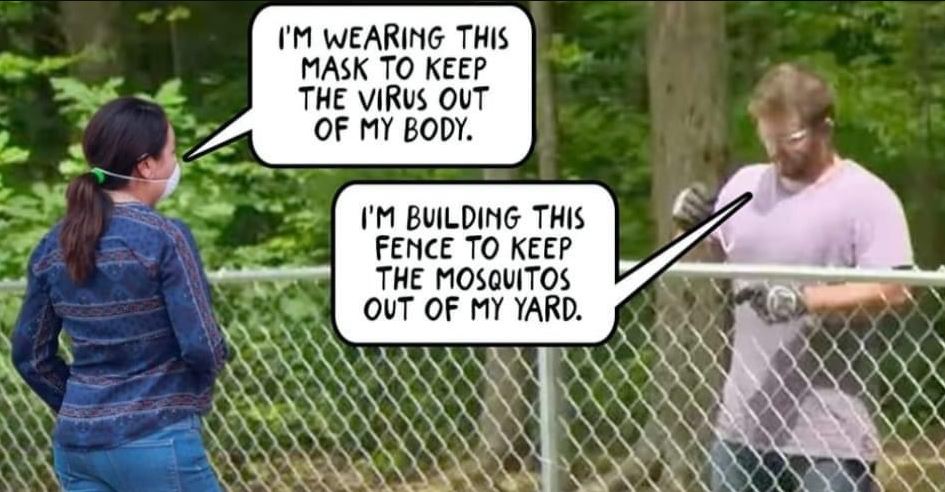
But why are masks so ineffective against viruses? Electron micrographs show the size of the SARS-CoV-2 virus is between 0.06 and 0.14 microns. By contrast, standard cloth face coverings and masks have 2.5 micron pore size, with area 625 times bigger than a virus, which is like trying to stop mosquitos using wide-mesh wire fences. Only true surgical masks have near-viral filter pore sizes, but tests show even they let through 12% to 45% of viral-size particles.
More critical than pore size are two other issues impacting mask effectiveness. The first is that surgical masks may be good at stopping bacterial droplets, but viral droplets quickly “evaporate into ‘droplet nuclei’, remain suspended in air for significant periods of time and could be inhaled.” Bar-On, et. al, National Institutes of Health, NCBI Resources, April 2, 2020.
OSHA’s Fact Sheet on Respiratory Infection Control makes clear that “Surgical masks are not designed or certified to prevent the inhalation of small airborne contaminants. … Surgical masks are not designed to seal tightly against the user’s face. During inhalation, much of the potentially contaminated air can pass through gaps between the face and the surgical mask and not be pulled through the filter material of the mask.”
Anyone wearing glasses knows the truth of this, since fogged glasses prove exhalation is flowing up around the nose past the eyes into the air stream… meanwhile coating contact lenses or glasses with germs so they become point sources of infection. Face shields get a bad rap for allowing air to flow around edges, but vape cloud videos show aerosols likewise follow the path of least resistance through the sides and top of surgical masks.
The other critical problem with mask use outside controlled clinical settings is that even when a mask succeeds in catching viruses these do not disappear from existence but instead turn the mask into an active point source of infection. Viruses collected on the mask get regularly dislodged into the air or pushed through the mask by future inhalations and exhalations or touched by hands, potentially infecting the wearer and others. The net effect may be worse than wearing no mask at all.
WHO lists a wide range of other “disadvantages of mask use by healthy people” including “headache and/or breathing difficulties”, “development of facial skin lesions, irritant dermatitis”, “difficulty with communicating clearly”, “discomfort”, “a false sense of security”, “improper mask disposal”, “environmental hazards”, along with special difficulties for “children, developmentally challenged persons”, “those with asthma or chronic respiratory or breathing problems”, etc.. See also, “Full Time Mask Wearing Brings Its Own Problems,” The Crimson White, University of Alabama, August 20, 2020.
Neurosurgeon researcher Dr. Russell Blaylock warns that reduction in blood oxygenation from prolonged mask wearing is “associated with an impairment in immunity” with “an increased risk of infections … including COVID-19 and making the consequences of that infection much graver”, as well as promoting “spread of cancers”, “cardiovascular (heart attacks) and cerebrovascular (strokes) diseases.” Continually rebreathing moist respiratory wastes beneath a mask raises the concentration of any viruses in the lungs and nasal passages causing worse reactions. “Newer evidence suggests…by wearing a mask, the exhaled viruses will not be able to escape and will concentrate in the nasal passages, enter the olfactory nerves and travel into the brain.”
In conclusion, the best current science does NOT support mask mandates nor claims that increased mask wearing would reduce virus transmission or save lives. The reality is quite the opposite.
[Editor’s note: Mr. Schumacher provided many additional sources beyond those quoted or linked in this article. We link those additional sources below.]
[From Mr. Schumacher: “My thanks to Dr. Roger Koops for his generous correspondence helping sort out evidence relating to mask pore size and surgical mask effectiveness, and especially for his original insights about how masks can become dangerous point sources of infection.”]
Additional source material (partial citations):
“Environmental Role in Influenza Outbreaks”
“Coronavirus: Mask Wearing Risks Isolating Deaf People”
“Surgical Mask Induced Deoxygenation During Surgery”
“Hypoxia Inducible Factor-1 Negatively Regulates Th1 Function”
“Hypoxia Enhances Immunosuppression”
“Hypoxia-driven Immunosuppression”
“Immunoexcitatory mechanisms in glioma proliferation” (relating to cancer)
“Nuclear factor-kB” (relating to cancer)
“Chronic Intermittent Hypoxia Induces Artherosclerosis”
Chemical neuroscience of COVID-19 transmission
Nervous system involvement after COVID-19 infection
“Masks for all not based on sound data,” University of Minnesota
“Universal Masking in Hospitals in the COVID Era,” N.E. Journal of Medicine
“Masks are Neither Effective Nor Safe,” Colleen Huber, NMD
“Masks Likely Do Not Inhibit Viral Spread,” Mercola
“Should Everyone Wear a Mask in Public? Maybe–But It’s Complicated,” Forbes
“Mask May Protect Others, But Not You” Forbes
by Craig Durgan | Jan 29, 2021 | General
The currently adopted Jefferson County Comprehensive Plan has the following important statement:
“Even with Jefferson County’s current low growth rate, the shortage of attainable housing is not reconciled. The condition of average housing prices being beyond what average wages can attain has been documented over the last two decades in state and local reports, including the Port Townsend/Jefferson County Housing Action Plan (2006).”
It does not appear that Jefferson County is in compliance with its own Comprehensive Plan. The above-quoted statement confirms that. While the Comprehensive Plan actually encourages affordable housing, its Unified Development Code (UDC) does the opposite, as I will explain.
There are currently many impediments to providing adequate housing for workers, young families, small business owners, artists–just about anybody who doesn’t have tons of money. The most widely-discussed impediment is the lack of a sewer in Port Hadlock. Jefferson County is currently working on that issue, although progress is quite slow.
There are other impediments to building adequate housing that do not receive as much attention, though their impact is just as negative on our housing problem.
Currently the county has a minimum 5 acre subdivision requirement. This means that land can not be subdivided like it used to be. There are over 300 existing subdivisions in Jefferson County. These subdivisions are where the majority of homes are. By restricting the ability to subdivide more property into smaller than 5 acre lots the cost to build goes up dramatically. No one can build a house affordable to an average family on a 5 acre lot. The cost of the land is over $200,000, to start with. If the county permitted realistic subdivisions, a developer could create much smaller, and therefore cheaper lots so that more people could afford the new housing that would be built.
Under Washington regulations the minimum lot size allowed is 12,500 square feet in areas with public water and soils suitable for septic drainage fields. But the county does not allow a subdivision if the parcels are smaller than five acres–period. The result is that there is a severe lack of buildable and affordable lots in Jefferson County. This, in turn, artificially limits the housing supply and drives prices to unaffordable levels. The situation created by our county’s land use regulations, as I have written before, is driving young people out of our communities and turning us into an exclusive retirement community for the wealthy who can afford inflated housing prices.
It would appear that Jefferson County is not following the State-mandated Growth Management Act nor their own Comprehensive Plan. Under the State Growth Management Act the county is required to plan for growth. But Jefferson County regulations are preventing growth.
Something needs to be done to bring Jefferson County into compliance!