by Jim Scarantino | May 9, 2022 | General
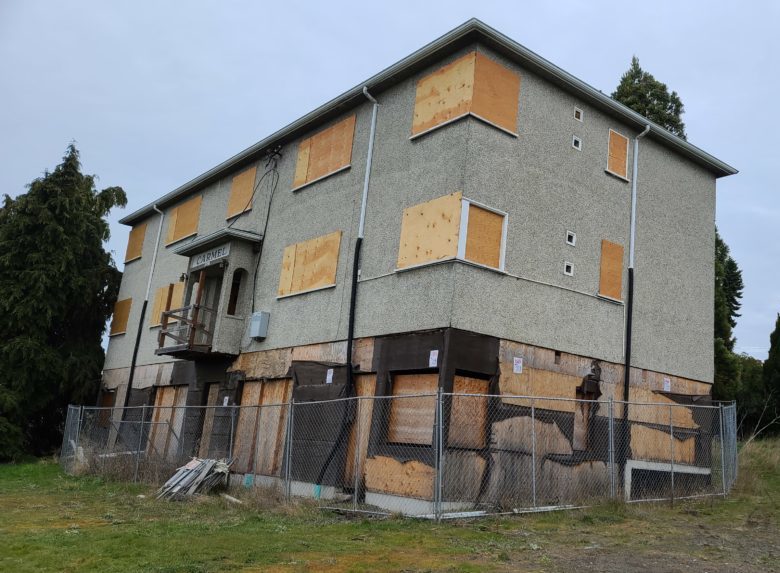
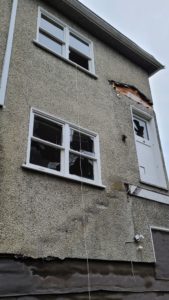
Port Townsend’s most ambitious, costliest “affordable” housing project. Barged from Victoria, B.C. the Carmel House, the building at the center of the Cherry Street Project, sits empty and blighted above PT’s golf course. The 2022 work plan for the City of Port Townsend includes no work on the Cherry Street Project except paying down the $1.4 million indebtedness the city incurred to get the thing rehabilitated. The building has been vandalized and is home to rats and raccoons.
The lessons of this abject failure run throughout our coverage since 2018. The first lesson is, simply, don’t believe what you read in The Leader. From the beginning, the newspaper “of record” has done nothing but act as a stenographer for city leaders and activists. It has been a willing participant in every PR effort to put lipstick on this pig. The Leader has never reported the true cost of this boondoggle, or any of its many failures.
Its most frequent tack was to proclaim “Progress!” even when failure was painfully clear to everyone. The Leader has never asked a hard question of the city or the housing activists — the former Homeward Bound Community Land Trust, recently rebranded as Olympic Housing Trust — who defaulted and wasted millions of dollars in public largesse. The Leader has never looked behind the candied words of the project’s backers, nor dug into public records that show taxpayers have been misled and lied to. Instead, the Free Press has done the work our city’s newspaper should have been doing.
The second lesson is in the dysfunction of an ideologically and politically homogeneous legislative body that operates by peer pressure and virtue signaling. The ultimate failure of this project was evident from the beginning. The city failed to inspect the building before purchasing and floating it across international borders.
Lo and behold, there was a Canadian hazardous materials inspection detailing the presence of asbestos and lead paint the city never saw until a couple years later. The project never could “pencil out” as a viable affordable housing project — not that numbers, which represent taxpayer dollars, seemed to matter to council members. It was more important to make a show of doing something grandiose and kind of artsy about affordable housing than it was to crunch numbers with an eye to reality.
Most shocking of all, the city’s own pro forma for the large loan it extended to the activists showed they would default in a couple years. Council shushed up the lone council member who noticed that and rushed the loan through. By the way, we found and reported that the loan contained a $400,000 hidden interest subsidy that was to be shouldered by taxpayers.
How could an unavoidable, predicted default not matter to City Council? That leads to lesson number three, the antidote to the problem observed as lesson number two.
There must be real diversity in a legislative body to make it work. The City Council that saddled taxpayers with the Cherry Street Project all came from the same political and ideological petri dish. They were a clique of the elite and the woke. It was more important to them to get along, reinforce a narrative, repeat feel-good/look-good buzz words, and nod in agreement than it was to get things right. Someone strong who stood outside the clique and didn’t seek their approval and friendship was needed on council to fight their headlong rush into failure.
The fourth lesson is that Port Townsend Free Press was needed back in April 2017 when council rushed into the Cherry Street Project by buying the Carmel House sight unseen. At least we’ve been hounding this story since we launched in May 2018 with our first article focusing on Cherry Street. Now taxpayers know the ride that has been their misfortune (there’s 17 years left on the bond that funded the defaulted loan, so the ride’s not done).
According to The Leader‘s uncritical reporting, the Cherry Street Project was to have been finished and occupied in the Fall of 2017 with a renovation price tag of only a couple hundred thousand dollars. We did the first of many public records requests and dug into the financial documents to get the real story, published May 28, 2018, just a little after the Cherry Street Project’s first birthday: “Cherry Street “Affordable” Housing to Cost More than $2 Million.” The latest cost estimates put the total cost of the project above $3 million. With the spike in construction costs, count on the price tag being higher today and in the future.
Still a mystery is why the city turned down a $1 million cash offer in September 2020 to bail them out of this mess. Not one city council member ever publicly raised a question about why the city manager gave the back of his hand to Keith and Jean Marzan when they offered to take the mess off the city’s hands and actually build some affordable housing on the site.
The Leader‘s last article on Port Townsend’s hugely disastrous, most expensive, most ambitious affordable housing project was October 1, 2020, when it proclaimed that “Port Townsend will forge ahead with the troubled Cherry Street Project, but with a new nonprofit partner.” The paper accommodated the city’s need for some positive spin on the heels of the activists’ default on their generous loan.
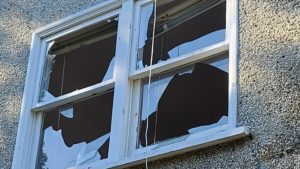
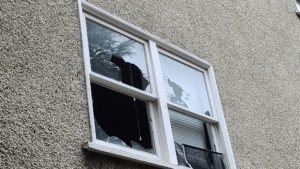
Since that rosy proclamation by The Leader, the only work on the project has been repairing some of the vandalism when teenagers launched a refrigerator through a window and broke out almost all the glass in the blighted 1950s asbestos-and-lead contaminated derelict. Oh, and putting up some fake “this site under video surveillance” signs.
Here is the full list of our reporting on the Cherry Street Project since our first article:
The Tragedy of the Cherry Street Project, 12/12/18
What’s Happening With the Cherry Street Project? 10/29/19
“Completely Bogus” Numbers–More Problems and Delays for Cherry Street Project, 12/2/19
Multi-Million Dollar Fraud on Taxpayers: The Cherry Street Project Unmasked, 6/27/20
Cherry Street Welcomes First Tenants, 2/28/20
Default the Cherry Street Project Now, 4/22/20
Latest Cherry Street Giveaway Hits Taxpayers Harder, 10/2/20
Cherry Street Project Handover “Not a Done Deal,”10/19/20
Accomplished Developer Will Donate Time and Services for Cherry Street Project, 10/20/20
Cherry Street Handover: Red Flags About Bayside Housing, 3/3/21 (and related articles)
Happy Fourth Birthday, Cherry Street Project! 5/10/21
Cherry Street Project Costs Soar in Bayside Housing Proposal, 6/23/21
New Majority on Council Should Kill the Cherry Street Project, 11/27/21
Cherry Street Project Vandalized, 1/4/22
“Incredibly Expensive” Housing Project Follows Cherry Street Debacle, 1/6/22
Mayor Faber (Almost) Opens Up on Cherry Street Project Failure, 4/23/22
by Ana Wolpin | Apr 30, 2022 | General
“I don’t really see the need for streateries in our code. Many of the restaurants already have courtyards or some kind of space outside. We’ve spent a bunch of energy putting together public spaces where people can take take-out food and sit next to the water.
I believe that it’s probably unfair for me to be taking up [parking] spaces that we should be sharing with all of the rest of the downtown businesses. I agree that it’s not really fair to prioritize restaurants over other businesses…
Nine months of the year it’s raining and cold and miserable here. If we put permanent structures on the street, those nine months of the year are taking up parking spaces that keep people away from the doors of businesses and they’re only used for three months.”
– David Hero, Silverwater Cafe
—————————————
Public backlash over streateries continued at the Port Townsend City Council meeting on April 18. With one exception, the council’s determination to make them permanent installations continued as well.
As reported in earlier Free Press articles, when the health department restricted indoor dining during Covid, the local business community agreed to grant restaurants emergency use of public parking stalls for outdoor dining in the city streets: streateries. Local shop owners were assured that this private use of public rights of way would be a temporary measure. Then in March — prior to any public process — the city council directed staff to draft an ordinance making the streatery program permanent.
As described in “Strangulation by Streateries?” and “Public Streets and Public Process Subverted,” the fast-track process that was developed to meet requirements for public input looked to be after-the-fact window dressing on a done deal. Every step of the way since, the council majority has dismissed and overridden public opposition, apparently bent on codifying the program despite widespread objections.
First, a March 29 open house designed to promote the concept brought overwhelming dissent from approximately two dozen business owners who attended. That was ignored. Then a poorly distributed survey, also designed to boost support, deleted from its published results a portion of comments that had been submitted. Still, hundreds of negative comments did show substantial opposition. (Those survey results can be seen here and here). They, too, were dismissed. Mayor David Faber characterized them as a “loud and angry minority.”
Opposition continued at the April 4 council meeting. Without exception, all public feedback about making streateries permanent was again negative.
Two weeks later, the overt agenda to put a permanent streatery program in place regardless of public input persisted.
The April 18 City Council meeting
Discussion at the April 18 council meeting confirmed that the majority of councilors already had their minds made up long before any of this fast-tracked public process.
Again the public feedback — predominantly from business owners, both in written letters submitted to council and voiced in live public comments — consistently urged the council to drop the proposal. Every councilor except one, Ben Thomas, made it clear that they were determined to approve a permanent streateries program despite public objections. The discussion was not about IF it should move forward, it was about hashing out the details.
After City Manager John Mauro expressed appreciation for all the public feedback, Public Works Director Steve King presented an overview of a streatery “draft ordinance in preparation for its final adoption.”
Public Works Director Steve King at 4/18/22 City Council meeting. Click on image for the video of the meeting. Streateries agenda item starts at 24 minutes.
The proposed ordinance allowed six streateries downtown, three uptown and one per block in other business districts, he said. There would be a lottery process for annual permits. Once an applicant was approved, there would be an annual renewal process, but no need to reapply for the annual lotteries. A permitted streatery would have exclusive use of those former parking spaces during business hours in perpetuity. Each streatery granted would be allowed up to forty feet of street frontage — eliminating two parking stalls where there was existing parallel parking, more for angled. An annual fee of $2000, or possibly $1500, was suggested. King explained that “the principle behind streateries is that it’s a use of public space for some private use, but it’s mostly a public enhancement.”
Prior to public comments, council members reviewed the draft ordinance. Libby Urner Wennstrom kicked off the discussion with this inversion:
“There’s a lot of businesses that are fairly supportive of this and there’s a handful of businesses that are very vehemently opposed.”
That assessment is the opposite of what multiple sources who have been canvasing businesses have told the Free Press. They say that Port Townsend’s business community is overwhelming opposed. The “vehement” opposition was so worrisome to Wennstrom, she asked King if a restaurant could sabotage the unwanted program: “I could see someone putting in a proposal so that it’s going to kill a lottery slot,” she said.
Monica MickHager asked if a streatery could have the option of putting all their outdoor seating on the sidewalk rather than the street, redirecting pedestrians into the street itself. Essentially, could they swap a permitted take-over of the parking strip for commandeering the entire sidewalk instead? When told yes, that was an option, she said she was “excited”.
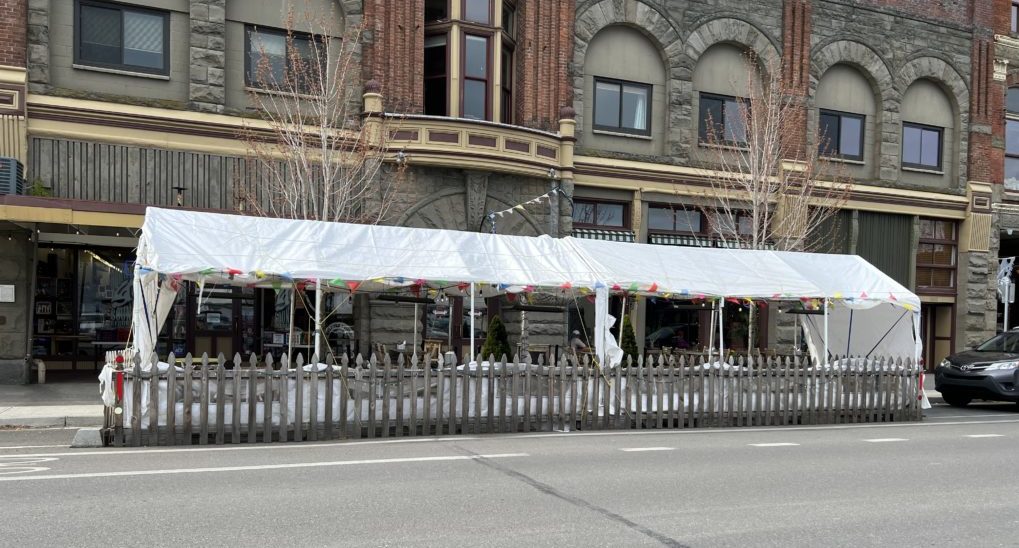
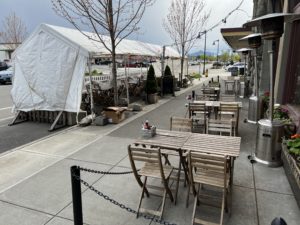
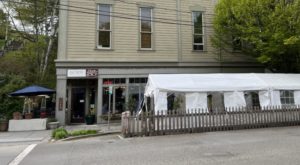
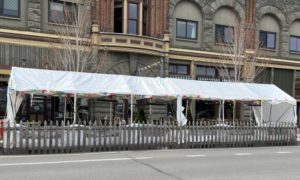
According to the proposed ordinance, this sidewalk seating in front of The Old Whiskey Mill (the streatery also pictured in the feature photo at top) could be expanded to completely cover the sidewalk, forcing foot traffic into the street where the tent now stands in order for pedestrians to get around the blocked sidewalk.
MickHager also asked if a restaurant sold their business whether the new owner was buying the right to have the streatery permit “as part of their private business.” That, too, was answered in the affirmative.
Receipt of letters written to council (grouped at links 1, 2, 3) were acknowledged by the City Clerk. All of them expressed opposition to continuing streateries. No letters were in support.
Harvey Windle, owner of Forest Gems wrote of the city’s long-time mismanagement of parking and of the streatery program taking public property, “given to a special class of people.” He shared a circulating petition titled “City Ordinance Change Benefiting Restaurant Special Interests.”
Michele Gransgaard, a concerned resident who has been canvasing businesses, criticized the survey used to help justify the program: “To report results from a sloppy, biased survey is disingenuous, anti-democratic, and clearly lacks integrity.”
She also warned of the toxic emissions diners in the street were exposed to: “The pollutants from car exhaust consists of lead, carbon monoxide, nitrogen oxides, ozone and airborne particulate matter.” Gransgaard additionally noted that there are already “many options for restaurants that offer outdoor dining.”
More than a few Port Townsend al fresco dining options have been in place for many years, off the city streets. Gransgaard has catalogued more than forty of them. They include Alchemy Bistro & Wine Bar, Aldrich’s (2nd floor outdoor patio), Batch Brothers, Bayview, Bishop Block Bottle Shop & Garden, Blue Moose, Cablehouse Canteen, Cafe Tenby, Cellar Door, Courtyard Cafe, Doc’s Marina Grill, Dogs-A-Foot, Elevated Ice Cream Co., Finistère, Hacienda Tizapan, Hudson Point Cafe, Ichikawa, Jen’s Marina Cafe, Key City Fish Tacos-to-Go, Lighthouse Cafe, Lila’s Kitchen, Mo-Chilli BBQ, O’Yummy Frozen Yogurt, Owl Sprit, Pho Filling, Port Townsend Vineyards, Pourhouse Beer Garden, PT Soda Fountain & Diner, Quench, Réveille Café, San Juan Taqueria, Sirens, Sea J’s Cafe, Spruce Goose Cafe, Sunrise Coffee, Taps, The Castle, The Cup, The Old Whiskey Mill, Tommyknockers, and Vintage by Port Townsend Vineyards.
PT Shirt Company owner Frank Iuro noted that as shown in the list above ALL of the current streateries downtown “already have outdoor seating areas that have been in existence since before the pandemic.” He wrote that the program would “rob other businesses of available parking for their customers.”
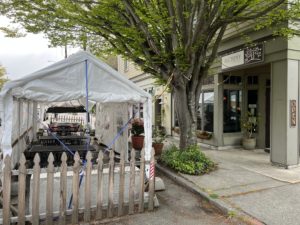
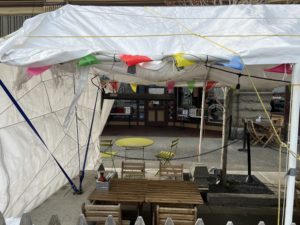
Seating under umbrellas off the city street seen at left provided outdoor dining for Alchemy Bistro & Wine Bar before a tented streatery was added in the public parking strip.
Alchemy’s street tent eliminated at least three angled parking spaces and is reported to have been largely empty for a minimum of the last five months.
Maestrale owner Jennefer Wood summarized the objections of many with these bullet points:
- Downtown parking has always been a major issue, taking more parking away only exacerbates the problem. A 2004 analysis of the problem in no way offers a solution like this;
- “Streateries” take away from badly needed downtown parking, adversely impacting businesses;
- They are unsightly, dangerous to see around, and too close to traffic – eating while breathing car exhaust does not sound appealing;
- They are not in alignment with any historical preservation of PT’s past;
- It is unjust and unlawful to allocate public land to private businesses;
- They block visual access to neighboring businesses, thus negatively impacting business;
- There are now “Parklets” available for the public to use for take out dining;
- A “public survey” was not widely advertised in order to receive public input, and negative feedback is being suppressed;
- Streateries were introduced under the covid emergency. The emergency is over.
- Let’s put this proposal in perspective of the larger parking problem and have a proper analysis from that point of view.
Several other PT residents, including a Water Street historic building owner who said the installations visually degrade the public space, also wrote letters in opposition. Letters from Annette Huenke and myself expanded on concerns described in the two Free Press articles linked above.
Public comments in person and by livestream also resoundingly opposed the program.
Gail Boulter and her husband own six long-standing shops downtown, The Green Eyeshade and The Clothes Horse among them. She said that when Covid first began restricting indoor dining in restaurants, City Manager Mauro called her.
“[He] wanted our impression about how we felt about the streateries… I said we would be happy to do anything we can to help our restaurants. However, under no circumstances would any of us merchants downtown want to see this to be a permanent situation. He assured me at that time Oh, no no no, this is a temporary fix.”
“Parking has always been the bottom line issue in Port Townsend,” she told the council. “Please take note of how the merchants feel about all this.”
Pat Louderback is owner of Getables downtown and a Main Street board member:
“During the last council meeting when discussing the downtown parking issues and the more than 300 discarded negative submissions about streateries,” he said, “it was stated by the council that the parking issues were a red herring designed to take us away from the real topic of streateries.”
“The red herring here is the streateries, drawing us away from the real problem, which is parking.“
Louderback pointed to comments in the survey from people who said if they can’t find parking downtown, they go home and order online. “This is all counterproductive to our often-heard Shop Local campaigns. So how do we as businesses and community TRUST the city, the council, which seemingly are influenced by special interests versus representing the community as a whole?”
“It’s the brick and mortar businesses, services, retailers and restaurants that draw consumers here,” he continued. “Further, reducing even ONE parking spot negatively impacts downtown businesses. You’re turning your back on these small businesses, slapping them in the face after they have struggled to survive, and supported this community.”
David Wing-Kovarik, owner of Frameworks Northwest, put aside his prepared statement after listening to the initial council discussion.
“$2,000 a year? That does not address the thousands of dollars lost in retail sales for those parking spaces for surrounding businesses. I’m in great support of restaurants; I send people to restaurants every single day. But every single day I have someone coming in complaining about the inability to park here… I have no idea what businesses you have been talking to that are in support of this.”
He said every business he has spoken to told him, We were told that this would be temporary by the city and by Main Street. “They’re NOT in support of this,” he emphasized. Of the many business owners he has talked to, only “ONE business said they were, and that was it.”
David Hero has co-owned the Silverware Cafe for 32 years. In addition to the statements he made in the quote featured at top — that there is already a plethora of outdoor dining options, that prioritizing public space for restaurants over other businesses is unfair, and that people only use al fresco facilities three months of the year — he pointed out that current code already allows restaurants to set up sidewalk dining with a minimum 6-foot right of way. The earlier photo of sidewalk tables outside The Old Whiskey Mill on Water Street is an example of that. We should encourage more use of “the already-existing sidewalk rules where we technically can put tables on our sidewalks,” he said.
Hero concluded: “I think it’s important to really think about how much use and how many people are actually going to use these outdoor facilities that are taking up valuable parking spaces during the nine months of the year when nobody can sit outside anyhow.”
Scott Walker commented:
“I have been involved in trying to advocate for parking management in this town for more than 20 years. I was on the Parking Advisory Group back in the early 2000s,” involved in the study council adopted nearly twenty years ago to institute managed parking downtown. “We haven’t done that yet and this proposal is getting the cart in front of the horse. You need to have an understanding of what the value of a parking space downtown IS before you give it up for $2000 a year, $1500 a year, or whatever number you come up with.”
“This proposal, I highly encourage you to kill it right now and get to work on the downtown parking management plan.”
Samantha Ladwig, owner of the Imprint Bookstore concurred:
“It is a frequent topic from customers who come in, the difficulty of parking, and how they have continually shopped less and less over time as it has become more and more difficult to find a space. I don’t think this is a good solution for tourists or the community to take away parking which is a growing issue.”
Not a single letter writer, in-person or virtual commenter expressed support.
The council deliberates
The discussion that followed all this public feedback demonstrates the disconnect between the citizens and those elected to serve them. (Full comments can be watched by clicking on any councilor photo.)
Ben Thomas expressed the only cautionary note, which was immediately argued against. He “likes the streateries,” he said, but agreed it is putting the cart before the horse. “I’m just really concerned listening to all these business owners… Some people may close businesses because of it, is my concern. I feel like there’s a social contract with our businesses that we don’t make it harder for them.”
Libby Wennstrom discounted his concern based on her experience 50 years ago in her hometown of Ithaca, NY. She said that when Ithaca closed off three blocks to make it pedestrian-only in 1972, there was “huge screaming from all the surrounding businesses” with similar objections to those “we’ve heard here tonight… but in that case it didn’t pan out… These streateries have been incredibly successful in towns all over Puget Sound.”
Wennstrom is so keen to remove parking, she suggested that the gift of public street space could expand to retailers as well. “It doesn’t necessarily have to be a restaurant that chooses to do this,” she directed at the objecting business owners present. “You could apply, with a business, to have a street space if you wanted to.”
Aislinn Diamanti expressed her commitment to the proposal: “We don’t want to go into another season that is likely to need these again as cases are going up.” They need to be given permanent status, she said, so that restaurant owners have incentive to invest in them over the next two years. Then, Diamanti suggested, after the council revisits the parking plan they “can come back” in two years and change the code again. “It would be a loss to go dark in that meantime because this use of twelve parking spaces isn’t known to be the highest and best use intrinsically.”
Monica MickHager worried that “we’re still in a pandemic… I think the streateries are a necessity for us, just on the mere fact alone that we’re still dealing with Covid.” She acknowledged the critical parking issues, however, and suggested reducing the numbers of streateries the ordinance allows, “until we have an adopted parking management plan.” She proposed that the downtown streateries be limited to their current number, not increased to six.
Owen Rowe opined that “we are not seeing the end of Covid. So I think there is a good case to be made for extending the temporary use of streateries.” But we can’t ask the restaurants to invest in better, more permanent structures, he said, without giving them the assurance of program longevity. “We need to commit to whether this is going to continue beyond Covid.” He agreed with the suggestion to reduce the number allowed.
Mayor David Faber apologized “for making uncharitable comments at last meeting to members of the public who have concerns about streateries.” His disparaging remarks reflected his thinking that they were minority views that don’t represent the community as a whole. “Ever since I was first elected to council, I’ve been hearing from an untold number of people about how we need to stop designing our public spaces around the personal automobile.”
He said that even though the city needs to address the parking issue “asap”, it can’t take on parking management right now. “I think the proposal is extraordinarily modest. It’s not taking very much, not taking away any significant amount of parking spaces. it’s only formalizing what’s been in place for over two years.”
He agreed that “the survey was imperfect, it was quick, we agreed to do a quick process which people are understandably upset about.” But then he again referenced the flawed survey results as evidence that most were in favor of the proposal. “Every single person I talk to outside of downtown business owners have said favorable things to me about creating a permanent streateries program.”
“I love these things. I love the concept of what they bring to the community.” He also voiced support of the suggestion to “lock in” what’s already in place. “I think we should proceed with this.”
Ben Thomas again expressed concern over the business community’s opposition. It’s hard “to ignore the public comment,” he said, “not just tonight.” But he agreed with other council members that he’d like to see streateries: “I do think they are potentially a positive thing for us… just not expanding it at this time when there’s all this public pressure against it.” He, too, supported limiting downtown streateries to the current number.
The final number agreed upon was four streateries downtown, two uptown, and one per block in other commercial districts. The remainder of the discussion was about other details of the ordinance the council is scheduled to vote on at the May 2 meeting.
Just what ARE those parking spaces worth?
During deliberations, Wennstrom disputed the statement from business owners that a $1500 or $2000 annual fee would not even begin to offset the value of two or more parking spaces, that they were worth at least $13,000 a month to the business community. “I want to know any downtown business that’s paying $13,000 a month for a Water Street storefront,” she challenged. A voice in the audience schooled her that it’s not the rental value of the frontage that is relevant, “it’s in generated sales for surrounding businesses.”
As Annette Huenke wrote in a previous article, Main Street estimated in 2004 that “each downtown parking space generates approximately $150 to $300 per day in retail sales revenue.” In addition to retail spending in shops, restaurants, at the theater and other recreational activities, revenue is also generated by service businesses as well, including medical, insurance, financial, and legal:
“Adjusting for inflation using government calculations, at $300 per day, a single space contributes to downtown’s fiscal vitality $169,987 annually. Two = $339,975; the triplets in front of Alchemy and in the Tyler St. lot are worth $509,962 per year.”
Michele Gransgaard, who has been researching parking management strategies, notes that the businesses most severely affected by the loss of parking from a streatery will be those in closest proximity. Her research has shown that “40% of people won’t shop at a store where parking is a hassle.”
Not only does a business adjacent to a streatery suffer from lost parking, the visual obstruction from tents or the more permanent structures encouraged by this program damages one of a retailer’s most valuable assets — storefront visibility. Can you identify which businesses are next to The Old Whiskey Mill in this photo?
There’s Quimper Sound on one side, Commoner on the other. These businesses pay a premium for main street storefronts. Their expensive, well-designed windows and signage are a large part of what draws shoppers to their stores.
Peekaboo… The hip Quimper Sound logo is barely visible on its window through The Old Whiskey Mill streatery tent. Their neon “OPEN” sign is completely obscured, along with other window attractions.
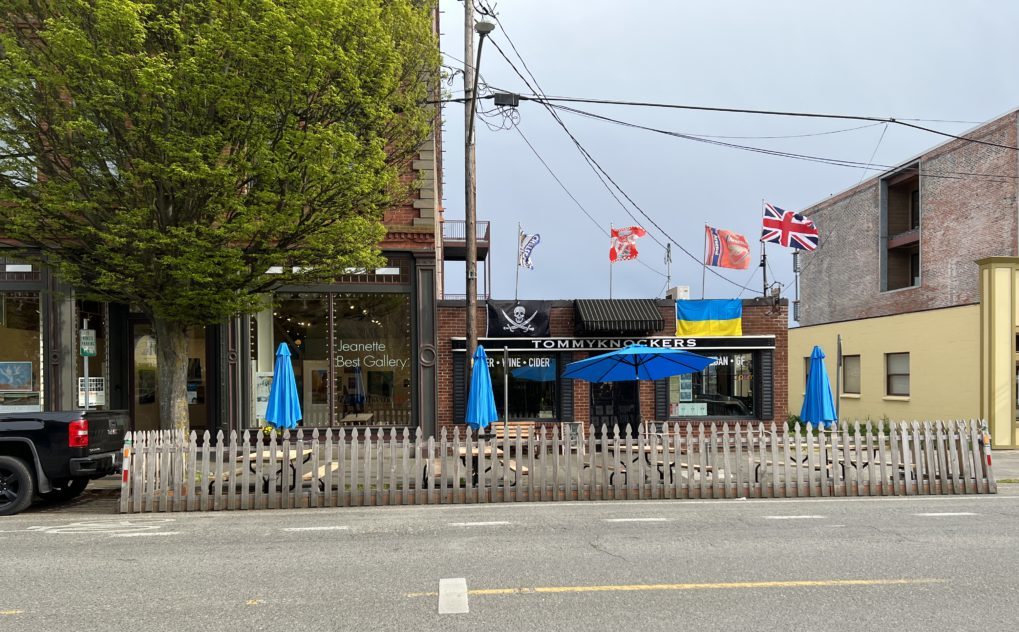
One of the benefits of creating a permanent streateries program, say its advocates, is that it will incentivize the restaurant owners to invest in better all-weather structures than the tents. Picture a permanent structure erected in the parking strip where Tommyknockers’ tables and umbrellas now stand. Not only will their own restaurant signage be obscured, but the major draw of the Jeanette Best Gallery next door — the gallery name and art on display through the window — gone.
All streatery photos taken Thursday, April 28, 2022 around 5 p.m. by Stephen Schumacher. Additional photos taken at 7 p.m. show every streatery downtown still empty.
Perhaps “public enhancement” from a bustling streatery on a lovely summer’s day will add to adjacent businesses’ foot traffic and increased vitality in commercial districts. But what of the other nine months of the year that David Hero alludes to?
In an April 28 letter to Mayor Faber, Annette Huenke wrote:
Sadly, it appears to be a waste of time attempting a dialogue with you, council, King and Mauro, since you determined on March 14th that we will have streateries because you all enjoy them. The parking issues that have plagued PT for over 30 years, the fact that we already have a viable parking plan, the loss of revenue from sacrificed parking, your perverted public process, the utter fallacy that this can ever be made fair and equitable among downtown businesses, let alone restaurants… none of that matters. You like streateries.
Automobiles are essential for travel to Port Townsend, even for people who live here. Jefferson County has the highest share of population age 65 and older in the state. New homes are going up all over the 3-mile and beyond range. There is a 58-lot subdivision going in on Cook Avenue. Most of those newcomers will not share city leaders’ fantasy of walking, biking or busing 6 miles into town. I can count on one hand how many of my North Beach neighbors do. Nearly all take their cars wherever they go. Port Townsend is already naturally inviting, as well walkable for those with the ability and desire to walk it.
As the Port Townsend City Council overrides citizen feedback opposing their plan to replace parking with outdoor dining areas in our public rights of way, many residents are asking Who are our elected officials serving? At Monday’s city council meeting, 6:30 pm on May 2nd, the council’s vote on authorizing a permanent streateries program should give us an answer to that question.
—————————————
May 2nd Port Townsend City Council meeting Agenda – Streatery ordinances are agenda items VII and VIII
Proposed Resolution 22-020 Establishing Public Works Department Street Use Permit fees
Public in attendance and webinar participants will be able to provide up to three minutes of public comment during the meeting. Public comment will also be accepted by email and will be included in the meeting record, provided emails are received two hours before the start of each meeting. Please send public comment to: publiccomment@cityofpt.us.
by Brett Nunn | Apr 26, 2022 | General
Two weeks ago I gathered with a few friends in what will remain an undisclosed location in Port Townsend to watch, via Zoom, the Washington State Board of Health (SBOH) vote on whether the COVID-19 vaccine should be added to the list of shots required for public school attendance. It certainly wasn’t the Super Bowl, but for those of us invested in the health of our children it was the culmination of several months of grass roots lobbying of our state public health officials.
I played a very small part in the effort. As a group it appears we overwhelmed the systems of a state agency that was used to operating under the radar, debating issues that rarely caused any controversy. I mentioned in a previous article one early Zoom meeting of the Technical Advisory Group (TAG), set up to assess the criteria for adding the shot to the required list, had 7,500 people sign up to make a public comment.
For this final meeting, where the SBOH would vote on whether to adopt the recommendations of the TAG, over 1,500 pages of emailed comments were received and entered into the record. The SBOH didn’t state how many people signed in to speak at this final meeting, but the comment period was expanded to an hour and a half, with two minutes per comment. Even with the extra time, fewer than fifty people were actually heard. No one supported the COVID-19 shot for kids.
Like many, I was hopeful, yet ready to be steamrolled by the bureaucracy. As you have probably heard by now the SBOH voted unanimously to not add the COVID-19 shot to the list of required vaccines for kids — for now. The option to reconsider in the future was left open. I will consider the decision a victory against the forces of medical tyranny. In a conversation I had recently with Gerald Braude, a writer for Informed Choice Washington, he describes the decision as a strategic withdrawal. I fear he may be right. You can read his in-depth article about the April 13th SBOH meeting here.
Screenshot of April 13 State Board of Health Meeting
At least for the moment we still have the choice, if only at the public school level, on whether we want the COVID shot for our children. Regrettably, this does nothing for families like mine with older children heading off to our state colleges, also public schools, but at this point offering no choice regarding the COVID shot other than applying for a religious exemption. We may have begun to turn the tide. We must not stop here.
When government does something bad, we have a right to redress of grievances. When government does something good, which has been admittedly rare over the last few years, we should let also let them know, as well as address any concerns they may have expressed during the decision-making process. Here is my letter sent to the Washington State Board of Health after their unanimous vote on April 13th:
To the Washington State Board of Health. Thank you for your hard work over the last two years, and for your latest decision to not add the COVID-19 shot to the list of requirements for children to attend public school. You have made the right choice. It seems a few fragments our democratic system may yet be working.
One of your members mentioned the loss of public trust as being her primary concern in this process. I heartily agree. As a citizen of Washington State, I have lost all trust in my public officials.
This loss of trust began with the Governor seizing power through an emergency declaration and then forcing illogical and arbitrary mandates on me. More than two years have passed and Governor Inslee refuses to give up these powers. His latest reasoning in a long list of ever-changing excuses, the need to keep federal dollars flowing into our state, does nothing to rebuild my trust.
I also lost trust with my state representatives who have looked the other way this entire time, aiding and abetting our tyrannical governor.
The loss of trust continued with the Superintendent of Public Instruction, who clearly stated he was pro-COVID shot, while threatening any disloyalty to his COVID orders with defunding of non-compliant school districts. When asked, State Superintendent Chris Reykdal stated the COVID shot requirement would be made on a statewide basis, undermining the authority of school boards, and therefore eliminating both school administrations and most importantly concerned parents, from the decision-making process.
Finally, public trust was lost by you, the State Board of Health specifically, through continuing to promote only the vaccines for treatment despite the VAERS data showing tens of thousands of deaths, and well over a million injuries to Americans from the COVID-19 injections.
Will the SBOH ever examine whether the vaccines you would be forcing on our children, formulated for the original strain of COVID-19 way back in March of 2021, even be effective against the current mutations? (We can see they aren’t. Why can’t you see that?). Will the board ever discuss the data that clearly shows that children have a much higher likelihood of injury from the vaccine than from the disease? Please look over the latest study from Children’s Hospital in Seattle published March 25th, 2022 in the Journal of Pediatrics. Has the board reviewed the benefits of natural immunity, or other options including the clear success of the Dr. Peter McCullough protocols advocating early treatment with safe, inexpensive, and readily available antiviral medications?
If you were to ask me, I would tell you the restoration of public trust will begin when you give up the mantra of “These vaccines are safe and effective”, and start having a transparent and truthful conversation with the people, not the politicians, of this state. The thousands of comments from thousands of well-informed parents should be evidence that you are not in possession of all the information.
I understand the extreme pressures you are under to support the official government narrative. Yet someday, in the not-too-distant future, we will look back and see this pandemic vaccination program for what many of us believe it to be, a crime against humanity. In the end, I would want to be remembered for supporting the freedom of choice for the individual citizens of this state, and not in support of a governor who puts billions from the Federal Government before the rights of his constituents.
Respectfully,
Brett M. Nunn
I expect my suggestions will fall on deaf ears like just like all of my attempts to pull back on the “safe and effective” curtain here in Port Townsend and to start conversations with our public officials. In watching the SBOH debate this issue, a few of the members seem to be asking the right questions. We need to keep speaking to them until the message finally gets through. I will be presenting this information to the Port Townsend School Board in the following weeks just to make sure they have heard the good news as well.
by Jim Scarantino | Apr 23, 2022 | General
“I wouldn’t change a thing about what we did.” Mayor David Faber said that about the Cherry Street Project at a December city council meeting. The topic of that meeting was whether Port Townsend should purchase 14.4 acres on the edge of town, the Evans Vista project, to build the equivalent of a separate village of affordable and low-income housing. It would be a massive project that Michelle Sandoval, mayor at the time, predicted would be “incredibly expensive.”
The Cherry Street Project will be five years old on May 10, 2022, yet remains unfinished. Windows facing the street are boarded up; windows at the rear are broken out, the result of vandalism. The city is paying off a 20-year bond with a principal and interest obligation of around $1.4 million. Hundreds of thousands of dollars have been spent. Valuable land is tied up with a derelict building. The last estimate was that another $1.8 million would be required to rehab the old building.
In preparation for an article on the Cherry Street Project’s fifth anniversary, I emailed Mayor Faber regarding his “I wouldn’t change a thing about what we did” assessment of the Cherry Street Project. I asked him,
“What would you say was done correctly in the inception and execution of the Cherry Street Project? Were no mistakes made, since you “wouldn’t change a single thing” in retrospect?”
A fair question, particularly since the Mayor has insisted that he and others have learned from the Cherry Street Project and the Evans Vista Project won’t be a repeat. It is our policy to print in full and verbatim all written responses and statements we receive to our inquiries.
Mayor Faber did respond. But he had conditions. He first wanted an off-the-record “chat” to “set some ground rules.” Here is his complete and verbatim response:
Hi Jim,
I’m happy to have a conversation with you, provided we first have an off-the-record chat to set some ground rules. If you can’t agree to do that, then please, by all means, continue misconstruing my comments without my involvement as is your right, even if you are needlessly creating division for clicks.
Give me a call whenever you want: (360) 821-9374.
Best,
David J. Faber
At first I thought this would be a great idea and agreed. (Golly, a chat with the mayor!). But then I realized that agreeing to an “off-the-record chat” to “set some ground rules” was problematic. Why should anything the Mayor has to say about a housing project be off the record? Why did we need ground rules for a Q&A on the Cherry Street Project? I had never had a request like this in fifteen years of writing for a major newspaper or my own investigative news sites.
Mayor Faber,
Upon further reflection, it would be better if you wrote out the ground rules you want for an interview. If they are to govern any future exchange and what goes into a published article, it does no good to have them “off the record.” So, please just send the ground rules you want and we can proceed from there if they are agreeable. I can’t remember any public official ever insisting on an off the record conversation to set ground rules. I don’t seek a free running conversation, just answer to a question but I will fairly consider your proposed ground rules.
I send out written questions and publish the entire answers so that nothing gets misquoted or left out. My written question to you is still open and your response will be published verbatim and in full. A written exchange requires no ground rules. And, if you would like to say more on the Cherry Street Project than my question covers, please add that to your response and it will also be published verbatim and in full.
Awaiting your proposed ground rules and written answer and expanded statement, if you choose to respond. I think this is the best way to proceed to avoid any misunderstanding or accusations following publication.
I am keeping my editors informed of this exchange, by the way.
Sincerely,
Jim Scarantino
Mayor Faber responded the next morning:
No, I think it would be best for us to have a conversation. If you disagree, then fine, enjoy writing half-truths without my further involvement.
Best,
David J. Faber
I let Mayor Faber know that I was awaiting instructions from my editors and would get back to him. We talked about it and jointly made a decision to reject his pre-condition of an “off-the-record chat” to “set some ground rules.” Here’s the response of Port Townsend Free Press to Mayor Faber’s unusual request:
Mayor Faber,
My editors and I appreciate your invitation to have a conversation with you on the Cherry Street Project. We cannot, however, agree to keeping from the public any statements made by the Mayor of the City of Port Townsend, and, therefore, do not agree to any off-the-record preconditions. (That is why I have not called you, because you seem to have set the condition that that conversation would be off-the-record). Everything said in the interview or any telephone calls is public information and subject to publication.
To ensure there are no misquotes or misinterpretations in any article resulting from the conversation, I will tape our exchange and you are certainly welcome to do the same.
Our invitation to you to publish on our site any statement you wish to make on the Cherry Street Project remains open.This gives you the opportunity to put your best case to the readers directly, without going through a reporter relating what you have to say or not putting it as you would want. As I have stated several times in our exchanges, any written responses to our questions or submitted statements are published verbatim and in full. We recently did this with County Prosecutor Kennedy, by way of example. And we still invite you, if you choose, to provide a written answer to the questions that initiated this back-and-forth: What would you say was done correctly in the inception and execution of the Cherry Street Project? Were no mistakes made, since you “wouldn’t change a single thing” in retrospect?
Lastly, in your emails you have implied that I have been “misconstruing [your] comments without [your] involvement” and that I have been publishing “half-truths without [your] involvement.” You are invited to include in a statement to be published your explanation of what has been reported at the Port Townsend Free Press that misconstrued your comments or constituted half-truths regarding the Cherry Street Project. Of course, I would hope that in our conversation you will also explain those statements further.
Please let me know how you wish to proceed.
Jim Scarantino, Contributor, Port Townsend Free Press
Mayor Faber has not responded.
Mayor David Faber presiding at the April 4 meeting
There has been no substantive discussion in City Council of the reasons for the abject failure of the Cherry Street Project… ever. It would be useful on the fifth anniversary of the Cherry Street Project for the mayor to offer a few words on why he insists he would do things the same again. Insiders have known, as we have reported previously, that this thing was headed for a train wreck from the beginning. None of our reporting, based on what we have learned from public records requests and documented with photographs, has ever been disputed by Mayor Faber or any other city official. Keeping taxpayers in the dark is not why we publish the Port Townsend Free Press and we won’t participate with Mayor Faber in holding anything back from the people who are footing the bill for City Hall’s mistakes.
Our offer to Mayor Faber to publish his answer to our questions and any other statement his wishes to make about the Cherry Street Project remains open.