GOVERNOR INSLEE RESPONDS

GOVERNOR INSLEE RESPONDS

Do Black Lives Matter When It Comes To Green Cars?

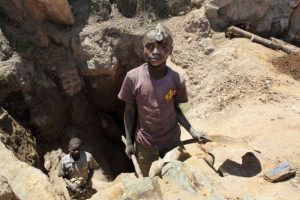
Electric cars run on the suffering of Black children living like slaves.  Dangerous, toxic mining conditions in the Congo cause death, disease and birth defects at alarming rates.  The cobalt from Congolese mines is necessary to meet the demand for the large quantities of cobalt needed in batteries powering the “green” transportation revolution.

There’s no getting around the racial injustice behind every green car:  Affluent Western whites drive around in vehicles paid for by Black African suffering on a horrifying scale.

We reported this in our first installment on this topic.  You can read it all by clicking here.

We learned that electric car users and their advocates want to avoid discussing this painful topic.  Not one person we contacted for comment–from Jefferson County EV owners and the Jefferson County Electric Vehicle Association to the City of Seattle’s Green Fleet program to the group pushing this year’s carbon tax, I-1631–responded to our simple question:  How do you handle buying, driving and advocating for the increased use of electric cars when you know the racial suffering that goes into every vehicle?

After our story ran, we received a response from the administration of Governor Jay Inslee.  We had been in contact with them before the story ran and stated we had yet to receive a response.  Now we have.

Washington’s Green Fleet Initiative

In our first report we wrote:

“While attending a climate change summit in Paris in 2015, Governor Jay Inslee unveiled an electric fleet initiative to ensure that at least 20% of all state vehicle purchases are electric by 2017.  So we reached out to the State of Washington with our questions about the morality of buying electric cars that rely on child and slave labor.

Off the record we learned the state is buying mostly Chey Bolts.  The batteries are made in Michigan.  So far, so good.  But our research showed that the batteries in Chey Bolts come from LG Chem of South Korea, which buys its cobalt from the same Chinese outfit implicated in all the reports starting with Amnesty.  In the Amnesty investigation LG Chem admitted using cobalt from the mines where the horrible conditions were found.  The Washington Post asked LG Chem where they got their cobalt.  They claimed their cobalt comes not from the Congo, but from New Caledonia.  However, minerals experts consulted by The Post concluded that could not be true, as LG Chem uses more cobalt than New Caledonia’s entire national production.”
Here’s the statement we received from Jennifer Reynolds, Communications Consultant in the Governor’s Department of Enterprise Services:
Thank you for your inquiry regarding the state’s purchase of electric vehicles that may contain cobalt mined in the Congo.  While the state does not have purchasing screens in place, we are engaged in efforts to find sustainable materials to fuel electric vehicles. For example, this year, Governor Jay Inslee led efforts to fully fund the Joint Center for Deployment and Research in Earth Abundant Materials (JCDREAM), a collaborative effort between the University of Washington and Washington State University to stimulate education, research and innovation in new battery technology that uses materials that are more environmentally and economically sustainable. The Governor has also engaged with the World Economic Forum’s Global Battery Alliance, an industry-led coalition to support development of an inclusive, sustainable and innovative battery value chain. In addition to advancing a sustainable supply of raw battery materials and unlocking innovation along the value chain, this effort seeks to create a circular economy for batteries that reuses and recycles materials and avoids more mining.
So what does it mean?
1.  The State of Washington is not screening its electric vehicle purchases to exclude vehicles containing cobalt that cannot be certified as not coming from mines using child or slave labor.
2.  Governor Inslee, a strong advocate of increasing dependence on electric vehicles, knows there is a problem.
This is consistent with all the electric vehicle manufacturers contacted by media organizations and Amnesty International, as detailed in our first report.  They know they can’t certify their products as ethical, they know the cobalt they are using almost certainly is produced by African suffering and injustice, and they are taking steps to do something about it.
But as CNN and CBS revealed, most of what they’re doing is just talking.  Nobody yet has an alternative to the 60% of the world’s reserves of cobalt found in the Congo.  If serious, uncompromising steps were taken to stop the flow of “blood cobalt” into their supply lines, companies would have to cease production of many products.
The Scales of Justice
Let us hope the State of Washington, as it increases its purchases of electric vehicles, uses its power, its status and its influence to correct this horrible injustice.
Let us hope there is a miraculous scientific breakthrough that discovers or creates a material to match cobalt’s unique properties that make it absolutely essential to electric car batteries.
Electric vehicles run on the suffering of Black African children.  That is the reality for the foreseeable future.  This is the dirty little secret of green cars.
But it is not little.  UNICEF says at least 40,000 children, some as young as four years old, give their health, freedom and lives for cobalt for the Western world’s high tech cars.
It is not secret.  We can no longer say we don’t know.
Many people view purchasing an electric car as a moral decision.  Now that we know what goes into those cars, there is more than a belief in the theory of anthropogenic global warming tipping the scales.

DEMOCRAT HOUSE INCUMBENTS CRUSHING REPUBLICAN CHALLENGERS IN FUNDRAISING

DEMOCRAT HOUSE INCUMBENTS CRUSHING REPUBLICAN CHALLENGERS IN FUNDRAISING

GOP Hopes for Turning the Peninsula Red Face Money Problems


Inspired by the historic victory of Republican Jim Walsh in the 19th Legislative District, the Washington House Republican Caucus has visions of the rest of the Olympic Peninsula turning red.  Democrats with the advantage of incumbency stand in the way, armed with a huge cash advantage.

Republican Jim McEntire, a former Clallam County Commissioner, is challenging four-term incumbent Democrat Steve Tharinger for the 24th District Position 2 seat in the House of Representatives.  McEntire failed in 2010 to beat Tharinger in the Democrat’s inaugural run for the legislature.  Tharinger is also a former Clallam County Commissioner and chairs the powerful House budget committee.

Jodi Wilke, a nurse, is in her first political run against incumbent Mike Chapman for the other 24th District seat in the Legislature.  We reported on that contest here.
The 24th includes Jefferson, Clallam and part of Grays Harbor counties.  Republicans hope to repeat what happened in 2016 in Grays Harbor County in the rest of the 24th.

The 19th Goes Red

In 2016, despite a $100,000 fundraising disadvantage, Republican Jim Walsh upset incumbent Democrat Teresa Purcell. He was the first Republican elected in the 19th since the mid-1980s.

The economic struggles of the area helped him over the top. And then there was Trump.

The 19th covers parts of Grays Harbor, Lewis, Cowlitz, Pacific and Wahkiakum Counties.

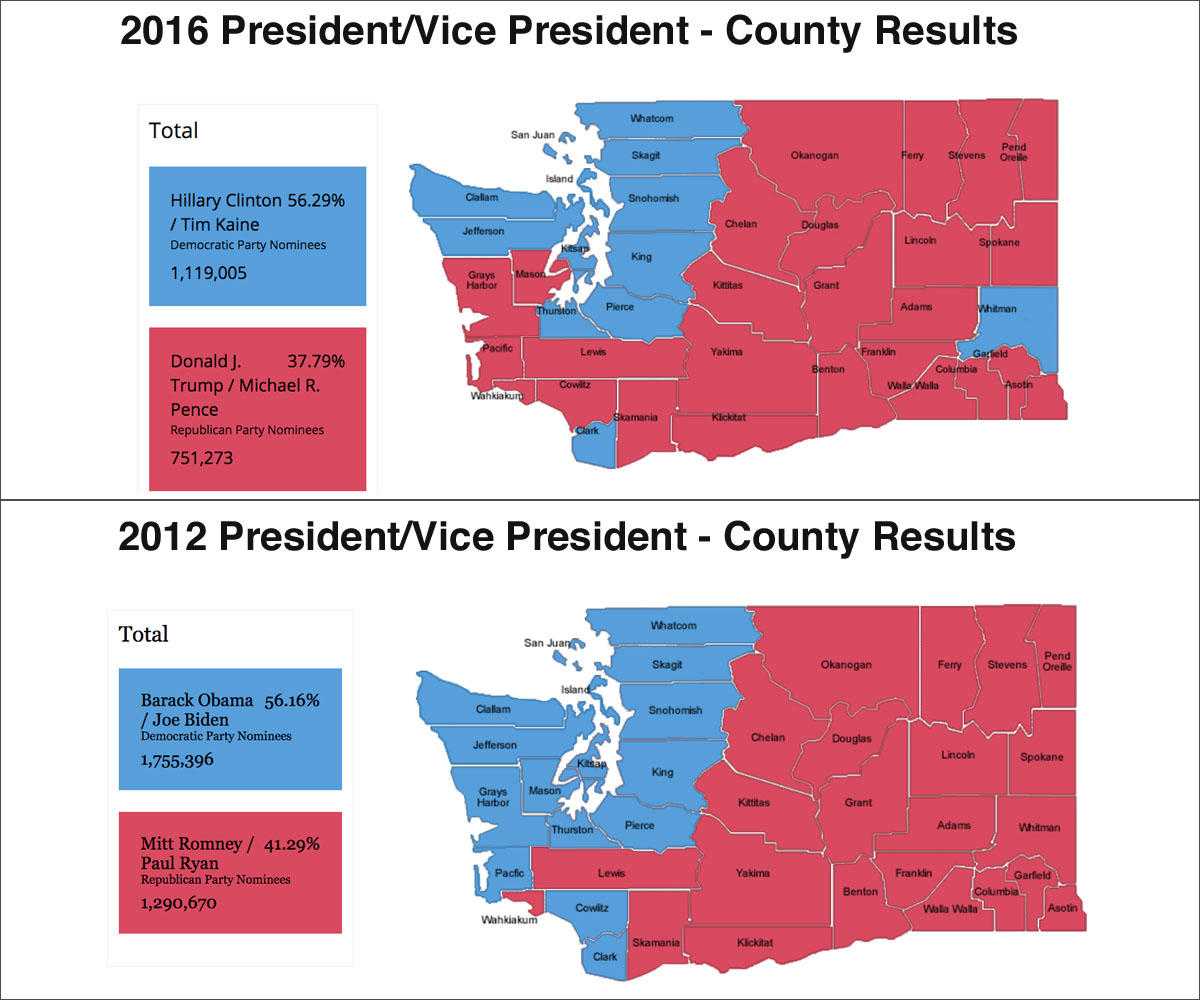
Three of those counties—Grays Harbor, Pacific, and Cowlitz—voted for Trump. Trump’s victory in Grays Harbor was the first Republican win there since Herbert Hoover.

Republicans see the 24th District suffering the same symptoms that turned the 19th red: unemployment higher than national and state levels, low incomes, lack of job opportunities, a sense that their needs are being ignored in Olympia and Washington, and resentment against Seattle elites.
Clallam does elect Republicans.  Jefferson has not for decades.  By most measures, it is the third most liberal county in the state after King and San Juan.  But the taxpayer revolt that soundly defeated Prop 1, a property tax increase to fund housing programs, has given Republicans some hope.  They aim to peel off enough Jefferson County votes outside of Port Townsend to keep the liberal, high-voting enclave from deciding the race.
The absence of a Trump effect in Clallam and Jefferson counties does not bode well for GOP hopes.  Trump lost Clallam.  In Jefferson he could not garner even 30% of the vote.

Money Woes for GOP Challengers

Tharinger currently holds a war chest of about $52,000 in cash.  McEntire has raised only $17,600 and has already spent $11,400, according to the latest Public Disclosure Commission data.

McEntire has raised 2/3 of his funds from individuals. The House Republican caucus has kicked in $5,000.

Tharinger’s contributions show the advantages of a four-term incumbency and chairmanship of the powerful budget committee. He started with $16,000 in the bank and has raised $36,000 for this race. Less than a third of those contributions come from individuals. More than a third comes from political action committees, with most of the rest from businesses and $3,100 from unions.

Tharinger has spent only $1,000. He has barely begun campaigning.

In our previous report on the Chapman-Wilke race, we reported how Chapman has been piling up a huge number of endorsements and held a 3-to-1 fundraising advantage. We understated that advantage by omitting what he had in the bank at the start. Based on current PDC data, Chapman has available about $54,000 in cash. He also has barely begun his campaign.

Chapman’s opponent, Wilke, has raised $15,000, and already spent $8,000.

The House Republican Caucus has yet to contribute anything to her campaign.

Right now, McEntire and Wilke are quite visible and active. Their signs are already up and they are busy with campaign events and appearances across the district. They have not faced much competition for the spotlight. That will change when Tharinger and Chapman hit the trail and start spending their piles of campaign cash.

HAAS FACES SECOND COMPLAINT

HAAS FACES SECOND COMPLAINT

Prosecutor’s Odd Response Repeats Charge He Let A Serial Rapist Go Free

Jefferson County Prosecutor Michael Haas has been hit with another complaint for unlawful use of his office in his campaign for re-election.  While the alleged infraction may be minor, Haas’ response reveals an incumbent chafing under scrutiny and brings to the fore a more troubling issue.

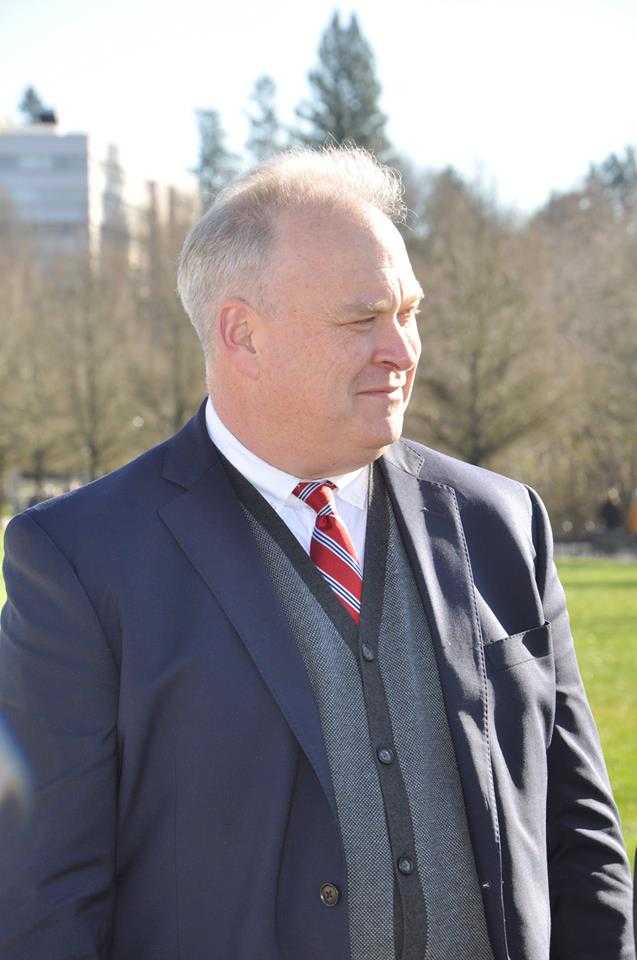
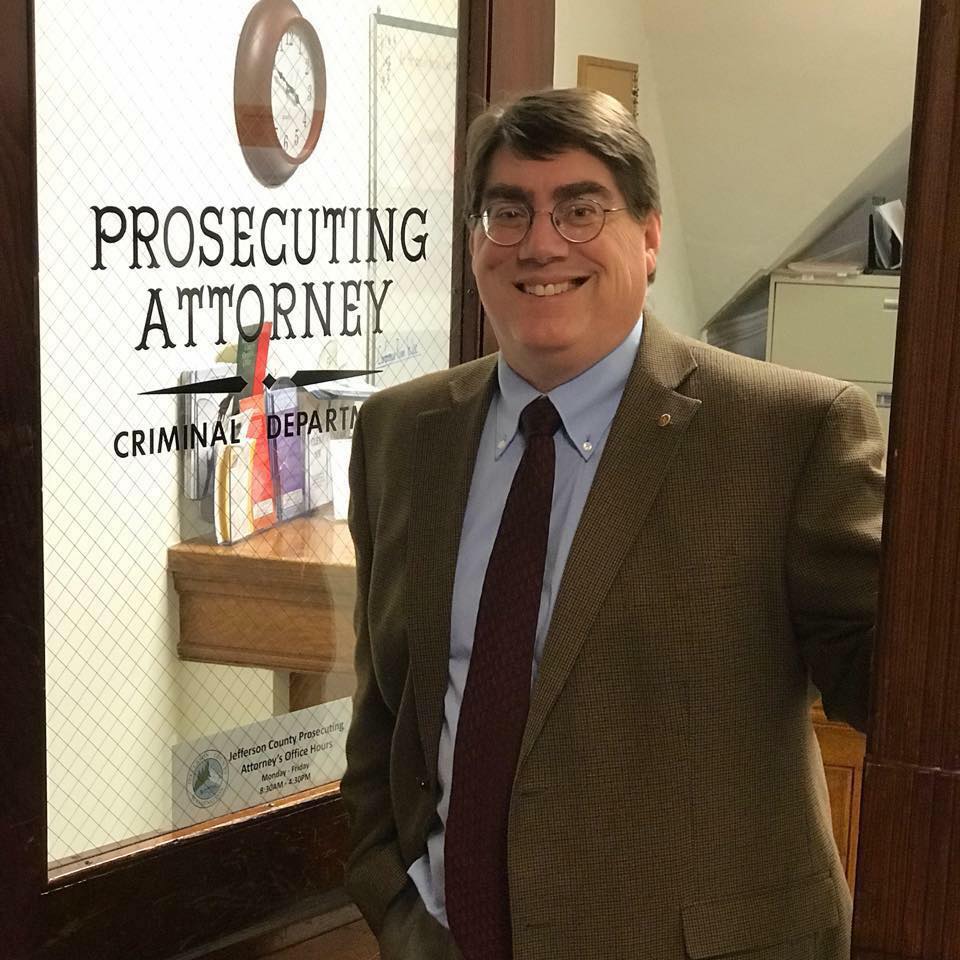
This profile photo for the Re-Elect Haas for Prosecutor Facebook page has landed him in hot water.

On June 7, 2018, Gary Maxfield of Port Townsend filed a complaint with the Washington Public Disclosure Commission alleging that the use of this photograph in Haas’ campaign violated RCW 42.17A.555.  That law prohibits an elected public official such as Haas from using “any facilities of a public office” for the purpose of assisting a campaign for elective office. “Facilities of a public office” include “office space.”

You can read Maxfield’s brief complaint by clicking here.

Haas filed his response June 14, 2018.  You can read it by clicking here. He did not deny the use of the photograph in his campaign for re-election.  Without any explanation, he simply contended its use was not illegal.  And if it was illegal he argued the infraction was de minimis, a term used by lawyers and judges to indicate something so trivial it is inconsequential.

Haas may or may not be right.  On the one hand, literally applied, the law cited by Maxfield would prohibit use of images of the prosecutor’s office in campaign materials.  He clearly may not use his office for a campaign event.  PDC guidelines make it clear he could not hold a press conference for his campaign in his office  A photograph of him at such a press conference certainly could not be used in his campaign materials.

On the other hand, the PDC’s regulation governing this law does not prevent a public office from making public facilities available on an nondiscriminatory, equal access basis for political purposes.  The PDC has issued a rule interpretation allowing judges to use their courtroom for campaign photographs as long as the courtroom is available for the same use by everyone.  That means allowing their opponent to sit in their same chair on the bench for their own campaign photograph.

As far as we know, Haas did not offer his office space for a photo session by his campaign opponent before using this photo in his own campaign materials.

The PDC will decide.  Perhaps what is more interesting than the legal issue is Haas’ rather odd response and the bigger controversy it brings again to light.

“Mr. Maxfield is not a fan of mine.”

Haas’ first response to the complaint was not to address the legal issues.  Indeed, he never addressed whether his use of his office in his campaign material is prohibited or not.  His first response was to go after the complainant’s statements on Facebook.

Haas copied part of a thread in comments to a post on the Facebook page of his opponent regarding his endorsement by local law enforcement–something unprecedented in Jefferson County.  You may read our story on that development here:  Haas Lashes Out at Law Enforcement for Endorsing Kennedy.

Haas used this comment by Maxfield to lead off his PDC response:

Haas complained to the PDC that “Mr. Maxfield is not a fan of mine and his complaint is clearly politically motivated.”

The PDC is likely unmoved by this opening statement.  It is a rare complaint indeed that is filed against a candidate by their own supporters.   As for “letting a serial rapist go free,” we’ll come back to that.

Haas then made the argument that no violation can be found, even though the photo of his office was used in campaign materials, because it was taken before he decided to seek re-election.  He says he liked the photo and used it on his personal Facebook page.  Then he expresses confusion about how the photo ended up used in his campaign:
Later when I committed to running for re-election I restored my campaign Facebook page.  Unfortunately, I am less than fluent when it comes to using Facebook.  I assume but am not certain, that the photo in question simply transferred to the linked campaign Facebook page.

Certainly, he knew it was there before he was notified of Maxfield’s complaint.  It was the profile photo for his campaign Facebook page.  He had regularly posted statements to his supporters on that page and could not possibly have missed seeing it.

An Odd Argument for a Prosecutor

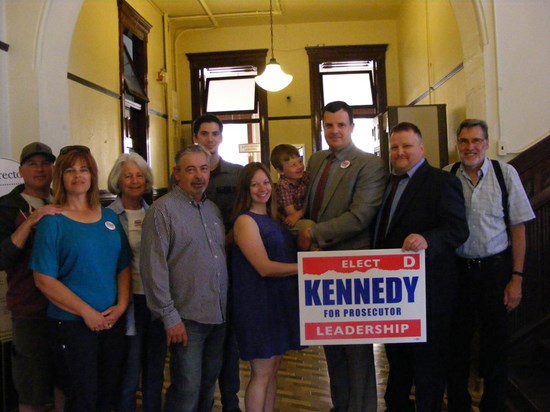
Still not addressing the legality of his own conduct, he then takes a swing at his opponent, James Kennedy, for using a photo taken in a hallway of the Jefferson County Courthouse when Kennedy filed as a candidate.  He alleges that because Kennedy is employed by the Clallam County Prosecutor, he has also violated the rule against using the facilities of public office in campaign material.

Coming from a prosecutor, this is a very odd defense.  It goes:  “I shouldn’t be held accountable for breaking the law because that other guy did it, too.”

Had Haas read a little further in RCW 42.17A.555, he would see that his swing at his opponent missed.

Haas acknowledges that the Kennedy photo was taken on the first floor of the courthouse and not in any office. It was taken outside the Clerk’s Office door, where, inside, in the normal and regular conduct of that office, people file to stand for election.

RCW 42.17A.555 permits the use of public facilities in campaign materials regarding “activities which are part of the normal and regular conduct of the office or agency.”

This complaint came fast on the heels of another complaint by one of his own employees alleging Haas was electioneering in his office and pressuring employees to support his re-election.  Haas admitted putting one of his campaign pins on an employee’s personal effects.  That employee also told PDC investigators he had solicited campaign contributions from his deputies and she was feeling uncomfortable with the pressure he was placing on her in regard to the upcoming election.  The PDC closed that case without finding enough evidence for a material violation, noted this was the first complaint against Haas and left him with a pointed reminder not to use his office for electioneering.  You can read our report on that first complaint against Haas by clicking here.

Did Haas Cut a Serial Rapist Loose?

Haas ran as a challenger in 2014.  He could fire away at the incumbent without having his own record to defend.  But now he is the incumbent and on the defensive.  The men and women in law enforcement he has been working with to make cases for prosecution are actively working to see him defeated.  Current and former employees of his own office, as seen in the PDC’s investigation, Kennedy’s list of endorsements and Kennedy’s campaign finance reports, are speaking out against him.

Haas must justify how he has handled cases and treated crime victims.  The tables are turned.

Which brings us back to Maxfield’s allegation about Haas “letting a serial rapist go.”

Maxfield is no doubt referring to a rape case dropped by Haas on April 26, 2018.  In addition to the latest sexual assaults of which that individual stood accused, he had a previous conviction for assaulting a woman he abducted.  Four other women had taken out restraining orders against him.  That individual had yet another conviction for assault, on a women he met through an alcohol treatment group.  (See Seattle PI story here). The latest woman he was accused of assaulting was a young woman he brought from her home in the Phillipines to southern Jefferson County.  A jury had once found him guilty of raping her, but an appellate court years later overturned the conviction and sent the case back for retrial.

Haas dropped the case without consulting the victim.

Kennedy contends Hass mistreated the alleged rape victim in several ways.  We are waiting on a response from Haas’ office to a public records request.  In the meantime, we are studying the court record and speaking to people close to the case.

Haas’ conduct has been called a blow to women’s and victim’s rights.  He has defended his actions as proper and ethical.

What really happened?  This will be a major point of contention in the campaign for Jefferson County Prosecutor.

Watch here for our report.

Lest we forget to mention:  Haas’ wife has removed the offending photo from the campaign’s Facebook page.

Do Black Lives Matter When It Comes To Green Cars?

Do Black Lives Matter When It Comes To Green Cars?

Electric cars run on the suffering of Black children living like slaves.

Amnesty International exposed this painful truth in 2016.  You can read their report by clicking on its title, “This is What We Die For.” Most of the world’s cobalt comes from the Congo.  Lots of cobalt is needed for electric car batteries. Its production is controlled by warlords and corrupt government officials.  They are getting rich off children who dig and haul and wash cobalt in hellish conditions.

A subsequent Sky News television report (click here) is heartbreaking and infuriating.

A handful of Chinese corporations control Congo’s cobalt production.  These Chinese corporations supply Chinese and South Korean battery makers who produce most of the world’s rechargeable lithium batteries.  Those batteries are used in cell phones, lap tops and scores of electronic devices.  But electric cars need 10 to 20 pounds for their batteries whereas a cell phone requires 5 to 10 grams and a lap top one ounce.

Cobalt mines outside the Congo might be able to meet the demand from manufacturers of smaller devices.  But so much cobalt goes into electric car batteries that the Congo’s 60% share of the world’s reserves must be utilized.

Amnesty International’s findings were confirmed by UNESCO, CNN (see below), The Washington Post(a comprehensive multi-media report, 9/2016), The Daily Mail, (8/2017), and Al Jazeera (12/2017).  This is just a sample of the reporting.

The mines cause other dire problems.  As reported by The Daily Mail:

Soil samples taken from the mining area by doctors at the University of Lubumbashi, the nearest city, show the region to be among the ten most polluted in the world. Residents near mines in southern DRC had urinary concentrates of cobalt 43 higher than normal. Lead levels were five times higher, cadmium and uranium four times higher.

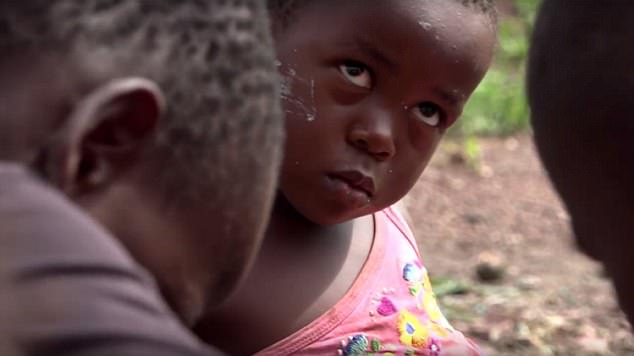
Four-year-old Monica found by the Daily Mail
to work in cobalt mines.

Battery makers, car manufacturers, Apple, Microsoft and the Chinese companies buying Congolese cobalt promptly decried the brutal situation uncovered by Amnesty, declared their supply  free of cobalt mined by slaves and children and pledged vigilance to ensure humane conditions in the mines and to exclude “blood cobalt” from their products.  A Responsible Cobalt Initiative was launched by the Chinese cobalt middlemen and Chinese battery makers.

Two years later, the conditions Amnesty discovered persist.

CBS News reported March 5, 2018, it found children still working the cobalt mines:

CBS News found what looked like the Wild West. There were children digging in trenches and laboring in lakes — hunting for treasure in a playground from hell.
The work is hard enough for an adult man, but it is unthinkable for a child. Yet tens of thousands of Congolese kids are involved in every stage of mining for cobalt. The latest research by the United Nations Children’s Fund (UNICEF) estimates 40,000 children are working in DRC mines.
More than half of the world’s supply of cobalt comes from the DRC, and 20 percent of that is mined by hand, according to Darton Commodities Ltd., a London-based research company that specializes in cobalt.

In a May 2018 report CNN updated Amnesty’s 2016 findings that car makers cannot determine the source of the cobalt in batteries.  They exposed the Congolese certification system as a sham.  The certificates are supposed to assure upstream users that their cobalt was not mined by slaves and children.  CNN showed that the certificates are issued by the same people responsible for inhuman mining conditons.  They found that the Congo’s Presidential Guard protects the facilities trafficking in “blood cobalt.”

Despite the pledges and denials, CNN concluded that no car manufacturer can assure buyers that their electric car does not run thanks to cobalt mined by African children.

Now We Know.  What Do We Do?

We sought to determine how area owners and advocates of electric cars deal with this knowledge.  What we learned is that they don’t want to talk about it.

We started with the Jefferson County EV Association.  They participated in this year’s Rhody Festival Parade, silently rolling past the crowd in electric cars with signs declaring their vehicles’ virtues.  We first contacted them without revealing the subject we wanted to pursue.  Their spokesperson was willing to answer questions.  But since we asked the specific question of how they handle knowing about the suffering behind their cars’ engines we have received no response.

We put the same questions to the four electric vehicle owners who tell their story on theassociation’s website.  One of them is an elected PUD commissioner.  None responded.

We reached across Puget Sound and put our questions to the woman who runs Seattle’s Green Fleet Management.  The City of Seattle holds frequent press conferences and issues press releases touting its ever-increasing fleet of electric vehicles.  We received no response to our questions.

We reached out to Coltura, a Seattle advocacy group whose mission is seeing the United States rapidly transition completely to electric vehicles.  A recent report by Coltura lamented the failure of local governments to meet the Legislature’s directive to run all vehicles on electricity or biofuels “to the extent practicable.”  Coltura did not respond to our questions.

While attending a climate change summit in Paris in 2015, Governor Jay Inslee unveiled an electric fleet initiative to ensure that at least 20% of all state vehicle purchases are electric by 2017.  So we reached out to the State of Washington with our questions about the morality of buying electric cars that rely on child and slave labor.

Off the record we learned the state is buying mostly Chey Bolts.  The batteries are made in Michigan.  So far, so good.  But our research showed that the batteries in Chey Bolts come from LG Chem of South Korea, which buys its cobalt from the same Chinese outfit implicated in all the reports starting with Amnesty.  In the Amnesty investigation LG Chem admitted using cobalt from the mines where the horrible conditions were found.  The Washington Postasked LG Chem where they got their cobalt.  They claimed their cobalt comes not from the Congo, but from New Caledonia.  However, minerals experts consulted by The Post concluded that could not be true, as LG Chem uses more cobalt than New Caledonia’s entire national production.

We are still waiting for a statement from the state.

Another Seattle activist organization, the Alliance for Jobs and Clean Energy, is pushing I-1631, a ballot measure which would impose an annually rising charge on gasoline and other carbon-based fuels.  Their goal is to force people out of their gas-powered cars into electric vehicles or mass transit that would also run on electricity.  Their equivalent of a carbon tax, they claim, is based on social justice and racial ethics.

Months ago we asked them to respond to the findings of the racial injustice inherent in the cobalt supply system that leads straight to the electric vehicles they advocate.  They never responded.

Electric Cars Are Great–Except for the Racism Part

In the United States, it is whites with enough money to pay the premium prices who buy electric cars.  Yet it is poor African Blacks who pay the highest prices in terms of their freedom, their health and their lives.There may be white people in the US and Europe who might defend this human suffering in Africa as necessary in the fight against what they consider a greater concern–climate change.  But they are never going to volunteer themselves or their children to take the place of Blacks in the cobalt mines.  They prefer someone else doing the  dangerous, miserable jobs in the struggle for climate justice.  And it’s not someone who will ever have the money to enjoy owning an electric car.

Consider this: Most of the high-paying jobs in the oil and gas industry in coming years will go to Black and Hispanic workers.  (Women are also snagging a big chunk of those lucrative jobs).  Unlike warlords and corrupt officials who exploit Black laborers, the US oil and gas industry gives workers in the US a very good life.

Efforts are underway to find a substitute for cobalt.  There are also calls for including cobalt in the US law that targeted blood diamonds and rare minerals controlled by African warlords.  Developing technologies promise carbon capture on a scale that will let people keep their internal combustion cars.  Mazda is rolling out gasoline-powered cars next year that promise lower carbon emissions than electric vehicles.

Some very intelligent people, such as environmental economist Bjorn Lomberg, contend that electric cars don’t do that much to reduce carbon emissions and may actually be detrimental to the environment and broader social justice causes.

Electric cars may not be all that green.  As reported by the National Review:

In 2013, the Environmental Protection Agency described these batteries as having the “highest potential for environmental impacts,” with lithium mining resulting in greenhouse-gas emissions, environmental pollution, and human-health impacts. The Union of Concerned Scientists, a group that specializes in “science for a healthy planet and safer world,” agrees: For long-range electric vehicles such as Tesla, manufacturing emissions are 68 percent higher than for conventional cars.

It may be more ethical to hang onto your gas-powered car as long as it keeps running.  You avoid the carbon emissions and pollution that come with manufacturing a new one.  You won’t be rewarding people who profit from inhumanity.  And you won’t find yourself in the hypocritical position of shopping for free trade goods in a car that runs on human suffering.