by Ana Wolpin | Aug 25, 2022 | General
Until a few short weeks ago, I’d never heard the slur “TERF”.
Until the story of Julie Jaman’s ban from the YMCA pool broke, I had no idea that so much trans-activist venom and vitriol had infected our community. Or that people we have invested with positions of power in local government were promoting hatred towards a large swath of our community in deference to an extremist agenda.
TERF stands for Trans-Exclusionary Radical Feminists. Apparently, when 80-year-old Julie Jaman objected to a man with a penis who “identified” as a transgender woman roaming the YMCA pool locker room where Jaman was naked in the shower, she joined the ranks of TERFs.
If that makes her a TERF, then I must be a TERF, too… along with many, many other community members who have addressed the city and written to the Free Press about this now international story.
One of our readers alerted us to this website that graphically illustrates the violent, even vicious intent behind the acronym.
Like so much of the trans movement, inversions of reality abound. Terms like “discrimination” have been expropriated by those doing the real discriminating onto those being discriminated against. “Exclusionary” and “radical” are likewise inverted, projected onto women simply asking for basic rights when those doing the projecting are the actual radical extremists.
As noted in my previous article, in early August, city leaders betrayed public trust and hammered a wedge unlike any I’ve ever seen in Port Townsend. At the August 1st city council meeting, citizens who expressed concerns about women’s privacy rights were at the receiving end of the inversion, called bigots and trans-haters.
In his summation following public comments, Mayor David Faber joined those doing the name-calling, twisting the narrative from a request for common-sense solutions for women’s privacy in public spaces into a trans-rights call to action, grandstanding behind his mask about hate and discrimination having no place in our “welcoming” community. Those who had actually delivered the hate that night were lauded as the inclusive ones, protecting a special and fragile minority.
Faber’s flamboyant inversion of the story, perched atop his mayoral dais, shocked women’s rights advocates, provoking scrutiny of his social media history. Writer Mandy Stadtmiller is among those who uncovered a misogynistic and “creepy” persona driving our mayor behind the mask.
In her August 16th Substack Rabbitholed, she asked:
“David Faber, the mayor of the town, has been making quite a reputation for himself online since the incident went viral,” wrote Stadtmiller.
“Adding a new layer of shock, an investigation into his social media reveals exactly how disturbing Faber’s creepy online trail is in regularly objectifying and demeaning women and comparing himself to child-pornography-legalization-advocates like the gamer Vaush.”
Wennstrom joins the hate parade.
Mayor Fabor began the charge. But it was city councilor Libby Wennstrom who really fanned the flames, inciting Facebook followers to “show up” to confront the newly-dubbed “trans-haters” at the pool.
In another post, Wennstrom promised she’d be there, too. The prompts found their mark. According to reports, attacks from counter-protestors at the pool were aggressive and full of rancor, shouting down and name-calling a small group of predominantly elderly women who’d hoped to have a conversation.
But that was just a warm up. Wennstrom has now ramped up her hate campaign, escalating the attack with a prominent new Facebook post in which she “updated her cover photo” to a threat against all TERFs:
In a field of hot pink, caught between a giant wave and a steep cliff, we see a woman running for her life. The turquoise message boxing in the scene, shouts “TERFS OUT OF PORT TOWNSEND!”
Wennstrom is promoting a pogrom to rid our town of all women who do not share her ideology about sharing bathrooms with men. If you do not accept that a man with a penis who says he is a woman IS a woman, you are not welcome here.
You now are not only a hater, you’re an exclusionary radical feminist. The image and message of her Facebook graphic implies that your life is in danger if you do not hotfoot it out of town, pronto.
At the August 15 rally at the Pope Marine plaza, Chief of Police Tom Olson reinforced that message. As peaceful, elderly women were being assaulted by an angry mob, police stood directly across the street outside City Hall and watched impassively. People begging for help were told they were “free to leave” and shouldn’t expect any protection because of a “directive” from the top.
Excuses from Olson now range from we are understaffed to we didn’t have enough time to prepare (a week, with state patrol also present) to the crowd was too big. Plus, “All of our officers were primarily focused on an orderly council meeting.”
Yes, the dog-and-pony-show, Pomp and Circumstance city council meeting. Mayor Faber and the rest of council staged their own spectacle that evening, an orchestrated love fest for the trans community followed by a self-congratulatory reading of a proclamation urging “all residents and visitors to be respectful, welcoming, and kind to everyone.” Faber described the proponents for trans rights as “beautiful”.
Just across the street, less than an hour before the virtuous proclamation was adopted, those “beautiful” people were screaming hate at and assaulting fellow residents. Councilor Wennstrom’s hate campaign had drawn a more-than-willing audience. This is what our welcoming, respectful, kind community looked like:
And this:
Screen shot from video taken by Crystal Cox
Central to this conflagration are policies that allow any man claiming to be a woman access to private women’s spaces. Not a single person I heard speak at either the August 1st city council meeting or at the August 15th rally at Pope Marine Park has suggested that people identifying as transgender should be discriminated against, let alone hated. Again, the inverse is true. As one of our readers commented under my previous article, “If some adult wants to identify as a fence post, it’s none of my concern. Just don’t indoctrinate the children with fence-post-ism.”
The issue being addressed is that all-gender policies are an invasion of privacy and an invitation for sexual predation.
Matt Osborne of The Distance estimates that “somewhere between 70 and 90 percent of men who identify as transgender opt to keep their penises.” They jump on the transgender bandwagon, but avoid surgeries that would alter their genitalia… all the while insisting that they are women who should have access to women’s private spaces. Stories abound of trans inmates sexually assaulting and even getting women pregnant when they are housed in female prisons. Studies show a sharp rise in sexual predation where dressing rooms, school locker rooms and public bathrooms are all-gender. It’s an undisputed fact that when gender boundaries blur, sexual crimes rise.
Let’s talk TERF
But according to the trans-rights narrative, we are being “exclusionary” if we object to our private spaces being violated by a man with a penis who “identifies” as a woman. As I commented in a recent exchange — because a man wants to be and proclaims he is now a woman, no one is to question that, lest we cause hurt feelings. That makes us hateful, bigoted and discriminatory. It’s even worse if we happen to be women; then we are also trans-exclusionary radical feminists. TERFs.
Local women’s rights advocate Amy Sousa explains in this video that There’s No Such Thing as a TERF. It is violent hate speech, she says, “being used to silence women who want to speak out about their sex-based rights.” The images of threatening fists and a woman hanging from a noose at the opening of this article illustrate her point.
Who is being protected is not even clear. As one PTFP reader noted:
“It seems even the definition of transgender is fluid. Buy a female swimsuit and hang out in bathrooms, lockers, and showers at your leisure. No questions can be asked… Right now, I don’t think anyone has a clear definition of what a trans person is. Fully trans after buying the swimsuit? Fully trans after removing body parts? Fully trans after some counseling? Gay trans? Bi trans?”
Women are not allowed to ask these questions, to do so makes us TERFs. And as the option of being “gender-fluid” gains traction in this narrative, your choice of bathrooms, showers and locker rooms can change on a whim. Pop star Demi Lovato recently explained our new gender-fluid reality — today I can be he/him, tomorrow I am they/them, and the next day I choose she/her. Lovato admittedly grapples with confusion over which public bathrooms to use; it all depends on how she feels in the moment.
No one has suggested that any specific trans person in our community is a pedophile or rapist. But if the violent behavior by some who attended the August 15 rally is any indication of the types this movement cultivates, that certainly gives cause for alarm.
Many Free Press readers have shared their distress over the dangerous divide being witnessed. The threat of being ostracized and even fear for their personal safety if they speak out has led many to request anonymity:
“I was there, witnessed and experienced the aggression from what seemed to be out-of-town rent-a-thugs. But there were also locals I knew and recognized dressed in antifa garb, with earpieces, standing to left side of the Cotton Building, watching like spiders. It was creepy and disturbing. As was the robotically-chanting mob. I haven’t felt a part of this place since the start of Covid. But Monday was a full-on rupture.”
———————
“I saw four women in the speakers area pushed to the ground! I didn’t understand why a perimeter wasn’t set up so the crazed hooligans couldn’t interfere and hurt others. Surely the City and police knew this was going to be contentious or they would not have closed part of the street… Obviously, the City wanted to use this situation to bully by proxy, to crush free speech and compromise democracy.”
———————
“I can’t imagine wanting to live here after experiencing the obvious set-up and abandonment of local elderly residents. The sight of a Port Townsend Police vehicle or a Pride flag makes my blood run cold. This was pre-meditated assault on law abiding residents.”
———————
“Had I not witnessed firsthand what transpired, I would never have believed it possible. The behavior of the trans-rights activists — in the name of “love” and “tolerance” — astounded and sickened me… What I witnessed on Monday evening shook me to the core. The videos I’ve watched do not adequately convey the feeling of being there.”
———————
“I also attended with the intent to observe and came away deeply troubled and sickened by the hatred and rage, violence and mob mentality expressed by my community. I don’t care where these people came from – the TRAs – if paid or invited to agitate. It’s still this community that supported the message of hate and violence under the guise of love and diversity. I don’t know where we go from here. It doesn’t seem that dialogue is possible. Or that truth matters.”
The women being told to “FUCK OFF!” on signs by masked protestors and to get out of town by City Councilor Libby Wennstrom are in large part elders who have contributed decades of their hearts and souls into this community. Many of them are long-time human rights, environmental, and — like myself — peace activists. For simply saying our needs deserve the same consideration as the fantasy of an adolescent boy who suddenly declares himself a woman, we are now undesirables.
Libby Wennstrom is on a mission to rid Port Townsend of us. Jousting and tweeting while Rome is burning, Mayor David J. Faber combines juvenile insults and pompous proclamations in a We’re So Welcoming charade. The rest of the city council seems delighted to be going along for the gaslighting ride. Chief of Police Tom Olson is accomplice, protecting City Hall, not Port Townsend’s residents.
Any woman who does not bow at the alter of the well-funded trans lobby that demands erasure of millennia-long protective boundaries is now a TERF. We are to be driven out of town. Certainly not given the same protections as the now-prioritized trans minority. Or perhaps, as illustrated in the earlier montage, hung by the neck until dead.
From the website
TURF IS A SLUR
Documenting the abuse, harassment and misogyny of transgender identity politics
————————————
“WOMEN OUT OF PORT TOWNSEND” top graphic: @arachoid666 on twitter
by Ana Wolpin | Aug 12, 2022 | General
“Wow! Why are trans rights and trans feelings
more important than any woman’s?
Why are women and children not worthy of protection?”
– Comment from Port Townsend Free Press Facebook post
————————
Dozens of citizens filled Port Townsend City Council chambers and joined by phone Monday night, August 1st, to address the council about the banning of 80-year-old resident Julie Jaman from the city’s public swimming pool. The near-hour of emotional and often impassioned public comments underscored a deep cultural divide in the Port Townsend community.
Jaman’s story, which went viral nationwide and then internationally following the Free Press‘s detailed coverage, involved her shock of hearing a man’s voice in the women’s locker room while she was naked in the shower after a swim at the pool. When she looked out from the thin plastic shower curtain and saw a biological man in a women’s swimsuit, she became upset and demanded the person leave. Rather than de-escalate the situation, the pool manager who intervened told Jaman that she was guilty of “discrimination” and that because of her objections she was banned from the pool for life.
The 60-year-old Mountain View Pool is at the center of this controversy and of a community complex, the Mountain View Commons. The former school campus also includes the Port Townsend Police Department, the Food Bank, and local radio station KPTZ. The Olympic Peninsula YMCA began operating the city-owned pool in 2021 in partnership with the City of Port Townsend. The city is ultimately responsible for all the public spaces at the site and for policies established at the pool.
After the distressing incident, Jaman wrote a letter to the Port Townsend City Council and state reprepresentatives. At the council’s August 1st meeting, she read from a follow-up statement during the 3-minute public comment period.
Julie Jaman leads off public comments about discrimination at the city pool at the August 1, 2022 Port Townsend City Council meeting. Click on this image to watch the archived meeting. Jaman’s comment begins at minute 7.
In measured tones, Jaman asked for “respectful and inclusive” policies for all pool patrons:
“There is no signage informing women the shower room is now all-gender. Have parents been informed of what they can expect with these policies? The Y has not provided any dressing/shower room options for women who do not want to be exposed to men who identify as women.
It is unconscionable that the YMCA would instigate these new policies without clearly informing pool patrons and parents. Although in 2021 the Y reported that they were adding family and all-gender dressing and bathing areas, they’ve not done that. Instead, they’ve usurped the binary designations… with no choices. The staff seems to have received little professional training on how to handle reactions to such a radical cultural change — particularly for the most vulnerable, older female patrons, and children who may be exposed to inappropriate behavior… the dignity and safety of unsuspecting women who have trusted to use these facilities for many years.
This is not right. The YMCA, the city, the police and sheriffs, the parents, the professionals who assist victims of voyeurism, peeping toms, pedophilia and assault need to come together to figure out how to make the new policies work for all pool patrons, not just one group.”
More than 20 people followed Jaman, participating both in person and by phone in a heated comment session.
Half who spoke agreed that allowing biological men to use women’s facilities creates comfort and safety issues, and asked for a third shower and changing area to accommodate trans/non-binary individuals.
The other half believed that trans individuals should have access to whatever facilities they choose as their gender identity. Some went so far as to say that the people who don’t accept that are bigoted, hateful and deserve to lose their Y membership if they can’t get in line with trans ideology.
Some commenters tried to find a middle ground, also asking for additional facilities at the pool to accommodate the divide.
THE MANTRA: Trans Women Are Women, Trans Men Are Men
The reach and saturation of the trans narrative was no more evident than in the parroting of slogans by a small child who came with his family to address the council. The self-described “9-year-old non-binary person” stressed that it is not fair that people didn’t accept that a person is whatever gender they say they are.
At the podium, the nine year old explained through a mask:
“Since I’m so young people don’t often take me seriously. And they will use my pronouns, but I can tell that they are not really respecting me and they don’t actually think that a child can make this kind of decision. But I believe—that imagine this—that you know what gender you are, that’s the gender you are. And if you know you are not in the gender you are born, you know that’s a mistake. You are not someone who identifies as female, you are someone who IS female. I believe that if you know what gender you are and you get sent into the pool and somebody gets mad at you because you’re not in the bathroom they think you should be, then that is not fair. You know what gender you are and if someone else says, Well, sorry we think you should be in this bathroom, how would that make you feel? It’s not fair that we don’t count these as the same as us, these are the same kind of people and I don’t believe that we should be treating them like someone who identifies as someone else. That is not fair.”
Andre Wilson reinforced that assertion. “I am a transgender man who identifies as non-binary. I lived a miserable life as a transgender child.”
“Transgender people are the person they identify as. So when a trans woman says they are a woman, they are a woman. When a trans man says they are a man, they are a man. There is no question about that.”
Washington state law affirms that contention, Wilson said, emphasizing a second time: “Trans women are women, trans women [sic] are men, non-binary people are non-binary. That’s it.”
Variations on that refrain were repeated by speakers throughout the comments. Asserting that a biological male identifying as a woman IS a woman, they championed their right to equal access of formerly binary bathrooms and showers.
Rebecca Horst announced that she had spent three hours in traffic driving from Sequim to get there. “This individual is NOT a man identifying as a woman, this individual IS a woman,” she said referring to the biological male in the swimsuit who had shocked Jaman.
Another person who chanted the trans mantra was Megan Doherty, “a lesbian who grew up in Port Townsend.” After saying how “brave and strong” the trans community was, she concluded her comment with:
“All that I heard today from the opposing side was ignorance and hatred and bigotry… If you don’t like it, you can choose to leave the pool and go somewhere else. But you do not have the right to pick and choose who gets to use the pool based on your own bigotry and your own ignorance. Trans women are women, trans men are men.”
A curious re-direct of the issue — neither Julie Jaman nor anyone else who spoke had ever suggested that trans people shouldn’t be allowed to use the pool. It was Jaman who had been banned from using the facility.
Speaking to the appropriation of the town’s community pool as a “Pride” agenda headquarters, Alby Baker said,
“I just have one question: Why would a public pool be turned into a marketing platform for sexual preference? And I’d like to get an answer from you guys.”
Facebook invitation:
Come down to Mountain View pool from 11-1 this week
to support Trans youth and the YMCA!
Mayor David Faber replied that responses would be given during the council’s discussion following comments. They weren’t.
Lema Constria (this name is hard to make out on the video capture and could not be clarified by the city) said she lives in Port Townsend with “my wife”, and identified herself as one of the counter-protesters at the picket that had taken place outside the pool earlier that day. She, too, said that the people who were standing for biological women’s rights to a private space were bigots. She repeated the falsehood that people protesting Jaman’s treatment were asking for trans people to be banned from the pool. Constria took the victimization a step further, protesting: “Trans people are people, they deserve human rights.”
It was a shift of focus that took place multiple times during the comments, painting the trans community as the ones being maligned in this discussion. No one had ever said or even implied that trans people didn’t deserve human rights; Jaman was appealing discrimination for being banned for a reaction to what she felt was a violation of her privacy as she stood naked in the shower.
“We are accused of hating trans people, of being Christians…”
Alison Hedlund had also been at the Monday afternoon action at the pool. Hedlund expressed surprise over the attacks she experienced from the group of counter-protesters, at the twisting of the story being told:
“The protest at the Y today… was full of rancor and accusations and insults by the people who showed up on the other side of this issue. We are accused of hating trans people, of being Christians at the Young Men’s Christian Association… and when we laughed, that we must be cultists… and then that we must be pedophiles.”
Annette Huenke, who had also attended that protest in the hopes of having productive dialogue, wrote of her experience. It started out, she said, as a civil conversation with 5 or 6 young people:
“The discussion was respectful until a couple of older women arrived and began to ratchet up the tone with raised voices and name-calling. We were accused of saying things we had not said. We were anti-vaxxers, eventually we were pedophiles, rapists, even Nazis.”
As more counter-protesters trickled in, wrote Huenke, the possibility for conversation came to an end:
“Julie’s friends left in frustration, leaving just the two of us. One of the older women began hectoring us, yelling that we needed a hobby… The slanderous name-calling continued. Some younger folks began joining her, creating a non-stop barrage of loud voices intentionally making it impossible for she and I to hear each other.
This is a common bully tactic used by trans proponents, the goal being to shut down reasonable debate and shut out the opponent. It is highly uncivil and undemocratic.”
The anger and rancor perplexed Hedlund. In her public comment, she asked council:
“But what about our needs as women? Do men transitioning to be women understand discrimination and violence are part of being a woman, and that we DO need protection from predators? Do women transitioning to being men understand that they are also vulnerable to male harassment and violence? I would think so. There is absolutely NO privacy in the women’s locker room, which means we are vulnerable.
I haven’t been there for years because of the lack of privacy… When men can decide that they are identifying as a woman, walk in, display their private parts, have the freedom to ogle or harass or assault anyone there, we have seen what can happen when pedophiles or rapists can and do populate careers and locations where they have easy access to women and children. Anxiety and PTSD is not uncommon when women feel vulnerable around men. Women’s concerns about our safety and privacy are and always have been legitimate, and we have long been accorded the natural right to these public facilities…
Locker room facilities should be upgraded to accommodate the safety and privacy needs of EVERYONE, instead of declaring that we now have a free-for-all to enter any bathroom or locker room.”
What became clear over the course of the comments was that the group asking for a shower/changing area that allowed traditional women to feel safe was seen by transgender advocates as an attack on Clementine Adams, the 19-year-old transgender employee who Jaman had told to leave the room while she was naked — and, by extension, an attack on the entire trans community. They were on the offensive to protect their right to use whatever facilities they chose. They were the ones being discriminated against, they said.
Those supporting the all-gender open policy repeatedly shifted the conversation to how oppressed and fragile trans people are.
“I am a transgender man myself,” phoned in Mo Wolfe from Brinnon.
“I have had surgeries, I have done hormones for years, I have a beard and I appear fully as a man. To say that people should go into the facilities that align with their biological sex can cause trans people extreme amounts of violence… Trans people have extreme high rates of suicide and violence. People should go to the restroom that they feel would be safe for them.”
But what about the sensitivities of elderly women? Where is the shower room that they will feel safe in?
Can we speak of pedophiles?
The mention of pedophilia held the biggest charge of the night.
The concern expressed that when men claiming to identify as women are granted intimate access to children, such access attracts pedophiles and other sexual predators, caused Constria to angrily retort: “People objected to being called bigots but are calling trans people pedophiles. Trans people are NOT pedophiles!”
“Calling and comparing trans people to pedophiles is absolutely disgusting,” said Mo Wolfe. A phone-in comment from former mayor Michelle Sandoval added, “People who are expressing fear need to get ‘pedophiles’ out of their language.”
IS there any cause for concern that pedophiles and rapists will use trans-inclusive laws to “identify” as women and gain access to vulnerable women and children? In her letter to the city, Julie Jaman wrote:
“Nationally, women continue to lose their personal rights to choose; they, along with little girls, forced to use non-binary facilities, are experiencing increased encounters with peeping toms and assault in shower, dressing and toilet rooms – at schools, gyms, prisons and now, potentially, at Mt. View Pool.”
But that could never happen here. Or could it? An increase in sex crimes when gender-free access is allowed in formerly gender-binary facilities is addressed in the Free Press article, Mountain View Pool No Longer Safe for Women and Girls. It presents “empirical evidence that unisex dressing rooms, bathrooms, and showers are the sexual predator’s candy store.”
Phoning in from the county, Mary Bond used her three minutes to attack previous speakers who had criticized the Y. She’d taken down their names: “I’m horrified to hear the bigotry quoted by [lists seven names] and others… They are bigots and I am ashamed, embarrassed and horrified. Trans women are women. Trans men are men,” Bond chanted.
Finally, almost an hour in, soft-spoken Addy Thornton, saying she had not planned to comment, carefully summed up what prompted her to speak:
“What I’ve heard is a lot of projection, that those of us who feel discomforted… that feel that decency and morality has been somewhat altered… we’re just hearing things that we’re not doing. The issue at hand is that there is not a place that can be separate, so that everybody is being allowed to be who they are.
Those of us who have grown up for however many years and have never encountered this until just recently—just the past few years where there is this agenda that has been foisted down our throats… I can’t help but feel that this is politically driven, that we are being not asked—but coerced—into accepting that which is impinging on our rights, our freedoms, our ability to operate in a situation where we feel comfortable…
There’s a mantra going on… and just because somebody says so many times that a trans woman is a [woman]… doesn’t make it real. It’s not scientific, it’s biological. So why don’t we agree to disagree… but we have to put conditions into place… for the majority of people.”
The City’s Response
Following public comments, Mayor David Faber opened the council discussion:
“I’m not going to speak to the particular incident that happened a few days ago, I think that the state law on that is very clear.
What I’m going to speak to is that Port Townsend is a welcoming community, and hate and discrimination has no place in this community. LGBTQ people, trans people in particular in this case, are entitled to basic respect. And they have not been receiving that in much of the commentary tonight, calling them pedophiles and rapists and predators. Given the rise in harassment and bigotry that trans persons have experienced recently, it’s important that cisgendered people like me speak out in support of our trans community.”
City Manager John Mauro then reiterated that the Y was following state law, an assertion that has been contested and may result in a lawsuit. He said there were conflicting reports about what had taken place and that the city’s agreement with the Y allows it to ban whoever it wants.
“I couldn’t sit here and say that we are not behind the Y’s decision based on abusive behavior and for the respect of every individual.”
End of discussion.
Faber and Mauro had made their declarations. Evidently, a response had been pre-determined. Circle the wagons.
The script:
- Avoid addressing the treatment of Jaman, question her story;
- Reinforce the Y is “just following state law” excuse;
- Dismiss the outcry for separate changing rooms as trans-hate;
- Focus on pandering to the transgender community.
No other council members spoke up.
Had a meeting been held that the public didn’t know about? Once again we saw the citizenry given their three minutes for public comment to satisfy legal requirements, but the city’s position had already been decided. Sitting through an hour of comments was a formality that had to be tolerated… barely tolerated, as you listen to Mayor Faber’s irritation increase throughout the hour.
Readers are encouraged to listen for themselves to the full public comments. Decide for yourself if you hear bigotry and discrimination from the community members being labeled bigots and trans-haters. Without exception, not a single commenter who appealed for separate public shower/changing areas free from biological men denounced, let alone expressed hatred for, trans people. As Sebastian Eggert said. “I have no problem with alternative lifestyles.”
But he and others drew the line at allowing biological men in women’s private spaces. They voiced fears that biological women have held for millennia and in response were told that their discomfort and fear made them anti-trans bigots.
Jaman challenged this reverse discrimination in her letter to the city:
“The YMCA policies on gender identity use “pride” as a euphemism to prevent discrimination against one group of people but at the expense of another group – women who don’t want to use all-gender bathing/dressing areas.”
As Addy Thornton had put it, “The issue at hand is that there is not a place that can be separate, so that everybody is being allowed to be who they are.” The council never responded to that simple need that had been voiced by every speaker except the few demanding all-gender access.
People had simply asked that their needs be given the same consideration as the trans community.
So where did all that “hate” rhetoric come from?
“The trans-haters are planning to show up at the Mountain View pool…”
Not only did our mayor characterize valid fears as trans-hate, dismissing public outcry in deference to catering to the trans community, Port Townsend City Council member Libby Urner Wennstrom set her own example of how to be a city leader. Her social media posts fanned divisiveness, mirroring the hate language spewed by the counter-protesters who attacked Hedlund and others during pickets at the pool and at the city council meeting.
The day after the meeting, Wennstrom encouraged people to confront the “trans-haters” who were protesting the Y’s treatment of Jaman and the pool’s policy. On the Y’s Facebook page Wennstrom posted:
“The trans-haters are planning to show up at the Mountain View pool picketing again today (Tuesday 8/2) from 11-1.
If you feel that hate has no place at our public pool, and want to support the Y in creating a safe welcoming place for EVERYONE, show up today!”
The Y is meant to be “a safe welcoming place for everyone”… except women and their families who are uncomfortable sharing once-private spaces with biological males. They don’t get a color in the festive rainbow Pride banners permeating the Y. Those people, in Councilor Wennstrom’s words, are trans-haters. Haters who will be put in their place with a new statement forthcoming from the city council.
While no meaningful city council discussion followed public comments, in the final minutes of the August 1st meeting (at 2:41:40), long after the public had left the chambers, Wennstrom requested additional council action on the pool controversy. She proposed adopting a statement opposing “discrimination against transgender people and to formally support the Y and its staff in their efforts to assure that everyone feels welcome to use our public pool.” She made a motion directing the council’s newly-formed Culture and Society Committee to draft this statement. The motion passed unanimously with no council discussion.
Free Press writer Jim Scarantino attended the August 10th Culture and Society Committee meeting for the drafting of the city statement. The committee is comprised of three council members — Owen Rowe, Monica Mick-Hager and Ben Thomas. Scarantino’s thumbnail report:
“The entire Port Townsend Police Department, minus one officer, provided protection for 9 citizens in the audience, 3 city councilors and 2 city staff at today’s City Council Culture and Society Committee. I observed 4 uniformed officers, one officer in plain clothes and the police chief also in plain clothes. Nothing happened. Only 1 comment. Safest place in Port Townsend. As for any 911 calls going unanswered this afternoon, or police taking a long time to respond, I suppose you will need to talk with City Manager John Mauro, one of those surrounded by superb law enforcement protection, at taxpayers’ expense. I wondered if they were paying the Sheriff to cover the city while the force was in city hall trying to stay awake. Totally boring. The Committee adopted a resolution in support of undefined transgenders, and was struggling with how to define cisgender, too. Supposedly some definitions will be in the resolution when it is presented to City Council at their next meeting, 8/15/22… Mauro was shaking with anger at Julie Jaman’s KIRO interview.”
The callous, abrupt and abusive treatment of a community elder who had been a pool patron for 35 years is not an issue for our city leaders. But the negative press she is bringing to the city is.
It’s all about damage control now.
What was originally called a statement has now been elevated to a special “Proclamation” from the mayor, formalizing the city’s fealty to the transgender community. As backlash continues to grow, the city is doubling down on its support of the Y’s abysmal handling of this charged and sensitive incident.
Protest planned against Mayor Faber at City Hall – “Zoopity boop.”
Jaman’s ban, the city’s inaction, and the council’s choice to focus its time and attention on a transgender “Proclamation” instead of listening to its broader constituency, has led to a planned protest outside City Hall. Amy Sousa, a nationally-known feminist living in Port Townsend, organized the event.
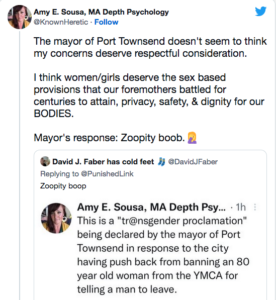
According to an exclusive in The Post Millennial, Sousa and at least 50 others plan to hold a press conference outside of city hall prior to the August 15th city council meeting. In a recent series of tweets between Sousa and Faber, Sousa posted notice of the mayor’s proclamation.
Faber responded by calling her and others who have issues with the proclamation, “transphobes”.
“The mayor of Port Townsend doesn’t seem to think my concerns deserve respectful consideration. I think women/girls deserve the sex based provisions that our foremothers battled for centuries to attain, privacy, safety, & dignity for our BODIES,” Sousa wrote in response to Faber’s tweet.
Mayor Faber’s reply: “Zoopity boop.”
Sousa described the mayor’s response as “juvenile”.
In the new “gender-fluid” reality, intrinsic fears and discomfort held by traditional women no longer matter. Jaman’s shocked outburst was “discriminatory” and per the YMCA’s “code of conduct” warranted an instant expulsion of her on the spot.
“It’s not fair that this woman here was judged to the extent of being banned from the pool for LIFE in the span of however many seconds it took her to react the way she did,” said Peter Robinson in his public comment. “We need to take into account that a lot of elderly people have lived through a lot of binary years and all of the pressures that society put on them back in those days.”
Much like Orwell’s Animal Farm—where All animals are equal, but some animals are more equal than others—terms like “inclusivity”, “non-discrimination” and “everyone” appear to be selectively applied in Port Townsend.
All people are entitled to basic respect, but some people are more entitled than others.
Community elders who raise their voices because they feel violated don’t make the cut.
——————————————
I did not vote for the T [in LGBT]… They lumped us all in without us involved. They are using LGBT and PRIDE to oppress, gaslight and bully people. They want more rights not equal rights. Trans women have more rights in today’s society then biologically born women. We fought for equal rights, not to take away the rights of others.
— #LGB
Only a woman who has children or has had children understands this response. That “Mama Bear Instinct” or the feeling of “I will do absolutely anything for the good of my children” can happen anytime… anywhere.
You know the feeling… it’s an emotional rollercoaster that can leave a mom shaking with fear or anger. I have been there!
— Edel Sokol
I know some Y employees who think the Y acted wrongly but they can’t/won’t speak up for fear of losing their jobs plus having to deal with the “mob mentality” that would tear them apart. So much for inclusiveness. Sounds like a hostile work environment to me.
— Nonsensical
It’s good to know somebody cares about how women might feel, especially as abuse survivors. True story, hardly anybody does care about what women experience and there is zero sensitivity. Sad too, because our compassion is often exploited, so we are shamed into remaining silent and putting the needs of others before our own.
— Gabrielle Guthrie
Gender Identity Ideology is a hoax. It masquerades as civil rights and compassion and science, and is the opposite of each of these. It is outrageous that men now declare themselves women, and are allowed to destroy women’s sex-based privacy, sports, etc. It is appalling that “progressives” applaud this misogyny. It is horrific that children are being fed to Big Pharma under the guise of this toxic ideology. See Hitchhiker’s Guide to the Transgender Galaxy for details.
– Carol Dansereau
(A few of the 300+ reader comments
posted under previous Free Press articles in this evolving story)
by Ana Wolpin | May 14, 2022 | General
In a letter to the Port Townsend City Council on May 2, 2022, I wrote:
“There is apparently a vision to eliminate or at least reduce use of the ‘personal automobile’ in our commercial districts… Those of you and others you know who are sold on this vision of a vibrant, car-free shopping/dining/recreating community experience have idealized a concept. You’ve seen it work in Europe or three blocks in Ithaca (where I recently learned a parking garage was built for every block closed to traffic) or during a festival…
A concept is one thing, Port Townsend’s reality quite another.”
My letter was one in a packet of 59 pages of submitted written comments—all negative—about making streateries permanent. At the city council meeting on May 2, following in-person and livestream public comments that with one exception also unanimously opposed the proposal, the notion of codifying streateries long-term was almost tabled. (Thank you, Ben Thomas and other council members who initially supported that motion.)
However, as reported in the Free Press on May 5th, the motion to table the initiative was withdrawn. Instead, what some have taken to calling “gutter dining” was extended in the downtown commercial district until December 31st as an ongoing temporary measure. An ordinance to allow permanent streateries uptown and in other business districts was put off for revisiting at the following council meeting on May 16.
So now, despite all the public backlash — talking about how toxic it is to eat in the street amid waves of exhaust fumes, how ugly and unused the tents are, how significant the loss of parking is, and how there is no longer an emergency threatening to put restaurants out of business — these temporary downtown installations are slated to remain for almost eight more months. And an ordinance to permit streateries permanently in other commercial areas is still on the table.
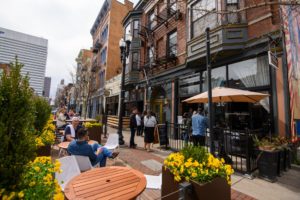
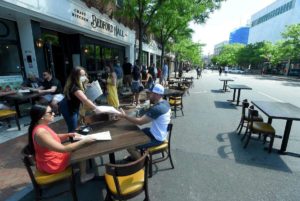
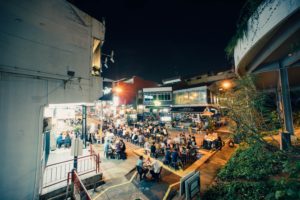
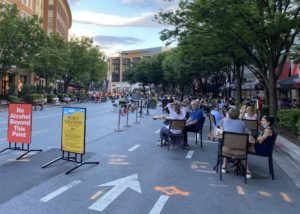
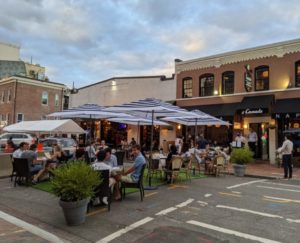
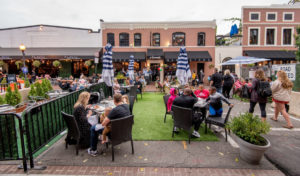
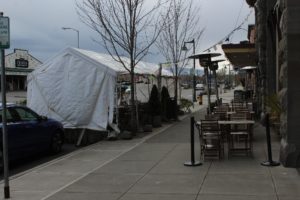
Do a search for streateries online and here are the kinds of images that come up:
These are streateries in Cincinnati, Ohio… Stamford, Connecticut… Bethesda, Maryland… Georgetown, DC. They embody the buzzwords we hear so often about the movement to eliminate personal vehicles in urban areas: friendly, walkable, bikeable, vibrant. What do these welcoming images all have in common? Shirtsleeve weather, roads closed off, no traffic.
What is the reality in Port Townsend? Weather is just one challenge. Safety is another. Not only has the long-lamented parking problem not been addressed for almost two decades, none of the kind of planning needed to reorient traffic patterns to make this kind of streetscape safe is in process. There is a complex set of factors that need to be considered.
But in service to an ideology, in a classic cart-before-the-horse move, the city council still appears intent on creating an ordinance to “just try” some permanent streateries in high-traffic zones. While permission for the downtown streateries is being extended—not eliminated—in temporary status pending the completion of a parking plan, there is a new version of the proposal to create permanent streateries uptown and in other commercial districts coming before council on May 16.
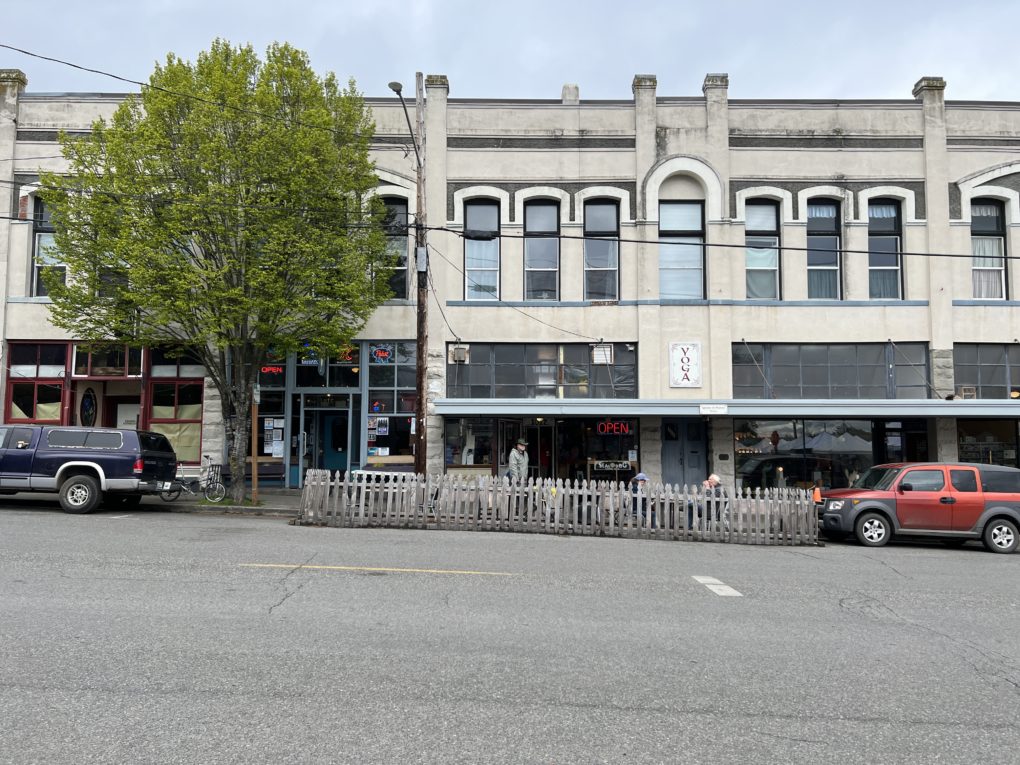
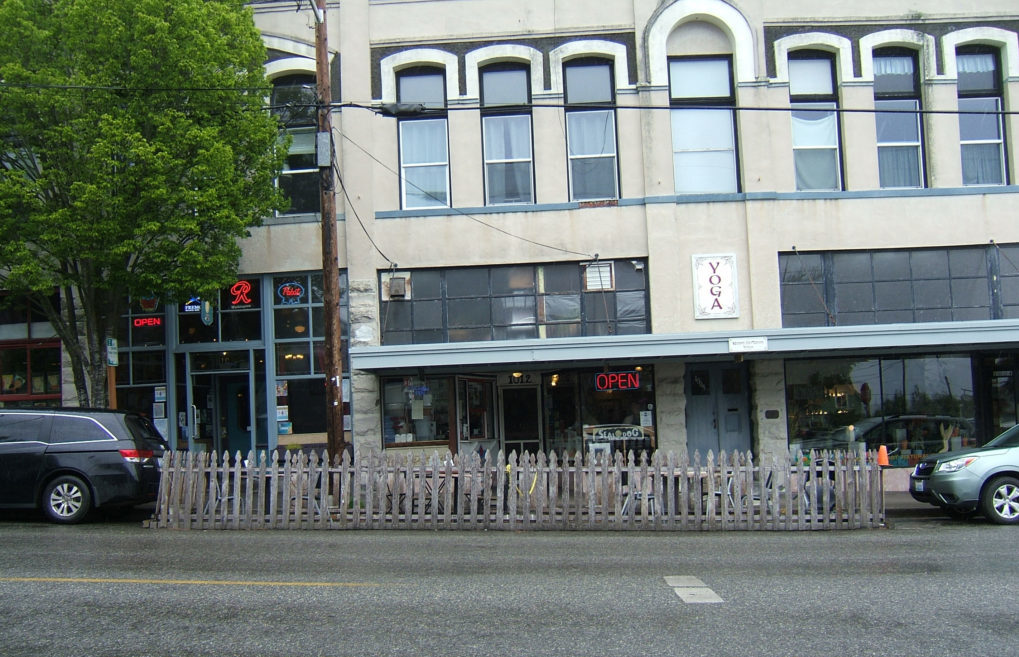
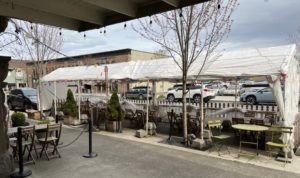
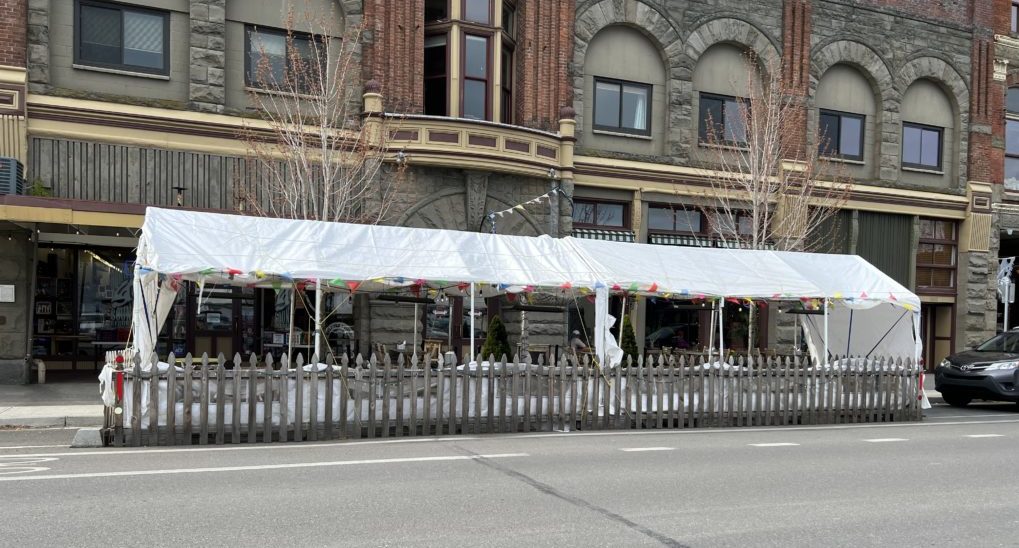
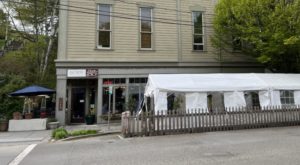
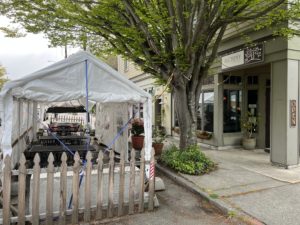
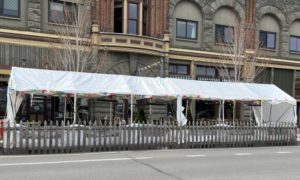
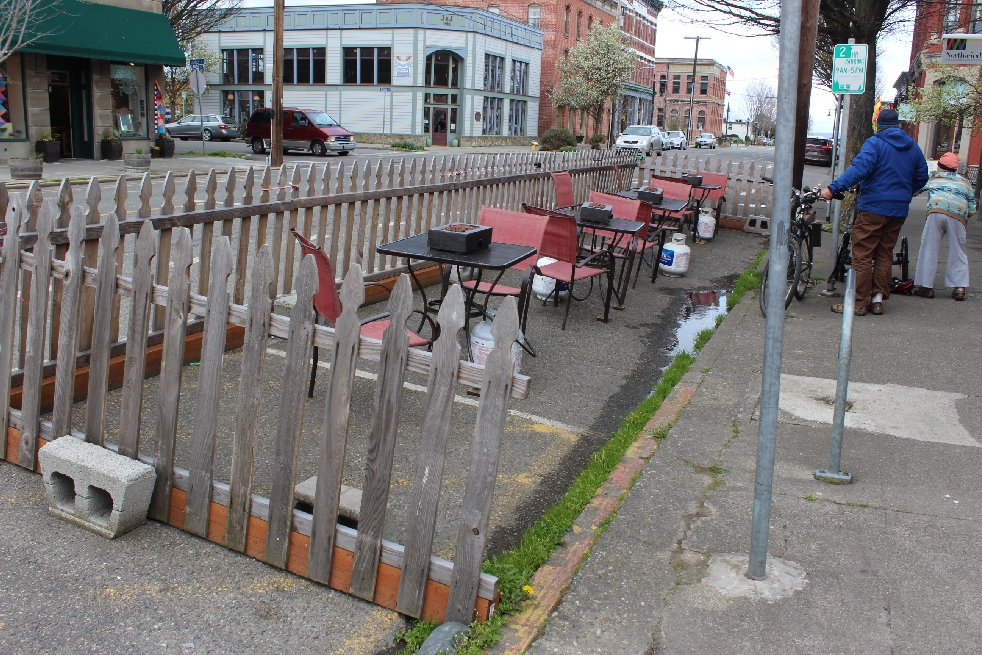
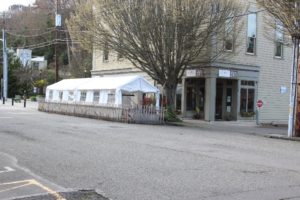
The uptown streatery on Lawrence outside the Seal Dog Coffee Bar appears to be driving this intent. When some of the councilors say “I love streateries,” beyond the ideology they are most often referencing that quaint, funky collection of tables uptown loosely contained by a picket fence where there used to be street parking that is pictured at top. It’s a place where regular patrons like to hang out on nice days, and they enjoy the community it creates.
But tables in the street? Though traffic is slowed coming to and from the corner of Tyler and Lawrence, the set-up along the road is still an accident waiting to happen. The exhaust pouring out of slow-traveling vehicles, often idling just feet away, is noxious. Will a permanent installation fix this?
And what will the visual impact actually be? As I wrote in my May 2nd letter:
“Has anyone actually looked at what a permanent structure would consist of at Seal Dog Coffee Bar uptown? If, as Steve King said, the width of the streatery would be limited to the tiny coffee house’s building frontage, that existing installation would be somewhere between a third and half the size it is now. Two tables if they are sufficiently distanced to pacify those now living in perpetual fear of a virus, three, possibly four small two-tops at a real squeeze. Is that worth a major investment for a small restaurateur?”
Here is that streatery on Thursday, May 12th, a cool, rainy spring afternoon. Empty. The coffee shop itself occupies the middle storefront with the lower neon OPEN sign. It’s 17 or 18 feet in width. While the 34-foot fenced streatery was vacant at about 12:30 pm, the warm and dry “tiny coffeehouse in uptown Port Townsend” with “welcoming cozy vibes” was hopping inside.
Of course customers will choose a cozy indoor space over sitting outside in the rain. To shelter customers from our weather nine months of the year, a tent or other structure will be necessary. We are told that granting permanent use of parking spots is incentive for the restaurant owner to invest in better structures than the open seating or tents. And we are to trust that because the permanent installations will go through HPC review, they will not detract from one of PT’s biggest draws, our nationally designated historic character.
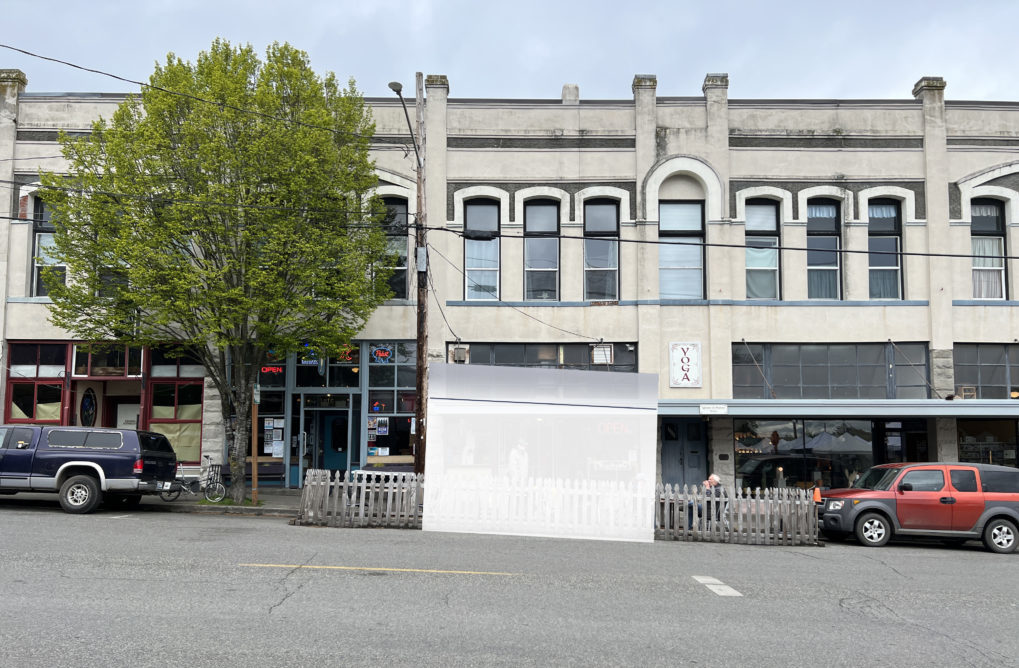
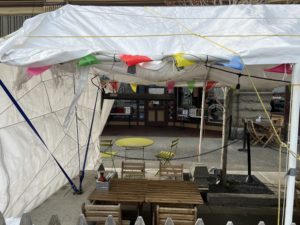
Per the ordinance, a permanent streatery is to be no more than the width of the storefront unless neighboring businesses agree to encroachment. If a permanent streatery outside the Seal Dog consisted of a tent the width of the building frontage, here’s a facsimile of what that would look like (minus the picket fence):
It might have windows. It might not be a tent. But that is more or less the size it would be, intruding on our streetscape. Cars would be able to park on either end where the fence is.
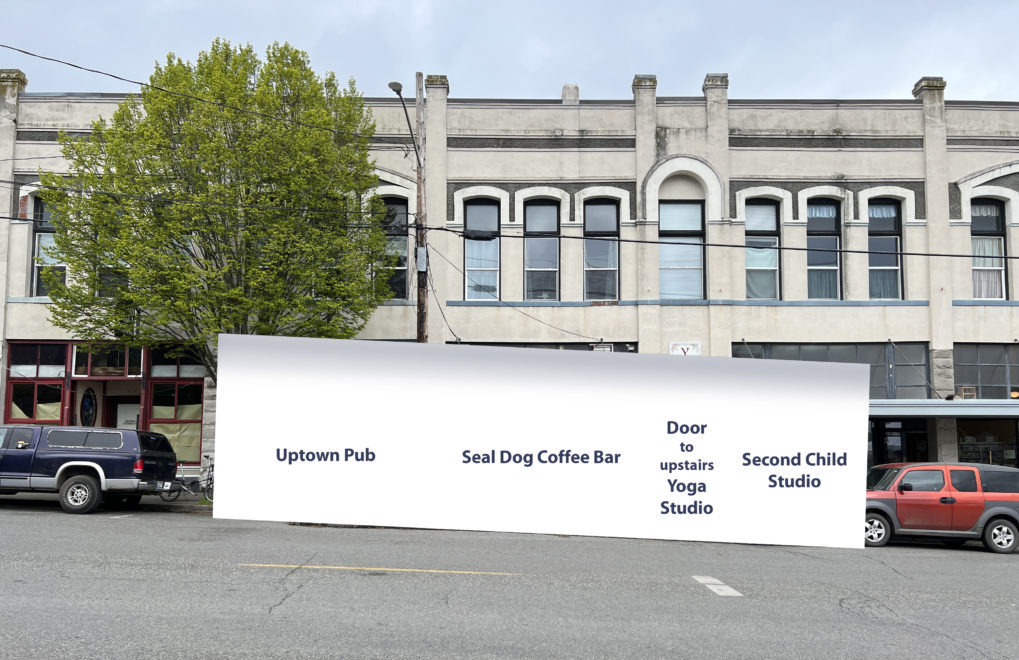
If, as suggested at the meeting by Public Works Director Steve King, permission to encroach on the adjoining businesses was given, the streatery could expand to two allowable parking spaces. Here is what a 40-foot tent or other structure taking the maximum of two spaces might look like:
The window frontage of the Uptown Pub on the left and the Second Child Studio on the right is now obscured. And these sketches don’t depict the concrete barriers, industrial railing or other protective barricades around the tent or solid structure that will be critical to provide even a modicum of safety from vehicular traffic. A quaint picket fence is only a visual deterrent, not a long-term safeguard. The necessary barriers will add to the visual blight.
Are permanent streateries the right solution?
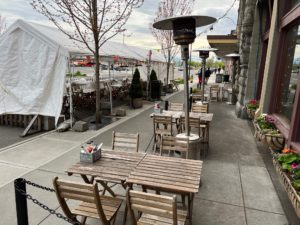
As previously reported, there are already more than forty outdoor dining areas in Port Townsend, nearly all in existence before the pandemic, that are not in the city streets, do not encroach on other businesses, and do not eliminate parking spaces. These include sidewalk cafes like The Old Whiskey Mill’s below, that have tables already allowed by existing city code.
Photo: Stephen Schumacher
At the May 2 council meeting, Ben Thomas pointed to these tables on the sidewalk as an example of other ways to achieve the same goal. Why not make it easier for restaurants to create sidewalk cafes?, he suggested.
But the council instead has an ordinance that was set in motion on March 14 before any public process, which staff and the council have put great time and effort into, offering restaurant owners the permanent use of public parking spaces for street dining installations within busy commercial roadways.
Permanent streateries not only require enclosed structures for all-weather use and high-impact safety barriers because of proximity to traffic, at the May 2 council meeting there was talk of wooden platforms to raise them off the street, and propane heaters to warm them. The whole construct then sits on the street alongside moving and idling traffic spewing toxic fumes. To snap that rainy day photo of the uptown streatery during the lunch hour, I had to wait for a break from a stream of cars and two buses that went by in those few minutes.
Over the course of three city council meetings where permanent streateries have been addressed, only one person has spoken or written in favor of them: restaurant owner Kris Nelson. The proprietor of both Sirens and The Old Whiskey Mill claimed in her public comment on May 2nd that her streatery on Water Street outside the Whiskey Mill had been used all but “approximately 27 days” last year. She acknowledged that the vaxx card requirements, no longer in place, likely accounted for most of that use. Still, we have to wonder what “used” means. Did her wait staff count people at the sidewalk tables which are not in the street and by definition not part of the streatery? Those are already a permitted use in the city code. Since indoor dining restrictions have been lifted, how many meals have been served in the street tent itself?
In the last few months, the tented streatery has been empty in every photo I’ve seen of it, every drive-by, regardless of time of day, level of traffic, rain or shine.
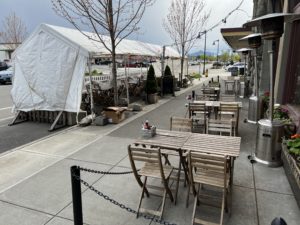
Here is the vacant Old Whiskey Mill streatery on the afternoon of March 30th:
Photo: Harvey WIndle
Again completely empty at 5:00 pm on April 29th:
Photo: Stephen Schumacher
On May 1st at 6:10 pm, the streatery and sidewalk seating looked like this:
That May Day evening, the dinner hour was relatively warm — no wind, no rain, pedestrians strolling the sidewalk. Stephen Schumacher, who sent the above photo to me just after he took it, wrote:
“There were a lot of folks walking around the sidewalk at that time… I had to cool my heels a minute then shoot quickly to avoid getting pedestrian faces in the photo. Strangely there was a guy eating a slice of pizza at the small round green table on the sidewalk NEAR the streatery but not IN the streatery.”
People certainly find al fresco sidewalk dining appealing on a beautiful summer day. They may even try a meal in a tent on the street with cars spewing exhaust just feet away when they have no other choice. But absent the restrictions that ban indoor dining, as I wrote in my letter:
“The streatery was being avoided. This is not a festival with streets blocked off… people do not want to dine in an active city street.”
With so many outdoor dining areas in Port Townsend already available, with sidewalk tables already allowed by existing city code, and with the possibility for our city council to encourage more sidewalk seating through easing of fees and/or regulations, why do we need to put diners in the streets?
At the May 2 meeting, Kris Nelson explained to council:
“My vision of our streatery would be a place… that you can sit outside and eat and drink that feels special and magical and different [her emphasis]… that adds to the fun experience of Port Townsend.”
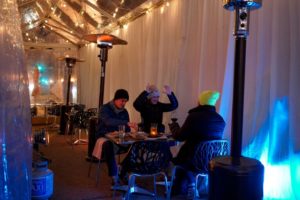
This photo of a Washington, DC streatery during the pandemic is one of the few I could find that didn’t consist of open air tables in fine weather. It has a floor, propane heaters, draped walls and festive lighting… the kinds of amenities we can anticipate if streateries are allowed to be permanent here. And with heat radiating both down and beside the tables, still the diners are eating and drinking bundled up in their winter coats and hats, with cars driving by just beyond the veil. Is this the kind of special, magical, different dining experience we can look forward to?
Would the Seal Dog Coffee Bar want to invest in the kind of permanent structure pictured above? Would its neighbors permit encroachment of their storefronts? The Seal Dog’s existing tables with picket fence eliminate parking, but at least they do not obscure adjacent businesses.
There’s got to be a better solution than a streateries ordinance to allow modest places like the Seal Dog a few tables on the sidewalk where people can enjoy gathering outside in pleasant weather. Do we really need to gift public rights of way in perpetuity to select restaurants in order to achieve a few more outdoor drinking and dining spaces?
On Monday, May 16, the city council will discuss this proposal once again. Public comments can be given at the meeting or written in advance and emailed to publiccomment@cityofpt.us.
—————————————
Additional Streateries Reporting:
Strangulation by Streateries?, March 30, 2022
Public Streets and Public Process Subverted, April 17, 2022
Who is City Council Serving in Their Push for Streateries?, April 30, 2022
Council Backs Off From Downtown Streateries, Contrary to Leader Misreporting, May 5, 2022
by Ana Wolpin | Apr 30, 2022 | General
“I don’t really see the need for streateries in our code. Many of the restaurants already have courtyards or some kind of space outside. We’ve spent a bunch of energy putting together public spaces where people can take take-out food and sit next to the water.
I believe that it’s probably unfair for me to be taking up [parking] spaces that we should be sharing with all of the rest of the downtown businesses. I agree that it’s not really fair to prioritize restaurants over other businesses…
Nine months of the year it’s raining and cold and miserable here. If we put permanent structures on the street, those nine months of the year are taking up parking spaces that keep people away from the doors of businesses and they’re only used for three months.”
– David Hero, Silverwater Cafe
—————————————
Public backlash over streateries continued at the Port Townsend City Council meeting on April 18. With one exception, the council’s determination to make them permanent installations continued as well.
As reported in earlier Free Press articles, when the health department restricted indoor dining during Covid, the local business community agreed to grant restaurants emergency use of public parking stalls for outdoor dining in the city streets: streateries. Local shop owners were assured that this private use of public rights of way would be a temporary measure. Then in March — prior to any public process — the city council directed staff to draft an ordinance making the streatery program permanent.
As described in “Strangulation by Streateries?” and “Public Streets and Public Process Subverted,” the fast-track process that was developed to meet requirements for public input looked to be after-the-fact window dressing on a done deal. Every step of the way since, the council majority has dismissed and overridden public opposition, apparently bent on codifying the program despite widespread objections.
First, a March 29 open house designed to promote the concept brought overwhelming dissent from approximately two dozen business owners who attended. That was ignored. Then a poorly distributed survey, also designed to boost support, deleted from its published results a portion of comments that had been submitted. Still, hundreds of negative comments did show substantial opposition. (Those survey results can be seen here and here). They, too, were dismissed. Mayor David Faber characterized them as a “loud and angry minority.”
Opposition continued at the April 4 council meeting. Without exception, all public feedback about making streateries permanent was again negative.
Two weeks later, the overt agenda to put a permanent streatery program in place regardless of public input persisted.
The April 18 City Council meeting
Discussion at the April 18 council meeting confirmed that the majority of councilors already had their minds made up long before any of this fast-tracked public process.
Again the public feedback — predominantly from business owners, both in written letters submitted to council and voiced in live public comments — consistently urged the council to drop the proposal. Every councilor except one, Ben Thomas, made it clear that they were determined to approve a permanent streateries program despite public objections. The discussion was not about IF it should move forward, it was about hashing out the details.
After City Manager John Mauro expressed appreciation for all the public feedback, Public Works Director Steve King presented an overview of a streatery “draft ordinance in preparation for its final adoption.”
Public Works Director Steve King at 4/18/22 City Council meeting. Click on image for the video of the meeting. Streateries agenda item starts at 24 minutes.
The proposed ordinance allowed six streateries downtown, three uptown and one per block in other business districts, he said. There would be a lottery process for annual permits. Once an applicant was approved, there would be an annual renewal process, but no need to reapply for the annual lotteries. A permitted streatery would have exclusive use of those former parking spaces during business hours in perpetuity. Each streatery granted would be allowed up to forty feet of street frontage — eliminating two parking stalls where there was existing parallel parking, more for angled. An annual fee of $2000, or possibly $1500, was suggested. King explained that “the principle behind streateries is that it’s a use of public space for some private use, but it’s mostly a public enhancement.”
Prior to public comments, council members reviewed the draft ordinance. Libby Urner Wennstrom kicked off the discussion with this inversion:
“There’s a lot of businesses that are fairly supportive of this and there’s a handful of businesses that are very vehemently opposed.”
That assessment is the opposite of what multiple sources who have been canvasing businesses have told the Free Press. They say that Port Townsend’s business community is overwhelming opposed. The “vehement” opposition was so worrisome to Wennstrom, she asked King if a restaurant could sabotage the unwanted program: “I could see someone putting in a proposal so that it’s going to kill a lottery slot,” she said.
Monica MickHager asked if a streatery could have the option of putting all their outdoor seating on the sidewalk rather than the street, redirecting pedestrians into the street itself. Essentially, could they swap a permitted take-over of the parking strip for commandeering the entire sidewalk instead? When told yes, that was an option, she said she was “excited”.
According to the proposed ordinance, this sidewalk seating in front of The Old Whiskey Mill (the streatery also pictured in the feature photo at top) could be expanded to completely cover the sidewalk, forcing foot traffic into the street where the tent now stands in order for pedestrians to get around the blocked sidewalk.
MickHager also asked if a restaurant sold their business whether the new owner was buying the right to have the streatery permit “as part of their private business.” That, too, was answered in the affirmative.
Receipt of letters written to council (grouped at links 1, 2, 3) were acknowledged by the City Clerk. All of them expressed opposition to continuing streateries. No letters were in support.
Harvey Windle, owner of Forest Gems wrote of the city’s long-time mismanagement of parking and of the streatery program taking public property, “given to a special class of people.” He shared a circulating petition titled “City Ordinance Change Benefiting Restaurant Special Interests.”
Michele Gransgaard, a concerned resident who has been canvasing businesses, criticized the survey used to help justify the program: “To report results from a sloppy, biased survey is disingenuous, anti-democratic, and clearly lacks integrity.”
She also warned of the toxic emissions diners in the street were exposed to: “The pollutants from car exhaust consists of lead, carbon monoxide, nitrogen oxides, ozone and airborne particulate matter.” Gransgaard additionally noted that there are already “many options for restaurants that offer outdoor dining.”
More than a few Port Townsend al fresco dining options have been in place for many years, off the city streets. Gransgaard has catalogued more than forty of them. They include Alchemy Bistro & Wine Bar, Aldrich’s (2nd floor outdoor patio), Batch Brothers, Bayview, Bishop Block Bottle Shop & Garden, Blue Moose, Cablehouse Canteen, Cafe Tenby, Cellar Door, Courtyard Cafe, Doc’s Marina Grill, Dogs-A-Foot, Elevated Ice Cream Co., Finistère, Hacienda Tizapan, Hudson Point Cafe, Ichikawa, Jen’s Marina Cafe, Key City Fish Tacos-to-Go, Lighthouse Cafe, Lila’s Kitchen, Mo-Chilli BBQ, O’Yummy Frozen Yogurt, Owl Sprit, Pho Filling, Port Townsend Vineyards, Pourhouse Beer Garden, PT Soda Fountain & Diner, Quench, Réveille Café, San Juan Taqueria, Sirens, Sea J’s Cafe, Spruce Goose Cafe, Sunrise Coffee, Taps, The Castle, The Cup, The Old Whiskey Mill, Tommyknockers, and Vintage by Port Townsend Vineyards.
PT Shirt Company owner Frank Iuro noted that as shown in the list above ALL of the current streateries downtown “already have outdoor seating areas that have been in existence since before the pandemic.” He wrote that the program would “rob other businesses of available parking for their customers.”
Seating under umbrellas off the city street seen at left provided outdoor dining for Alchemy Bistro & Wine Bar before a tented streatery was added in the public parking strip.
Alchemy’s street tent eliminated at least three angled parking spaces and is reported to have been largely empty for a minimum of the last five months.
Maestrale owner Jennefer Wood summarized the objections of many with these bullet points:
- Downtown parking has always been a major issue, taking more parking away only exacerbates the problem. A 2004 analysis of the problem in no way offers a solution like this;
- “Streateries” take away from badly needed downtown parking, adversely impacting businesses;
- They are unsightly, dangerous to see around, and too close to traffic – eating while breathing car exhaust does not sound appealing;
- They are not in alignment with any historical preservation of PT’s past;
- It is unjust and unlawful to allocate public land to private businesses;
- They block visual access to neighboring businesses, thus negatively impacting business;
- There are now “Parklets” available for the public to use for take out dining;
- A “public survey” was not widely advertised in order to receive public input, and negative feedback is being suppressed;
- Streateries were introduced under the covid emergency. The emergency is over.
- Let’s put this proposal in perspective of the larger parking problem and have a proper analysis from that point of view.
Several other PT residents, including a Water Street historic building owner who said the installations visually degrade the public space, also wrote letters in opposition. Letters from Annette Huenke and myself expanded on concerns described in the two Free Press articles linked above.
Public comments in person and by livestream also resoundingly opposed the program.
Gail Boulter and her husband own six long-standing shops downtown, The Green Eyeshade and The Clothes Horse among them. She said that when Covid first began restricting indoor dining in restaurants, City Manager Mauro called her.
“[He] wanted our impression about how we felt about the streateries… I said we would be happy to do anything we can to help our restaurants. However, under no circumstances would any of us merchants downtown want to see this to be a permanent situation. He assured me at that time Oh, no no no, this is a temporary fix.”
“Parking has always been the bottom line issue in Port Townsend,” she told the council. “Please take note of how the merchants feel about all this.”
Pat Louderback is owner of Getables downtown and a Main Street board member:
“During the last council meeting when discussing the downtown parking issues and the more than 300 discarded negative submissions about streateries,” he said, “it was stated by the council that the parking issues were a red herring designed to take us away from the real topic of streateries.”
“The red herring here is the streateries, drawing us away from the real problem, which is parking.“
Louderback pointed to comments in the survey from people who said if they can’t find parking downtown, they go home and order online. “This is all counterproductive to our often-heard Shop Local campaigns. So how do we as businesses and community TRUST the city, the council, which seemingly are influenced by special interests versus representing the community as a whole?”
“It’s the brick and mortar businesses, services, retailers and restaurants that draw consumers here,” he continued. “Further, reducing even ONE parking spot negatively impacts downtown businesses. You’re turning your back on these small businesses, slapping them in the face after they have struggled to survive, and supported this community.”
David Wing-Kovarik, owner of Frameworks Northwest, put aside his prepared statement after listening to the initial council discussion.
“$2,000 a year? That does not address the thousands of dollars lost in retail sales for those parking spaces for surrounding businesses. I’m in great support of restaurants; I send people to restaurants every single day. But every single day I have someone coming in complaining about the inability to park here… I have no idea what businesses you have been talking to that are in support of this.”
He said every business he has spoken to told him, We were told that this would be temporary by the city and by Main Street. “They’re NOT in support of this,” he emphasized. Of the many business owners he has talked to, only “ONE business said they were, and that was it.”
David Hero has co-owned the Silverware Cafe for 32 years. In addition to the statements he made in the quote featured at top — that there is already a plethora of outdoor dining options, that prioritizing public space for restaurants over other businesses is unfair, and that people only use al fresco facilities three months of the year — he pointed out that current code already allows restaurants to set up sidewalk dining with a minimum 6-foot right of way. The earlier photo of sidewalk tables outside The Old Whiskey Mill on Water Street is an example of that. We should encourage more use of “the already-existing sidewalk rules where we technically can put tables on our sidewalks,” he said.
Hero concluded: “I think it’s important to really think about how much use and how many people are actually going to use these outdoor facilities that are taking up valuable parking spaces during the nine months of the year when nobody can sit outside anyhow.”
Scott Walker commented:
“I have been involved in trying to advocate for parking management in this town for more than 20 years. I was on the Parking Advisory Group back in the early 2000s,” involved in the study council adopted nearly twenty years ago to institute managed parking downtown. “We haven’t done that yet and this proposal is getting the cart in front of the horse. You need to have an understanding of what the value of a parking space downtown IS before you give it up for $2000 a year, $1500 a year, or whatever number you come up with.”
“This proposal, I highly encourage you to kill it right now and get to work on the downtown parking management plan.”
Samantha Ladwig, owner of the Imprint Bookstore concurred:
“It is a frequent topic from customers who come in, the difficulty of parking, and how they have continually shopped less and less over time as it has become more and more difficult to find a space. I don’t think this is a good solution for tourists or the community to take away parking which is a growing issue.”
Not a single letter writer, in-person or virtual commenter expressed support.
The council deliberates
The discussion that followed all this public feedback demonstrates the disconnect between the citizens and those elected to serve them. (Full comments can be watched by clicking on any councilor photo.)
Ben Thomas expressed the only cautionary note, which was immediately argued against. He “likes the streateries,” he said, but agreed it is putting the cart before the horse. “I’m just really concerned listening to all these business owners… Some people may close businesses because of it, is my concern. I feel like there’s a social contract with our businesses that we don’t make it harder for them.”
Libby Wennstrom discounted his concern based on her experience 50 years ago in her hometown of Ithaca, NY. She said that when Ithaca closed off three blocks to make it pedestrian-only in 1972, there was “huge screaming from all the surrounding businesses” with similar objections to those “we’ve heard here tonight… but in that case it didn’t pan out… These streateries have been incredibly successful in towns all over Puget Sound.”
Wennstrom is so keen to remove parking, she suggested that the gift of public street space could expand to retailers as well. “It doesn’t necessarily have to be a restaurant that chooses to do this,” she directed at the objecting business owners present. “You could apply, with a business, to have a street space if you wanted to.”
Aislinn Diamanti expressed her commitment to the proposal: “We don’t want to go into another season that is likely to need these again as cases are going up.” They need to be given permanent status, she said, so that restaurant owners have incentive to invest in them over the next two years. Then, Diamanti suggested, after the council revisits the parking plan they “can come back” in two years and change the code again. “It would be a loss to go dark in that meantime because this use of twelve parking spaces isn’t known to be the highest and best use intrinsically.”
Monica MickHager worried that “we’re still in a pandemic… I think the streateries are a necessity for us, just on the mere fact alone that we’re still dealing with Covid.” She acknowledged the critical parking issues, however, and suggested reducing the numbers of streateries the ordinance allows, “until we have an adopted parking management plan.” She proposed that the downtown streateries be limited to their current number, not increased to six.
Owen Rowe opined that “we are not seeing the end of Covid. So I think there is a good case to be made for extending the temporary use of streateries.” But we can’t ask the restaurants to invest in better, more permanent structures, he said, without giving them the assurance of program longevity. “We need to commit to whether this is going to continue beyond Covid.” He agreed with the suggestion to reduce the number allowed.
Mayor David Faber apologized “for making uncharitable comments at last meeting to members of the public who have concerns about streateries.” His disparaging remarks reflected his thinking that they were minority views that don’t represent the community as a whole. “Ever since I was first elected to council, I’ve been hearing from an untold number of people about how we need to stop designing our public spaces around the personal automobile.”
He said that even though the city needs to address the parking issue “asap”, it can’t take on parking management right now. “I think the proposal is extraordinarily modest. It’s not taking very much, not taking away any significant amount of parking spaces. it’s only formalizing what’s been in place for over two years.”
He agreed that “the survey was imperfect, it was quick, we agreed to do a quick process which people are understandably upset about.” But then he again referenced the flawed survey results as evidence that most were in favor of the proposal. “Every single person I talk to outside of downtown business owners have said favorable things to me about creating a permanent streateries program.”
“I love these things. I love the concept of what they bring to the community.” He also voiced support of the suggestion to “lock in” what’s already in place. “I think we should proceed with this.”
Ben Thomas again expressed concern over the business community’s opposition. It’s hard “to ignore the public comment,” he said, “not just tonight.” But he agreed with other council members that he’d like to see streateries: “I do think they are potentially a positive thing for us… just not expanding it at this time when there’s all this public pressure against it.” He, too, supported limiting downtown streateries to the current number.
The final number agreed upon was four streateries downtown, two uptown, and one per block in other commercial districts. The remainder of the discussion was about other details of the ordinance the council is scheduled to vote on at the May 2 meeting.
Just what ARE those parking spaces worth?
During deliberations, Wennstrom disputed the statement from business owners that a $1500 or $2000 annual fee would not even begin to offset the value of two or more parking spaces, that they were worth at least $13,000 a month to the business community. “I want to know any downtown business that’s paying $13,000 a month for a Water Street storefront,” she challenged. A voice in the audience schooled her that it’s not the rental value of the frontage that is relevant, “it’s in generated sales for surrounding businesses.”
As Annette Huenke wrote in a previous article, Main Street estimated in 2004 that “each downtown parking space generates approximately $150 to $300 per day in retail sales revenue.” In addition to retail spending in shops, restaurants, at the theater and other recreational activities, revenue is also generated by service businesses as well, including medical, insurance, financial, and legal:
“Adjusting for inflation using government calculations, at $300 per day, a single space contributes to downtown’s fiscal vitality $169,987 annually. Two = $339,975; the triplets in front of Alchemy and in the Tyler St. lot are worth $509,962 per year.”
Michele Gransgaard, who has been researching parking management strategies, notes that the businesses most severely affected by the loss of parking from a streatery will be those in closest proximity. Her research has shown that “40% of people won’t shop at a store where parking is a hassle.”
Not only does a business adjacent to a streatery suffer from lost parking, the visual obstruction from tents or the more permanent structures encouraged by this program damages one of a retailer’s most valuable assets — storefront visibility. Can you identify which businesses are next to The Old Whiskey Mill in this photo?
There’s Quimper Sound on one side, Commoner on the other. These businesses pay a premium for main street storefronts. Their expensive, well-designed windows and signage are a large part of what draws shoppers to their stores.
Peekaboo… The hip Quimper Sound logo is barely visible on its window through The Old Whiskey Mill streatery tent. Their neon “OPEN” sign is completely obscured, along with other window attractions.
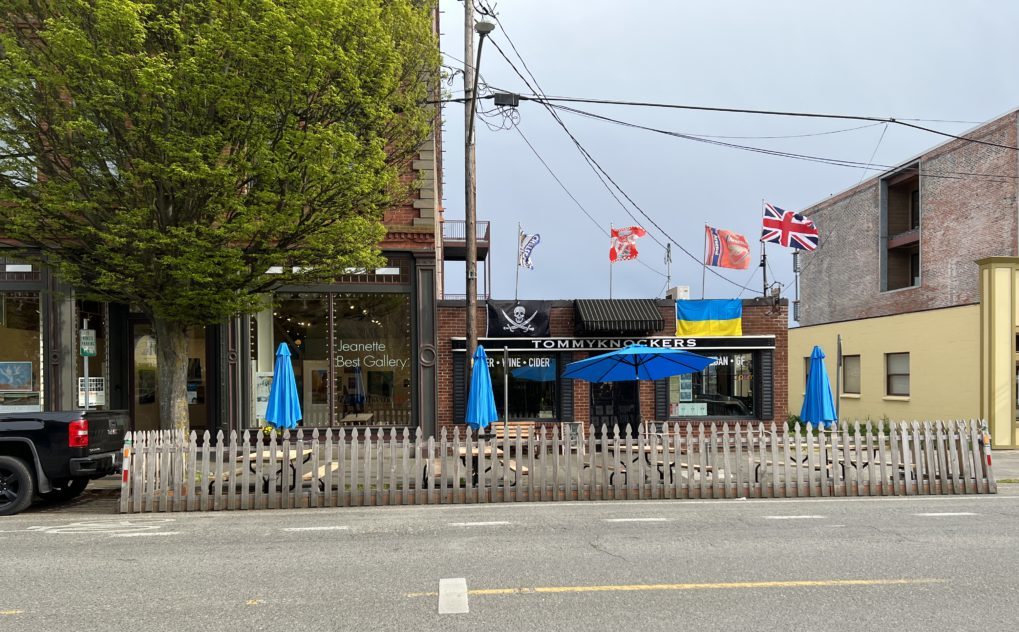
One of the benefits of creating a permanent streateries program, say its advocates, is that it will incentivize the restaurant owners to invest in better all-weather structures than the tents. Picture a permanent structure erected in the parking strip where Tommyknockers’ tables and umbrellas now stand. Not only will their own restaurant signage be obscured, but the major draw of the Jeanette Best Gallery next door — the gallery name and art on display through the window — gone.
All streatery photos taken Thursday, April 28, 2022 around 5 p.m. by Stephen Schumacher. Additional photos taken at 7 p.m. show every streatery downtown still empty.
Perhaps “public enhancement” from a bustling streatery on a lovely summer’s day will add to adjacent businesses’ foot traffic and increased vitality in commercial districts. But what of the other nine months of the year that David Hero alludes to?
In an April 28 letter to Mayor Faber, Annette Huenke wrote:
Sadly, it appears to be a waste of time attempting a dialogue with you, council, King and Mauro, since you determined on March 14th that we will have streateries because you all enjoy them. The parking issues that have plagued PT for over 30 years, the fact that we already have a viable parking plan, the loss of revenue from sacrificed parking, your perverted public process, the utter fallacy that this can ever be made fair and equitable among downtown businesses, let alone restaurants… none of that matters. You like streateries.
Automobiles are essential for travel to Port Townsend, even for people who live here. Jefferson County has the highest share of population age 65 and older in the state. New homes are going up all over the 3-mile and beyond range. There is a 58-lot subdivision going in on Cook Avenue. Most of those newcomers will not share city leaders’ fantasy of walking, biking or busing 6 miles into town. I can count on one hand how many of my North Beach neighbors do. Nearly all take their cars wherever they go. Port Townsend is already naturally inviting, as well walkable for those with the ability and desire to walk it.
As the Port Townsend City Council overrides citizen feedback opposing their plan to replace parking with outdoor dining areas in our public rights of way, many residents are asking Who are our elected officials serving? At Monday’s city council meeting, 6:30 pm on May 2nd, the council’s vote on authorizing a permanent streateries program should give us an answer to that question.
—————————————
May 2nd Port Townsend City Council meeting Agenda – Streatery ordinances are agenda items VII and VIII
Proposed Resolution 22-020 Establishing Public Works Department Street Use Permit fees
Public in attendance and webinar participants will be able to provide up to three minutes of public comment during the meeting. Public comment will also be accepted by email and will be included in the meeting record, provided emails are received two hours before the start of each meeting. Please send public comment to: publiccomment@cityofpt.us.
by Ana Wolpin | Mar 30, 2022 | General
Political players at the City of Port Townsend have made no secret of their desire to eliminate vehicular traffic in the city’s primary business districts in favor of a more walkable, bike-able, maybe even pedestrian-only commercial hub. When John Mauro was hired as city manager to replace 20-year manager Timmons, it was on the strength of his “green” credentials. As reported in the Free Press in October 2020 (Who is John Mauro, Port Townsend’s City Manager?), in his prior position as Chief Sustainability Officer for the city of Auckland, New Zealand:
“He gave interviews and wrote climate action plans and plans for planting trees and adding bike paths and eliminating cars from Auckland streets.”
A green and sustainable environment may be a laudable goal. Is the elimination of parking in PT’s Historic Districts — by awarding use of publicly-funded street rights-of-way to some business owners, to the detriment of others — the right way to achieve that goal?
When pandemic response began dramatically changing our local landscape, temporary “streateries” were developed to enable restaurants to relocate their indoor dining to parking areas outside their businesses — literally on the city streets. Naturally, the loss of valuable parking spaces meant potentially reduced traffic for all other businesses along those streets. But, hey, this was an emergency, and the burdens on folks in the food industry were especially onerous.
The emergency is past. It’s business as usual again. But the restaurateurs who have benefited from the expanded real estate do not want to lose it. The city is now proposing that these “streateries” are granted permanent status — benefiting a small coterie of restaurant owners while the majority of the business community suffers the loss of even more already-limited parking options for their customers.
Water Street “streatery”, removing 46 feet of parking, as well as public sidewalk space.
The city posted notification of an “Open House on Streateries” on their website. The presentation took place yesterday evening. According to the timeline on the city webpage, this is the fast-track schedule to codify their proposal:
- March 21, 2022 Survey noted above distributed by Port Townsend Main Street
- March 29, 2022 Open House at 4:30 at the Cotton Building
- March 31, 2022 Survey closes
- April 4, 2022, City Council Meeting reviews public feedback
- April 18, 2022, City Council Meeting – Council will be presented with proposed code and receives public feedback
- May 2, 2022, City Council Meeting presents any revisions of ordinance for the proposed code
Where was the public notice?
The public was never notified of this significant proposed change to city code in the newsletter that is included in all city utility bills each month. It was not mentioned in reports from either the mayor or the city manager. Will next month’s newsletter announce this plan, after the survey has closed and the City Council has already reviewed public feedback?
A press release is linked on the city’s page noted above, but we can find no mention in the Leader of this proposal or process. Nor did Main Street’s Word on the Street publicize it, though the timeline above states that Main Street distributed a survey.
That survey is also on the city’s website, here. It consists of 13 questions. Question 5 is “Do you support the establishment of a long-term program for streateries and parklets?” Free Press editor Stephen Schumacher responded:
“This feels like a theft of public streets by converting ‘temporary emergency’ outdoor dining into permanent space for preferred businesses at the expense of others, who may not have been given legally required public notice. These outdoor street structures are ugly and unnecessary and impinge on parking and reinforce the false narrative that some kind of ongoing ‘emergency’ is going on or may soon be resumed.”
Additionally he wrote, “I reject the premises of questions 6-11 because these illegal takings of public properties for private insider benefits need to be terminated not perpetuated.”
The only public notice of this proposal we were able to find other than the page on the city’s website was a March 16 article in the Peninsula Daily News (PDN), Port Townsend to consider permanent ‘streatery’ program. It notes that a Main Street survey conducted last year found that business owners complained about the loss of parking spaces “and about the way some of the streateries look.”
Unless a resident regularly reads the PDN or frequents the city’s website, one wouldn’t know this giveaway was in process.
The issues with parking, to which the city has turned a blind eye for years, have been an ongoing nightmare for some Port Townsend businesses. Harvey Windle, owner of Forest Gems, anchoring the busy downtown intersection of Washington and Adams, has been a vocal critic of the parking morass for eight years and has written the city multiple times about this proposed commandeering of public property.
His most recent letter, emailed today to Port Townsend’s city attorney, city council and mayor, and City Manager Mauro, questions not only the fairness of serving special interests in this city street giveaway, but the public process itself.
“Besides the negative proposed removal of even more parking spaces for insider special interests, the process looks to be extremely flawed.
My manager knew of the proposal only because she signed up on a mailing list.
Monday with only a few days before input cut off on the 31st I took what little time I could spare and spoke with 2 neighboring businesses. Bergstroms and the new owner of the Antique Mall.
Neither were aware of the proposed unknown final number (problem there as well) Streaterie and Parklet conversions and were shocked at the proposal.
Claims were made that businesses were given information. Where is the checklist of businesses contacted?
Why was this not in the local paper weeks in advance with both sides of the issue covered?
Robin Bergstrom asked me if there was something he could sign in protest. A class action lawsuit is where this is headed.
I contacted the City Attorney then and am now.
I believe most do not know of what is going on. Especially after speaking with other business owners.”
Today Windle spoke with even more downtown business folks.
“Stopped into Gooding O’Hara Mackey. Receptionist knew nothing about plans. Was disgusted that the streatery across the way has not been removed. Never used, she said. Also commented that she has to find parking daily.”
He also visited another business on Taylor “which was bustling.” The owner told him she went to last night’s meeting and “expressed that she did not want the streateries to continue or grow in numbers.”
There is also a safety issue. These are not quaint sidewalk cafes, they are in the roadway. Until (if) all vehicle access is eliminated, diners are literally feet from traffic negotiating the often busy uptown and downtown business districts. A side order of gas and diesel fumes with your meal, anyone? There isn’t even a curb providing a few inches of elevation to deflect a wayward car from careening into unprotected diners.
“Streatery” below the curb, in the street. Grills on the table tops and propane tanks at your feet. Puddles. Cars driving just inches away, some trying to park at the edge of the picket fence. A safe and pleasant dining experience?
The PDN states “streateries are taking about 10 parking spaces out of the downtown-Uptown equation.” Windle conducted his own survey and estimates that about a dozen spaces are being lost to these “temporary” outdoor dining spaces at present. But there are only three streateries currently installed — one outside of Alchemy on Washington at the end of Taylor Street, two along Water Street (photos at top and above). You can bet that with official city code inviting eateries to annex the street parking outside their properties, there will be many more to come.
Alchemy “streatery”, eliminating 5 or 6 parking spaces
If this proposed plan is codified, these three would likely be the tip of the iceberg. Taylor Street alone could have several streateries. Windle noted that until recently, there were “many others”, outside Sirens and Elevated Ice Cream among them. His letter to the city continues:
“In this case restaurants will think they benefit but where do their customers park?… Where are my special woodworkers spaces? And auto shops? And antiques? When restaurant owner Kristin buys a 6 million dollar parking-not-enforced building I think her losses are manageable without taking from me and others…
Several restaurants are owned by the President of Main Street, run under already compromised Mari Mullen under the influence of Mr. Mauro.
Mauro has a widely known lack of qualifications and has ignored parking issues from his beginning here. It is hard to claim that was not pre-arranged…
Mr. Mauro has no business further damaging limited parking. The City Council is responsible to keep him in his place and doing his actual job.
I am attaching 2 photos for the record of Mr Mauro and Mari along with restaurant owner Kristin’s attempt to close Taylor…
Even restaurant customers need parking. This is insanity. Helter Skelter Insanity against all visitors and business…”
Windle’s comment about “Kristin’s attempt to close Taylor” is in reference to the owner of Alchemy.* These are the photos he provided:
“Open Streets Initiative” on Taylor Street.
All photos: Harvey Windle
If this “Open Streets Initiative” is the direction this current proposal is headed, there will be far more than a dozen parking spaces lost on Taylor Street alone.
The survey on “Long-term Proposals for Port Townsend Streateries and Parklets” — which the city didn’t announce in its newsletter and the Leader never reported on — closes Thursday, March 31.
*Correction: Past owner

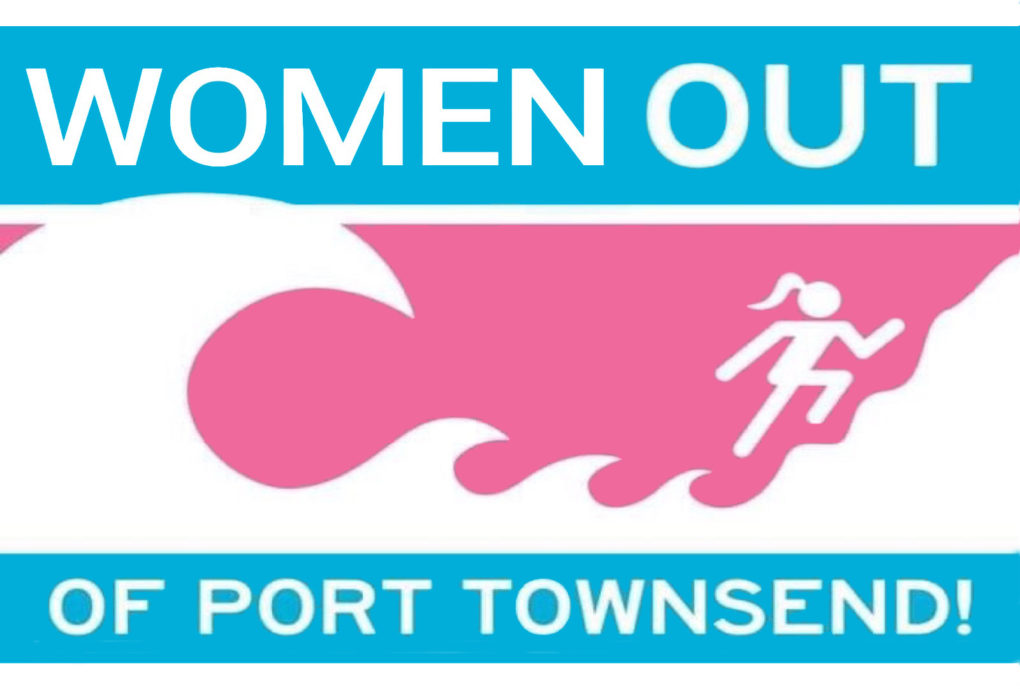

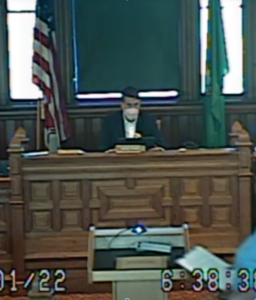
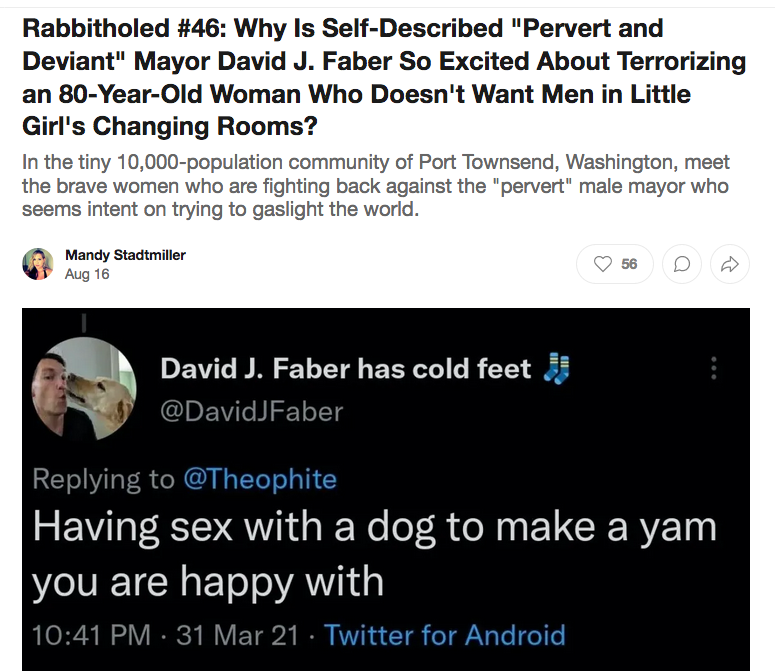
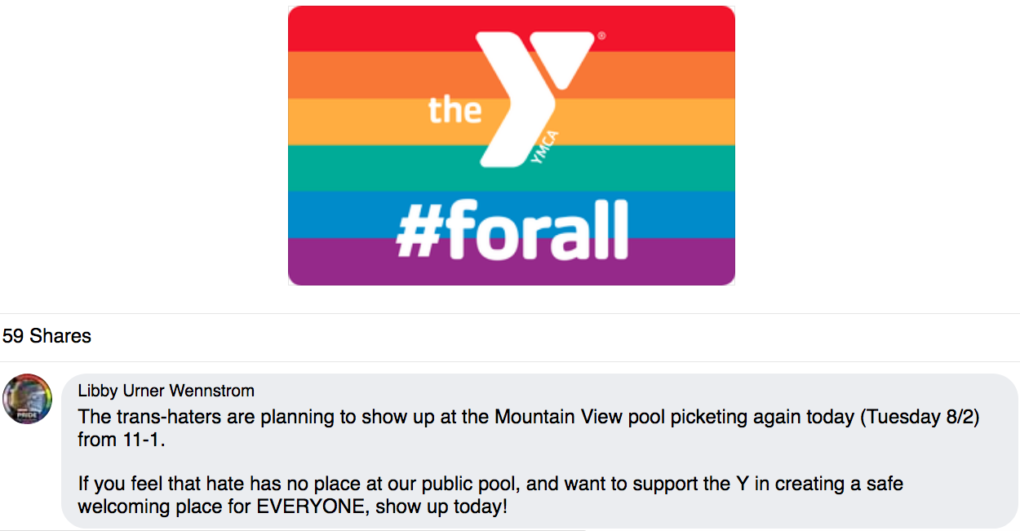
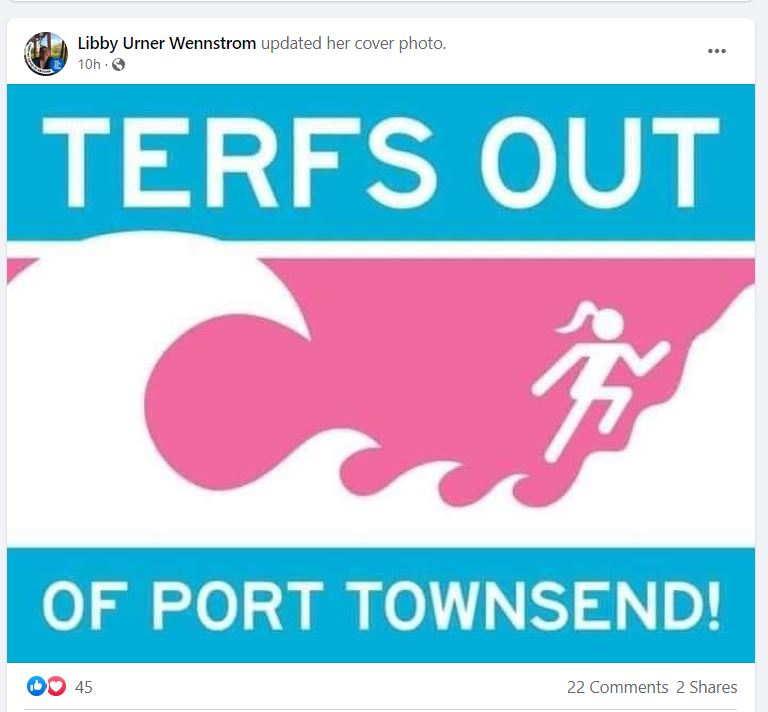
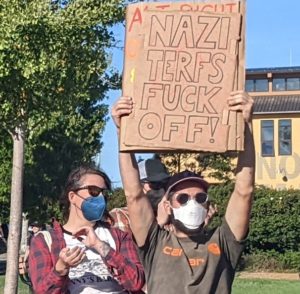


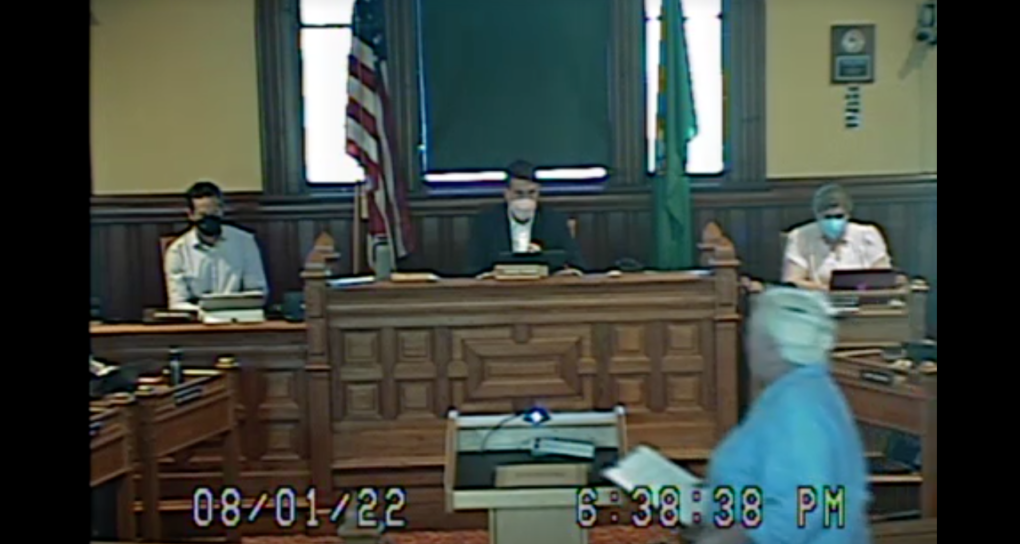
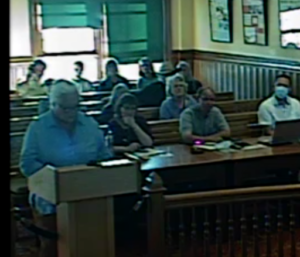
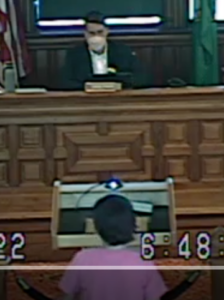 At the podium, the nine year old explained through a mask: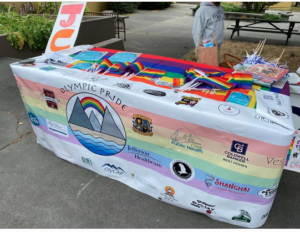
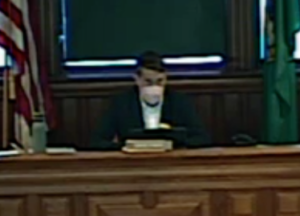
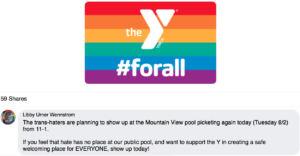
 She proposed adopting a statement opposing “discrimination against transgender people and to formally support the Y and its staff in their efforts to assure that everyone feels welcome to use our public pool.” She made a motion directing the council’s newly-formed Culture and Society Committee to draft this statement. The motion passed unanimously with no council discussion.