
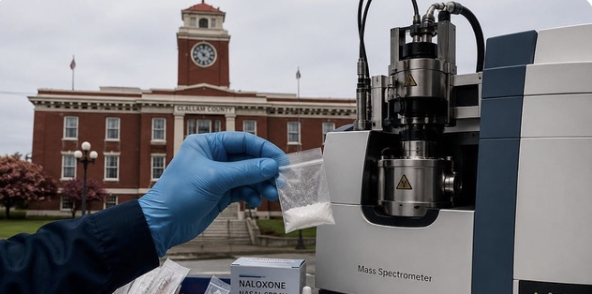
The article below is reprinted with permission from the Clallam County Watchdog. It is one in a series of stories about the growing substance abuse problems (and deaths) in Clallam County, which according to Watchdog reporting have risen in tandem with programs promoted by Dr. Allison Berry.
Berry is Health Officer for both Clallam and Jefferson counties. Under her watch — which critics contend has normalized, facilitated and prolonged active drug addiction — scenes like these are increasingly common in Clallam County:
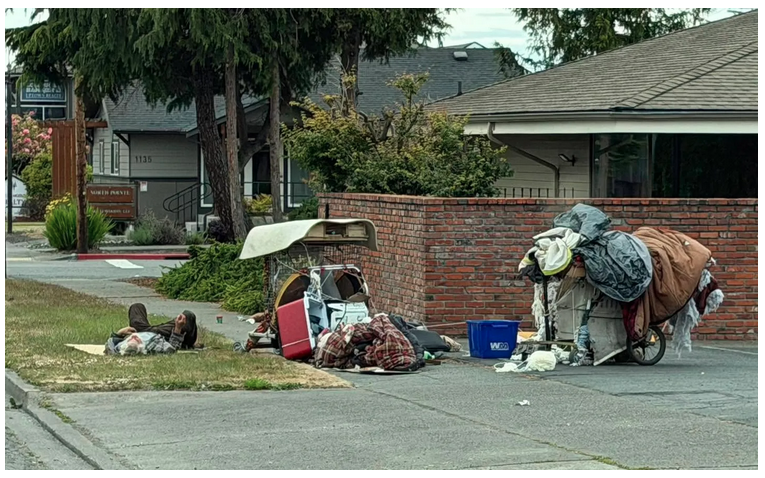
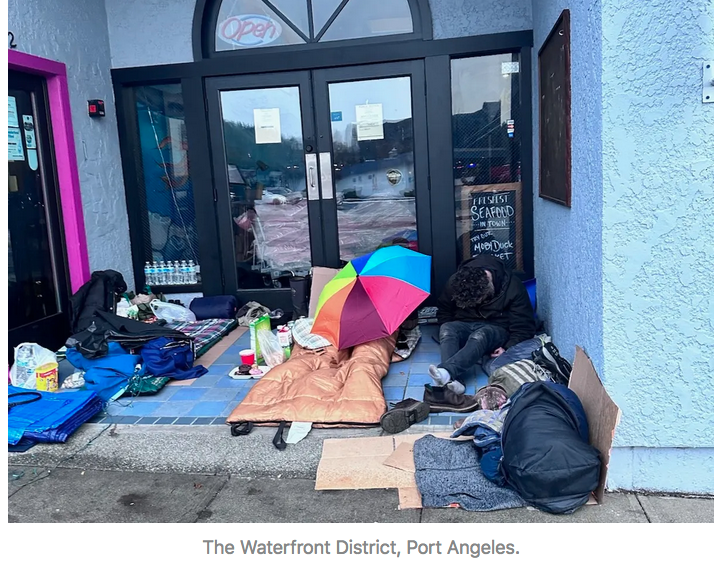
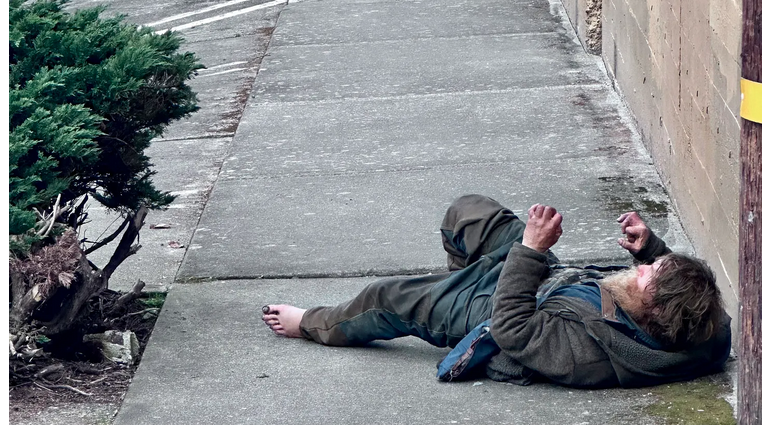
“What began as a syringe exchange evolved into a comprehensive Harm Reduction Health Center that distributes supplies for virtually every method of drug consumption.
Today, participants receive syringes, smoking supplies, foil, naloxone, boofing kits, and other drug-use supplies. “How-to” literature not only explains alternative methods of consumption, but details how to achieve the most effective high…
In 2018, the county’s syringe exchange had no dedicated employees and a modest budget of just over $60,000.
By 2025, the Harm Reduction Health Center employed four full-time staff and operated on a budget of $531,010 per year…
Meanwhile, overdose deaths in Clallam County have more than tripled since 2018.”
This article examines Health Officer Berry’s effort through a grant to add a mobile unit carrying a specialized drug-testing machine which would have expanded the scope of the “harm reduction” program, reaching into Jefferson County.
“[T]he drug-testing machine would eventually be integrated into harm reduction’s planned mobile van. In partnership with Jefferson County, the mobile unit would provide drug testing and distribute supplies throughout both counties.”
This expanded program was stopped by a single conscientious employee who documented legal liabilities. Testing results require skilled interpretation by trained personnel and false negatives could result in death or injury to drug users. The county, by returning the tested drug to the user, would be responsible for those deaths and injuries.
Public records shown in the Watchdog article reveal how Berry nonetheless:
• disregarded both grant requirements and training materials which stressed that a qualified Drug Technician was needed to operate the drug-testing machine;
• actively promoted the program months before final approval was granted;
• argued to move forward with the program even after liability issues were documented, so that grant money did not “sit wasted” and to prevent “demoralizing” staff.
Health Officer Berry continues to defend these programs. Additional Clallam County Watchdog articles on this subject are linked at bottom.
— The Editors
———————————————————-
Public records reveal how Clallam County nearly became a government-run drug testing service — and the employee who stopped it.
by Jake Seegers
Harm Reduction Almost Broke Clallam County
When Health Officer Allison Berry was appointed in 2018, Clallam County’s harm reduction program was relatively simple: participants exchanged used syringes for clean needles on a one-for-one basis.
The stated goal was straightforward: reduce the spread of HIV, hepatitis, and other bloodborne diseases among people who were already injecting drugs.
Over the next eight years, however, Health Officer Berry and the Clallam County commissioners steadily expanded harm reduction far beyond its original scope. What began as a syringe exchange evolved into a comprehensive Harm Reduction Health Center that distributes supplies for virtually every method of drug consumption.
Today, participants receive syringes, smoking supplies, foil, naloxone, boofing kits, and other drug-use supplies. “How-to” literature not only explains alternative methods of consumption, but details how to achieve the most effective high.
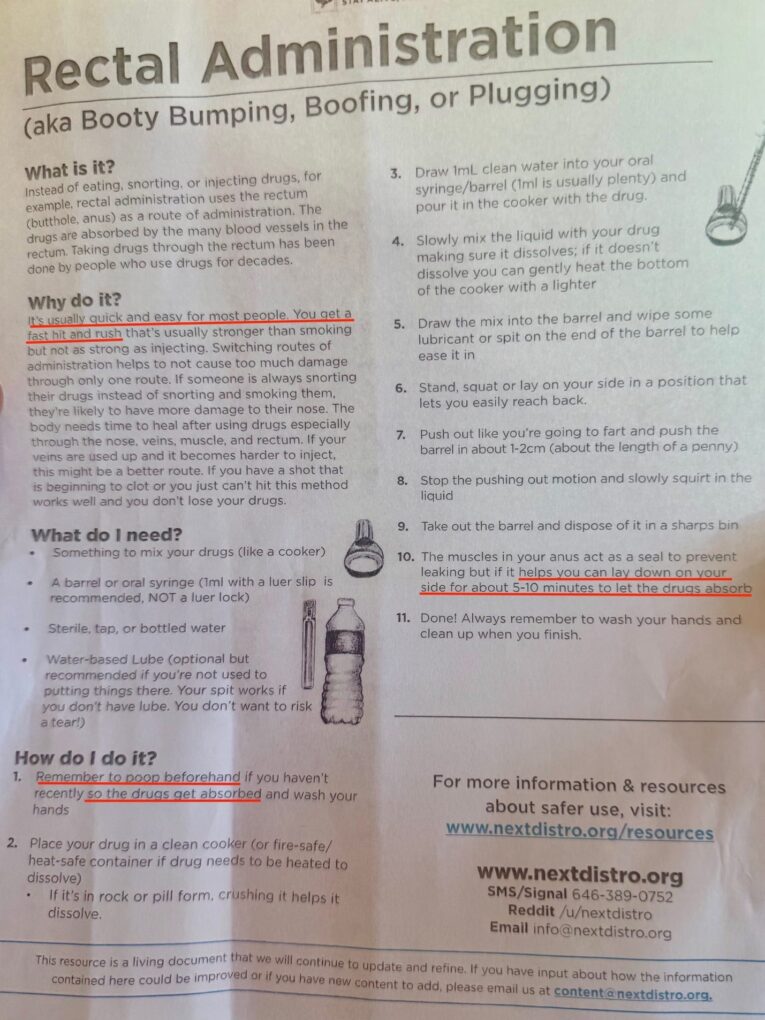
The transformation of a simple disease-prevention strategy into a distribution center for drug-use supplies and resources did not happen by accident. It was the result of a deliberate and sustained effort to expand harm reduction at nearly every opportunity.
Health Officer Berry and the commissioners frequently justified each expansion as a necessary response to the worsening overdose crisis. Yet at every stage, the same question received little discussion:
At what point does reducing the harms of drug use become facilitating drug use itself?
For the Health Officer and the sitting commissioners, there appears to be no limit to their commitment to expanding harm reduction.
That commitment reached a new level in 2023 when Clallam County joined the University of Washington’s ADAI (Addiction, Drugs, and Alcohol Institute) Drug Checking Project. Commissioners Randy Johnson, Mark Ozias, and Mike French unanimously approved the grant-funded program that could have exposed county taxpayers to millions of dollars in liability. [Click here for Community Drug Checking Network Project Site Scope of Work original source.]
Take a Ride in My Drug-Testing Machine
In late 2022, Health Officer Berry began advocating for a grant-funded portable drug-testing machine, also known as a mass spectrometer.
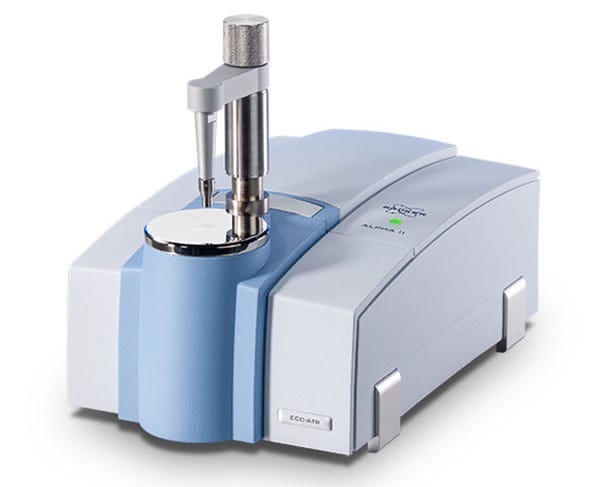
During a December commissioner work session, she stated that the purpose was to better inform response efforts. Berry’s statements, along with her emails, indicated that the county prosecutor, Sheriff’s Office, Port Angeles Police Department, and others had signed off on the program.
The problem with these claims was twofold.
First, the Sheriff’s Office, Port Angeles Police Department, and Coroner’s Office would not have access to the machine. The spectrometer was intended exclusively for the Harm Reduction Health Center.
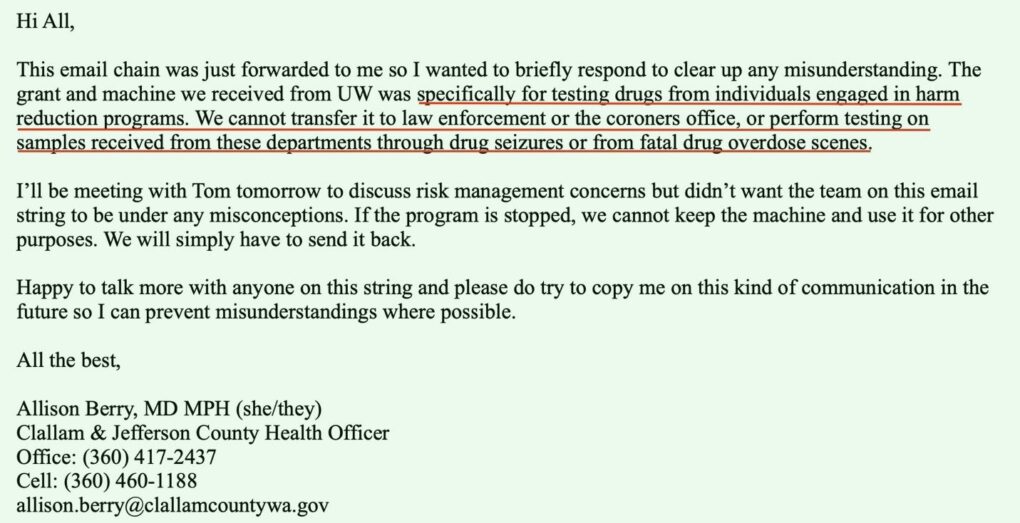
If the primary goal was data collection, why exclude the very agencies that routinely encounter illegal drugs through investigations, arrests, and overdose deaths?
Second, an email from then-County Administrator Rich Sill indicates that the Sheriff had raised concerns that returning drugs to participants after testing could be unlawful under Washington law.
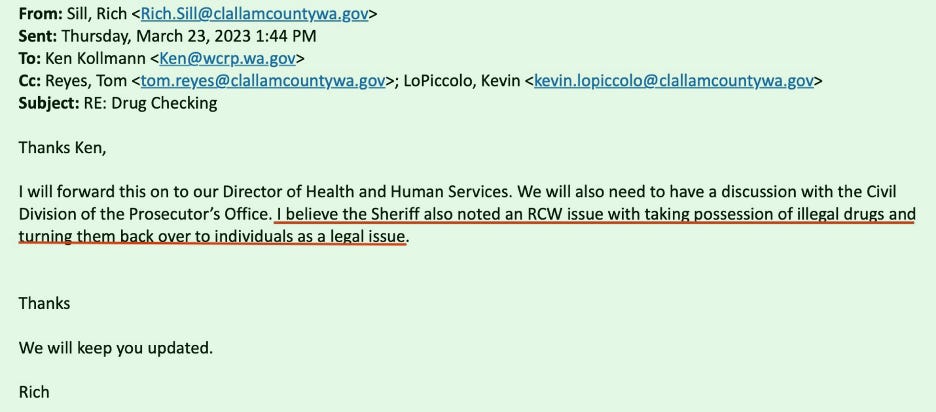
An individual who delivers an illegal substance to someone who later dies from using it may be charged with controlled substances homicide under RCW 69.50.415.
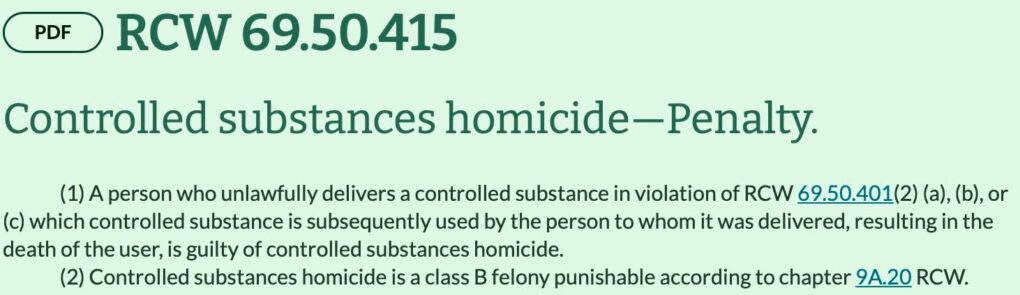
While ESSB 5536 would later take effect in August 2023, providing protections for public-health employees involved in distributing harm-reduction supplies and testing illegal substances, it did not explicitly provide protections for returning drugs to participants after testing.
The drug-checking program was scheduled to begin before those protections took effect. It also would have launched during the worst overdose period in Clallam County’s history. According to the Coroner’s Office, trailing-twelve-month (TTM) overdose deaths peaked between April 2023 and March 2024, with 51 deaths during that period.
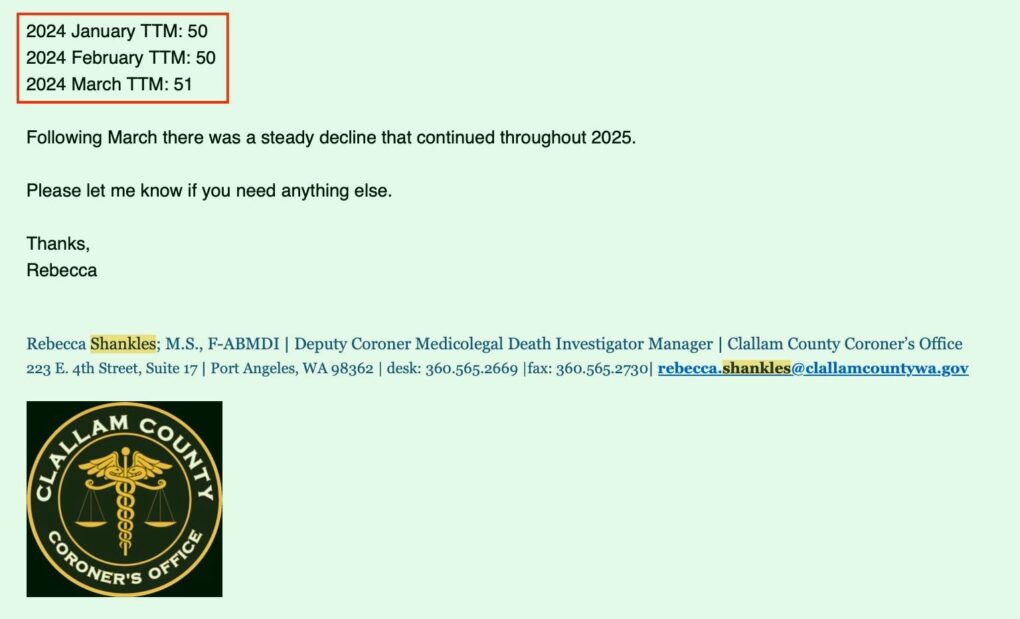
That equates to nearly one overdose death every week.
What were the chances that one of those individuals would have used the drug-checking program? If a participant received a contaminant-free result and later died, could county employees face legal exposure under RCW 69.50.415?
The potential legal and financial liability was significant.
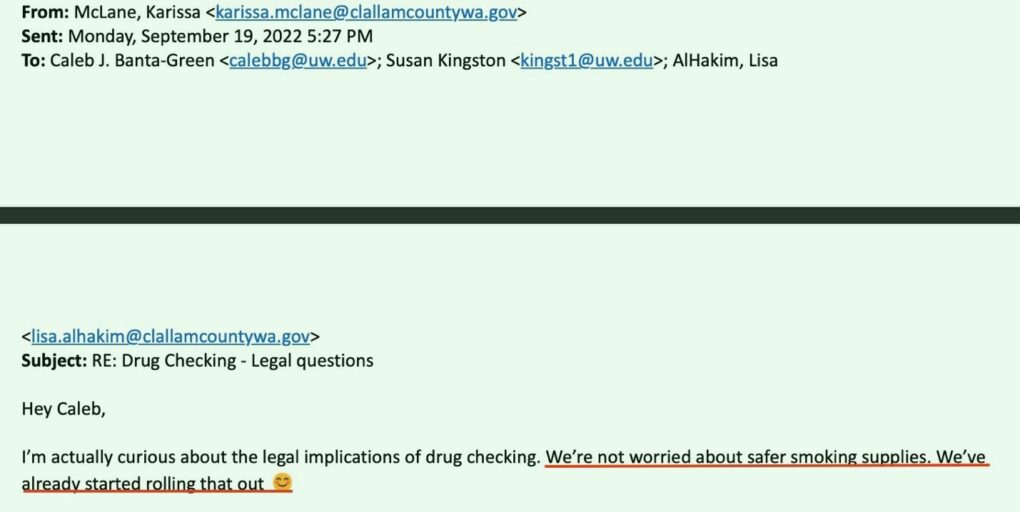
Yet liability concerns appeared to carry little weight. In fact, nearly a year before ESSB 5536 took effect, the county had already begun distributing drug-use supplies beyond syringes as part of its ongoing expansion of harm reduction.
The Process
When the drug-checking program was presented to commissioners during a January 30, 2023 work session, Commissioner Johnson asked the obvious question:
“That’s great, but where are they [illegal drugs] coming from, the Sheriff’s office?”
Karissa McLane, then Public Health Nurse Supervisor for Clallam County Health and Human Services (HHS), explained that participants in the county’s harm reduction program would bring their own drugs in for testing.
A month earlier, during a December 12, 2022 work session, then-Commissioner Bill Peach asked:
“If it turns out that it is illegal drugs, can they get arrested?”
McLane responded:
“That’s a good question. Yes. People can bring their drugs in to get tested. We’ve consulted with our prosecuting attorney’s office and discussed with our sheriff’s office and have determined that people will not be arrested for bringing drugs in to get tested from us.”
The proposed process was straightforward:
- An individual acquires illegal drugs — possibly from any of several open-air drug markets in Port Angeles, like Safeway or the Veterans Bell.
- They bring those drugs to the Harm Reduction Health Center.
- A county health employee tests them using the mass spectrometer.
- The results are shared with the participant.
- The drugs are returned to the participant for use.
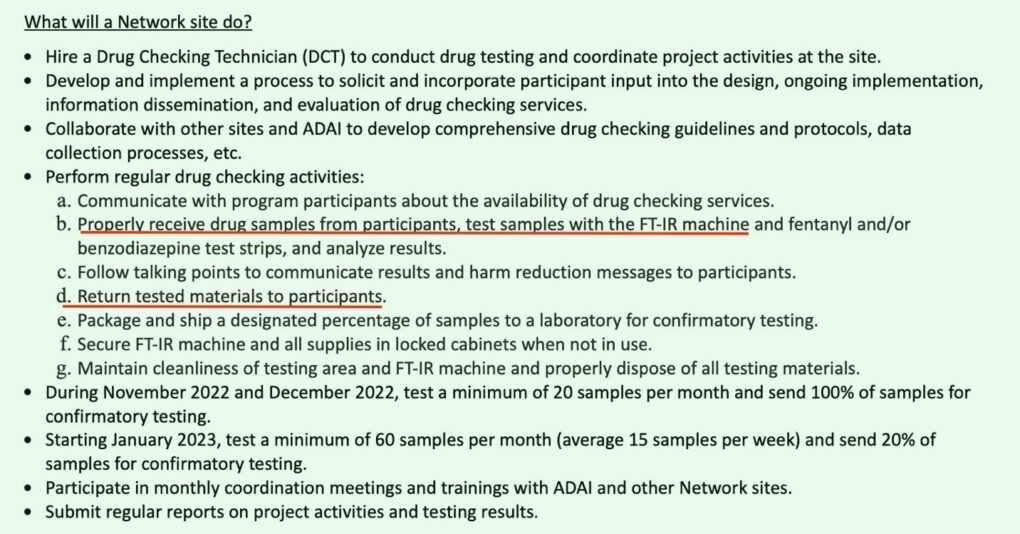
The problem is that sophisticated testing by a trusted county health professional can create a false sense of safety when contaminants are not detected. Liability disclosures attempted to address this by explaining that a test result “doesn’t always mean a drug is safe to use.”
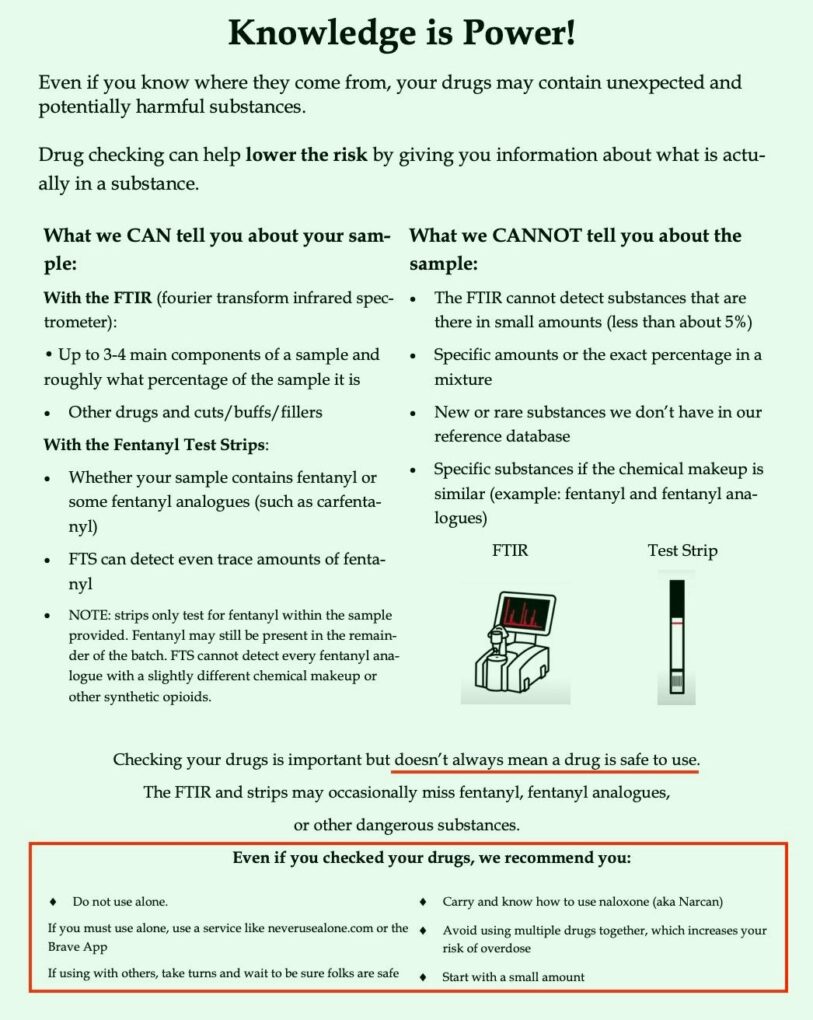
But common sense would suggest a simpler message:
“Drugs are never safe to use.”
“Fentanyl will kill you. Don’t use it.”
Yet participants were unlikely to hear such unequivocal language. “Harm Reduction Messaging” guidelines attached to emails obtained through a public records request cautioned:
“When discussing harm reduction, it is important to choose your language carefully to ensure that you are not coming across as paternal, shaming or denigrating.”
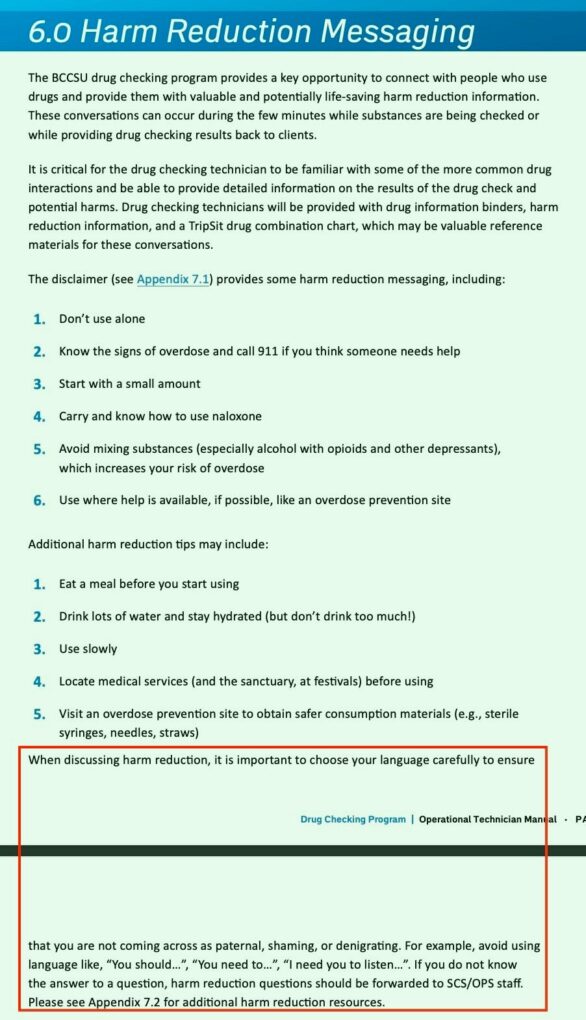
When a participant hands illegal drugs to a trusted county health professional, receives a contaminant-free result, and leaves with those drugs—along with a pipe, syringe, or boofing kit—the message received is clear:
Go ahead and use it. It’s been checked.
Blinders
But what would have happened if a county health employee deemed a drug contaminant-free and the participant later died from an overdose?
The answer could have been millions of dollars in liability, litigation costs, settlements, and judgments ultimately borne by taxpayers.
The potential exposure extended beyond Clallam County.
During a January 2023 commissioner work session, Karissa McLane explained that the drug-testing machine would eventually be integrated into harm reduction’s planned mobile van. In partnership with Jefferson County, the mobile unit would provide drug testing and distribute supplies throughout both counties.
After the presentation, Commissioner Ozias asked:
“Commissioners, any other questions?”
The audience could have heard a pin drop.
On February 7, 2023, Commissioner Johnson moved to approve the program; Commissioner French seconded, and the board unanimously approved it without further discussion.
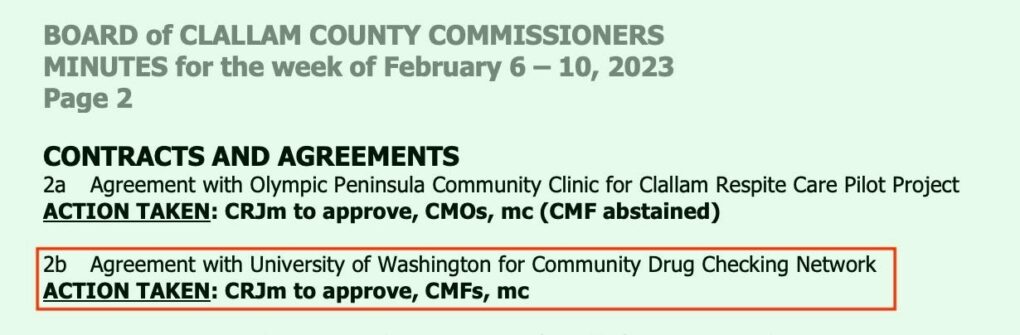
Following the vote, Commissioner Ozias enthusiastically remarked:
“[This] is really exciting! It’s really exciting to see the University [of Washington] being engaged so broadly and directly in communities like our county. I really appreciate that. So, thanks to our public health team for facilitating this.”
Just a Matter of Time
Despite the liability risks, Health Officer Berry and HHS appeared to downplay the importance of having a qualified technician operate the drug-testing machine. While discussing the grant, Berry wrote:
“I am less interested in hiring our own tech.”
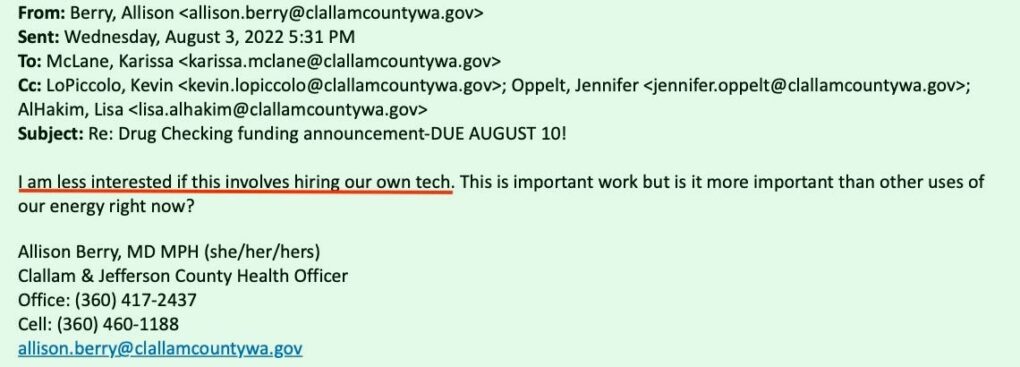
Lisa Al-Hakim, then-Prevention Specialist/SSP Coordinator for Clallam County Public Health, proposed an alternative. The Hepatitis Education Project (HEP), a Seattle nonprofit and fellow ADAI Drug Checking Grant recipient, had hired an “OD Prevention Coordinator” instead of a dedicated technician.
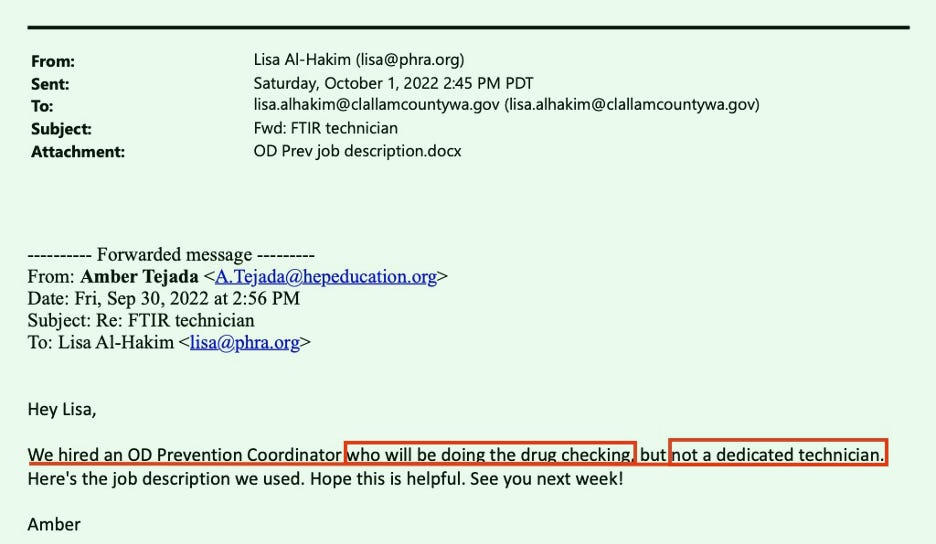
The decision appears to have been driven by cost and long-term harm reduction sustainability. Al-Hakim wrote:
“So it looks like HEP hired a OD prevention specialist and rolled their drug-checking tech work into that, which isn’t a bad idea thinking along the lines of sustainability for the harm reduction health program.”
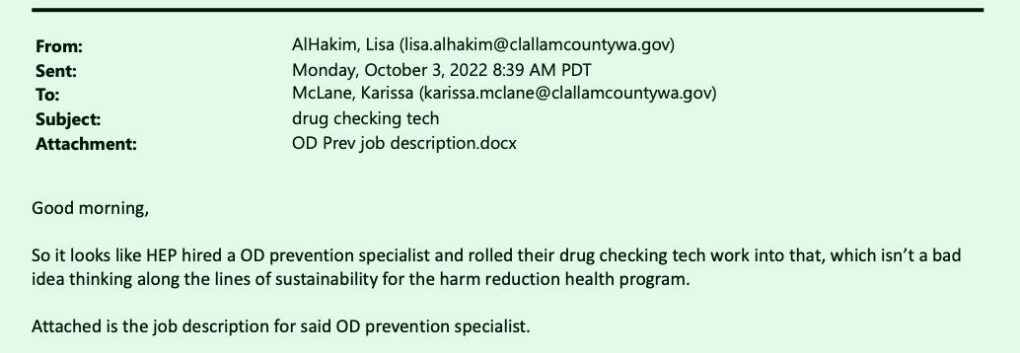
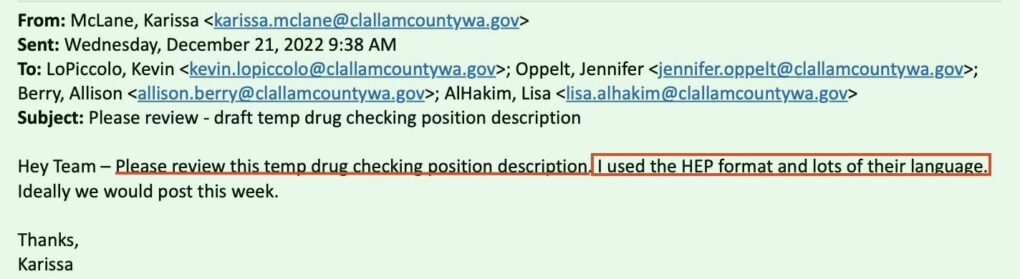
Clallam County followed HEP’s lead.
The problem is that the Drug Checking Network grant specifically required a Drug Technician.
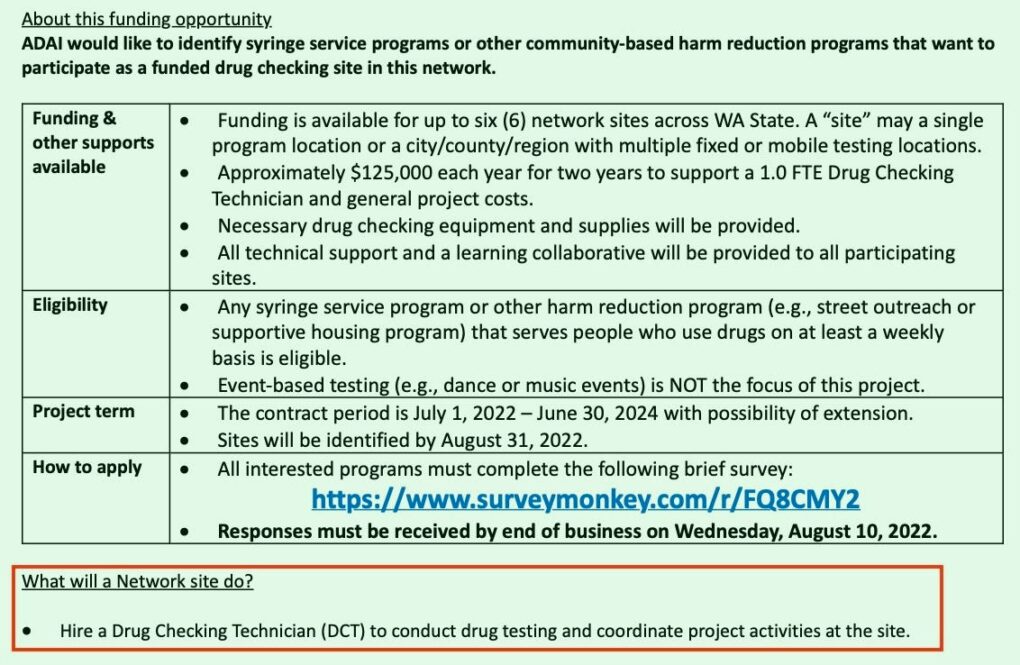
And, Clallam County’s scope of work committed to hiring one.
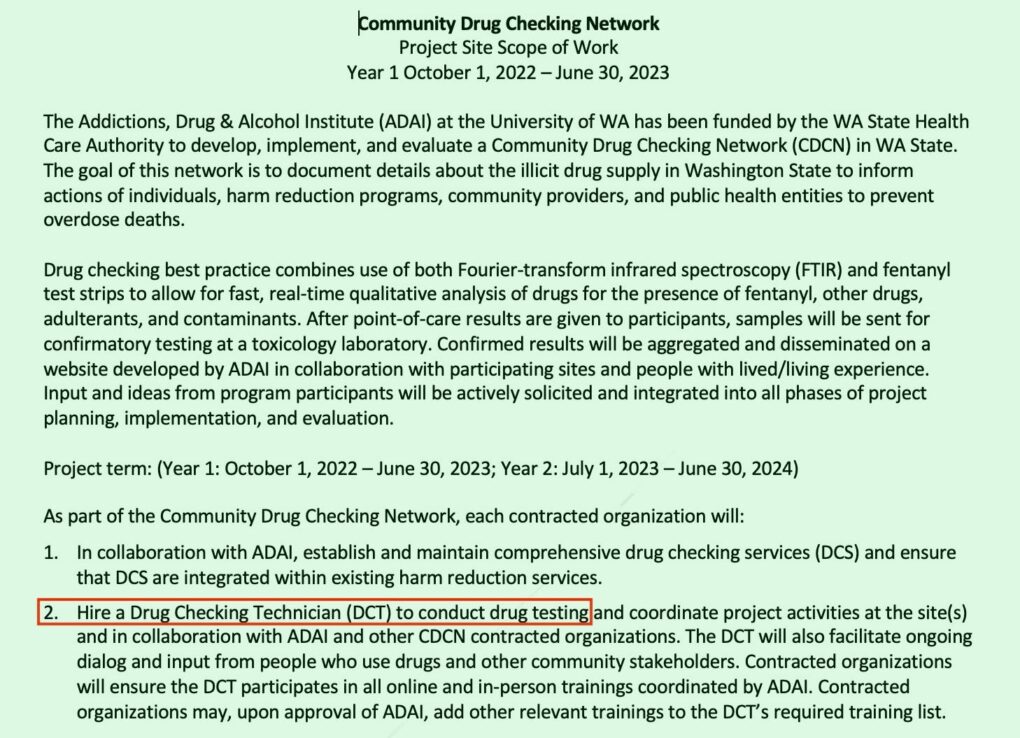
Instead, the OD Prevention Coordinator position emphasized lived experience and social-service work rather than technical qualifications.
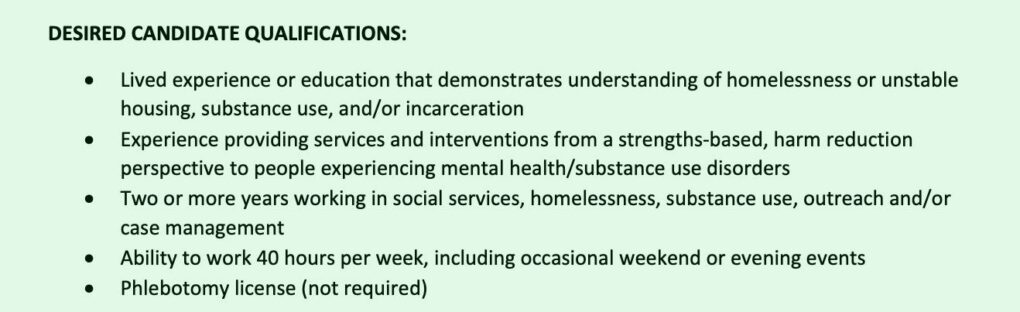
But technical expertise was critical to interpreting the spectrometer’s results.
Before a training session led by Yarelix Estrada of the New York City Department of Health, internal emails acknowledged that interpreting the machine’s spectra readings required experience. The training materials warned:
“We do not trust machines. Do not take the first match and assume it to be true. The art of drug-checking is in the technician’s ability to think critically about the sample and OPUS is only a tool.”
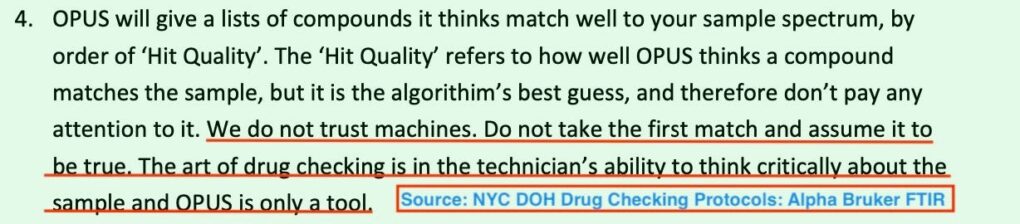
Drug checking was not simply a matter of pushing a button. It required the judgment and critical analysis of a trained technician.
Instead of prioritizing technical expertise, the county specifically encouraged individuals with personal histories of substance use to apply.
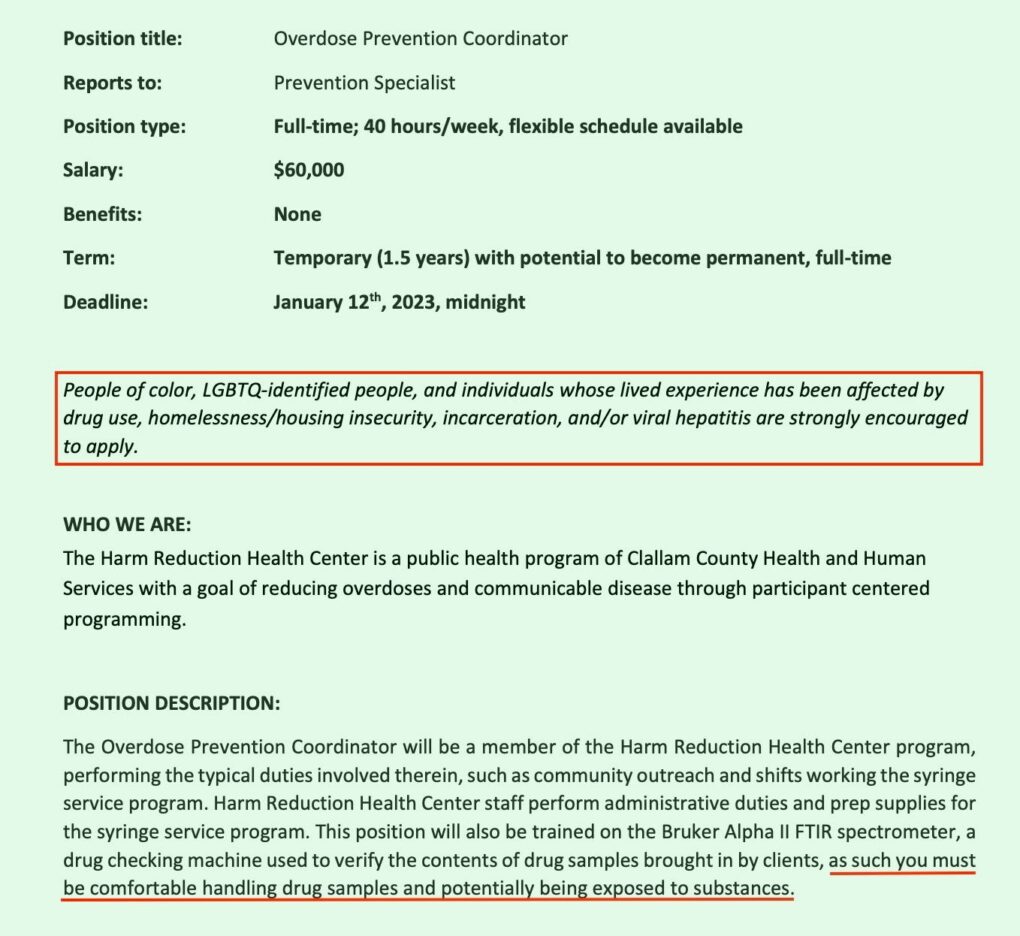
Additionally, the position description stated that candidates “must be comfortable handling drug samples and potentially being exposed to substances.”
Encouraging individuals in recovery to apply for a position that requires handling the very drugs they were attempting to avoid does not seem like harm reduction.
The drug-testing machine would have become part of the county’s mobile harm reduction van, with complex analyses potentially conducted not by a Drug Technician, as discussed in the grant, but by an outreach coordinator—possibly someone in recovery—who would handle a constant flow of illegal drugs. That employee would have been responsible for interpreting results, giving drugs to participants, and communicating whether or not contaminants had been detected.
It is difficult to imagine a scenario carrying greater potential for error—or greater liability for Clallam County taxpayers.
A Voice in the Desert
While county officials pressed forward with expanding harm reduction despite significant liability concerns, one employee stepped forward to protect the county from itself.
When Tom Reyes, Deputy Director of Human Resources and Risk Management, learned of the drug-checking program, he immediately recognized the risks and voiced his concerns:
“I believe it is only a matter of time before a lawsuit is filed on someone, or some agency, providing testing. I hope Clallam County is not that first!”
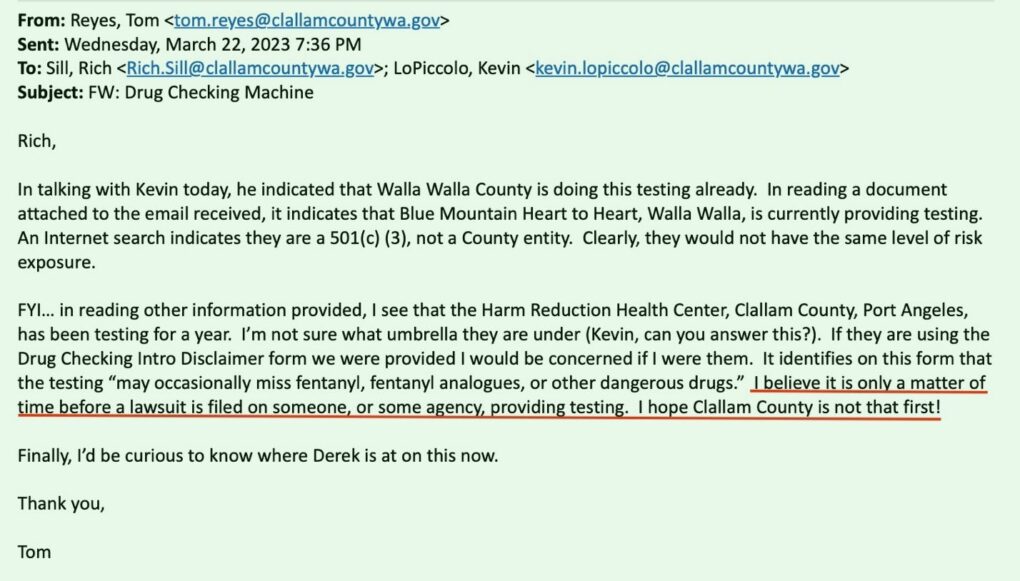
Also of concern, most of the other participants in the ADAI drug-checking program were NGO’s, not government departments.
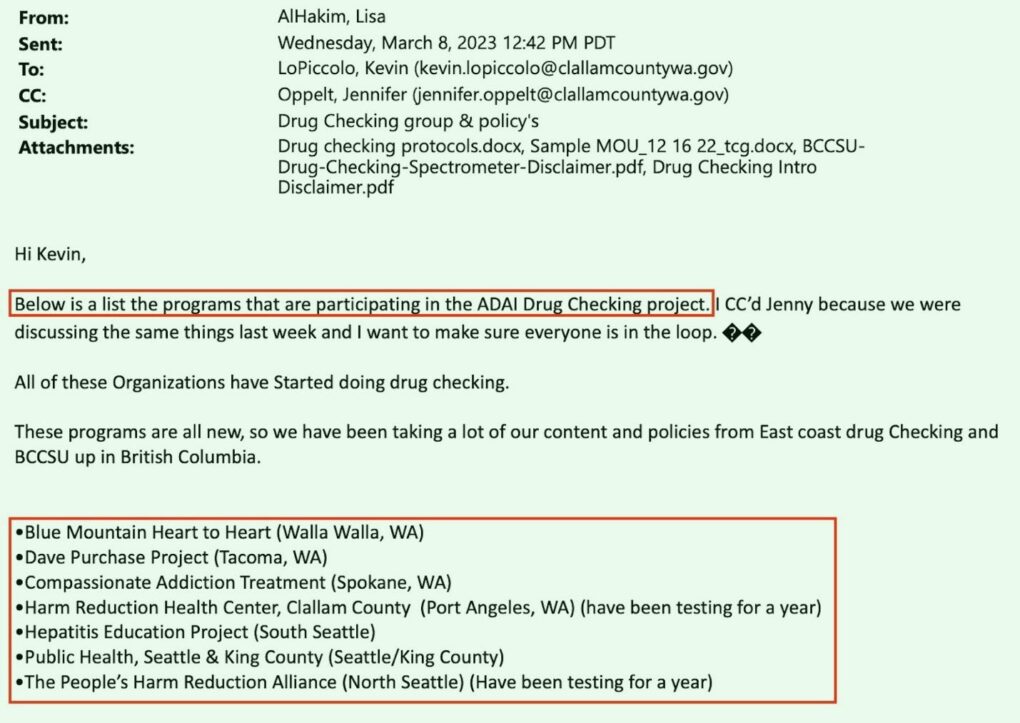
In the same email, Reyes noted:
“An internet search indicates they are a 501(c) (3), not a County entity. Clearly, they would not have the same level of risk exposure.”
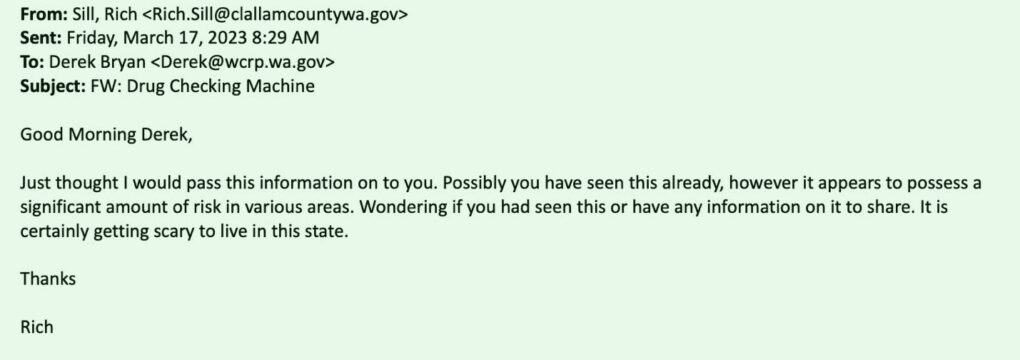
A former detective with the Clallam County Sheriff’s Office, Reyes acted quickly despite apparent internal pressure to dismiss the liability concerns. He contacted Derek Bryan of the Washington Counties Risk Pool, the insurer that provides coverage for Clallam County.
Less than a week later, a response from Ken Kollmann effectively stopped the program in its tracks.
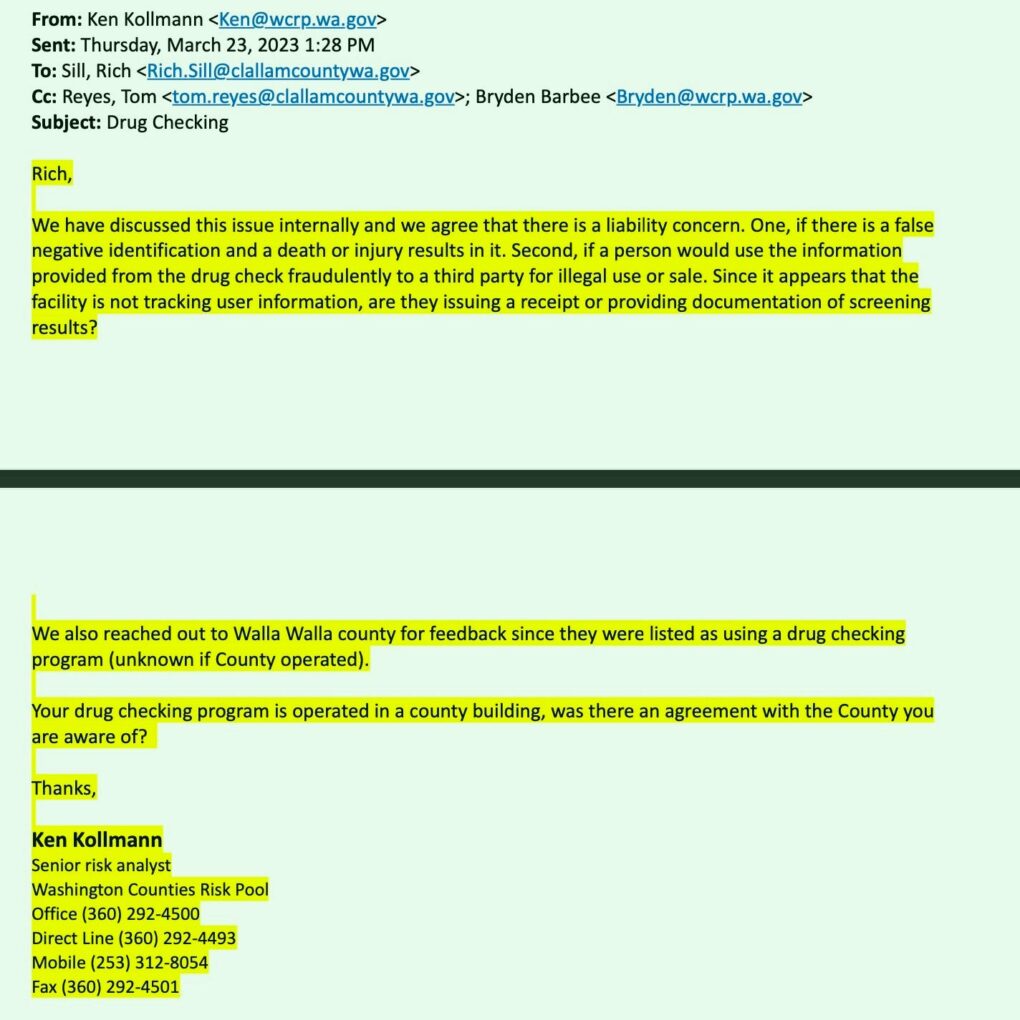
The county dodged a bullet—one that its Health Officer and commissioners had been willing to put the county in front of.
Common Sense Prevails
The drug-checking machine was never the real story.
The story is how far county leadership was willing to go in its effort to expand harm reduction.
Public records show that pursuit of the ADAI Drug Checking Grant was part of a broader, coordinated effort to grow harm reduction services in Clallam County.
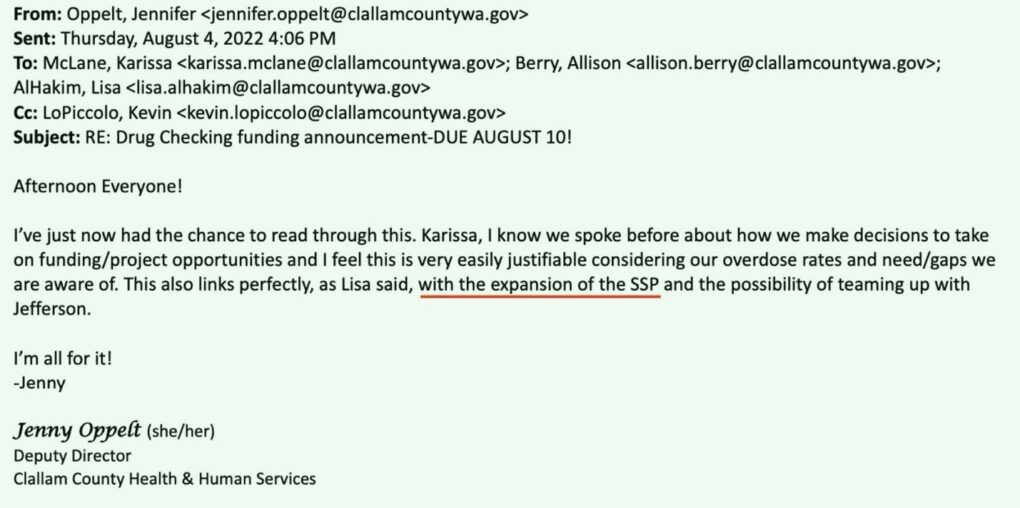
The Harm Reduction Health Center had already taken possession of the machine and was actively promoting the program months before final approval was granted.
When the program encountered resistance, Health Officer Berry attempted to salvage it by appealing to the pity of Tom Reyes:
“Our staff are already incredibly overstretched and watching this position go unfilled and the money sit wasted has been deeply demoralizing to them. We cannot afford to lose any more staff to burnout this year.”
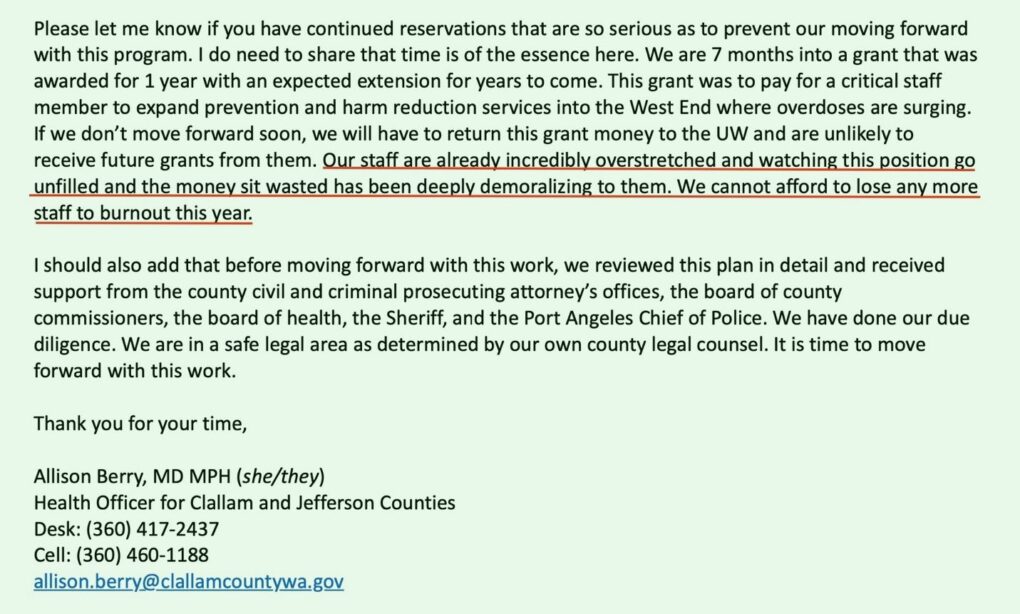
But Reyes understood what others seemed unwilling to acknowledge. As Deputy Director of Human Resources and Risk Management and a former Sheriff’s Office detective, he recognized the extraordinary liability being created by a county-operated drug-checking program.
While commissioners and public health officials focused on expanding harm reduction, Reyes focused on legality, liability, and common sense.
He elevated his concerns to the Washington Counties Risk Pool, and within days, the program was effectively dead.
Although Clallam County had already acquired the machine, it was ultimately returned to the University of Washington. The county dodged a potentially catastrophic mistake because one employee was willing to ask the questions that elected officials and public health leadership would not.
Yet losing the drug-checking program did not slow the expansion of harm reduction.
In 2018, the county’s syringe exchange had no dedicated employees and a modest budget of just over $60,000. Various employees, including Dr. Berry (Unthank), pitched in to run the program, totaling 0.51 full-time equivalent (FTE) employees for the entire year.
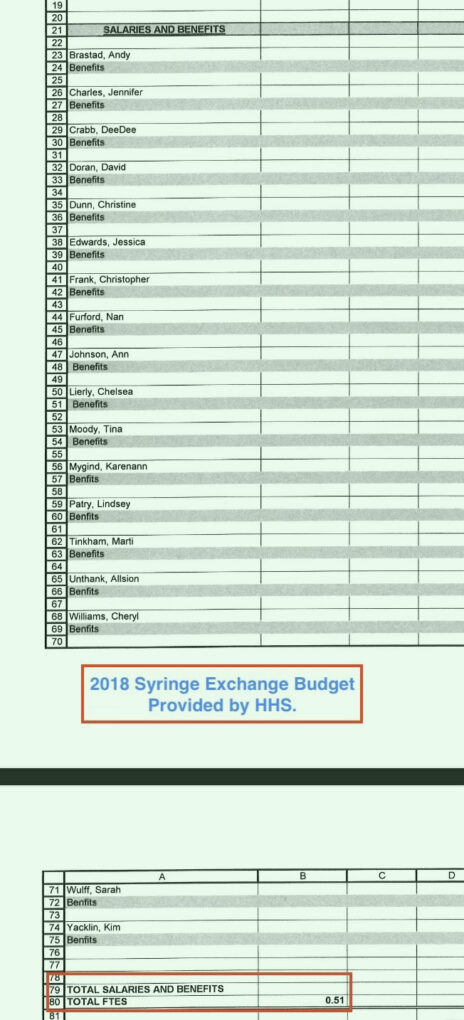
By 2025, the Harm Reduction Health Center employed four full-time staff and operated on a budget of $531,010 per year—roughly equivalent to the cost of four Sheriff’s deputies. At a time when residents are demanding greater public safety, that’s a significant allocation of resources toward a program that seems to expand harm.
Monthly participant encounters increased nearly fivefold, from 212 in 2023 to 975 in 2025.
Meanwhile, overdose deaths in Clallam County have more than tripled since 2018—far outpacing increases nationally, statewide, and in other states that resisted the aggressive expansion of harm reduction policies.
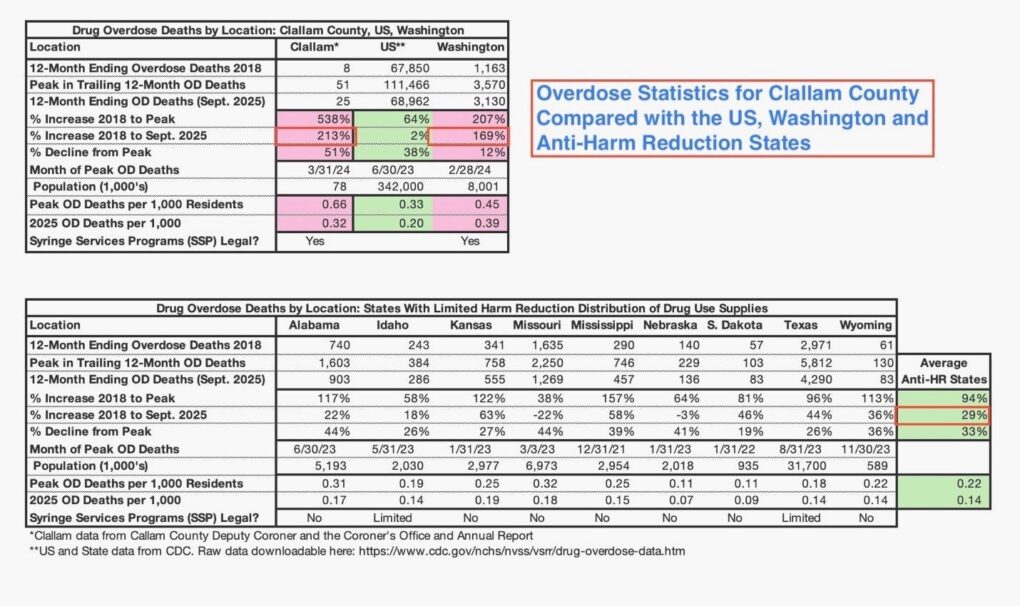
The pattern is difficult to ignore.
When legal concerns emerged, county leadership pressed forward.
When liability concerns emerged, county leadership pressed forward.
When common-sense objections emerged, county leadership pressed forward.
The drug-checking machine was simply the most extreme example.
In the end, Clallam County was protected not by its commissioners, not by its Health Officer, and not by the advocates determined to expand harm reduction at every opportunity.
It was protected by a lone voice willing to challenge the prevailing narrative and insist on accountability.
Clallam County needs more leaders willing to do the same.
Because when government becomes so committed to an ideology that it is willing to expose taxpayers to extraordinary risk in pursuit of it, common sense is no longer optional—it is essential.
Jake Seegers is a Port Angeles resident who earned his Bachelor of Science in Biomedical Sciences from Montana State University and his MBA from The Ohio State University's Fisher College of Business. He currently is portfolio advisor for a family business and is the primary homeschool educator for his family's three children.
This is crazy! But after Allison Berry’s Covid “harm Reduction” that was not, I am no longer shocked.
Thank you, Jake, for bringing this insanity to light.
Clapping clapping for Tom Reyes concern, assessment, and then swift action, and for Jake Seegers intrepid reporting!
So in the end, it’s just another way to normalize the government’s hand in the drug business. Both sides – their role doing service in the illegal drug business in this article and their role in the legal drug business in vaccines. Under the umbrella of the greater good of the community.
As a now long-retired former prosecutor and criminal defense attorney, I was aghast to read this! Are these people nuts? Anything to suck in more grant money to expand their little governmental empires and hire more employees with our tax dollars?
The notion that a buy off from local law enforcement was sufficient — and I suspect they were not fully informed when it was presented to them — to avoid civil OR criminal liability shows a complete ignorance or disregard of existing law. IT IS A FELONY TO DELIVER A CONTROLLED SUBSTANCE TO ANOTHER PERSON IN WASHINGTON. This includes even small amounts. The addict who hands the substance they obtained from a dealer — which was a delivery by that dealer — then commits a new, separate delivery by handing it to the technician who tests it. They have already committed a lesser felony just by possessing it. And the technician handing it back, was unlawfully in possession of that substance (unless the legislation provides some sort of immunity) during the testing, and they commit a felony delivery by handing it back. The law only requires delivery, not sale, to make these actions criminal.
I once represented a gang member in Seattle who was charged with delivery of cocaine because he handed his crack pipe to another addict while they were sitting at a bus stop. The pipe contained cocaine, he shared it with someone else, hence, it’s a delivery. Is that semantic nit picking? No, it’s the law, unless that’s changed recently. I know that many prosecutors would exercise their personal discretion and never file charges based on that hypothetical fact pattern, but it’s still against the law. If someone dies because the test was conducted incorrectly, addicts might overdose more frequently because “dude” tested it and said it was okay, when, in fact, it was laced with other drugs that the technician did not test for. And geez, for a drug dealer, what a wonderful way to provide an expanded market for his customers; “dude” says this stuff is really potent! This sort of sheer idiocy is not the way to get ahead of burgeoning overdose deaths simply because lawmakers want to make brownie points. The possibility of a technician being charged with controlled substance homicide is quite real, just read the statute and also consider accomplice liability. And civil liability? This was a great piece of investigative journalism, and someone really needs to find Berry a new vocation, because she’s been completely inept, given her current job title.
Knowingly delivering a controlled substance to another is not only unlawful, it’s just plain wrong.
I have not understood why everyone involved in the drug testing scheme didn’t see how insane the thinking had become. What has become of common sense?
Does the Harm Reduction program come with some financial incentives that the public is not aware of? Or has the ego of a public health official clouded every ounce of rational decision making for the people and county she serves? We are getting desensitized to the failures and costs of “Harm Reduction”. But if you have friends/relatives outside this state, why not run the main points of harm reduction by them. Trust me, they will think (and understandably so) that this county has completely lost its way. Our drug addicts are being coddled to continue their illegal ways. Where is the outrage? Where is the conspiracy thinking that someone in power has a financial interest in keeping HR an active program? No metrics? No stats? No tax payers to answer to? What the actual F ****? Attrition will be on the headstone when the county is finally put to rest.
Long story short:
These tax payer funded programs really do more harm than good. Wonder why they push harder and harder for them?…
Zachary Brunette follow the💰
The more homeless population in a community, the more drugs in the community then they get to open up all these more programs to help people, but they are designed to generate money, and they generate money for the people above, which means more homeless, more drugs, more grant money, and more and more federal money that they receive, and they funnel it elsewhere and misuse it.
Homeless and addict driven industrial complex. Lots of tax payer money to be collected for communities who enable addicts which make up the overwhelming portion of the homeless issue.
Encouraged LGBT, people of color and recovering addicts, to apply, with no professional expertise required. For a job that requires a professional expert. Sounds like putting some of our most fragile members in our community at risk imo. The same people she claims to protect, she’s so willing to put on the chopping block for a Berry bad idea.
Here is the evidence that leaders in Clallam and Jefferson counties are ideologues to the point of near insanity and lack any common sense. They should not hold any power.
John, succinctly said.
Definitely not to be trusted.
Lets do the math :
It’s no accident the world is as it is, it’s design. The consistency of the worldwide bureaucratic insane asylum tells the tale.
Decade after decade of extreme spending for endless wars and disastrous policies : state sponsored schools are merely indoctrination centers for an increasingly dumbed-down public; medical systems destroy health; governments & militaries continue destroying freedom and countless lives (as they always have); oligarchs & officialdom steal the face right off your head; while uncountable millions of unelected & elected bureaucrats ensure the entire global machine remains well greased.
“Ruled by psychopaths and run by idiots.”
Berry’s on the spectrum.
Welcome to idiocracy, where the mind control is thick enough to stage “the (next) great reset”.
Voltaire said it right —
“Those who can make you believe absurdities, can make you commit atrocities.”
And/or overlook them.
It’s only our programmed belief systems & divisions that keep propping up the nightmare. The madhouse is currently on fire (again), where taking sides in the conflagration is a fool’s errand.
Forget about “electing” red-blue donkeys & elephants — it’s all theatre. No matter who ends up holding office for a term, the government’s always “in”.
What has changed?
“The one thing we learn from history is that we never learn”.
Hey, why not buck that trend?
Now would be just the thing.
Getting rid of Berry would be tres satisfying, but like that mythical tale, a hundred more will take her place. They already are, of course.
What changes?… until we do? Tag, we’re it.
This is simply more tax payer funding for the community enablers of the addict.
I’ve been going to Jefferson Healthcare for dermatology appointments twice a week for almost a year now and often take the bus from Sequim and walk. From about September until a couple months ago, one to five actively using drug users were camped out sitting directly under the window of the Jefferson County health dept window front in the qfc parking lot even though overnight camping and loitering isn’t allowed anywhere else in that plaza. I had smoke blown within 2 feet of me, saw powder that if it got touched could have killed people, and multiple other things. Over the course of a couple months I had to call in a few of the things and learned Berry was the one who made the call if PTPD had them dispersed or not. For awhile in the spring it almost grew into an encampment. Then PTPD pointed a traffic camera toward it and it somewhat stopped. But I personally am very aware of her responsibility for what happens in the QFC plaza in PT so the rest of this tracks too.
What does “Berry was the one who made the call if PTPD had them dispersed or not” mean? Did the PD tell you they were requested not to move these people and if so, why? If they had powder in your sight that was lethal if touched, I can’t believe she would have either the power or desire to make the police just leave it alone. How would pointing a traffic camera at it stop it any more than people actually seeing it?
It’s up to the business owner who is on private property. The rest of QFC plaza has no loitering and no overnight camping except the few feet in front of the dept of health’s suite, and PTPD told me to call them and they brought it up the chain and said Berry said they can be there. There was one elderly female that slept there every single night for over 4 months, on the concrete with a makeshift tent made with a baby stroller with her belongings and a shopping cart. Which I personally am fine with EXCEPT in front of a public health department for women’s health. I went there for reproductive health in my 20s and couldn’t imagine a young person braving it when there were 7 people in front of there.
Shannon, I read through your comments. I thought I’d share some insight that is kind of related, but doesn’t really respond to your comments… sorry! But, I thought responding to you would be a good place to say it. But first, a note related to your comments specifically.
They do free needle exchanges at the dept of health there next to QFC. Free boxes of needles for drug users essentially. Not inherently against the practice, but the proximity may be related?
And yeah, a lot of shoplifting related to drug abuse happens at QFC.
Ties more into harm reduction programs and “treatment”.
I don’t know what drugs these people are using.
For opioid abusers a significant number get Suboxone prescriptions which they then sell/trade to support their habit.
Many also go to the Methadone clinic early morning… Quite a trek – and somehow managed to save the cup of methadone liquid, save it for when they need it or who knows what. I have heard some stories of trading a cup of methadone for some drugs.
The problem with the Suboxone clinics is that they often have minimal oversight and the patients abusing the system know how to get around the safety checks. There also isn’t necessarily any inherent treatment program tied with this kind of therapy. Suboxone and Methadone halflives are crazy long…. and withdrawals can last a month or longer.
I know the local programs/clinics that offer this are genuinely helping people function. I also know that those who are taking advantage of the system are just using it to enable their habit.
I’d love to see a lot more 90 day rehab programs… or even the year long programs a lot of DOC convicts are released into.
Removal of the social component, sober living, supervision, regular visits with counselors and treatment specialists. Every addict I know who has successfully gone through recovery either went through a long term program… or went through withdrawals in jail and spent a lengthy stretch in jail while attending AA/NA. Quite a few people now that I know and all are doing very well, if not prospering.
I know all of this, I was working for Jamestown Networks in 2020 when my old boss Kyle at their economic development authority was helping on getting the MAT clinic by Sequim Costco planned and started and how important it is when it’s done right.
And that Jefferson health dept suite gives out glass pipes to smoke out of now too. I’m not saying to stop the exchange. I’m not saying to even stop turning grants that were 50k biannually 10 years ago into over 500,000 grants today, I’m not saying to discuss correlation doesn’t equal causation but its relationship to Olympic Medical Center almost going under. I’m not even saying it is sensitive with it right next door the low income housing that’s in window view of others in recovery and what that means for them and their families if they get tempted by what they see. I’m not saying to infringe on anyone’s rights, citizen or non citizen, housed or unhoused, sober or not, substance abuse disorder or not.
All I’m saying is the police told me it was literally Allison who decides who is on that sidewalk in front of their suite and the rest of the plaza and most of Castle Hill has a no loitering and a no overnight camping policy and its 💯 on her for what I’ve seen happen there including to that elderly woman in those freezing temps for months. The staff literally can’t see what they’re doing when they’re inside at their desks and it shouldn’t be their responsibility to but it’s their boss that lets them be there.
And at the end of the day, it’s not a private company. I grew up in Brinnon and my family home is still there. It’s my county health department. I went there for the shots you get in junior high if I remember correctly. I went there to get a food handlers card when I was 19. It needs to be safe for everyone.
This article is an opinion piece masquerading as science.
Its central argument is, “harm reduction expanded, overdoses increased, therefore harm reduction caused overdoses.” That’s a textbook example of correlation being mistaken for causation. By that logic, firefighters cause fires because they’re always at burning buildings.
The overdose crisis exploded because the illicit drug supply changed—primarily due to fentanyl and an increasingly contaminated, unpredictable drug supply—not because health departments started distributing naloxone or exploring drug checking. The CDC, National Institute on Drug Abuse, and the Washington State Department of Health all identify fentanyl as the primary driver of overdose deaths, not harm reduction.
Drug checking doesn’t tell people drugs are “safe.” It tells them what’s actually in them. Multiple studies have found that when people learn fentanyl or other unexpected substances are present, many choose to use less, not use alone, or carry naloxone. That’s the opposite of encouraging drug use.
The article also ignores a simple fact: people with addiction already know drugs are dangerous. Addiction isn’t cured by lectures or moral outrage. Harm reduction exists because dead people don’t recover.
If the author wants to advocate for more treatment beds, detox, housing, and enforcement against traffickers, I’m all for it. But attacking evidence-based interventions that keep people alive long enough to reach treatment isn’t science—it’s bullshit.
I detect the distinct odor of your BS
If by “BS” you mean recommendations from the National Institutes of Health, the CDC and decades of peer-reviewed research, then yes, you’ve detected the smell of scientific consensus.
Science is a course of inquiry, not a world-view. It is never settled. Consensus has no place in it.
“Science is the belief in the ignorance of experts.” – Richard Feynman
As for the sanctity of “peer-reviewed research” …
“It is simply no longer possible to believe much of the clinical research that is published, or to rely on the judgment of trusted physicians or authoritative medical guidelines. I take no pleasure in this conclusion, which I reached slowly and reluctantly over my two decades as an editor of the New England Journal of Medicine.” ― Marcia Angell
“The case against science is straightforward: much of the scientific literature, perhaps half, may simply be untrue. Afflicted by studies with small sample sizes, tiny effects, invalid exploratory analyses, and flagrant conflicts of interest, together with an obsession for pursuing fashionable trends of dubious importance, science has taken a turn towards darkness” — Richard Horton, editor of the Lancet
Evan –
The question of whether “harm reduction” strategies work is NOT, as you contend, the central premise of this article. A more recent article in the Watchdog does explore how these strategies have failed — in Oregon, San Francisco, Vancouver. For an excellent overview see the June 23 post “Rock Solid” Science?
Correlation versus causation is irrelevant to why we editors felt it important to share this article with our predominantly Jefferson County audience. Far from being an “opinion piece masquerading as science,” it is an exposé of our appointed—not elected—health officer run amuck, with far too much power.
Jake Seegers’ meticulously documented research exposes Health Officer Berry’s determination to further an ideological agenda regardless of true life-or-death liabilities.
Disregarding grant requirements for a professional technician to operate the drug-testing machine, instead Berry advertised for an employee with a history of substance abuse who satisfied ideological criteria of being part of a marginalized minority. That alone should disqualify her from overseeing health departments in our counties.
But far worse was her continued push to see this program realized even after it was clear that the liability for the county, beyond potentially costing taxpayers millions of dollars, put lives at risk due to the very real potential for false negative readings of drug tests.
All this was noted in documents Seegers uncovered. Rejecting those clear legal and moral risks, Berry still insisted that “We have done our due diligence… It is time to move forward with this work.”
Her top considerations were that the health department would have to return grant money and staff would be demoralized. As Stephen M commented above, “the possibility of a technician being charged with controlled substance homicide is quite real.” Berry’s priorities, it could be argued, constitute criminal negligence.