

The Leader‘s April 12 front-page headline “Blue Heron Middle School awarded grant for mental health” caught my attention, reminding me of a recent conversation with a high school teacher revealing that close to half of his students are in counseling for mental health issues.
This seems a staggering number, and reflects what is widely known: Our children are in the midst of a mental health crisis. Anything that might help our youth deal with anxiety and depression, easily accessed during their day at school, promises to be a good and positive change.
So that’s where School-Based Health Centers (SBHC) come in, with Blue Heron Middle School slated to become our county’s latest clinic in the fall of 2024. This article explores the SBHC concept, the entities and funding behind it, and what it all means for parents of students in Jefferson County schools.
More than likely, as a parent, in that pile of papers you signed at the beginning of the school year — and certainly, if your child received a sports physical from the school-based clinic at Port Townsend, Chimacum, or Quilcene — you, like me, signed a release giving permission to Jefferson School Based Health Centers to “perform such medical and therapeutic procedures as may be professionally necessary or advisable for me (or my child’s) health screening, diagnosis, and treatment.”
The form looks like this:
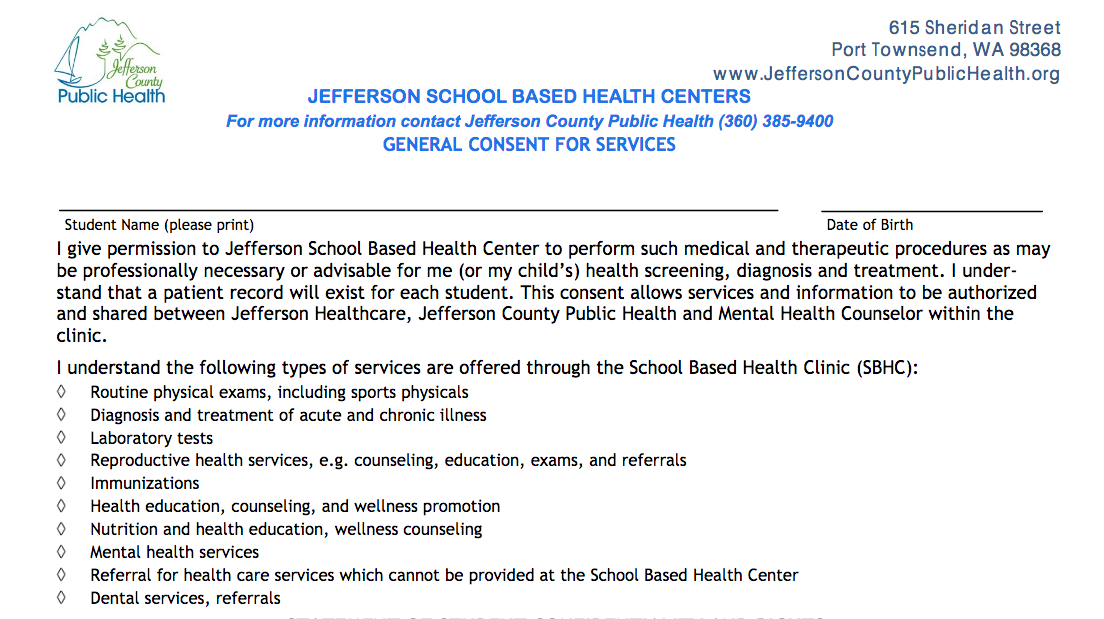
Top portion of page 1 of the two-page form giving parental General Consent for Services. The full form can be viewed here.
There is more to granting this permission than may meet the eye. In 2019, through highly controversial legislation, Washington State provided for out-patient mental health treatment for minors without parental consent. Parents’ rights were removed to even be informed about certain treatments and services that school personnel and outside professionals deemed advisable.
After citizens statewide successfully challenged that legislation earlier this year with the Parents Bill of Rights (more on that below), state policy appears to be in the process of shifting. But revised guidelines have yet to be developed. And local SBHC officials maintain that the parental rights initiative applies only to records kept by public schools, school staff, and school administrations. They contend SBHCs are separate entities from the schools and will not be required to share their records with parents even with the new law.
Parents need to be aware of what current guidelines allow for, who/what is behind the SBHC enterprise, and what is at stake. Even after researching this, the question of what parents are consenting to when they grant blanket permission to Jefferson School Based Health Centers remains shrouded in unknowns.
Where Did School-Based Health Come From?
Here is a brief history of SBHCs in Washington State from the website of the Washington-School Based Health Alliance:
In 1987, the Seattle City Council funded a three-year pilot of a SBHC at Rainier Beach High School, and services started in 1988. This successful pilot paved the way for Seattle levy funding for SBHCs in 1990 and King County levy funding in 2016. State and federal funding became available for SBHCs statewide in 2021.
There has been rapid growth of SBHC’s across the state in recent years, with diverse operational and funding models, with the number almost doubling since 2017. Today, there are more than 70 SBHC sites, sponsored by more than 25 healthcare agencies, in over 30 school districts – urban, suburban, and rural – across Washington.
According to Gerald Braud, writing for Informed Choice Washington, recent legislation in our state ensures this concept will continue to grow. HB 1225 created a school-based health center program office in the Washington State Department of Health in 2022, staffed with three and half employees at a cost of nearly $2 million a year.
It is not a new concept in Jefferson County, which currently has three SBHCs overseen by Jefferson County Public Health, located at Port Townsend High School, Chimacum High School, and Quilcene K-12. The clinic at Blue Heron, scheduled to open fall of 2024, will be the fourth.
According to the Leader, the grant covering the cost of remodeling the space for the clinic at Blue Heron is from the Washington State Legislature, but the concept and support for the Washington School-Based Health Alliance comes from the increasingly influential, parent non-profit, School-Based Health Alliance, founded in 1995, and based in Washington D.C.
From their website:
“School-based health care is a powerful tool for achieving health equity among children and adolescents who unjustly experience disparities in outcomes simply because of their race, ethnicity, family income, or where they live. It’s an idea that has gained currency across the country: place critically needed services like medical, behavioral, dental, and vision care directly in schools so that all young people, no matter their ZIP code, have an equal opportunity to learn and grow. At the School-Based Health Alliance, we’ve worked for over 25 years to:
- Advance national policy and legislative priorities for the field
- Advocate for greater support and funding
- Promote high-quality clinical practices and standards
- Support data collection and reporting, evaluation, and research
- Provide training, technical assistance, and consultation”
Funding Sources and National Partners
Here are the current entities listed as funding this national enterprise:
- Pivotal Ventures;
- MacKenzie Scott;
- Connecticut State Department of Public Health;
- Health Resources and Services Administration;
- NBA Foundation;
- No Kid Hungry by Share Our Strength;
- The Leon Lowenstein Foundation;
- JBS International – a Celerian Group Company;
- Rand Corporation;
- National Council for Well Being;
- Merck & Co.
I picked a few of these organizations that I thought might stand out for Jefferson County readers so we can understand who is funding the SBHA on a national level.
Pivotal Ventures manages the philanthropic efforts of Melinda French Gates, former wife of Microsoft’s Bill Gates.
MacKenzie Scott is the former wife of Amazon’s Jeff Bezos.
Together, in January 2024, these two donated $23 million to the School-Based Health Alliance to help launch school based health clinics in Atlanta, Chicago, Houston and Miami as well as fund general operations.
Rand Corporation (yes, that Rand!) is usually associated with the military and self-described as “a non-profit institution that helps improve policy and decision making through research and analysis.”
Merck makes, markets, and sells drugs and is self described as “aspiring to be the premier research intensive biopharmaceutical company.”
This enterprise also incorporates corporate interests and advocacy groups in its dozens of SBHA National Partners. Along with health associations and organizations like American Academy of Family Physicians and Boston Children’s Hospital, current partners include Colgate-Palmolive, National LGBTQIA+ Health Education Center, Beyond the Pill, Unity Consortium/United for Adolescent Vaccination, and Conrad Hilton Corporation (full list at bottom*).
As mentioned previously, the Washington School-Based Health Alliance is the state level outreach division of the national SBHA. Here is the current list of entities described as grant funders, event sponsors, and individual donors for the Washington School-Based Health Alliance:
- Kaiser Permanente;
- Ballmer Group;
- Washington Association for Community Health;
- ARCORA the Foundation of Delta Dental of Washington;
- Washington State Department of Health;
- Washington State Health Care Authority;
- Community Health Plan of Washington;
- Molina Health Care;
- Swedish Hospital.
Kaiser Permanente is a health insurance provider in Washington State and, in its own words, “exists to provide high-quality, affordable health care services and to improve the health of our members and the communities we serve.” The latest information I could find stated that in 2019 Kaiser Permanente entered a three year, $1.2 million agreement to provide start-up funds for two school-based health clinics in Washington State.
The Ballmer Group manages former Microsoft CEO Steve Ballmer and his wife’s philanthropic efforts. They donated $450,000 to general operations for the Washington SBHA from 2022 to 2025.
The federal pipeline for funding opened up in 2010 with the Affordable Care Act (ACA) aka Obama Care. According to the National Center for Safe and Supportive Learning Environments:
“The ACA, through section 4101(a), funded the Health Resources and Services Administration’s (HRSA) School-Based Health Center Capital Program, which provides $50 million a year for four years (2010 through 2013) for one-time funding for construction, renovation, and equipment for SBHCs.”
The pipeline remains open to this day. In 2023, the U.S. Department of Health and Human Services (HHS), through the Substance Abuse and Mental Health Services Administration (SAMHSA), the Health Resources and Services Administration (HRSA), and the Administration for Children and Families (ACF), announced $206 million in grant awards towards youth mental health.
Why This Matters – Losing Parental Consent
Why have I just overloaded you with information? Why should any parent, or anybody in Jefferson County, care about any of this?
“I give permission to Jefferson School Based Health Center to perform such medical and therapeutic procedures as may be professionally necessary or advisable for me (or my child’s) health screening, diagnosis, and treatment.”
What parent could imagine, with those few words regarding medical care at school, that they could be opening a door that allows access to their adolescent children for the massive conglomeration of federal, state, and private entities that populate the above lists? Or that the procedures they are allowing could potentially be provided without their consent?
What have we done by signing this release?
I wish we were talking about what many of us experienced in public school when life was a bit less complicated. You didn’t feel well, you went to the school nurse who looked you over, maybe gave you a band-aid. If you were running a fever, your parents were called to come pick you up.
But it’s not that way anymore.
Please look over the following chart from the website of the Washington School-Based Health Alliance, titled “Providing Health Care to Minors under Washington Law: A summary of health care services that can be provided to minors without parental consent.” School-Based Health Centers are an entry point providing access to these treatments through mental health care or referral to care providers off campus. Critics may note that this graphic is dated July 10, 2015, but I include it because it is posted on the Washington School-Based Health Alliance website, provides the best summary I could find, and continues to reflect the current state of the law.
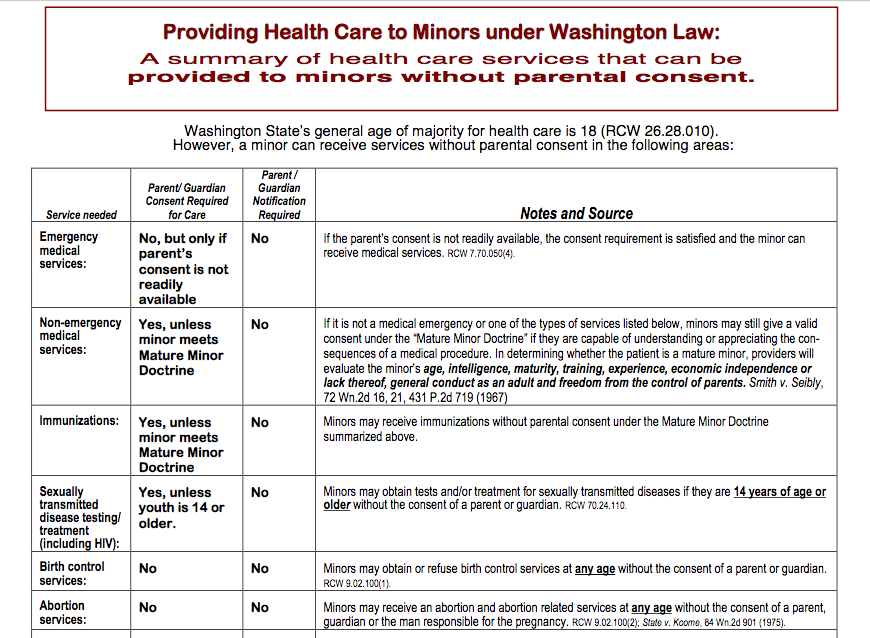
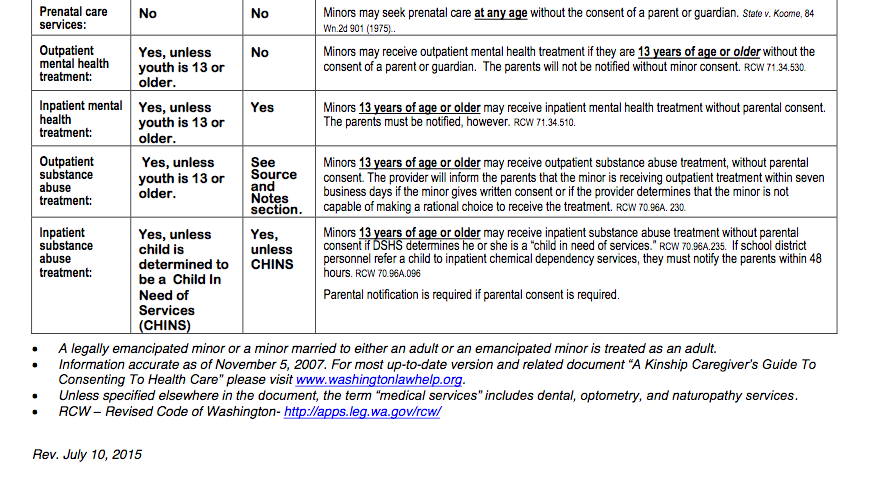
One change not reflected in this chart regards recent house bills passed in Washington State that some suggest might open the door to gender reassignment surgery for adolescents (13 years and older) without parental consent via out-patient mental health treatment:
- SB5904 allows “adolescents to confidentially and independently seek services for mental health and substance use disorders.”
- SSB5889 requires insurance providers to communicate only with the person receiving the care regardless of who holds the policy.
- And SB5313 bans insurance companies from rejecting gender affirming surgical procedures previously considered cosmetic, if they are deemed medically necessary.
The Pendulum Swings Back – Parents Bill of Rights
On March 4, 2024, the Washington State Legislature passed Initiative 2081 to establish a Parents Bill of Rights, by a wide bi-partisan margin. As a successful citizens initiative, signed by over 450,000 voters, it did not need the governor’s approval and became law ninety days later on June 4.
The opening paragraph of Initiative 2081 reads as follows:
“The legislature finds that: (a) Parents are the primary stakeholders in their children’s upbringing; (b) parental involvement is a significant factor in increasing student achievement; (c) access to student information encourages greater parental involvement.”
The initiative then lists the rights of parents and legal guardians of public school children younger than eighteen years old. Most of the rights mentioned already exist in state law. The key rights defined in this initiative, relative to medical care without parental consent, secures the parental right to inspect their child’s school records in accordance with RCW 28A.605.030.
It goes on to enumerate that public school records include all of the following: public school records, medical or health records, records of any mental health counseling, records of vocational counseling, records of discipline, records of attendance, also notifications of when medical services are being offered to their child, notification of any medical service or medications having been provided that result in any financial impact to the parent’s or legal guardian’s insurance payments or co-pays, notification when the school has arranged directly or indirectly for medical treatment that results in follow up care beyond normal school hours, and immediate notification if their child is taken or removed from their public school campus without parental permission.
Previously the schools followed administrative rules provided by the Washington State School Directors Association, WSSDA. In particular Policy 3211 — Gender Inclusive Schools, and Policy 3211 — Procedures – Gender Inclusive Schools. The key sentence in these procedures is: “Before contacting a student’s parents, the school will consult with the student about the student’s preferences regarding family involvement and consider whether safety concerns are present for the student.”
Parents might also want to know that these procedures seem to suggest setting up two sets of books — “Official Records” under the students legal name, the only one of which is the standardized high school transcript; and “Unofficial Records,” explained in the procedures, kept under the name chosen by the student to represent “how they choose to be addressed in their transgender or gender expansive status.”
The following paragraph from the procedures details the current policy In regards to what schools will release to parents (emphasis mine):
Information about a student’s gender identity, legal name, or assigned sex at birth may constitute confidential medical or educational information. Disclosing this information to other students, their parents, or other third parties may violate privacy laws, such as the federal Family Education Rights and Privacy Act (FERPA) (20 U.S.C. §1232; 34 C.F.R. Part 99). Parents have the right under FERPA to request their student’s records and if requested, the District will provide the student’s educational records to the parent according to 3231/3231P.
State and Local Responses to Requests for Clarification
In the second week of May, I contacted Annie Hetzal, the School Health Services Consultant, at the Office of the Superintendent of Public Instruction (OSPI), and asked if Washington State Superintendent Chris Reykdal had made any statements or issued instructions to school superintendents in regards to the parental rights initiative so that parents can access all their children’s school records, including from school-based health clinics, as soon as the initiative became law in June.
She told me in a text that the state Superintendent’s latest statement to district superintendents was “that OSPI is working on guidance for schools that is not yet finished.”
To clarify some of these issues on a local level, I contacted Jefferson County Public Health and spoke with Susan O’Brien, a family nurse practitioner in the Jefferson SBHCs.
Susan started with a brief history. Jefferson SBHCs got their start in 2007 with a grant from the Washington State Department of Health. Clinics were opened at Port Townsend High School and Chimacum High School for the 2008/2009 school year. The clinics were finished with donations of labor and materials from citizens and businesses in Jefferson County. This was the community coming together to fill a need that they believed wasn’t being met elsewhere.
The school clinics are primarily run by Jefferson County Public Health in cooperation with Jefferson Healthcare, and the Jefferson County School Districts. The hospital regularly provides funds for the clinics, and has a designated liaison, Dr. Sara Schmidt, who works as the main contact for requests coming from the clinics.
The recent funds from the state legislature are paying only for the remodel of the space at Blue Heron Middle School that will be used as a clinic. This was the first time that funding came from outside the community.
Students are allowed to come in with their friends, often just to ask questions like “What is going on with my body?”
Susan gave me an example of how these clinics can help families new to the community. A parent who just moved here had a child with asthma who needed help. Setting up a primary care provider can take months. The SBHC at the child’s school was able to utilize their close relationship with Jefferson Healthcare to shortcut the process and get the needed treatment for the child.
The Jefferson SBHCs track student use in two categories, medical visits and mental health visits. The information below also details how many “visits” translate into “users” or actual treatment:
- Chimacum: 200 medical visits from 89 users, 203 mental health visits from 89 users;
- Port Townsend: 325 medical visits from 157 users, 457 mental health visits from 42 users;
- Quilcene: 79 medical visits from 40 users, 392 mental health visits from 35 users.

Breakdown in each school clinic of number of medical visits and users per Jefferson County’s SBHC 2022-2023 Participation Report.

Breakdown of mental health visits and users in the report. Note that Brinnon which is K-8 does not have an SBHC, however their high school students attend Quilcene HS, which does.
Typical requests are sports physicals, birth control, concussion management, immunizations.
If needed, the SBHCs try to work directly with the student’s primary care physician. Other partners in the community include Discovery Behavioral Health and Jefferson Healthcare. Referrals for physical therapy to Jefferson Healthcare or Discovery Physical Therapy in Port Hadlock are not uncommon.
Obtaining Healthcare Without Parental Consent
When I ask about what I have found to be of greatest concern among parents — the ability of adolescents to obtain medical and mental healthcare without parental consent — Susan is clear in stating: “We follow the laws of Washington state. At the same time, we encourage the students to talk to their parents. Some students don’t feel safe. That’s why we have these laws in Washington state.”
If there is a problem with care received at a Jefferson SBHC, the practitioners, who are licensed employees of Jefferson Public Health, would be the responsible party. There is no direct state oversight. However, the Jefferson County Board of Health and Health Officer for Jefferson County, Dr. Allison Berry, provides oversight of the clinics at the county level.
Susan O’Brien stated, “The most important thing for parents to know is that school-based clinics are like clinics anywhere in Washington state — adolescents can receive mental health care without their parent’s consent.” She went on to explain that what the practitioners in the Jefferson SBHCs want is to support kids to be healthy in every way possible. Parents, she said, can choose for their children to not use the SBHCs if they so wish.
The Jefferson County Public Health website is not clear regarding that assertion. While their page about SBHCs notes that “students must be registered with signed parental consent to be seen for medical concerns,” it also displays a prominent notice assuring teens that they can access many services without their parents’ knowledge.
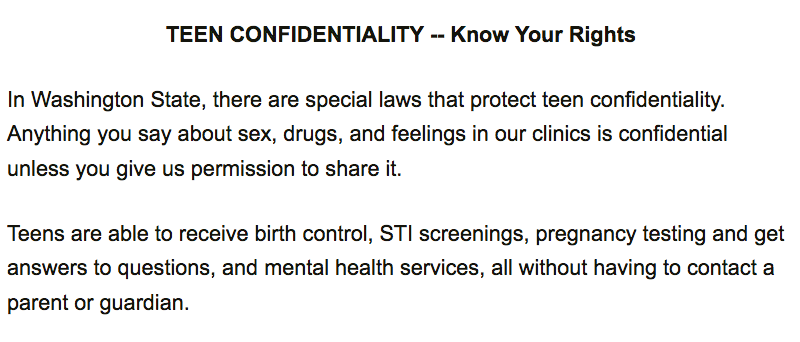
Notice featured on Jefferson County Public Health’s website describing SBHC’s “Confidential & affordable healthcare for students.”
As to the parental rights initiative, Susan confirmed that the Jefferson SBHCs have yet to receive any guidance from the Office of the Superintendent of Public Instruction and “will be following the laws of Washington state.” As noted earlier, Jefferson County Public Health’s current position is that the Parents Bill of Rights will not affect their policies, that it applies only to records kept by public schools, school staff, and school administrations. Susan says the SBHCs are separate entities from the schools and will not be required to share their records with parents. She summarized it this way:
“We don’t share our records with the schools, and the schools don’t share their records with us.“
It remains to be seen how or if the parental rights initiative will be implemented as the law now goes into effect (assuming it survives an off-mission American Civil Liberties Union legal challenge).
Ultimately, if parents are unhappy with the current state of affairs, it will be up to these parents to become familiar with current state law to establish their rights, while working cooperatively with their school administrators, school boards, and School-Based Health Centers to get the information they need to care for their children.
—————————————————-

—————————————————-
*Full list of SBHA National Partners:
AASA/The School Superintendents Association; American Academy of Family Physicians; Adolescent Health Initiative; Alliance for a Healthier Generation; American School Counselor Association; Apex; Association of Asian Pacific Community Health Organizations; ASTDD; Bi-State Primary Care Association; Beyond the Pill; The Center for Health and Healthcare in Schools, Child Trends, Coalitions for Community Schools; Institution for Educational Leadership; Community Health Center, Inc.; Conrad Hilton Corporation; Farmworker Justice; National LGBTQIA+ Health Education Center; Futures Without Violence; Health Outreach Partners; Johns Hopkins Consortium for School Based Health Solutions; Kaiser Permanente Thriving Schools; Mental Health Technology Transfer Center Network; Mid-Atlantic Tele-Health Resource Center; South Carolina Telehealth Alliance; Medical University of South Carolina; National Association of Community Health Centers; National Center for School Mental Health; National Health Care for the Homeless Council; Public Health Management Corporation’s National Nurse-Led Care Consortium; Trust for America’s Health; University of California/San Francisco; Unity Consortium/United for Adolescent Vaccination; American Academy of Pediatrics; Kaiser Permanente; National Association of Community Health Workers; Center for Adoption Support and Education; Prevent Blindness; Moses/Weitzman Health System; National Association of School Nurses; National Center for Safe Supportive Schools; Colgate-Palmolive; National Association of School Psychologists; Health Leads; Boston Children’s Hospital.
—————————————————-
Brett Nunn has spent the last two decades in Port Townsend's Uptown, raising a family, volunteering at local schools and wandering the outdoors. He writes about survival, community and culture. He is the author of the book, "Panic Rising: True-Life Survivor Tales from the Great Outdoors."
This article is well researched and well written by Mr. Nunn. My conclusions are different. I worked for the local mental health agency for 12 years as a case manager. My wife and I were foster parents in Port Townsend for 6 years. I’ve seen a lot of young people in crisis. I observed that privacy is an important factor in working with any client.
Thankfully the author is alerting parents that they have 13 years to develop good communications with their children. After that others may lend a hand. I am pleased that there are local resources to help our youth.
Thanks for the update.
Gary Novak
Kids who’s parents beat the ever loving shit out of them need therapy, and those parents are usually the last people who would or could sign them up for it. These sort of initiatives saved the lives of kids I went to school with in the 2000s, because this isn’t really anything new – youth could seek medical (including reproductive, die mad about it!) healthcare without parental consent beginning at 13 in the state of Washington, as I recall. As they should. Do not infantilize our children.
Gary and Girl in town:
Please take 7 minutes to watch this video from an articulate, loving mother in Washington state. It offers a first-hand account of how her confused and anxiety-ridden 11-year-old daughter was being socially pressured by the school, behind her parents’ back, to jump on the trans conveyor belt.
https://www.youtube.com/watch?v=AUNo1lq3Oec&t=5s
Schools’ use of a law intended to give kids protection from abusive parents to instead hide secretive gender transition programs from loving parents is the reason hundreds of thousands of Washington voters petitioned for a Parents Bill of Rights.
Yes, a parent developing good communication with their children helps to expose this madness, but as seen in this video, the only effective recourse for this family was to remove their child from public school. And in our state, had this girl been 13, not 11 years old, her mother would not have been given even the limited information she had about what her daughter was being put through until potentially irreversible harm had been done.
Conflating parental non-disclosure of “treatments” increasingly understood to further a social contagion — often with devastating consequences — with protecting kids from abusive parents is the problem. Untangling these two very different concerns is the challenge.
Hi Ana, I watched the video. I think any parent that feels let down by the public schools is wise to find alternatives as this woman says she did. I appreciated that the video was connected to other videos that told the other side of the story. Thanks, Gary (I have been confused why conservatives who strongly distrust public education to the point of pulling their children free were so upset when schools closed during COVID. Then they insisted they re-open. I see a contrariness that is not helpful. Do you have a video about that?)
Hi Gary,
Thank you for taking the time to watch the video and for responding. I’m not familiar with a group of parents who pulled their kids from school because of dissatisfaction with the public school system, but then insisted that the schools reopen during Covid. I do know that there has been a growing exodus from public schools and that Initiative 2081 was hoped to be a step in reversing that trend. After being signed by over 454,000 Washington voters, it passed by a vote of 82 to 15 in the House and by 49 to zero in the Senate. The State Superintendent of Public Instruction Chris Reykdal now telling school districts to ignore it will not help that cause (see Stephen’s post below).
Breaking news… the rule of lawlessness in action:
State superintendent tells WA school districts to ignore Parents Bill of Rights law
A new parents bill of rights took effect Thursday in Washington, but State Superintendent of Public Instruction Chris Reykdal is telling school districts to ignore it. ….
Reykdal’s office, in a news release issued Wednesday, suggested there are protections in federal law that the parental rights bill is in conflict with.
“Some of these records contain personal information and are protected under the Federal Education Rights and Privacy Act (FERPA) and the Health Insurance Portability and Accountability Act (HIPAA), and as such, cannot be disclosed without the student’s consent,” read the release.
OSPI [Office of Superintendent of Public Instruction] has asked Washington’s 295 school districts not to implement the new law.
“There is no question that students are best supported when their families are actively involved in their education,” Reykdal continued. “But if a student does not feel safe coming out to their family and they turn to a trusted adult at their school for support, they have a right to receive that support without fear of being outed by their school.”
An email from an OSPI spokesperson says in part: “Until these conflicts are clarified either in the court or by the Legislature we have asked school districts not to make changes to any policies or procedures related to student privacy.”
Washington Policy Center’s Education Center Director Liv Finne tells The Center Square, Reykdal’s position on this is out of line.
“It’s breathtaking,” said Finne. “Superintendent Reykdal has crowned himself Supreme Ruler of Education Policy in Washington State. Above the people, the legislature and now the courts.”
WA GOP Chair Jim Walsh posted a response on Facebook that says in part: “The cynical thing about Reykdal encouraging public school districts to break the law is that he faces little (direct) consequence. The districts will be the ones sued and held liable if they follow his dumb advice. WA school districts: Ignore Chris Reykdal. Do the right thing. Follow the law.”
Why can’t they ever make their pitch to sell their dubious services directly to parents at a PTA meeting?
Thank you for the article…as a LICSW treating adolescents in a hospital setting (usually up from the ED after a suicide attempt), it is disturbing, to say the least that in WA state, parents have to fight for their rights to parent their children. Let me say first, parents…please parent your children. They are precious beings who want guidelines and who desperately need you to pay attention to them, be with them, and love them. I recall one patient who I transferred to Seattle Children’s Hospital for further treatment with the parent’s consent. A week after the patient was admitted to SCH, I received a call from the mother asking me where her child was. That afternoon, I received a call from an attorney representing a group in West Seattle who had secured a discharge for the child from SCH and taken to an undisclosed location based on information the child had given to the “organization.” I will not disclose the reason, but there was no abuse involved. Imagine the parent’s horror upon visiting their child and being told she had been discharged and they were unable to tell the parents where the child was. I would like to strongly suggest that folks read “Bad Therapy” by Abigail Shrier…please, please read it! Parents must understand what is happening in our schools in an effort to “help” our kids.
Kris T., LICSW