by Jim Scarantino | Sep 9, 2020 | General
The homeless and their activists on one side, homeowners and concerned parents on the other, and the Jefferson County Fairgrounds caught in the middle. Lines are forming in a struggle for the future of this piece of open land in the heart of Port Townsend. The homeless contingent wants up to five acres turned into either a temporary or permanent encampment. Nearby homeowners on all sides of the Fairgrounds, the Lynnsfield community on the forested hills above, the apartments at the south edge, North Beach and the neighborhood squeezed between the Fairgrounds and San Juan Avenue, are organizing to stop what they see as a a power grab that would hurt their communities, home values and their children.
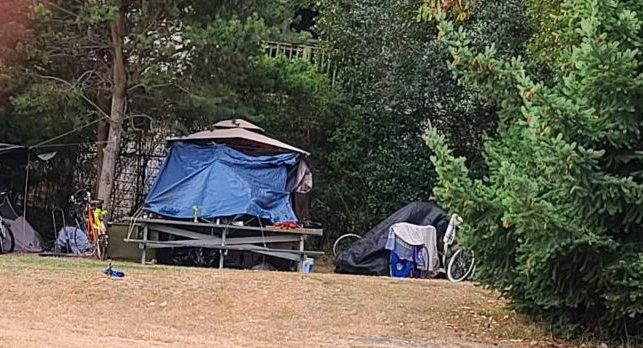
Currently, a sizable number of people identifying as homeless have claimed the right to live at the Fairgrounds for free. Relying on the Governor’s eviction moratorium, they are refusing to pay rent or other compensation to the Fairgrounds Association. They use the washrooms and trash bins and have run a long cord across the open field to a refrigerator in a tent set up against the fence at the back of the apartments just outside the Fairgrounds.
The story of how they got there is a convoluted tale compressed into the time since the Governor’s COVID declarations started putting those housed by COAST in the American Legion basement out on the street or into a hotel, and then, for those who could “congregate,” into the Oscar Ericksen Building at the Fairgrounds. Some have moved back to the American Legion basement, while others are squatting on the Fairgrounds property.
During this time there has also been a contingent of those who can’t or won’t “congregate.” These are people who have difficulty in society (e.g., some combat veterans), women who have suffered violence, people who would rather keep a pet than accept housing, and people who refuse to follow rules and choose to continue abusing alcohol and drugs.
They are not a homogeneous group. Port Townsend’s homeless population, according to a city employee who wrote for us in 2018, is composed mostly of those suffering from substance abuse and mental health issues. Some of these people can be very violent. There are also the “Bohemians” who choose this lifestyle and exploit the community’s compassion and free services, criminals on the run and, last in number, people who have lost housing due to rising rents, unemployment, domestic abuse, and other emergencies. See “Knowing the Homeless,” PTFP, August 24, 2018, and also, “Knowing the Homeless: The Individuals on Port Townsend’s Streets,” PTFP, September 27, 2018.
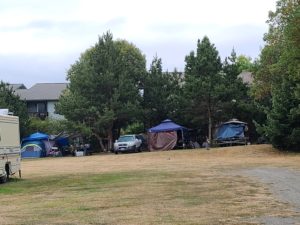
In the homeless tent encampment at the Fairgrounds, I met people who told me they had overcome addictions, a military veteran, people who had job skills and incomes but could not afford rent in Jefferson County, and people who maintained neat camp areas and cooked for those less fortunate than themselves. I saw the more resourceful people caring for some damaged, fragile individuals. I saw a young man with a large garbage bag cleaning up trash. I saw a man who may have severe mental health issues, dressed in a winter coat on a hot day and with a nine iron on his shoulder.
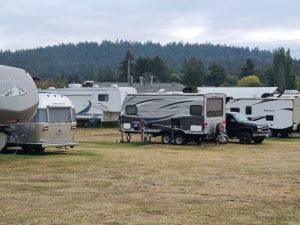
On the basis of two visits at different times of the day, the homeless seem to be getting along with the paying campers. On a morning visit, I saw a family with children rolling out of their tent while not far away a group in the homeless encampment were brewing coffee.
There are different groups at the Fairgrounds, says housing activist Barbara Morey. Some live in rather decrepit trailers and vehicles in the middle of the field. Several woman have moved away from the tent campers to be off by themselves. “It’s a way of life, of survival,” says Morey. And while she does not know of any needle use by the homeless at the Fairgrounds, she says she does not know all of them, especially recent arrivals.
There are indeed recent arrivals. On my second visit I saw RVs and trailers backed into spaces where before people had been living in tents. A woman I spoke with at length is gone, chased out by a man whom she told the Board of County Commissioners in a public comment is a drug dealer with people working for him. I had also interviewed this man at length. While we were talking a dog ran by with a large steak in its mouth and he had to chase after it. He was cooking steaks for “the community” that night. The long electrical cord running across the field went to a refrigerator in his tent. The woman who fled says he is the point of contact with the local food bank and uses food to exert control. In another letter to the Jefferson County Board of County Commissioners, in which she related her reasons for fleeing, she said she had gone to bed “without even a morsel” when she got on his bad side.
Drug use among the homeless in Port Townsend is a serious problem. In a 2018 photo essay for this site, Sky Hardesty documented bags of dope in the homeless camps at Kah Tai Park, and reported how drug dealers were using the homeless to move drugs though our community. In a recent essay here, Gabrielle Guthrie shared how the homeless have peddled illegal drugs to children in Jefferson County.
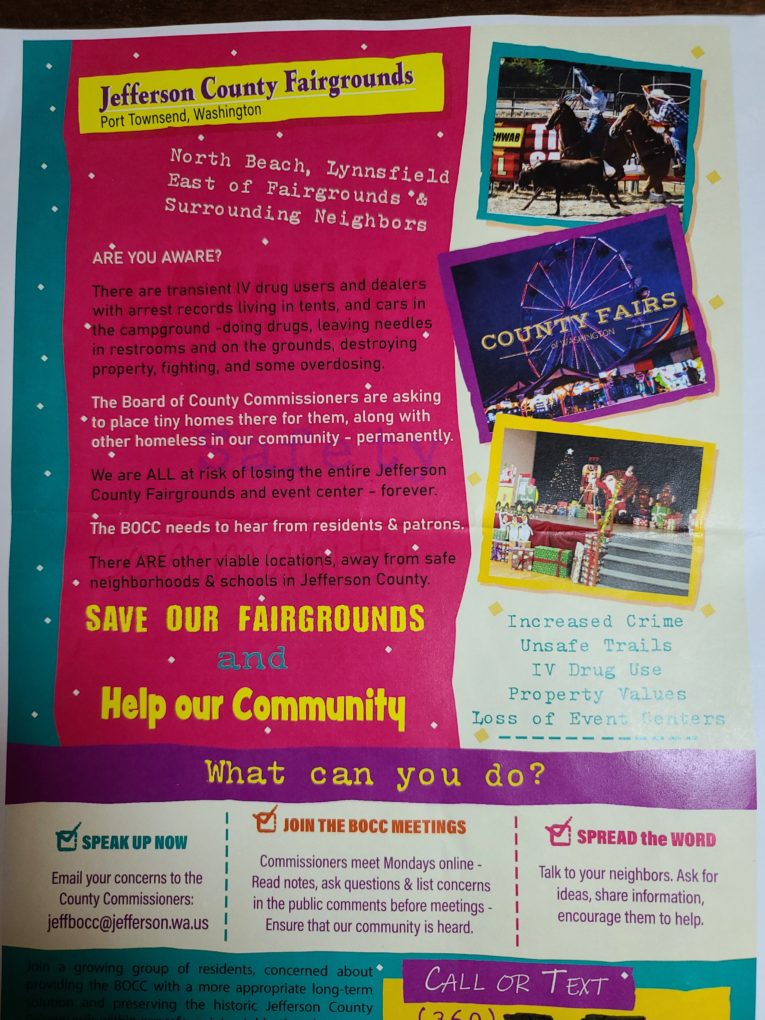
Flyer announcing neighborhood meeting on Fairgrounds controversy
Though Morey says she walks her dog every day at the Fairgrounds and has seen no evidence of needle use, discarded needles are a concern for neighbors who convened an outdoor meeting of about 25 people in a driveway on August 27. They won’t walk their dogs on the Fairgrounds, they say, because of discarded needles in the grass. They say that since the homeless moved in they have also seen discarded needles scattered near the Fairgrounds and on trails leading from the Fairgrounds. They report that two young girls walking their dog on one of those trails came across a man shooting up in the middle of the day.
A recent letter to the BOCC from a neighbor northeast of the Fairgrounds reported multiple instances of the honor box for their small farm being vandalized and stolen and having to call police for a man who passed out on their property. They wrote of hearing from neighbors of sexual acts and defecation in public, fights, drug use, and other thefts. The Fairground in the last week reported to police that its overnight cash box had been stolen.
At the August 27 meeting, homeowners talked about three overdoses among the Fairgrounds homeless population, one requiring a helicopter evacuation. They talked of a trailer that burned down, of fights, loud arguments with threats of violence, open substance abuse, shouting matches and conflicts with neighbors outside the Fairgrounds. One woman related how blaring music at 3 a.m. drove her to her balcony to plead for it to be turned down. She got no response, so she dressed and drove around to the gate. At the fence behind her apartment she found the source of the noise inside a tent. The occupant did not respond when she shouted at him. He was passed out.
Since that meeting, one of the participants has reported to me that the area is experiencing thefts from mailboxes and stolen packages have been found ripped open on trails leading from the Fairgrounds.
Parents are worried that the proximity of a large homeless population poses a risk to their children. If the homeless population becomes a permanent fixture, there is concern that youth activities, like 4-H, will be lost.
A permanent homeless encampment would also pose very substantial challenges for the Jefferson County Fair when it resumes after the COVID closures.
Even the more stable homeless campers I met know there is a significant problem with other homeless who use drugs and engage in criminal conduct. “We’re not like them,” they told me. They say that the washrooms are locked at night because a homeless woman had moved into the ladies room and wrecked it–after it had just been remodeled.
I am not naming any of the individuals on either side. I was allowed to attend the meeting with homeowners on the condition, set mostly by one woman, that I take no photographs and use no names in anything I wrote. I won’t name the homeless individuals who shared their addiction and recovery stories and who leveled accusations against other homeless. I don’t want them risking retaliation from people who could easily be set off. (I have received direct threats from quite dangerous homeless individuals after writing about their violence in Kah Tai Park. I don’t want to put anyone else through that by using their names, especially people living in vulnerable circumstances.)
The neighbors, some of whom own the apartments within a dozen yards of the homeless encampment, are angry that no one from the County and no homeless activists had come to ask them how they feel about a huge change to their neighborhood.
At the end of the meeting they discussed how to get organized and shared contact information for County Commissioners and the mayor. One woman said she will be getting the police reports that could show how crime and emergency calls have increased since the homeless took up residence on the Fairgrounds. They lamented that “the homeless are more organized than we are.”
There are a number of proposals to create a permanent camp at the Fairgrounds for the homeless. “We want five acres,” I was told by the homeless group who met with me. “We need access to bathrooms for personal hygiene. We can put RVs over there, tents here We need electricity.”
Morey, who led what was essentially squatting by homeless on the Fairgrounds in 2015, says she is working with others on the City-County Joint Task Force on Affordable Housing and Homelessness. She has submitted to that group a proposal to lease a section of the Fairgrounds to Bayside Housing for eight months, with the installation of at least 12 “wooden tents” and spaces for RV living and tent camping. The “wooden tents,” Morey said, are already being fabricated. They are in the nature of stripped down tiny houses.
Is any deal to lease any portion of the Fairgrounds for a prolonged or permanent homeless camp at hand? “No,” says Sue McIntire, Jefferson County Fair manager. Morey acknowledges, in less definitive terms, “Negotiations are ongoing, but we’re not making much progress.”
County Commissioner David Sullivan. who has been engaged in discussions with the Fairgrounds and homeless activists said at the August 31 BOCC meeting and repeated at their September 8 meeting, that nothing has been agreed upon. “The Fairgrounds people have good hearts,” he said. “They have helped the homeless in the past. But this is not their mission.”
At almost all the meetings this summer, the County Commissioners have discussed the deteriorating situation at the Fairgrounds and the coming onset of winter. Sullivan has said some of the pressures on the Fairground may lift as adverse weather and muddy fields drive campers away. But the discussions continue, and there is increasing pressure to find a solution for what happens after October 1 when the Governor’s eviction moratorium expires and the Fairgrounds can evict those who are now claiming its property as their own.
by Brett Nunn | Sep 8, 2020 | General
It has been five months since our family business was declared non-essential. I struggle to remember all that has happened, and at the same time know that we should never forget.
I think this all started with a viral outbreak from China. Then came a quarantine because our leaders told us we would kill each other if we didn’t stay home and wear masks.
Then there was Governor Inslee’s economic shut down, and infamous essential vs. non-essential dictate sending small businesses in Washington State into a death spiral.
Then there were protests. Or was it looting? Or was it a riot? I don’t remember if the protest, looting, and riots were about the virus. Seems like it had something to do with justice, but the results were lawlessness. Everyone forgot about death by COVID when they could see there were no limitations placed on individuals when burning, beating, and looting.
Despite the problems elsewhere, there is good news for my Port Townsend family of four. With everything closed and nowhere to go, our monthly expenses were less than anticipated. The lack of a paycheck for months on end hasn’t decimated our savings as we thought it might, but we aren’t through this yet.
Our business is still alive. Paychecks may become a regular thing again. Looks like we will be able to pay our mortgage when it comes out of forbearance next month. We are still sorting, counting, and packaging product as a family around the kitchen table. My wife is still doing all the shipping.
I imagine our daily lives are somewhat like everyone else’s. The group gatherings, the summer travel, the festivals, the concerts by which we celebrate and recognize the mileposts in life have been cancelled. It has been hard to tell one week from the next.
I have tried to stay in touch with other families and friends in our community with some success, but so many people seem to have gone underground, only doing what they have to do, keeping to themselves, keeping their distance.
The unemployment process has worked for our former employees. With the added federal dollars, the government check was better than we could provide. What my wife has done over the last few months is to tear apart and rebuild our business so it can survive in unfriendly economic times. It is smaller, more efficient, and eventually will be able to operate from anywhere.
The business climate that motivated the rebuild had been developing for years, created primarily by elected officials who have rarely had to meet a payroll or balance a budget. The Wuhan Virus economic shut down just accelerated the process. In simple terms, state-mandated high minimum wages and mandatory time off for entry-level employees eliminates jobs. Not what we wanted to, but we are moving in the direction we have to go in order to survive.
I don’t know what Governor Jay Inslee is up to at this point, and I don’t care. Over the last several months he has demonstrated complete disregard for the small business owners of his state. All I can conclude, if he wins a third term as governor, is that the people of Washington no longer expect much from their elected officials.
School is supposed to start on September 8th. Families were asked to commit through the end of November to either an on-line version, or a couple of days of the week in school and a couple of days online.
The schools have made a massive effort to be ready. I have confidence in the teachers. I want my kids in a classroom with their peers. Yet, I have seen the damage done to the mental state of my fellow citizens. I would rather not put my kids into the pressure cooker that I expect the next few months to be, so online school is our choice.
All of us have witnessed the clear dividing line in this town during this experience. Many if not all of the don’t-open-up crowd either didn’t need one or haven’t gone without a paycheck. I was shocked to hear good citizens of independent means tell me that the people of our town should go without work for months so that they could feel safe.
The hardest thing about living in Port Townsend over the last several months hasn’t been the pandemic or the economic crisis. It has been the politics.
If a person does not march in lockstep with the prevailing opinion, that person risks becoming an outcast. Everyone assumes you agree with the prevailing opinion because you are here. Why would you be here if you didn’t agree with the prevailing opinion?
A person has to watch what they say, what they do, where they are seen, and who they associate with. God help this person if they put the wrong campaign sign in their yard. God help this person if they are seen at the wrong protest, or not seen at the right protest. If an individual hazards to make it known that they might support a candidate or concept that stands for anything but the prevailing opinion, they risk a verbal assault of vulgarities screamed in their face. Those less “passionate”–those who won’t scream at you–will just no longer acknowledge your existence. They will look right through you as you pass them on the street.
We all have roles to play in the future of Port Townsend. If we follow the model fed us by the establishment media we will continue down the road to an insular community of close-minded individuals. I would like to think that Port Townsend would resist this prospect, but it may be too late.
Related: Part 1 of this series, “Life in Port Townsend for a Family with a ‘Non-Essential’ Business”
by Jim Scarantino | Aug 31, 2020 | General
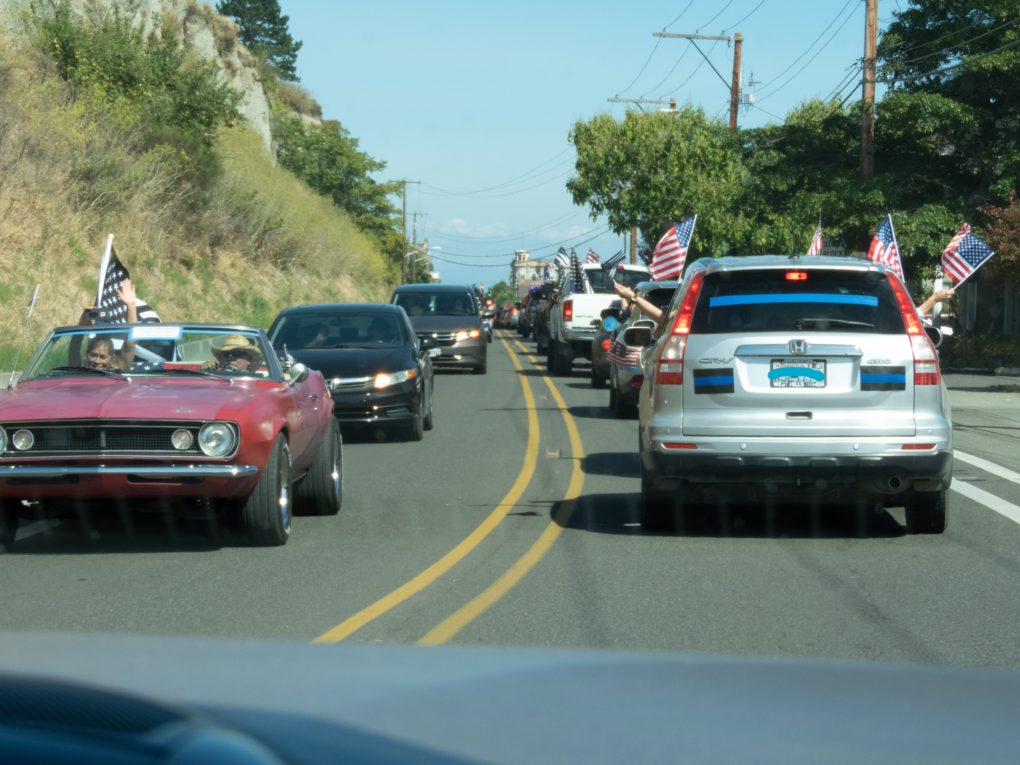
About 400 cars, trucks, and motorcycles. A line 6 miles long that took an hour to drive to the end of Water Street and turn around. A massive Back the Blue Rally organized by the wives of law enforcement officers stretched from Chimacum through Port Townsend on Sunday, August 30, 2020.
The starting point was H.J. Carroll park, where all parking spaces, the open field and the sides of roadways were filled almost an hour before the scheduled departure. The event took off 20 minutes early because there was no more room. I stood at the exit as the motorcade got underway with a hand counter. 342 vehicles rolled by me. I learned that more participants had parked at Chimacum High School and the Grange when word got out that the park was filled. Along the way, other vehicles joined in at Ness’s Corners and closer to Port Townsend. One observer counted 60 vehicles parked on the shoulders of Highway 19 near Anderson Lake Road waiting to join the long, long line of cars, trucks and bikes decked out with flags, streamers, balloons, and signs proclaiming “We Support Law Enforcement,” “Back the Blue,” “Thank a Cop,” “Cops or Chaos” and “Blue Lives Matter.”
Organizers did not intend this as a political event. It was open to anyone supporting law enforcement. But numerous “Culp for Governor” and “Trump 2020” signs rode the route along with pro-law enforcement messages. I spotted Sue Forde, who is challenging incumbent Michael Chapman to represent the 24th Legislative District. I also spotted Brian Pruiett who is challenging incumbent Steve Tharinger who holds the other seat representing the 24th LD. No Democratic candidates or their representatives were present. I did not see any signs for any Democrat candidate, though I did recognize in the cars leaving H.J. Carroll Park people I know to be Democrats and to have held elective office in Jefferson County.
The Rakers, Port Townsend’s popular classic car club, turned out in force for law enforcement, as did several motorcycle groups. Jefferson County has a very large retired law enforcement population, and they were well represented.
What impressed me is that nearly all of these people, really 99% of them, had not been engaged in anything like this before in Jefferson County.
Someone, perhaps intending to intimidate participants, drove up and down the rows of cars before the start filming license plates. Their vehicle bore the campaign sign of a candidate for the District 2 position on the County Commission, but the persons doing the filming did not include that candidate. I don’t think it would be fair to that candidate to align her with the actions of these people as I know she has spoken highly of our deputies and police officers.
I was the last to leave H.J. Carroll Park. Along the 9 miles into Port Townsend ahead of me the line of cars decked out for the event stretched as far as I could see. Groups of people along the roadway waved in support, unfurled American flags and held up signs supporting law enforcement. It was noisy, with horns honking and cheering, especially when the long line had doubled back on itself.
The night before someone had gone along the route hanging Black Lives Matter type signs and banners on private fences. The paper banners were in tatters. Someone then came along and affixed plywood boards with messages to private property. At least one property owner had called the Sheriff’s Office to report their property being targeted without their consent.
There were a handful of counter-protesters approaching Port Townsend, no more than half a dozen. And there were people having nervous breakdowns.
One woman going south was driving with both hands in her hair and shaking her head back and forth. Just off Sims Way, in a lot near Kitsap Bank, a young woman was doubling over, writhing, screaming, “I can’t breathe.”
And there were the usual middle fingers from old White women. This seems to be a Port Townsend ritual for greeting opposing viewpoints in a town that supposedly celebrates tolerance and diversity.
Supporters of the motorcade and opponents report that it rolled through Port Townsend steadily for about an hour. As I approached the intersection of Water and Taylor, suddenly the slowly moving line of vehicles came to a complete stop. I walked up to see what was happening. A group of about 25 people, mostly young, all White, had blocked traffic in both directions. They were screaming profanities into the air and at people on the sidewalks, dropping to their knees and raising their hands over their heads, laying down on the blacktop and…
…dropping their pants (this is on video but I won’t publish the images).
They seemed to be following the lead of an adult woman who owns a downtown bar. She was the one talking with the police officer who was begging them to clear the roadway and advising them that their actions were illegal. Several times she turned and addressed the group with questions and instructions. Video she took and posted to her Facebook page confirms that she seemed to be a leader of sorts.
An individual named Rex Fergus, who does not live in Port Townsend, caused a bit of a sensation. He was filming the event for his own media activities. He was wearing a tee shirt that said “Proud Boys.” He was not part of the motorcade (he was on foot). The video he took, including conversations with some of those blocking Water Street, may be seen at his Facebook page. It does not show him engaging in anything other than media commentary and discussion with bystanders and traffic obstructors. At the end of his video, a woman who identifies herself as Port Townsend resident, asks him to join her for a drink and a chat.
Except for about 15 vehicles, the other approximately 400 Back the Blue vehicles had completed their route and were on their way back to Chimacum before Water Street was blocked. The cars stretching for half a mile or longer back to Sims Way, and north along Water Street to Hudson Point were vehicles occupied by people having nothing to do with the event.
Police warned the protesters that they could be cited for illegally blocking a public roadway, but would likely not be physically arrested. That emboldened them and prolonged the blockade. At the request of police, the cars closest to the blockade turned around and the rest of the traffic followed. A truck and a car were slapped or kicked by those in the street, and a young man had to be restrained by police.
I do not know at this time whether any charges were or will be filed against the people who blocked traffic on Water Street.
by A Concerened Citizen of Port Townsend | Aug 29, 2020 | General
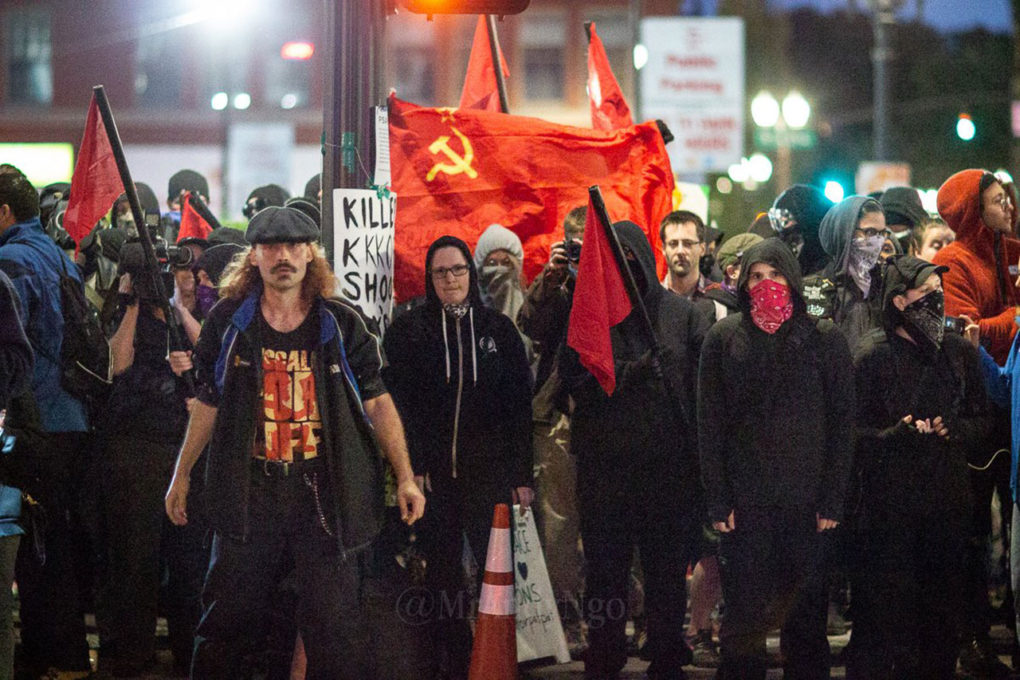
Start your own Antifa group. Easy peasy. As our Concerned Citizen of Port Townsend has learned, like making bombs, the instructions are available on the Internet. For those slow to recognize sarcasm, this is sarcasm. But it shows us what the people burning our cities, attacking police, exploiting Black lives and deaths and calling for ever more violence are about. Some of the tactics from Antifa’s how-to manuals are already being used here, such as interference with rallies for law enforcement, doxxing and retaliating against individuals and businesses that don’t conform to their ideology. Ironically, the businesses being targeted by PT’s Antifa wannabees and Black Lives Matter supporters are mostly immigrant minority-owned businesses. We might be writing more about that. From the Editor.
The other day I was wandering aimlessly on the web, and in a freak accident came across exactly what has been on my mind for the last few weeks, How To Form An Antifa Group, at joinantifa.com.
According to United States Representative and Chairman of the House Judiciary Committee Jerry Nadler, “Antifa is a myth”, so this must be a parody website, yet the information provided is most helpful.
In a bright and positive tone the website declares, “Antifascist groups, often called Antifa, are popping up all around the U.S. and a number of people have asked advice on forming a group.”
According to the website, the first question I must ask myself is, “Why Antifa?”
I am told that the label has distinct advantages and disadvantages, primarily “brand recognition and built in credibility”, but also certain “obligations”.
Everybody likes brand recognition and credibility, obligations not so much. But, in for a penny, in for a pound. Here are the obligations as listed on the website:
- Track white nationalists, far right, and fascist activity.
- Oppress public far right organizing.
- Support other anti-fascists.
- Build a culture of non-cooperation with law enforcement.
This seems doable.
I am told to stay anonymous, and use the “closed collective” model for recruiting other members. No open meetings, no people just walking in off the street.
I should carefully manage my online presence. Use only Twitter because it limits the amount of personal information that could be exposed.
Creating a website is a good idea because this implies my group is more “legitimate”. This should be used if, and when, I want to “Dox a local fascist”.
It is also recommended that I practice martial arts, and educate myself in which self-defense weapons, pepper spray, clubs, etc. are legal to carry in my area. It is suggested that I might contact a lawyer who could help me with this topic.
For those who don’t have time to master a martial art, or contact a lawyer, the topic of guns is discussed, especially concealed carry because it is better “for fascists to try and roll on you without realizing you are armed.”
I note that if I am lacking in self-defense hardware I can buy over-the-counter assault pepper spray, military inspired weapons, and tactical pens directly from companies advertising on the joinantifa.com website.
I skim over the sections on dealing with loose cannons, infiltrators, state repression, and political orientation except for this gem – if other organizations hesitate to collaborate with your Antifa group, approach them under a different name such as “Las Cruces Against United Racism”.
Finally I came to what I crave, the “Take Action” section. Here is what the website recommends.
- Establish an online presence – web page, twitter, etc.
- Start monitoring fascists – they are everywhere!
- Tear down any fascist posters or stickers in your community, replace with anti-fascist posters and stickers.
- Start Doxxing – identify fascists, publish photographs, home addresses, phone numbers, social media, and employment information. Get them fired. Make sure your “Intel” is correct because you can, “lose credibility and create unnecessary enemies” if you have bad information.
- Shut down events – “pressure venues to cancel racist or fascist events”.
- Self defense training, again – “a good way to increase confidence and meet new people.”
- Throw benefits and table at events – “important in cultural scenes where fascists are recruiting.” Don’t forget to donate to the International Anti-Fascist Defense Fund, intlantifadefence.wordpress.com.
- Organize mass demonstrations – if this is too big of a hurdle, joinantifa.com recommends combining efforts with “other demonstrations such as Black Lives Matter”.
It’s time for action Port Townsend! Who’s in?
by Jim Scarantino | Aug 20, 2020 | General
Is ejecting a man from a yoga class because of the color of his skin color a racist act?
It looks like one of the lead organizers of Black Lives Matter of Jefferson County kicked a Hispanic man out of the yoga class he leads at Fort Worden because the Hispanic man’s skin was not dark enough to meet some racial standard and he did not choose to label himself “BIPOC.”
Here’s what happened. It involves Cameron Jones, one of the two or three leaders of Black Lives Matter of Jefferson County.
Mr. Jones teaches a yoga class for the Mystic Monkey Yoga studio in Port Townsend. The class is entitled, “Yoga for BIPOC: Mindful Movement for Black, Indigenous and People of Color.” To participate in Mr. Jones’s class you book a spot and pay through the Mystic Monkey website. Then on Sunday afternoon at 3:30 p.m. you look for Mr. Jones at Fort Worden State Park where he holds his class outdoors.
On this particular Sunday, a Hispanic man new to the group spread his yoga mat on the ground and sat down. Mr. Jones in an August 7 Facebook post described what next occurred:
“I didn’t know this person and one of the other students commented on their approach with…apprehension…and why’d they be coming to class because this person was very, very light skinned….The person who came to class, an apparently cis-white male came ‘in’ (we were outside) placed their mat down and was ready to begin. Not that I expected this, but there was no preamble, no prior connection, seemingly no awareness as to the discomfort of others present. So I asked them their name and if they knew this was a BIPOC class. They responded yes. So I asked if they considered themselves BIPOC, they said, ‘well, my dad was Mexican.’ Ok. Cool. At this point there was still a low level of discomfort, so I asked if they identified as BIPOC. Their response was, ‘I really don’t believe in labels.’ This, for lack of a better word, triggered me. And I asked them to leave. They were visibly frustrated at always being perceived as a cis-white man and ended up leaving in frustration and anger. As they were leaving I attempted to invite them back so we could all sit and talk about what transpired, but they were too upset. Understandable.”
Understandable? What an understatement. Is this not an overt, rather aggressive display of bigotry that resulted in injury to a man who only wanted to participate in a yoga class?
Mr. Jones actually blames the victim for having helped “incite the event.” The “event” was that Mr. Jones and others did not approve of the color of this man’s skin, and it took off from there.
Nobody would or should tolerate a commercial enterprise offering a service only to White people. Nobody would or should tolerate a White instructor grilling a customer because of apprehension about their skin color. Nobody, regardless of who they are or the nature of their business, is entitled to treat any person differently because of the color of their skin.
The right to be free from discrimination on the basis of race and color is one of the most fundamental and protected civil rights under Washington law. Our state guarantees the “right to full enjoyment of accommodations, advantages, facilities, of any place of public resort, accommodation, assemblage or amusement.” This law was enacted in 1890 as the result of the efforts of a towering figure in Washington state history, William Owen Bush, a Republican and the first Black elected to state public office. (On a side note, Democrats opposed this bedrock civil rights law and Democrat legislators continue to defeat periodic efforts to honor Mr. Bush by naming an area of the Capitol after him.)
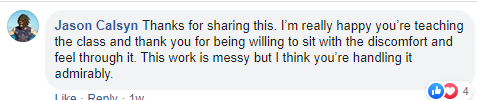
Perhaps the Mystic Monkey business is unaware that its teacher excludes and gives a hard time to anyone who does not have the right skin color. But there is no need to wonder. The owner of the Mystic Monkey business applauded Mr. Jones for his actions. The very first comment to Mr. Jones’ account of how he ran this Hispanic man off came from Jason Caslyn, who owns the business:
The Jefferson County Board of Health is expected today to declare systemic racism to be an emergency in Jefferson County. The preamble to the proposed resolution does not set forth a single instance of racism in Jefferson County among the justifications for their declaration. Maybe they’re looking for racism in the wrong places and among the wrong people.
by Z Cerveny | Aug 15, 2020 | General
WHAM! GRIND! SCRAPE!!
Grrrrrr.
I had scooted across 19th Street, going north on Landes after leaving the Safeway. When I got to the other side my front tires dropped, the road came up, and I was scraping the bottom of my car across the blacktop.
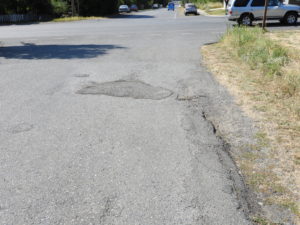
Landes at 19th
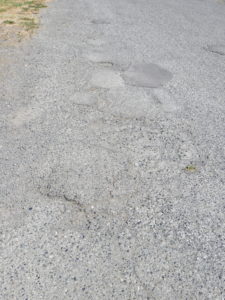
Landes Street
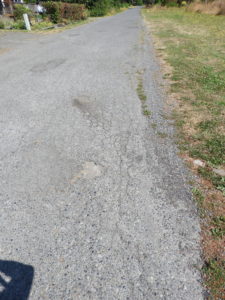
Landes Street
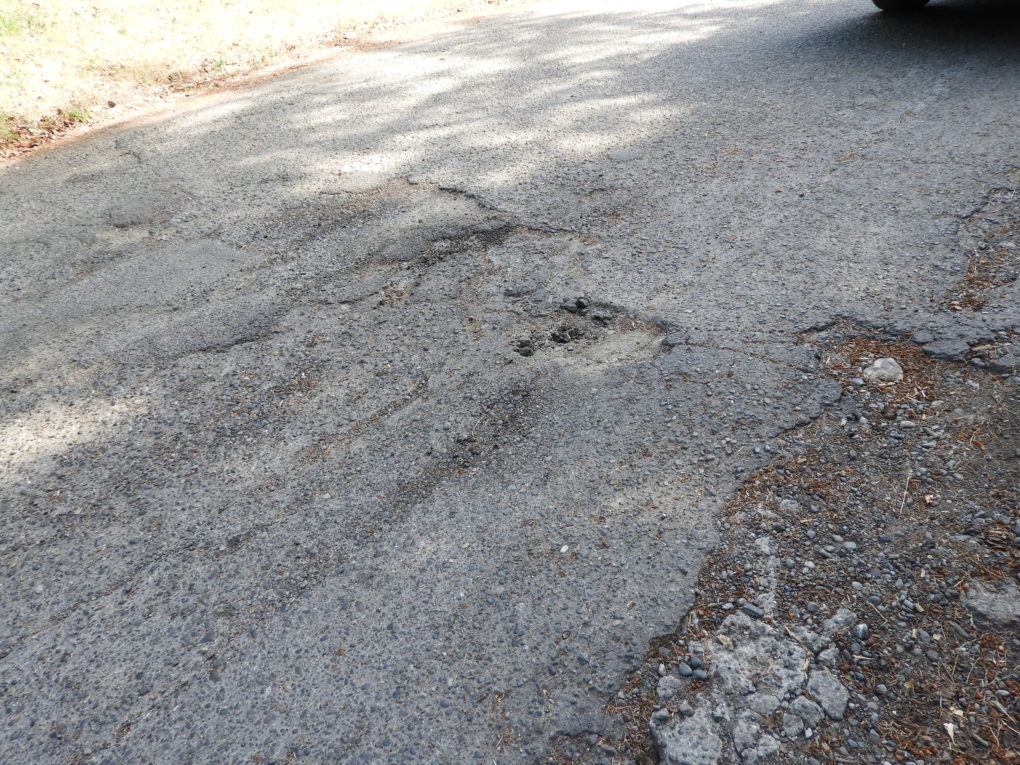
I disembarked to inspect for damage. That plastic part below the bumper was cracked. I didn’t see oil leaking. But I did see a road that looked like it had been paved by Jackson Pollock–the artist who had a laugh at the world making millions by splashing paint onto big canvases. Somehow he must have gotten the contract for applying tar to Landes Street. It has so many chaotic patches it looks like a gigantic abstract composition.
Cinema verite, too. This could be a multi-media production. I can’t imagine how shaky a hand-held video would be driving along these blocks. Potholes, rivets, ridges, gullies, and just failed paving make for one bumpy, jolting ride. It goes on for blocks.
After that day I started paying attention and realized failing streets are everywhere!
How did the maintenance of our streets fall so far behind? I had always thought that providing transportation infrastructure, a fancy phrase for city streets, was a basic service of a municipal corporation. Prior generations of city leaders laid out our street plan and upgraded them from dirt horse tracks with all the things that go into constructing a modern means for automobiles on rubber tires to move about. All that critical work, surveying, grading, compaction, base course and chip seal (I Googled road building) was done years ago. The current state of our streets looks like we’re having trouble hanging onto a tattered inheritance.
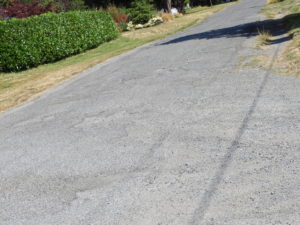
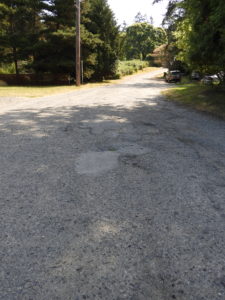
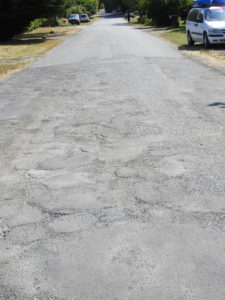
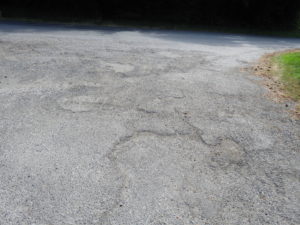
I thought Landes was bad. Then I went to visit a friend who told me to take Center Street to get across the valley. I took a right off San Juan and stopped. Maybe I’m now obsessed. But the deterioration of this residential street made me get out with my camera and walk. It gets worse and worse as you start climbing to Redwood, block-long sections of pavement barely held together by ugly, misshapen and sloppy splotches of cracked tar. And more than a few legitimate potholes.
That photo at the top of this story is Center Street, as is the one to the left and these, as well.
I got back in my car and rattled along until I got to Redwood. But this jolting journey isn’t over. I will be sharing more photos from around our town showing just how bad things really are.
I’m no highway engineer, but I’ve been told, and it’s common sense, that when roads are neglected like ours are they only get worse and worse. Prolific and poorly applied patching is less than a temporary band aid. It may actually contribute to accelerating the deterioration with the freeze-and-thaw cycle and rain getting into and under what was once a uniform asphalt surface.
You roll and rock along the same streets as I but maybe don’t get out and snap photos. What’s that lady doing stopping in front of the house again, taking more pictures of potholes? Don’t worry, that’s just sweet Z and her trusty Nikon.
I’m sending my work to Port Townsend Free Press in the hope it gets attention and encourages action. I observed that the editor teased my forthcoming stories on their Facebook page and used a couple photos I took of decaying, deteriorating, degenerating, dearly beloved Discovery Road. A couple weeks later the city announced it was seeking federal funding to do something about that grand boulevard. But first they will put in a bike lane on broken pavement. I guess that’s our PT Vibe applied to the art of road maintenance.
Until our next outing, happy trails, mon amis.