by A Concerened Citizen of Port Townsend | Oct 23, 2020 | General
After weeks of listening to the talking points from the mouths of our national leaders on the left, I sent this message to the Senators and Congressman representing Jefferson County, Washington at the federal level.
“Instead of congratulations for running a successful campaign that offers any viable alternative to the Trump Presidency, I am contacting you to register my shock and dismay with the leaders of the Democratic Party clearly signaling to the electorate that they will refuse to accept the results of the upcoming election if it is not in their favor. Joe Biden threatens the American population with continued rioting if the Republican candidate is re-elected, and through the Transition Integrity Project we learn that Democratic Leaders continue to war game for a coup to remove the president. This is not a Democratic Party I recognize or can support. Please tell me you will stand for the rule of law in the coming months. Please make an immediate public statement to your constituents that you support free and fair elections and will condemn any rioting that demands a duly elected candidate must go because a violent mob says he is illegitimate.”
I have heard nothing of any substance in return from Senator Murray, Senator Cantwell, or Congressman Kilmer. I am not surprised. They are busy people.
I have struggled lately to explain to my kind, intelligent and thoughtful friends in Port Townsend why I am astounded at the general lack of interest in the recent revelations surrounding the most monumental criminal conspiracy in the history of American politics. I hear their dismay when they described how rude it was for a Presidential candidate to be interrupted in a debate, but no one seems to be able to grasp that for the last four years there has been an active and ongoing effort at the highest levels inside and outside of our Federal Government to overthrow a duly elected president. People I speak to admit to little more than just wanting to move on. I am left to think that a crime in progress, perpetrated on the American people by officials in their government, is too much for them to comprehend. They seem to think if we just pretend not to notice, all this trouble will go away, and will never happen again.
Some have described this action as a “Soft Coup”, but after researching the origins of this term I think Phil D’Agostino, writing for The American Thinker back in December of 2019, defines what we are experiencing in far better terms.
“As evidenced by the statements of many current players behinds the scenes who have been actively trying to fundamentally transform America, it would seem that in the 20th Century, it was determined by those committed to the transformation, that the people of the USA would never willfully throw away their freedoms and embrace some form of Marxian socialism. Therefore, in order to effect this change, there needed to be an internal use of the system itself to subvert it through legislation and regulations to become a de facto state of Marxian socialism without ever calling it such, nor voting for such.”
D’Agostino continues: “Ever since, there have been bureaucrats and presidents who have worked against the will of the majority in order to ‘overthrow’ the duly elected government and replace it with their own view of what the US government ‘should’ look like. It is a war, not a coup. They are relentless, indefatigable. They will never stop.“
He goes on to say we might think this is just about Trump, but it is not.
Any person, “Who embraces the ideals of small government, personal freedom of choice, personal property rights, and the ability to defend our ownership of what we’ve created or accumulated, will be the next target. A relative handful of people would superimpose their views as a minority onto the will of the majority because they believe themselves to be smarter, better, more correct.”
So, for my kind, intelligent, and thoughtful friends in Port Townsend this is what has been pre-eminent in my thoughts over the last few weeks. I ask that you consider the undeniable truth that is there for all of us to see if we wish to do so and ask yourself, Do you want to be ruled by people who are sure they are smarter, better, more correct and know what you need better than you do? Or do you prefer the original intent of what was given to us so many years ago, government of the people, by the people, for the people? The choice between the two has never been more stark.
by Jim Scarantino | Oct 23, 2020 | General
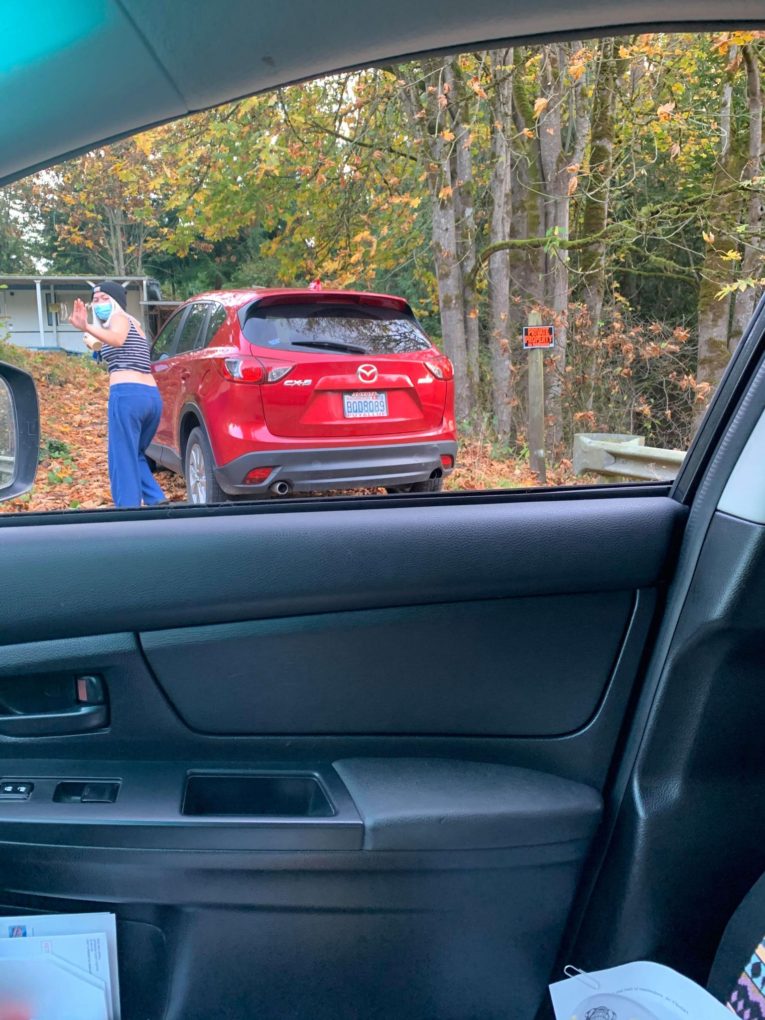
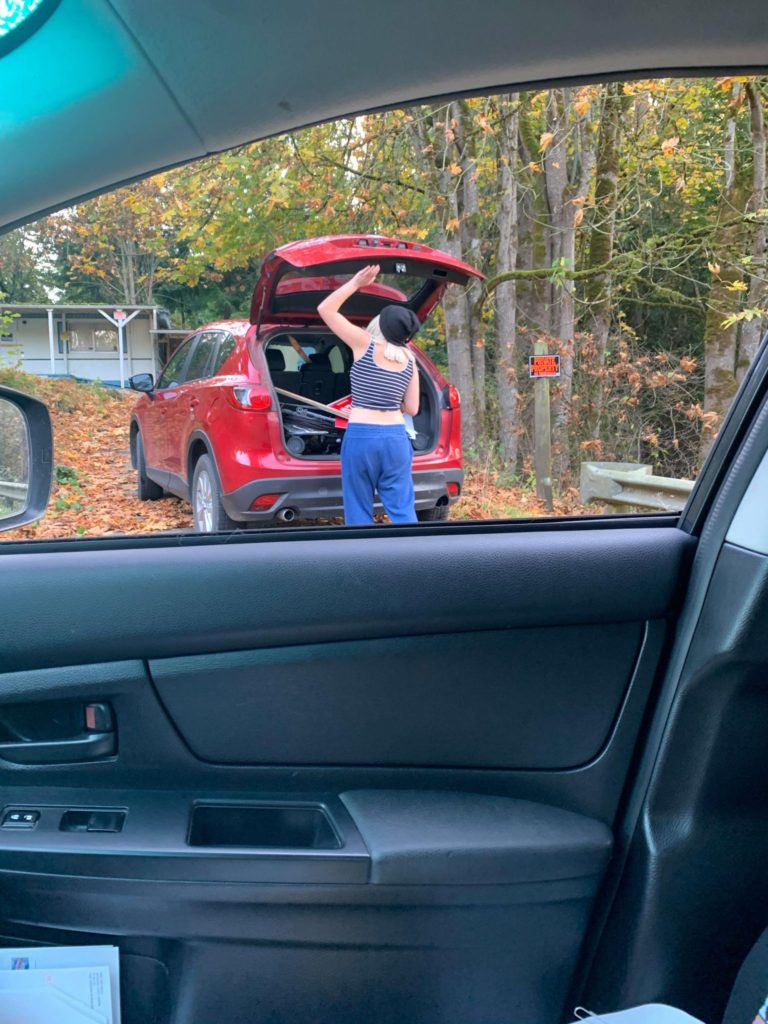
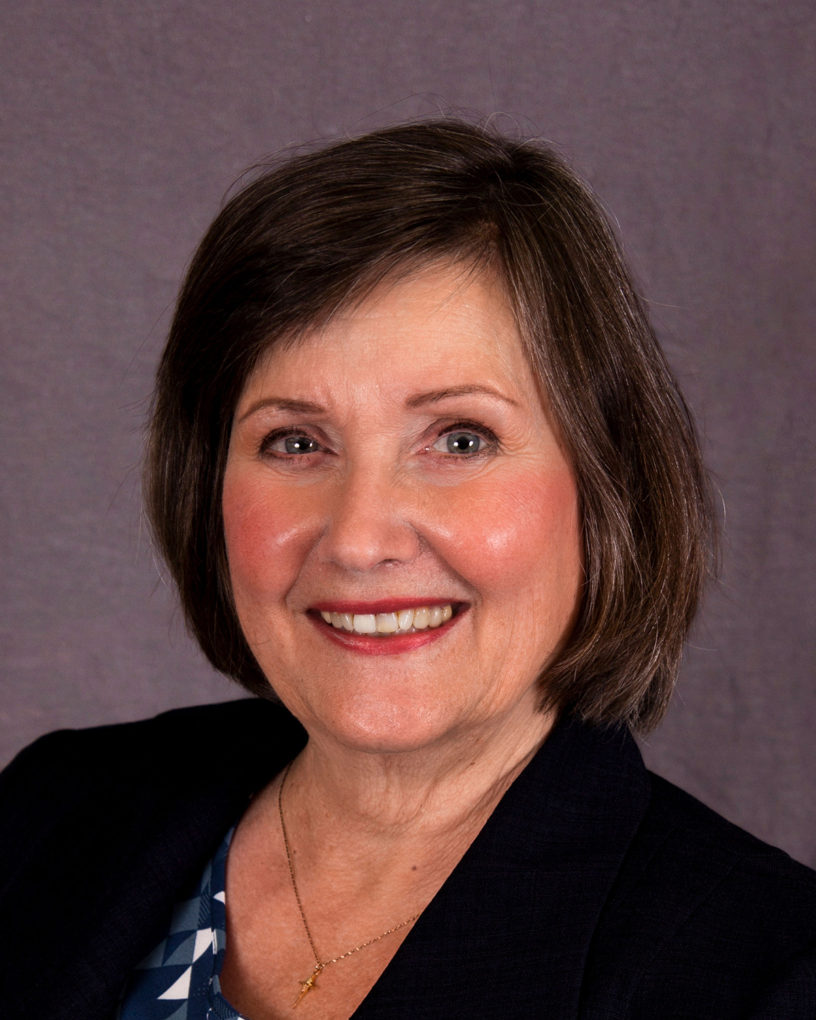
Who is this sign thief? She was photographed just after she stole a Trump sign. The location was Irondale Road at the bottom of a driveway, close to where 7th Street turns off. The sign had been standing along the road near the bottom of a drive for a single wide that is not currently occupied.
Port Townsend Free Press will pay $100 for information leading to her citation for the criminal offense of damaging/stealing political signs.
[Update: the thief has been apprehended and cited for eight incidents of stealing campaign signs. Good work, deputies. The woman who contacted the Sheriff’s Office has not claimed the reward. This thief wasn’t too smart. Not only did she pose for these photos, she recorded herself in the act and posted a TikTok video of her crimes.]
by Jim Scarantino | Oct 19, 2020 | General
Bayside Housing has not yet committed to taking on the failed Cherry Street Project.
“First, let me tell you this is not a done deal,” says Gary Keister. He is serving as the acting managing director of Bayside Housing. It has been without a permanent managing director since last year.
“We were being pressured into this by Homeward Bound,” Keister told Port Townsend Free Press.
Keister is the man behind the Old Alcohol Plant. His group of investors bought the building out of foreclosure in December 2014 and renovated a hotel that had been vacant since 2011. Beginning in 2016 the tower at the Port Hadlock property has been rented to Bayside Housing, a non-profit that provides transitional housing. The Old Alcohol Plant itself operates as a for-profit hotel and restaurant and bar business.
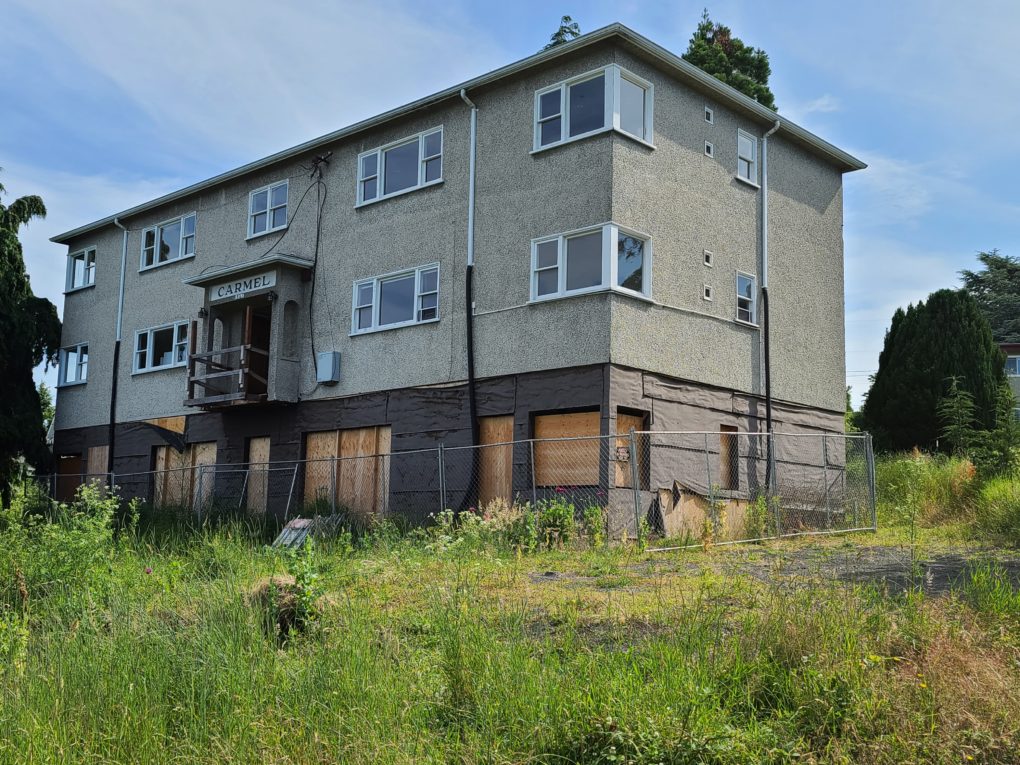
On Wednesday September 30, both the Port Townsend Leader and the Peninsula Daily News reported that Bayside Housing was going to take over the Cherry Street “affordable” housing project following the default by Homeward Bound Community Land Trust. Homeward Bound had been resurrected by the City of Port Townsend to take on turning a 70-year old four-unit apartment building barged from Victoria, B.C. in May 2017 into affordable rentals.
As readers of this site know, the Cherry Street Project has been a debacle from the start and keeps getting worse. When Homeward Bound could not find its own financing, the City shouldered a $1.3 million principal-and-interest bond obligation to lend the group the money to cover its cost estimate. Homeward Bound never got beyond putting the building on a foundation when it came back to the city saying it would need at least another $1 million. They did not get more money and defaulted on their loan in July 2020. They still hold title to the property, though the terms of their loan require that it revert to the city upon default.
The city and Homeward Bound prematurely announced that Bayside Housing would accept the project. Even on the fantastically generous terms offered by the city Bayside Housing does not appear to have the resources to take it on. At this preliminary stage, it has already faced financial setbacks.
It failed to secure a $700,000 bank loan. Its request for a separate $100,000 from the county was denied because an analysis of the project’s financial details showed it could not be a viable low income housing project. (See reporting by Patrick Sullivan at the Jefferson County Washington Facebook page).
And there’s this: Bayside Housing has never built or renovated anything. The group rents rooms from the Old Alcohol Plant and provides social services to its clients. It is not a building contractor. It does not own any real estate. According to its most recent IRS 990, it had only 4 employees, and that was before it lost is managing director.
The Port Townsend City Council on September 28 authorized the City Manager to negotiate a takeover of the project by Bayside Housing.
We asked Keister if Bayside Housing had the resources to see the project through and whether it was, in fact, going to assume responsibility for the Cherry Street Project.
In an email from Keister he told the Port Townsend Free Press,
First, as you know the council only voted to allow city management to negotiate a Purchase & Sales Agreement with Bayside. First, the City is not in a position to do that since ownership still rests in the name of Homeward Bound. The Bayside board is considering this matter at its next meeting. No decision has been made. I am not a board member nor an officer of Bayside. My role is to seek housing for the unsheltered. I have tendered my report to the board regarding Cherry Street, and brought to their attention the offer tendered to the city, as you related, for the purchase of the property by Keith Marzan. When and if Bayside makes a decision I will advise you.
The offer to which Keister refers was a $1 million offer from Keith and Jean Marzan to acquire the Cherry Street Project and build affordable housing, on the condition that the old building be removed and the land certified as asbestos free. Port Townsend Free Press had reported discovering in the city’s files an inspection conducted on the building before it was barged to Port Townsend. The inspection found asbestos in kitchen flooring. It also found lead paint on all the walls.
Port Townsend Free Press has also learned that asbestos was found in old pipes during excavation for the foundation.
The City Manager rejected the Marzans’ offer late last week. The Marzans may resubmit the offer with slightly different terms. They remain committed to building affordable housing and hope to work with the city to that end. Keith Marzan has a long career in banking and finance and has built nine homes in Port Townsend. Keith Marzan says he has already lined up an experienced and qualified project manager.
Bayside Housing does not apparently have on hand the more than $1 million estimated by Homeward Bound needed to complete work on the old building. An additional, unknown investment will also be required to compete civil engineering and landscaping outside the building, a sum which Homeward Bound said was not included the final project cost estimate.
In its most recent publicly available filing with the IRS, Bayside reported 2018 net assets of $670,000, after contributions and grants of just over $1 million. But of that sum, $802,000 reported as income was actually pledges and grants receivables. Because the 2019 IRS Form 990 is not yet publicly available, we cannot report whether those pledges were received and what Bayside’s balance sheet showed at the end of 2019.
In April 2020 Bayside disclosed it was facing financial pressures. At the same time that it rents rooms from the Old Alcohol Plant, it also depends on the Old Alcohol Plant and its restaurant for financial support. Because of the Governor’s lock down order, those commercial enterprises, like all Washington hotels, bars and restaurants, saw their revenue almost completely dry up. Jefferson County is only in Phase 2 of the Governor’s reopening scheme, which places severe restrictions on bar and restaurant operations. Washington’s hotel industry has shrunk by about 25% and across the nation nearly 50% of hotel rooms have been vacant.
Under the terms floated by the City to have Bayside assume responsibility for the project, city taxpayers will take a hit of about $2.33 million. This and other details uncovered in two years of investigative reporting can be found by starting with our last report, “Latest Cherry Street Giveaway Hits Taxpayers Harder.”
by Jim Scarantino | Oct 17, 2020 | General
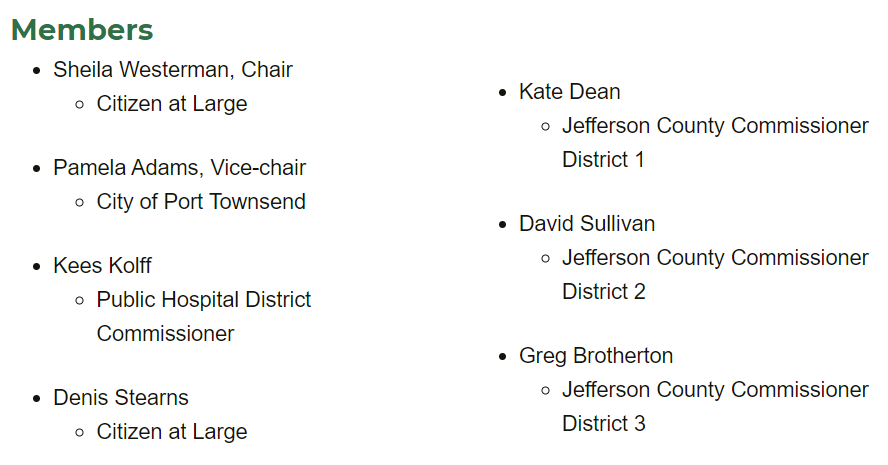
Jefferson County has a suicide rate far above the state average. Port Townsend’s suicide rate is staggering. The Jefferson County Board of Health has spent more time on climate change, nuclear disarmament and wordsmithing a resolution on “systemic racism’ than it has on a real public health crisis that is killing people, young and old.
Clallam County’s Board of Health and the community as a whole have done a lot to address their suicide crisis. It has been front and center in local discussions and programs for years. Clallam’s suicide rate dropped a third from 2018 to 2019.
Jefferson County’s suicide rate has not budged. This year the funerals for two young men who killed themselves, one only 13 years old, were held on the same September weekend. In recent weeks, four young people attempted to kill themselves and required hospitalization to save their lives.
The alarm bells should have been ringing long ago. Jefferson County has a suicide rate of 44 per 100,000 population. The statewide figure is 15.9. Jefferson County’s suicide crisis is far worse than neighboring Clallam County, where the suicide rate per 100,000 population for last year was 27, still bad, but not nearly as bad as our situation.
Jefferson County’s suicide rate has increased 42% since 2011.
In Clallam County, the suicides have been geographically dispersed. In Jefferson County they are concentrated heavily in Port Townsend. Eight of the 14 suicides for 2019 were inside city limits. That gives Port Townsend a suicide rate greater than 82 per 100,000 population, more than six times above the state’s grim metric, and three times worse than the states with the highest suicide rates nationwide.
Better Things to Do
In the past two years, the Jefferson County Board of Health has never had the county’s suicide crisis as an agenda item for any of its meetings. Not once has time been set aside to address the tragic deaths that make Jefferson County, and Port Townsend in particular, a dark place where despair, the nightmare of addiction, mental illness, and loneliness kill people.
Cynics say that local leaders suppress discussion of our social ills and their cost in lives because it would be bad for real estate sales. Word cannot get out that things are worse here than in Clallam County, supposedly the poor, economically depressed, lower-class poster child for addiction and suicide epidemics against which Jefferson County is frequently measured, but not honestly.
The truth is that none of the members of the Board of Health have demonstrated any interest in confronting our suicide crisis. Judging by how they use their time and staff resources, they just don’t seem to care.
But they do care about pet social justice issues.
Much time has been devoted to discussing climate change and whether it should be declared a climate emergency. Several Board members are climate activists. It has been an agenda item at a number of meetings in the last two years and the Public Health Officer has been instructed to use his limited time and resources on the subject–but not the suicide crisis.
Several times the Board of Health has visited the subject of increasing public acceptance of psychedelic drugs.
At their July 2019 meeting they discussed, debated and individually signed onto a resolution calling for the United States to adopt the 2017 Treaty on the Prohibition of Nuclear Weapons.
And, of course, hours have been consumed wrangling over the wording of a resolution declaring “systemic racism” to be a public health emergency in Jefferson County, though not one instance of racial discrimination has come before the Board.
After multiple redrafts and hours of debate, the resolution is still devoid of specifics. It fails to cite any measurable adverse health impact on even one individual of the “systemic racism” supposedly plaguing every aspect of our government, schools, and law enforcement agencies.
They actually started work on that resolution in February 2019, as young people were killing themselves or failing in their attempts all around them. They had previously tasked the Public Health Officer to do a literature search–not on preventing suicide–but on “looking at racism and bigotry as public health issues.” Quoting from the minutes of that meeting:
The Board had comments and questions on local actions to address bigotry, promoting community resilience through already established forums (such as the Community Health Improvement Plan), learning from the study of other detrimental conditions where abuse is passed from one generation to the next, exploring training programs offered by the Mandala Center for Change, mitigating risk factors, and moving towards a more compassionate society.
They’ve been on “systemic racism” for eighteen months.
An earlier draft of the “systemic racism” resolution contained the observation that Whites kill themselves at higher rates than other groups. Any mention of suicide was struck from the latest version.
by Jim Scarantino | Oct 16, 2020 | General
Only 4.5% of Washington’s emergency room hospitalizations were COVID related for the seven-day period ending October 14. As of October 14, only 18 people statewide with COVID-like symptoms were on ventilators.
You won’t get much detail on the state of the COVID outbreak in nightly television news updates. They only report new cases and deaths and total numbers, and always play up the drama. The old adage applies equally to COVID news as it does to other reporting: “If it bleeds, it leads.”
COVID has been a serious challenge, but never a dire situation for our hospitals, as we reported previously. There has never been an out-of-control COVID hospital crisis, despite what our Governor said as he toured the Army field hospital he ended up giving away. We have always had a surplus of hospital beds, even at the peak of the COVID case load in March, April, and May. The stress on our hospitals is even less now.
In this report we dig into the latest charts and tables from the Washington Department of Health.
The situation continues to get better. 2,169,192 Washingtonians have been tested for COVID as of 10/15/20. Total positive tests numbered 96,185. Deaths counted as a COVID death (and there are reasons to believe the figure is inflated) numbered 2,232, producing a mortality rate of 2.3%. This is much less than half of the death rate earlier this year, meaning that the daily death numbers have dropped so dramatically they are pulling the overall average down.
Six counties still report no deaths. Twenty-three counties report 10 or fewer, and thirty-one counties report fewer than 25 deaths connected or suspected of connection to COVID. As we reported previously, the concentration of COVID deaths continue to be limited geographically.
The distribution of deaths by age has not changed except by 1% during the entire COVID episode. 89% of all deaths continue to be among those older than 60 years, and 51% of all deaths are among those more than 80 years old. No one under twenty years of age has died from COVID. Unlike the flu, COVID is not killing children.
Hispanics have accounted for 40% of all positive tests, versus being 13% of the state’s population. No other ethnic or racial group has been so disproportionately infected. Whites, while comprising 68% of the population, have accounted for 48% of the positive cases. The reasons for these disparities remain largely speculative, but that has not stopped some activists from seizing upon them for political purposes.
By contrast, when it comes to deaths, all racial and ethnic groups closely match their percentage of the population. No group has suffered disproportionate mortality. Hispanics account for 14% of those deaths counted as a COVID-connected death, while their percentage of the population is 13%. Whites’ mortality percentage exactly matches their 68% of the population.
Overall, the survival rate for COVID patients is now nearly 100%, only dropping to 94.6% for those above age 70. That remains the best news of all.
The Economic Hit: Incredible Good News, But…
Jefferson County’s unemployment remains higher than the national average, down markedly from the first months of the Governor’s lock down order. Jefferson County unemployment stands at 8.8%, compared to the state average of 7.8% and the national average of 7.9%. Neighboring Clallam County’s unemployment comes in higher at 9.6%.
In May 2020, Jefferson County’s unemployment rate reached 16%.
A strong stock market, federal stimulus, and aggressive monetary policies have no doubt contributed to the historic snap back from grim economic measurements that were being compared to the Great Depression. The stock market gains in past months have no historic parallel. Small business confidence has returned to pre-COVID highs. We have recently seen the most new jobs ever created in the nation’s history in such a short period of time.
Sadly, the list of permanently closed businesses in Washington continues to grow. Downtown Seattle has seen hundreds of businesses announce permanent closures, a consequence not only of COVID restrictions, but also the Antifa/Black Lives Matter riots, escalating crime, the regulatory environment and problems from an uncontrolled homeless population.
The list of dead businesses elsewhere has also continued to grow. There is no official state count of closed businesses, but a Facebook page, Inslee’s List–The Dead Business Log, collects daily posts about dead businesses in communities across the state. The posts share owners’ sad statements about their decision to close, local newspaper articles on communities losing businesses or eyewitness accounts with photos of the closed businesses.
These business closures translate to fewer employers, and a redirection of commerce from small businesses to large corporations that were permitted to continue to operate under the the Governor’s orders. Amazon and Costco have seen record sales during past months while small businesses died.
Increased economic concentration may be a legacy of Governor’s Inslee’s actions. The destruction of small businesses could be a lasting structural obstacle to a complete recovery, as small businesses are primary job creators.
We are still far from that complete recovery. 2019 saw historically low unemployment in all demographics, with the lowest unemployment and highest labor participation rates on record for Black and Hispanic Americans, as well as women. The U.S. reached a 50-year low of 3.5% unemployment in September 2019. Washington’s unemployment rate for January 2020 was 3.9%, half of where it now stands.
by Jim Scarantino | Oct 14, 2020 | General
Sue Forde is running to represent the 24th Legislative District in the Washington House of Representatives. Forde (R) is challenging the incumbent Michael Chapman (D). We recently reported how Chapman’s campaign is funded almost entirely, more than 95%, by lobbyists and PACs from outside his district.
The 24th Legislative District covers Jefferson, Clallam and most of Grays Harbor Counties. Forde sat down with Steve Marble, former supervisor for the Clallam Conservation District, and currently a tugboat captain and Vice President of the North Olympic Farm Bureau, to answer questions for the Port Townsend Free Press.
Why are you running for State Representative?
Forde: I’m running because we need a change and balance in Olympia, to less overreaching government, fewer taxes, and common sense representation of the 24th District where we live, raise our families, and work — instead of the Seattle and I-5 corridor. Our current legislators, based on their voting records, and with a 70% increase in the budget since Governor Inslee took office, are advocates of taxing more, spending more and regulating more. This does not serve the people of our rural district well. I offer a different choice, toward taxing less, spending less, and streamlining government — representing the people of OUR district, not Seattle and the I-5 corridor.
What is the difference between you and your opponent?
Forde: For more than two decades, my opponent has worked in government positions, first as county commissioner and now as a state representative. Many folks I’ve spoken with say he’s lost touch with the common people. One example is his recent mailer claim of being “second to none” in “supporting small business”. Factually, he scored an “F” with the Washington Small Business Association (NFIB), and an “F” with the Association of Washington Business, based on his voting record. He also voted for a tax increase on small service businesses.
By contrast, I have worked in the private sector throughout my teenage and adult life and have a lot of “life” experience. I’ve taught at community college and at a private accredited high school; raised Saanan goats, played in a rock and roll band, and started up, owned, operated and sold several small successful businesses, including an escrow company, and a print shop. For the past 20 years, I’ve owned and operated a successful website design business. I understand what it’s like to meet payroll, hire employees and comply with the myriad of state-required regulations. Small business is the backbone of our nation and state, employing more than 80% of the workers. We need to help them recover from the shutdown for COVID.
I’ve also worked for large title insurance companies as an employee, a certified senior escrow officer, and as a branch manager. I understand young workers’ struggles to bring home sufficient pay to cover rent and food. As many of you have done, I worked hard to achieve the American dream, possible in our beloved country because of our constitutional, republican form of government protecting our freedom to strive for higher living standards, other success, and happiness. We are losing our freedom to improve our lives. It’s alarming to me to see how far adrift we have gone, away from these God-given freedoms toward a top-down, big government-dictated society.
My opponent has a different worldview. He promotes big government control over our lives. His record shows that he believes in increasing taxation, spending taxpayers’ money for all manner of government projects, and regulating our businesses and lives excessively, at a continuing loss of personal freedom. An example is the passage of the state-mandated comprehensive sex ed bill starting in kindergarten, as young as age five. Under this bill, passed party-line by Democrats, parents, local school boards and teachers would not have control over their children’s education. This bill needs to be repealed (Referendum 90 is on the ballot to do just that), and replaced with one where parents and local school boards will choose the program (Initiative 1109 is one such effort, with signatures being gathered now).
I believe that smaller government is best, and that government should encourage the free enterprise system to work the way it’s intended. Competition brings better service and products, while reducing the cost to the consumer. State government can be streamlined for better efficiency and lower costs.
What effect do you think defunding the police in Seattle will have on us here in our District?
Forde: There are multiple adverse effects to defunding our police. Regarding what’s happening in Seattle, we see not only people and businesses suffering from riots and destruction as police are required to withdraw, but an exodus from that city out to our rural areas where housing availability is entirely inadequate.
Many folks with whom I’ve spoken are also concerned about the increasing number of transients on our streets, and the potential crime increase in defunding the police. We should be safe in our homes and communities. Crimes should be prosecuted, and people have the right to bear arms for self-protection. My opponent has voted to impair Second Amendment rights with 13 different bills (as well as establishing a “Sanctuary State” – SB 5497), and our guaranteed rights under our State Constitution, Article 1, Section 24: “The right of the individual citizen to bear arms in defense of himself, or the state, shall not be impaired…”
We need to stand united to solve this problem – standing for our front-line protectors – our local police forces – and addressing the growing homeless situation.
With the COVID-19 shutdown, especially of small businesses, what are your thoughts about recovery?
Forde: Like a dictator, our governor has issued arbitrary, illogical, and unfair orders. He has picked winners and losers. He allowed big box stores to remain open and shut down small businesses. Government construction projects went full-steam ahead while private construction businesses were forced to close. Pot shops could open, while church congregations were not allowed to meet.
Additionally, our governor has refused to call a special legislative session so another branch of government could rightfully assist with a fair, constitutional solution and reduce destructive consequences to our economy, people, and our freedom.
I fault the Democrat majority in the legislature as well. For months, Republicans have been calling for a special session, but Democrats won’t join for the required two-thirds vote to convene. So, our representatives’ (and our) voices continue to go unheard at the legislative level.
Once allowed to reopen, there will be – and already have been – businesses closed forever. I’ve spoken with many of these small businesses’ owners who have poured their heart and soul into saving, planning, organizing, hiring employees, working to become successful, and providing their communities with goods and services.
For recovery, small businesses will require support. There are a variety of ways to do so – especially with tax reductions and/or forgiveness. Relaxing or eliminating costly and time-consuming regulations will allow business owners to focus on jobs and growth. Deregulation would enable entrepreneurs and their employees to concentrate on rebuilding business or starting new ones.
What are your main issues that you’d like to address?
Forde: (1) Getting our economy rolling again, bringing new businesses and good-paying jobs into our communities, and getting our children back into school.
(2) No more new taxes or tax increases, and reduction of property taxes, which will help lower the cost of living in your home, whether you own or rent. I will vote “no” on a state income tax, a pay-per-mile tax, higher gas taxes and more payroll taxes, all of which Democrats are talking about introducing in the next legislative session. Ten BILLION in NEW taxes were passed in 2019. In 2020, with a Two BILLION SURPLUS, Democrats chose to spend the “extra” money, instead of returning it to the people. My opponent voted for these.
(2) Safety and Security for our families, which includes supporting our first line of defense against crime, our police officers and our Second Amendment rights.
(3) Protection of our individual, constitutional rights, including faith, family, life, and freedom. This would include local control by parents and teachers.
(4) Education. I propose school choice, where the money follows the child for the best education, instead of a one-size-fits-all approach. This would include public school, private and Christian schools, vocational /technical schools, and homeschooling.
(5) Transparency and accountability in state government. When “title only” bills are used to write full bills without any public input, and passed sometimes in the dead of night, that’s not right. Our Constitution calls for a 10-day period in which there can be review and comment about proposed bills. This tactic circumvents it, and flies in the face of the people’s right to know. I will work to change that toward open and transparent, accountable government.
I will work hard to serve the people of the 24th District. I have not taken funding from special interests in Seattle; the huge majority of donations to my campaign are from small businesses and individuals within our District – the people I will be representing. My opponent, in contrast, has received the strong majority of his funding from the I-5 corridor, special interest and out of state, with a very small percentage coming from businesses and individuals within our District. Do you think he will be representing you, or them?
I’m asking for the support and vote of each voter who believes, as I do, that we need a positive change in Olympia, with a voice through a real “citizen” representative.