by Jim Scarantino | Dec 21, 2020 | General
Unimaginable horrors taught my grandfather the power of Christmas. Vincenzo Scarantino was 18 years old in 1915 when police swept through his remote Sicilian village rounding up conscripts to throw against Austrian fortifications. He spent the rest of his youth in muddy or frozen trenches in a war waged so Italy could seize the port city of Trieste.
A million men were killed or wounded where my grandfather fought. The fighting along the Austrian front was almost continuous for three years. The Eleventh Battle of the Isonzo alone cost 280,000 dead, wounded or missing. My grandfather was there.
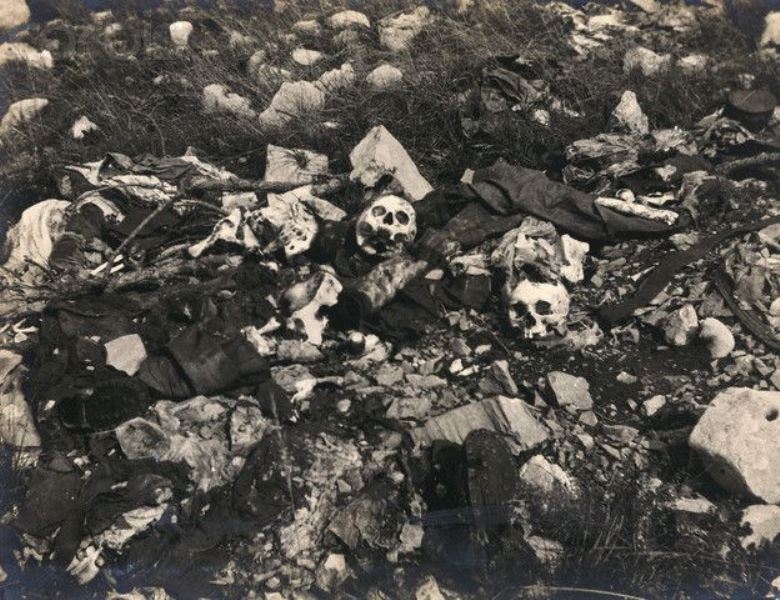
That photo above was taken during the war on the Carso Plateau, another place where my grandfather fought. My wife and I hiked the area and saw an exposed slope, ten stories high, where my grandfather’s battalion tried for years to take heights defended by machine guns and flame throwers. Trenches cut by hand into solid rock over a century ago are still up there. Rusted barbed wire will trip you. You can find air vents for bunkers under your feet. There’s a trail through the old battlefield marked with blood red paint splashed on limestone.
Mussolini built a memorial to the Isonzo’s war dead. He called it La Redipuglia. It cascades in massive concrete and marble steps down that ten-story slope. It holds the bones of over 100,000 soldiers, more than 60,000 of them unidentified.
Vincenzo told us once–my father translating to English from mountain Sicilian–of charging through smoke and artillery fire and noticing that the waves of men to his left and right had disappeared. Thinking he had fallen behind, he ran faster to catch up to the soldiers ahead. He discovered they were the remnants of another company. All the men he had started with had been mowed down by flanking fire.
My grandfather talked about being gassed. He had just enough time to fit a mask over his face. Slower reflexes and notoriously shoddy equipment doomed his comrades. Then the Austrians came. My grandfather pulled bodies of friends over himself. He held his breath as Austrians bayoneted his protective blanket of corpses.
He spoke of a lieutenant who always had a fancy cigarette holder between his teeth and was always eager to spend his men’s lives. This officer recklessly exposed himself above the earthworks. Waving his pistol, he demanded another headlong rush into machine gun fire. A sniper’s bullet knocked the cigarette holder–and the lieutenant’s teeth–out of his mouth. My grandfather smiled when he told that story. A single shot saved hundreds of lives that day.
Italian dead carpet an Isonzo battlefield after a failed attack
My grandfather said the world had gone crazy. He used the Sicilian word, “matto,” which translates roughly to “deranged” or “criminally insane.”
What some may view as the craziest incident in this meaningless war was the only thing that made any sense to my grandfather.
One Christmas day the guns fell silent.
Unlike the 1914 Christmas truce in France, no formal cease-fire had been negotiated on the Italian-Austrian front. Men just stopped killing each other. My grandfather and his buddies nervously crawled out of their trenches, then stood up and walked unarmed in No Man’s Land.
The soldiers of the Austro-Hungarian Empire also took the risk that Christmas morning. Adversaries met in the open. The Sicilians didn’t speak German, or Magyar, Czech, Serbian, Croat, Albanian, Slovenian or Polish. Many didn’t even speak Italian. But both sides knew the melodies of Christmas carols. Words in the languages of a polyglot empire matched lyrics that sounded more Arabic than Latin. Men raised their voices to celebrate an equally crazy idea, that God stepped into our deranged, broken world as a helpless baby and that His incarnation through human birth could mean the world’s peace and salvation.
The soldiers shared cigarettes. They embraced and wished each other well. As dusk fell they returned to their slits in the ground. The next day generals ordered them to get back to killing each other. The men had to fight. Italian officers enforced discipline with the Roman practice of decimation: They shot every tenth man in reluctant units.
That order to resume the killing may have done more damage to my grandfather than anything else he experienced in the war. Miraculously, he was never seriously physically injured. But I remember him in the middle of the night screaming, sweating, and shaking. My father saw the same things when he was a boy. He says my grandfather never got over being forced to kill men he had hours before embraced as his Christian brothers.
Vincenzo later worked in Pennsylvania’s coal mines. Men again died around him. He had survived bullets and bombs and phosgene gas, followed by cave-ins and fires, to be killed by tiny particles of coal dust in his lungs.
In helping me research my grandfather’s story, my father dug out Vincenzo’s Bible (in Italian, not a word of English). Between the pages of the Gospels telling us about Christ’s birth he found prescriptions for laudanum, a potent opiate once used to numb “shell shock,” what we now call post-traumatic stress disorder.
I’ve been wondering why my grandfather filed unused prescriptions in his Bible. I imagine him studying slips of paper promising temporary relief from the horrors in his head. Then I see him opening his Bible and tucking prescriptions he knew offered no real cure among pages telling an eternal story of hope arriving in a most unexpected form.
I like to think that my grandfather found peace among those worn pages, and in the memory of one sane moment in a world gone mad.
Merry Christmas. Peace on Earth. Or, as Vincenzo Scarantino would say, “Buon Natale!”
[Another version of this story, “Haunted by a Battlefield Christmas,” was published by The Albuquerque Journal, December 25, 2008.]
by Jim Scarantino | Dec 17, 2020 | General
Drugs, violence, crime, overdoses, chronic alcoholism, medical emergencies…and madness.
Port Townsend police generated over 250 pages of reports on calls to the Jefferson County Fairgrounds from March through October 2020. The incidents range from calls to help one of the homeless/transients at the sprawling encampment find their birth certificate to rescuing a man who stood intentionally in a bonfire he had set himself to breaking up fights and executing felony arrest warrants.
The reports were provided to Port Townsend Free Press by a neighbor of the Fairgrounds who had submitted their own public records request.
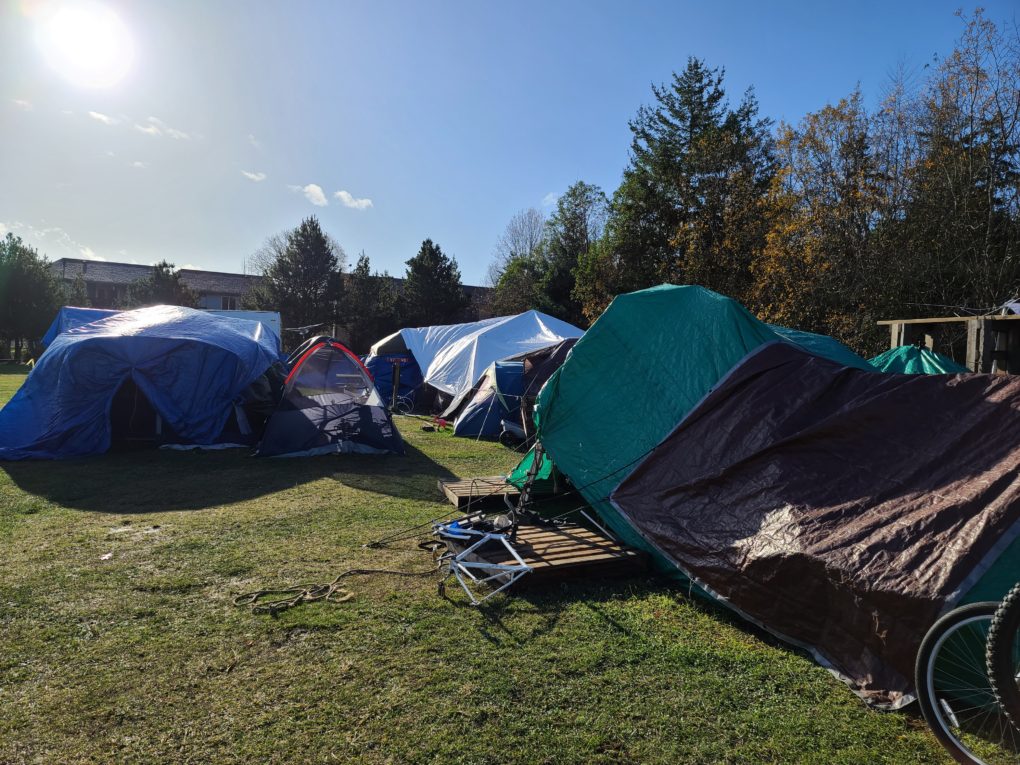
Recent tent additions creeping closer to apartments.
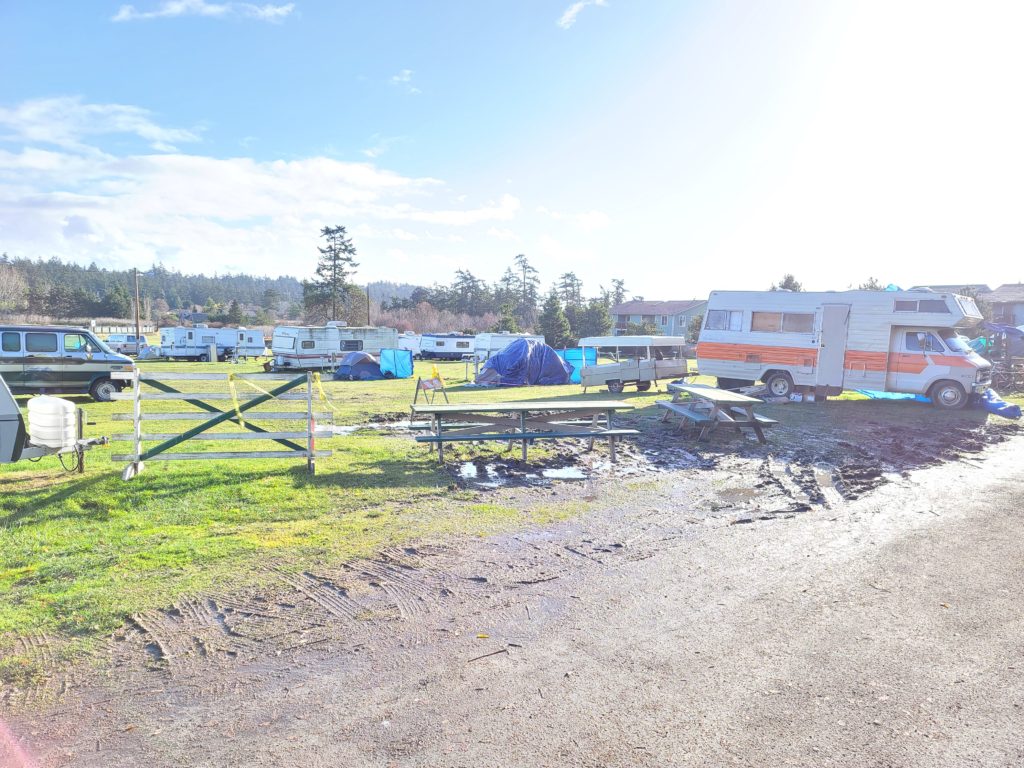
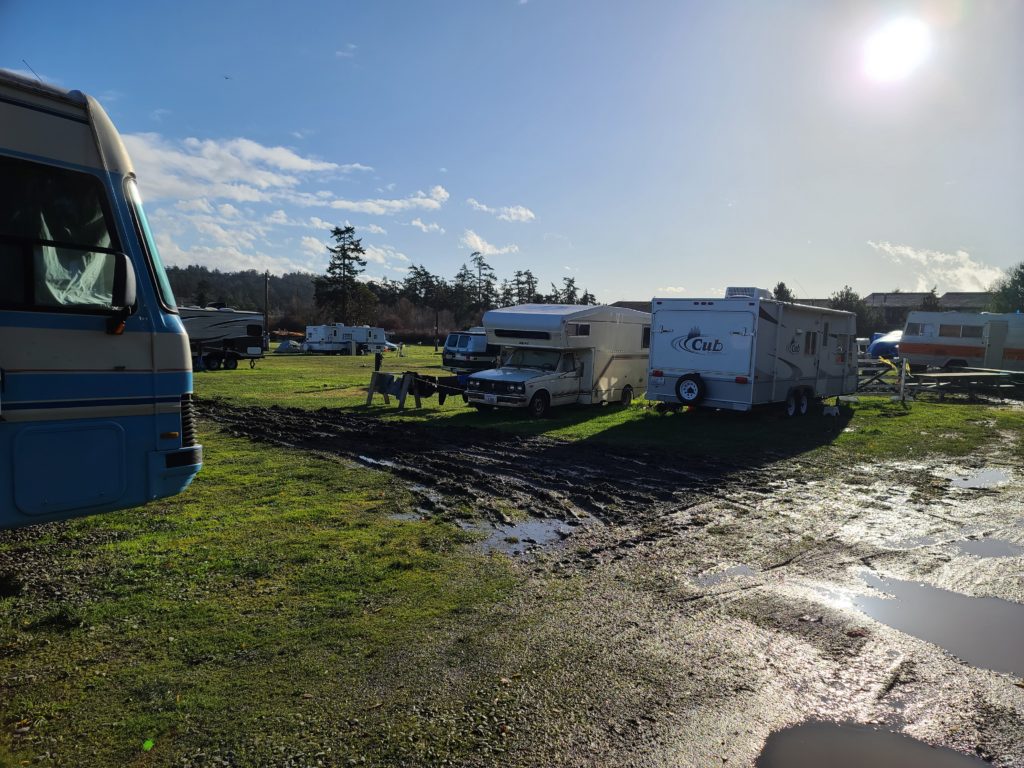
The encampment started early in the COVID days with people paying to stay in the campsites. When the shelter downtown closed and after people were moved out of the substitute shelter at the Oskar Ericsen building, the camp grew. When Governor Inslee prohibited evictions the camp grew even more. It has now at least doubled in size. None of the homeless/transients are paying for their campsite, use of the bathrooms and showers and SaniKan (which are cleaned at least daily for them by the Fairgrounds Association) or the electricity travelling through the extension cords snaking across the muddy field.
The exact number of people living in the encampment is undetermined as there is no requirement to check in. People just show up in ever larger numbers. Bayside Housing is bringing 35 dinners each night. This author estimates the number is far higher as the camp continues to grow and has birthed a satellite encampment on another section of the Fairgrounds.
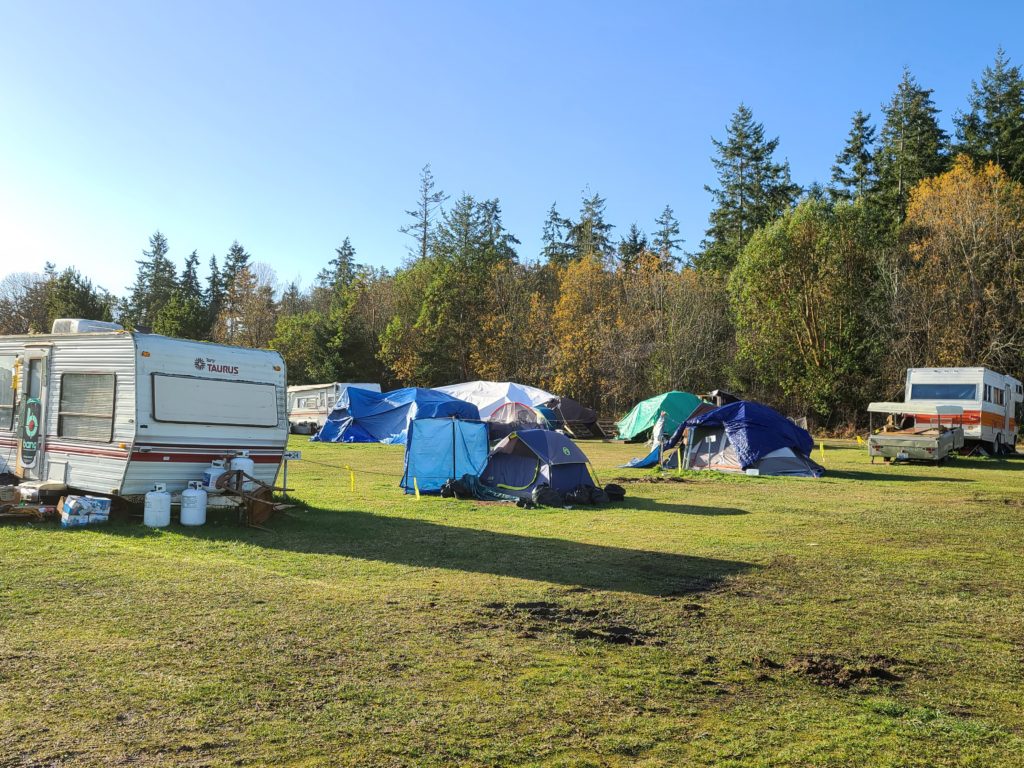
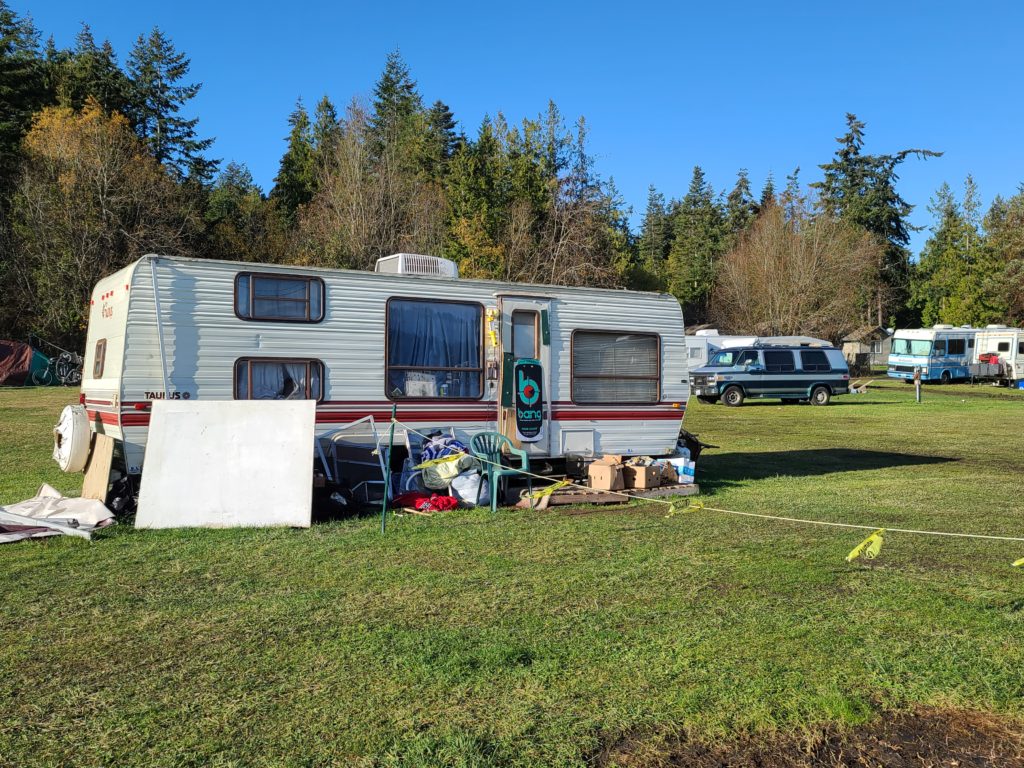
Partial view of encampment
One person there accounts for the largest number of incident reports. He is a danger to people in the neighborhood as well as others at the Fairgrounds. Some other names keep showing up in the reports. Some people have moved on, like the man airlifted to Harborview after an overdose. Many of the reports reveal multiple police officers and cars tied up at the Fairgrounds for hours at a time.
The problems requiring police response have continued beyond the cut-off for this batch of records. We reported on November 23 an incident where a neighbor was accosted before dawn at his house by the violent man mentioned in the preceding paragraph. On December 8, when this author was at the Fairgrounds, so were three police cars and an ambulance. There was a fight the weekend of December 11-12. And on December 14 three police cars were again at the fairgrounds as a fight broke out. Port Townsend Free Press will follow up this report after we receive police records for the remainder of 2020.
Following is a sample of what police have been dealing with.
Madness and Mental Illness
May 11: Mental health pickup. Subject offered resistance and started harming himself. Refused to exit patrol car and it took multiple officers to get him out and into the hospital. Police assisted in restraining him until sedated. The report states that this man “is gravely disabled. Unable to care for basic human needs.”
September 15: A resident of the apartments to the south of the Fairgrounds called 911 to report that someone in the camp had a bonfire with flames ten feet high. Something just exploded, the caller told the 911 operator. And a man was standing in the fire. When police arrived they saw a man building the fire larger and then stepping into the flames. Officers pulled him out and called for an ambulance. The man was “very elevated,” an officer reported.
October 27: The camp manager called police to report that a woman he had not seen before was in the bathroom and refusing to leave. She had been in the shower for 2 to 3 hours. She was in there screaming. When police contacted her she again refused to get out of the shower. She told them she “had to get rid of mites” and that she had been waiting for someone to bring her a towel. Officers observed that she was bitten all over her body. They got her out of the shower but she refused all other aid. They helped her back to her van and told her she could be trespassed (barred from the campground) if she repeated that conduct. They called the Department’s Navigator on her behalf in hopes maybe he could get her some help.
October 16: A resident near the Fairgrounds saw a man, known to police from many encounters at the Fairgrounds, attempting to conceal himself in bushes off the Fairgrounds and videotaping him. Later, while walking Cappy’s Trails the same man emerged and followed him. The resident told police he was very concerned for his safety.
October 21: A neighbor outside the Fairgrounds called to report that she had been followed on a walk by a man who previously had been at their house yelling at her husband to “stop putting things on the Internet.” When she encountered him on a trail he started yelling at her. She told police she was scared for her life. (This is the same man in the October 16 incident. This man generated around two dozen police responses, including his own complaints of being under attack and having items stolen. This is the same man who confronted a neighbor blocks away at 6 a.m. in that neighbor’s own yard, claiming that he lived there. See our 11/23/20 report, “Fairgrounds’ Neighbor’s Plea to County Commissioners About Dangers From The Homeless Encampment.”)
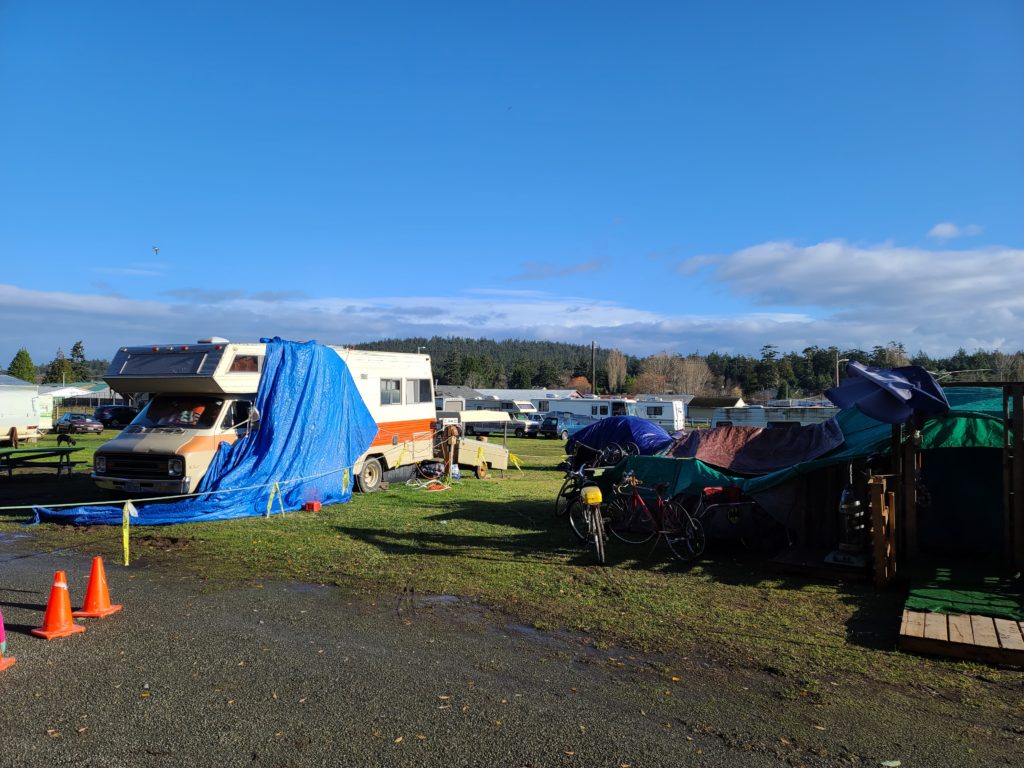
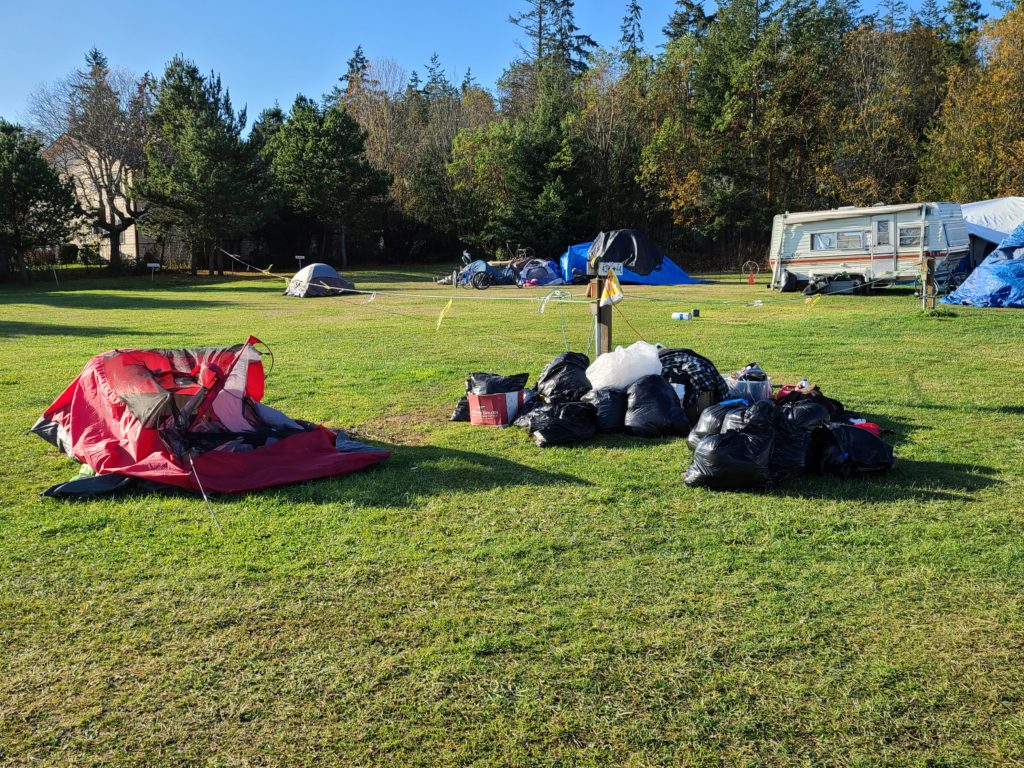
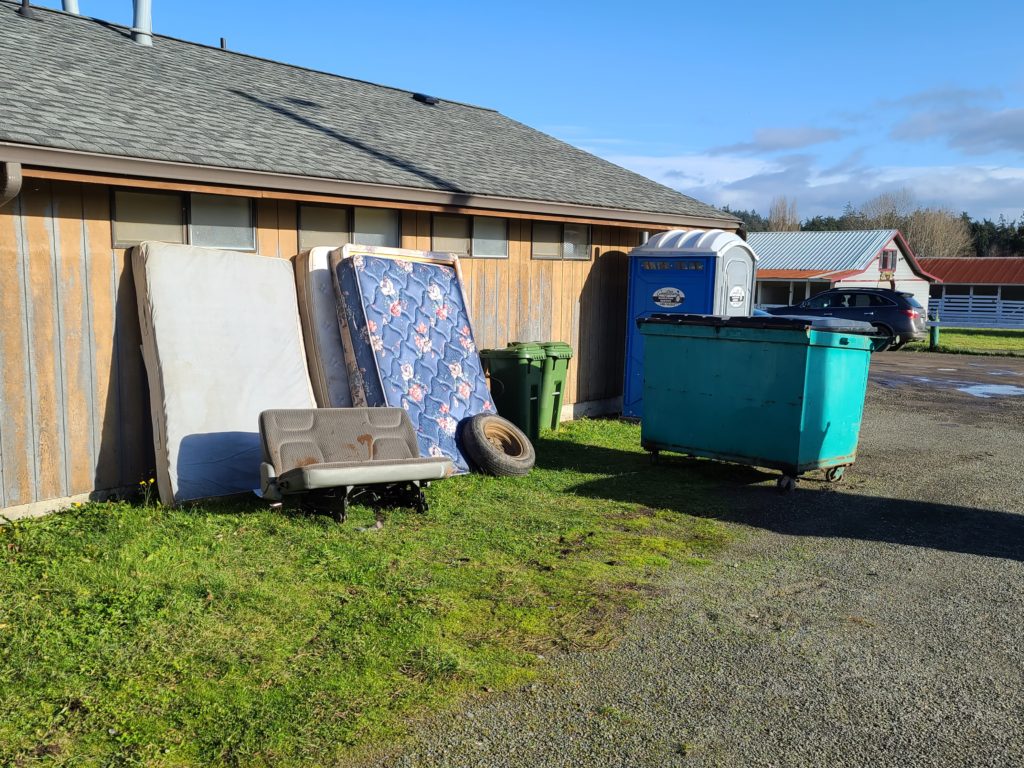
Ruined tent, abandoned mattress and trash in center of camp
May 19: Police contacted a man who claimed “there were people around who would not let him out of his tent.” No one was seen around his tent. He complained there were people chasing him and “out to kill him.” This happened whenever he drank alcohol. In this case he imagined two men attacking him after drinking, he said, only two tall beers. He had made other calls to police about people out to kill him, all of which had been found to be baseless. “At this point,” an officer wrote, “his fear of people trying to kill him, along with a large fixed blade he carries, makes me concerned that he may mistake an innocent person for an assailant and attack them.” This man had an open therapeutic court warrant but due to COVID restrictions the jail would not take him. “At this point there is little we can do,” the officer concluded. (This man may have left the camp. He does not reappear in subsequent reports.)
Violence and Crime
May 11: Neighbor called about hearing yelling, screaming, sounds of fighting. “They are going to kill each other.” Police responded. One man had invaded another’s tent, they fought and tent was damaged. “________ is getting more out of control and will eventually have to be placed in jail or put on a mental hold,” an officer wrote.
May 20: Police assisted “community partner” in collecting belongings of man arrested that day at Penny Saver.
May 21: Man assaulted female camper and was arrested. While in back of patrol car he started self-harming, banging his head as he was being transported to jail.
June 2: Man “trespassed” (banned) from Fairgrounds for committing assault.
June 3: Neighbor who walks the area reported seeing stripped bicycle parts every day, and people from the campground walking around “carrying sticks.” He feared for his safety and asked if he could open carry a handgun for personal protection. He requested police presence and patrols. (In our 10/29/20 “Transient/Homeless Village Grows at Fairgrounds,” according to the campground manager, 50-100 bikes have appeared at the Fairgrounds. Some get thrown in the dumpster.)
June 18: Officer tracked down stolen phone to man in encampment.
June 22: Check fraud reported, but victim grew belligerent toward officer, calling him “fascist” and refused help.
June 23: Two individuals wanted on felony warrants had been at campground but had left when police arrived.
October 15: The same man in the October 17 and 21 incidents, lunged at a man in the Fairgrounds bathroom and told him “you’re lucky I didn’t kill you.” The aggressive man had previously spit on this man.
October 19: This same man got in an argument with a person who lives near the Fairgrounds, and later punched him as he was walking his dog.
May 9: Police were called in response to fighting between men. An officer observed flies on one man’s sock, and that his ankle was swollen and oozing liquid. The foot was gangrenous. Though the man did not want help, the officer had him transported to the hospital.
September 7: Police were called with report of a woman beating up a man. She had fled by the time they arrived. The male victim gave a fake name and produced false identification, but was correctly identified and found to be wanted on a felony warrant. He was taken into custody.
September 10: Two men were fighting against one man over a camping space.
August 21: A neighbor called 911 to report sounds of fighting and screaming.
August 19: A neighbor called, hearing sounds of fighting and yelling, things being thrown. Police arrived and found there had been a conflict over placement of a bike.
August 14: Someone invaded a woman’s tent and threw her out.
July 21: Caller reported a car chasing another car through the Fairgrounds at a high rate of speed and a collision. The camp manager reported that those involved were new to the camp.
July 3: Neighbor called to report clearly hearing a gun shot from inside the Fairgrounds.
August 31: Squatters had moved into an abandoned trailer. One was heard bragging about breaking into a vegetable stand pay box. [A letter read aloud at a County Commissioners meeting was from the owner of the vegetable stand who reported the theft and other problems with people from the Fairgrounds encampment].
August 31: Fairgrounds Association pay box broken into. $300-$400 stolen and the box had to be replaced.
September 29: Women’s purse with her medications stolen from her pickup truck.
Drugs and Alcohol
June 8: Fairgrounds called about a woman parked in prohibited area. Officer found her sleeping in a car in middle of day, with syringe on ground by driver’s door.
June 15: “Extremely” drunk habitual drinker, being belligerent, staggering, resisting police. Had been kicked out of the homeless shelter.
June 17: Habitual drinker from campground drove to nearby house and was in driveway. Extremely drunk. Had urinated on himself. He resisted arrest and fought police, injuring the arresting officer.
July 6: Apparent overdose. Man found in car “unresponsive and catatonic, had very strong, rapid pulse but shallow breathing.” Life Flight called for air lift. Anti-overdose injection given [exact substance redacted in records released]. No effect noted as the officer grew more concerned. As officer was getting ready for next injection, the man came around. Transported for medical attention.
July 22: Man under influence of drugs or alcohol in distress, vomiting, choking. Other campers were irate and yelling at police. CPR administered. Life Flight called for air lift but could not fly due to weather. Police turned him over to medics.
August 24: Paying camper who stayed two nights called police to report seeing “a lot” of drug activity at two specific camping spaces. One person was serving as a look out while the other did business. She also reported hearing “suspicious communications about taking over the place.”
September 22: Neighbor reported syringe on ground just outside Fairgrounds. Retrieved by officer.
October 21: Known habitual drinker found passed out on track. Could not be wakened. “In his usual intoxicated state,” wrote officer. Left him with water and Gatorade.
Other Incidents
March 9: A trailer was fully engulfed in fire, but the flames were suppressed before a propane tank exploded. The occupant, wheelchair bound, had been rescued by neighbor who heard him shouting for help and then moved his own RV before it caught fire. Report does not state cause of fire, but a later report has police looking for a resident of the campground who was seen outside at the burned trailer immediately before it ignited. [Fairgrounds Association incurred a charge of $5,000 to have the burned trailer removed.]
May 27: Man banging cans, acting crazy and throwing garbage into street.
May 30: Campground called police about woman observed with with facial sores. Officer reports she had “a massive infection in her chin the size of a golf ball” and needed medical treatment.
In addition to what is covered by date here, over the period of seven months neighbors made frequent calls about hearing sounds of fighting, screaming, loud music and “sex noises.” Police made numerous calls simply to serve the mentally ill as substitute case workers, to get them to their camp and off the street, look for a lost wallet or birth certificate, to calm them, to check on their welfare and provide some kind of medical service, such as getting them inhalers or an Epipen to counteract a bee sting. Police also made a point of frequently conducting vehicle and foot patrols.
New arrivals at Fairgrounds encampment 12/16/20
The Word Is Out
I have reported here and at the Port Townsend Free Press Facebook page how the camp has continued to grow as people from outside our community have gotten word that they can stay there for free, get a free hot meal, free showers and bathroom facilities (with janitorial service), and free electricity and not be hassled about squatting. The word is out, as confirmed by a call the police received from a transient who has moved to Port Townsend from outside the area. He called the Department saying he had “heard about a new kind of homeless encampment at the Fairgrounds and would like to know all about it.”
The man wanting to learn “all about” the “new kind of homeless encampment at the Fairgrounds” was one of the individuals police stopped from beating a man to death in Kah Tai Park. We wrote about that incident in “A Bloody Afternoon in Kah Tai Park.” He has an extensive criminal record here and elsewhere.
Related: “Lines Form in Battle for Future of Fairgrounds,” PTFP, 9/9/2020
“A Grim Existence at the Fairgrounds,” PTFP, 12/9/2020
“Squatters Camp Grows at Fairgrounds,” PTFP, 12/1/2020
by Jim Scarantino | Dec 9, 2020 | General
Mud and cold rain. Life in an always damp tent or unheated RV. Puddles for a front porch. No place to hide from the wind, or escape the sounds of fighting, incoherent muttering, screaming and partying in the growing squatters camp at the Jefferson County Fairgrounds.
Drawn by a free place to camp with bathrooms and free food, and no hassles to move along, people from outside the county are coming. In three visits this week I saw newcomers every day. The camp has more than doubled since September. There is now a satellite camp to the Northeast of the main encampment.
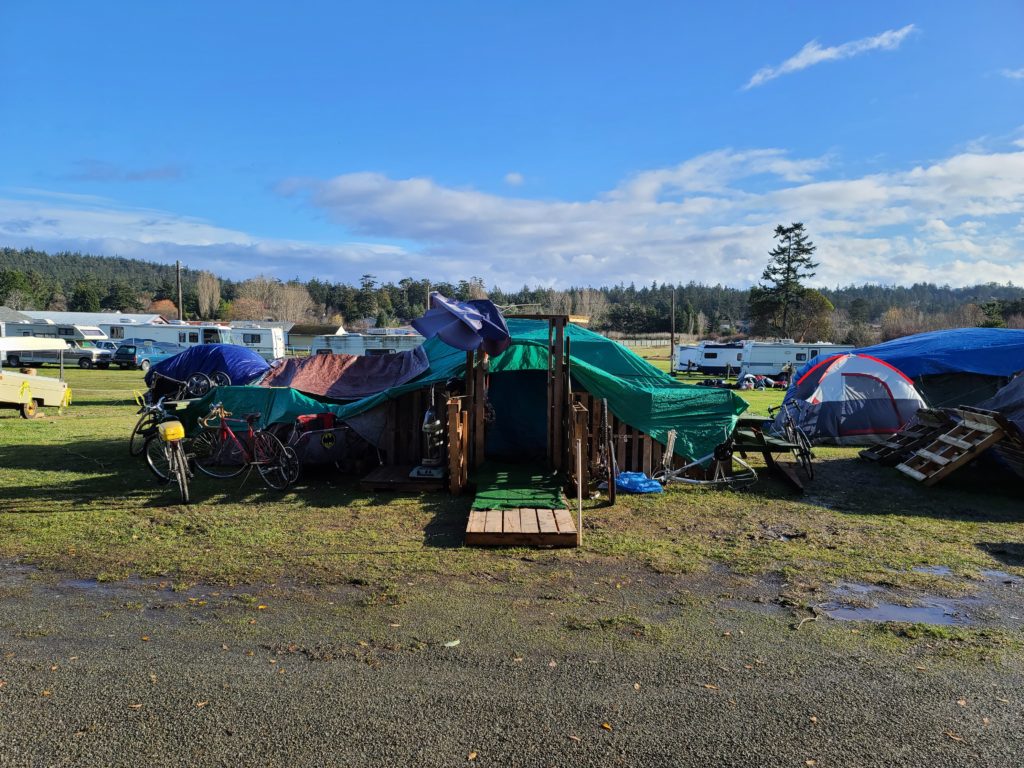
Some of these shelters are improved tent sites, with rain tarps covering several smaller tents inside. Some tents have wooden entrances and sides fashioned from pallets or picnic tables. Some have wooden furniture inside. And some are just cheap pup tents sagging with rainwater or collapsed by wind in the boggy, rutted field.
The people living here share bathrooms and a SaniKan. The bathrooms are frequently trashed, with piles of human feces on the floor to be cleaned up by the woman who tends the facilities for the Fairgrounds Association. So to keep this from happening bathrooms get locked at night and people must use the SaniKan, which then gets smeared with feces. Camp staff say they’ve heard people laughing about this disgusting form of vandalism.
The Fairgrounds Association is providing these facilities so people don’t defecate in the fields or in buckets in their tents. Whoever is ruining the bathrooms is ruining them for everyone else and making life miserable for camp staff.
Neighbors have complained of people from the Fairgrounds defecating in their front yards and driveways. That has occurred despite the availability of the Fairgrounds’ facilities.
Yet, there are a couple people in the camp who are holding down jobs, who don’t suffer from mental illness, who are not chronic drinkers or addicts. I spoke with one of them on his way to the bathroom in the morning. “It’s hard,” he said, and wanted it known that not everyone here is causing problems.
Only two people out of maybe more than 100 are paying, though a significant number have incomes. They have decided to exploit the Governor’s COVID moratorium on evictions to get a free place to stay with hot water and bathrooms and garbage pickup. The Governor’s moratorium expires at the end of December. The chances that this camp will be empty after that are slim to none. These people are settling in and building a village of sorts. They will also likely receive support from politically connected non-profits who can be counted on to oppose any effort to evict them and restore the Fairgrounds to what it was.
Two PTPD cruisers at squatters camp, 12/8/20
A few have left. A van was abandoned in the middle of the camp. One woman is now wandering the streets downtown. But more and more keep coming and the camp keeps growing.
Police are out there several times a week, sometimes multiple times each day. Neighbors report seeing ambulances coming and going frequently. There have been fights. At least one man was arrested. He’s back after spending only a night or two in jail.
Port Townsend Free Press has previously reported on the crimes and sense of insecurity spreading into the neighborhood. A persistent problem has been the theft of mail from mailboxes. Stolen mail has been found on the foot paths in the area. A woman who lives across the street who has had her mail stolen several times says she spent a couple hundred dollars to purchase and install a locked mailbox.
When I was there on a cold and rainy December 8, the Dove House drug and alcohol outreach worker was present. They have someone at the camp Tuesdays and Thursdays. OlyCap has two brothers who spend the night and someone during the day to provide some sort of security, though they have no authority over anyone, and there are no rules to be enforced. Bayside Housing is delivering one meal a day. Hot Thanksgiving dinners were delivered by the folks who do the holiday meals at the Tri-Area Community Center.
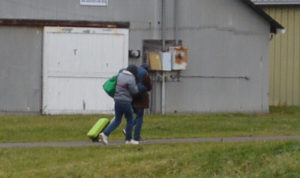
On this day a Port Townsend police officer and the Department’s navigator were dealing with a very drunk woman. Another police car had pulled up one of the muddy tracks and that officer was talking with other campers. The poor drunk woman couldn’t be helped. She collapsed several times on the ground as she staggered around the camp. I believe this woman was identified in a Peninsula Daily News story as also suffering bi-polar disorder. She appeared to be the same woman in the photograph.
There are people here who are getting no help, anywhere. Judson Haynes, the Port Townsend Police Navigator–their social worker–says most offers of help are refused.
As it is, we can’t do much to help them. Port Townsend does not have much in the way of in-patent mental health facilities. We don’t have any detox facilities that can handle the crushing need we already had before this camp started attracting people from outside the community. As this camp grows, and the problems mount, our community’s inadequacy to serve and help the mentally ill and addicts will inevitably generate more severe problems. Already there have been multiple overdoses at the camp. I saw heavy drinking in the middle of the day on one visit. The camp manager says he sees drug and alcohol use all the time. A neighbor reported to us a loud party over this past weekend in the large complex of tents that drew people who were not living in the camp. A Port Townsend Free Press contributor who knows a couple people in the camp believes drug dealing is being done out of at least one of the RVs and he has been offered stolen property in exchange for cash.
Neighbors have reported seeing discarded needles and that children have encountered people shooting up on the trails. Another neighbor reports to us that he has observed a drone hovering over the campground. Private drones are prohibited; this may be a police surveillance drone.
A man in a high quality RV is living here, and paying his way, while he works on his boat (his RV is next to police cars and between squatters’ RVs in the photo above). Another tent has people who fell through the cracks of the mental health system and have nowhere to go. I met a man who claimed he was a talented mechanic and was looking for work (he said had a retirement income, but also was squatting).
Port Townsend’s homeless are a diverse group. Most of them are suffering from mental health problems and/or addiction, with a lesser number being “Bohemians” who choose this lifestyle, criminals with open warrants and, last, those suffering economic catastrophe or escaping abuse. These latter two groups are not part of the chronically homeless, but the people most receptive to accepting help and getting back on their feet. See “Knowing ‘The Homeless'”, PTFP 8/24/2018.
As I was leaving, a third Port Townsend police car turned into the entrance as a cold, wet night fell on the sprawling squatters camp in the muddy fields of the Jefferson County Fairgrounds. Hours later, while finishing this story, a neighbor across the street reported seeing another ambulance heading for the tents.
Related: “Squatters Camp Grows at Fairgrounds: Photo Essay,” PTFP 12/1/2020
“Fairgrounds Neighbor’s Plea to County Commissioners about Dangers from Homeless Encampment,” PTFP 11/23/2020
“Transient/Homeless Camp Grows at Fairgrounds,” PTFP 10/29/2020
“Lines Form in Battle for Future of Fairgrounds,” PTFP 9/9/2020
by Craig Durgan | Dec 8, 2020 | General
We have all heard of Trickle Down Economics. But, there is another concept called “Trickle Up Poverty.” In Trickle Down Economics the concept is that the rich and/or the government basically spend or invest their money. That in turn allows development to occur where people get employed. Thus the money trickles down to others. But, what is Trickle Up Poverty? That is where there is no investment by the rich or the government and no jobs created. Poverty, which is a creation of the government, becomes more prevalent.
Of course, there is a glass ceiling to Trickle Up Poverty. Heaven forbid that the Elite should suffer in poverty. So, where is trickle up poverty practiced? Plenty of places–North Korea, Venezuela, and the United States of America. Socialism is a good example of Trickle Up Poverty. Everyone suffers together, except for the few at the top.
What? This could not happen in this country, no way we would do that!!! But it is happening right here in Jefferson County. Yes, right here.
Why would anyone want to promote poverty? Simple, it drives out the lower classes of people. Take any place here in Jefferson County and gentrify it. What do you get? Higher property values that translate to higher revenue for government and more income for the few that can afford to buy out the poor. It is happening right now. People with money are moving in and buying out those that either die, want out of the socialist mecca in process or are forced to leave due to no jobs and unaffordable taxes. The policies imposed on the county by the elite are having the intended effect of making Jefferson County the very sort of Carmel North, Aspen-by-the-Sea and Martha’s Vineyard West those same elites constantly doth protest too much.
Look at what they’ve done with the power they’ve had for two decades. That says it all.
Trickle Up Poverty is not new. It has been practiced in many parts of our country. Typically, the elite and the politicians they control create a dying economic model, usually by restricting property development. Once the local people have no jobs they are forced out and their property becomes available to gentrify. At one time, back as far as the 60s, Port Townsend was a working town where the working class stood a chance at upward mobility and better lives for their children. No longer. In fact, given enough time the last remaining larger employer, the pulp mill, will likely be forced out. Then the cycle will be complete.
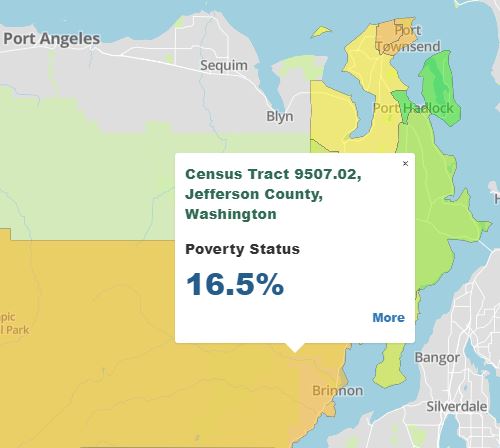
[Editor’s Note: According to the Economic Research branch of the St. Louis Federal Reserve Bank, the overall poverty rate in Jefferson County climbed more than 10% between 2016 and 2018, to 13.3%. That is 33% higher than Washington’s statewide poverty rate. The overall poverty rate hides an even uglier story. The census tract for Port Townsend has a poverty rate of 16.2%. The census tract for the southern and western county has a poverty rate of 16.5%. These figures come from the Census Bureau’s latest American Community Survey The poverty rate for the areas immediately south and west of Port Townsend and around Discovery Bay stands at 14.3%. The considerable wealth of households on Marrowstone Island and in Port Ludlow pulled those census tracts down to 7.8% and 10.9%, respectively. The extreme poverty in Irondale and pockets of the Tri-Cities was masked by the extreme wealth a few miles west on Marrowstone Island. Likewise, the surprisingly high poverty rate within Port Townsend city limits, with its million dollar homes and exclusive neighborhoods on Morgan Hill and near Fort Worden, reveals the severe economic divide in our community. Lastly, the Census Bureau’s latest employment data shows the job base for Jefferson County shrinking, not growing while at the same time the cost of housing continues to increase.]
by Jim Scarantino | Dec 6, 2020 | General
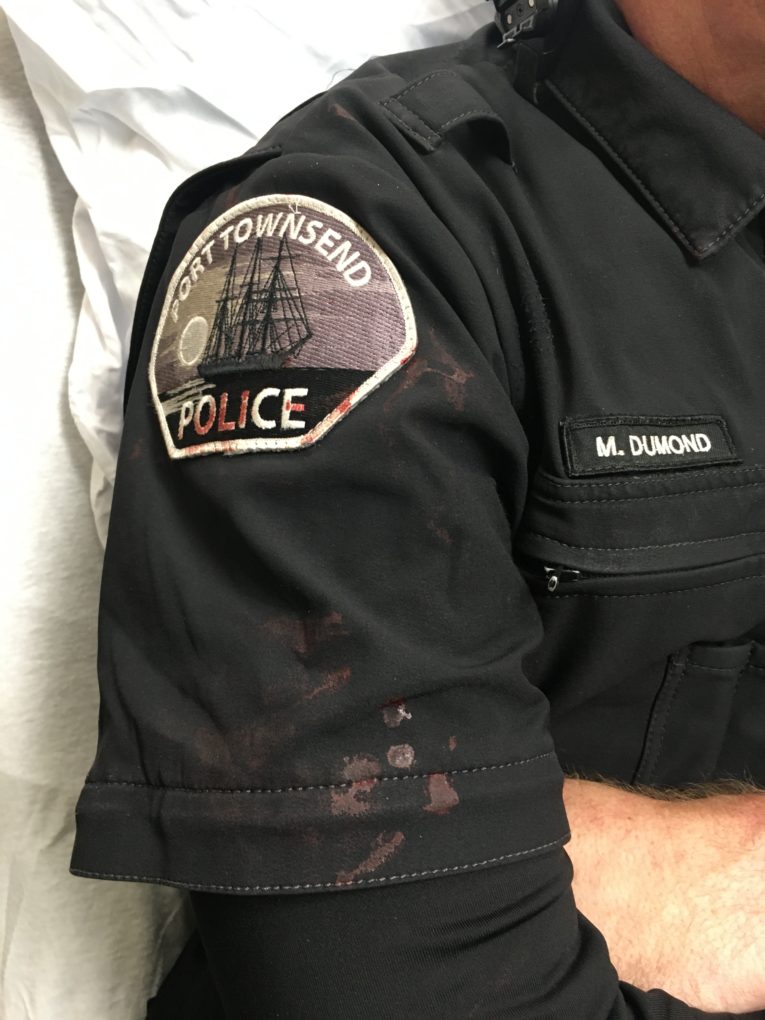
Violence ended the career of Port Townsend Police Officer Mark DuMond. After sustaining severe head injuries preventing an assault that could have killed a Jefferson Healthcare nurse he was never able to resume his full duties.
DuMond knew the man who injured him. All the police and Sheriff’s deputies know Jamie Beal. An Officer Safety Advisory is added to every dispatch when he is involved. In an altercation with around seven officers he dealt out punishment and lifted men, two at a time, with all their gear–well over 600 pounds in total–completely off their feet. He weighs about 250 pounds, is massively built, and likes to fight. He has mixed martial arts and jui jitsu training. He says he has been a cage fighter and combat veteran. He knows how to use his hands and his fantastic strength to hurt other people.
Before that incident he had attacked a person for no reason right in front of several Jefferson County Sheriff’s deputies just outside the Sheriff’s Offices. It took a bunch of them to subdue him. A bunch of them were left seriously injured.
But this powerful, dangerous man can also be a sweet, caring person…when he’s medicated.
On the night of March 26, 2020 his meds weren’t working. He knew he needed help and walked to Jefferson Healthcare where he was well known. Police were called. The pills medical staff gave him didn’t work. Actually, it was Officer DuMond who handed them over because nurses were too scared to get close. Two hours of de-escalation didn’t work and the violence officers knew was coming erupted. It took Dumond and five other officers giving everything they had–including DuMond’s career and physical well-being–to stop the attack on a nurse and protect themselves from a man huffing and roaring like a charging grizzly bear and swearing he was going to kill them, “weak pieces of shit” that they were.
What happened that night should be a lesson to the Port Townsend City Council and everyone who thinks police officers can be replaced with social workers. With one less officer, the officers may not have been able to restrain this man before he caused more injuries. A single officer, even a pair of officers, would have needed to use their firearms to stop him. If it had been a social worker confronted with this situation, there likely would have been at least one murder in the Jefferson Healthcare ER that night.
Just last week a social worker was stabbed to death by a client in Seattle. Several years ago Marty Smith, a social worker who had worked in Port Townsend, was beaten senseless by a man he was trying to have committed. The client then got a knife and proceeded to stab Smith to death.
In its meetings as the Ad Hoc Committee on Law Enforcement and Public Safety, the City Council has considered only ideological and ivory tower stuff–statistics, tables of data, generalized reports, program reviews. It has not drilled down into what police officers face every day and night. It has not examined a single case study of any of the gross number of “mental health” incidents reported to it each week by the City Manager.
This incident is by no means an outlier. This man is exceptional for his fighting ability, but not unique. You don’t need to search the archives of the Port Townsend Leader or The Peninsula Daily News very long to find other incidents of police officers being attacked and injured. Every officer and deputy I have met, from leadership down, has suffered some injury. They don’t volunteer the information. They’re like Officer DuMond on the night of March 26, barely able to stand, slipping in and out of consciousness, blood pouring from his mouth and nose, assuring everyone he was alright.
There is something simplistic in way the City Council has been considering the work of police. An air of naivete hangs over their discussions as they presume to “reimagine” the work of law enforcement to suit a perfectly peaceful and crime-free community that does not exist, here or anywhere.
This case is an antidote to that naivete. The following narrative is compiled from police records and the sights and sounds captured by body recorders.
.
Just Another Mental Health Incident
Jame Beal of Port Townsend, age 31, was anxious about his medications. He’d been in and out of Jefferson Healthcare that week with his concerns. He didn’t trust his meds. Were animals used to make them? Where were they made? Why wasn’t he feeling right? Maybe he was hurting his daughter by taking his meds.
He had been seen pacing downtown in an agitated state of mind, but had not yet reached the point of violence with which local law enforcement had become familiar. Family members and mental health professionals warned he was “cycling up” to violence. It was only a matter of time.
Around midnight on March 26 Beal walked into the ER. Immediately hospital security was alerted, and just as quickly a call went out to police. Beal pushed and shoved staff. The hospital needed law enforcement help. As soon as Beal was identified by name, law enforcement knew it would take a good number of officers to handle the situation. In addition to Port Townsend police, the Jefferson County Sheriff and Washington State Patrol responded. Five officers gathered outside the room where Officer DuMond was talking to Beal.
DuMond was worried. Beal was in a room that had not been cleared. He saw multiple items that could be used as weapons. Nurses would not enter the room. They were scared and spoke to Beal only over the shoulders of the officers who formed a protective cordon in the hallway. It was determined that injecting Beal was too dangerous. DuMond persuaded him to accept a pill or two (the exact dosage and medication was redacted from the records obtained by Port Townsend Free Press). Beal, once assured that the medicine was plant-based and made in North America, seemed to welcome the prospect of feeling better and spoke of hoping that meds started working. But DuMond remained worried about being in the room with Beal and asked JCSO Sergeant Shane Stevenson to stay close in case an attack came, an attack DuMond would have no hope of fending off alone.
The medication had no effect. For nearly two hours officers tried to calm Beal, but his body language and eye movements showed he was becoming increasingly agitated. He occasionally exploded with profanity then switched over to talking nicely with DuMond, who was filling the role of law enforcement officer, medical ombudsman, mental health counselor, family counselor, friend and social worker. They talked through all of Beal’s many problems and delusions, such as people in video games being real and actually being killed. DuMond was the go-between for Beal and his physician. The other officers helped when DuMond had to leave to talk to hospital personnel. He was trying to get a formal commitment order so Beal could be detained. That formal order never came, though hospital staff said Beal should be committed. Reportedly one doctor told police, “He’s going to kill someone.” But the officers never received the legal go-ahead required before they could formally detain Mr. Beal for his protection, and the protection of everyone nearby.
Beal invited officers to fight–“to roll.” He talked of when it would be acceptable to kill someone. He cursed an officer for accepting a bottle of water from a nurse. He would not drink water unless one of the nurses shouted to him that she consented. He said “I’m here for the women,” and didn’t like it that the female nurses were attending to other patients.
Beal slowly worked his way into the hallway where the officers had been standing for nearly two hours. His thoughts turned dark. He spoke of serving Satan and how evil had a purpose and mocked deputies for worshipping “something dead.”
Officer DuMond communicated to Sgt. Stevenson his increasing concern. He hoped to get Beal seated again, perhaps laying back on a bed so he could be more easily restrained when they could make that move. Suddenly Beal pushed into the nurses working area. “Buddy, where are you going?” DuMond asked and all hell broke loose. “No, no, no!” DuMond shouted. And though they knew Beal’s power and his ability to kill any one of them with his bare hands, none of the officers now hesitated.
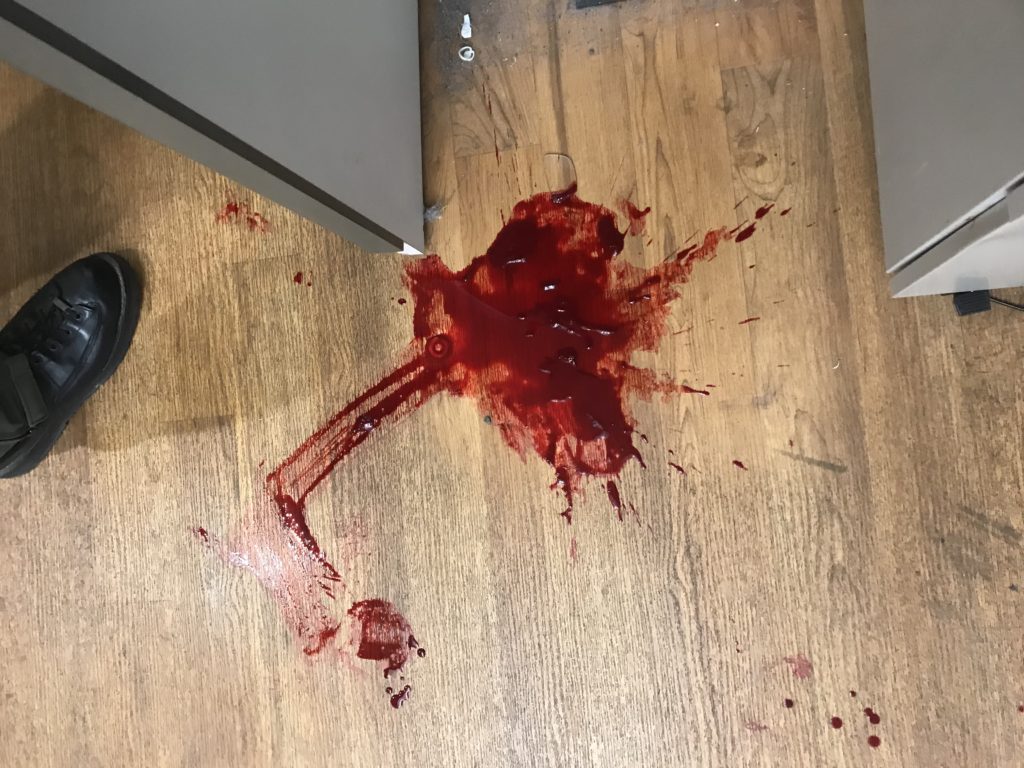
Beal grabbed a male nurse and swung to strike a blow, but thankfully did not connect as DuMond grabbed him. The next punch was for DuMond and it landed solidly on his face, snapping his head and upper body back violently. DuMond crumpled to his knees and may have lost consciousness (he had to watch video later to remember what happened after the blow to his head). Even then he held onto Beal as other officers brought Beal to the floor. Beal landed hard and the back of his head was cut. But nothing seemed to dampen his fury. Beal tried to break DuMond’s fingers then grabbed his face with his huge hand, while struggling to gouge out DuMond’s eyes. DuMond’s eyeglasses were broken but saved his eyes. Blood poured from his nose, mouth and open wounds all over his face. He wiped his blood on Sgt. Stevenson’s uniform so he could see as officers wrestled with Beal. Beal got his thumb and fingers inside DuMond’s mouth and was pulling at his cheek. DuMond’s blood must have been running down Beal’s arm.
Two officers, very large men, had Beal’s left arm as he was on his back. He lifted them both off the ground with that one arm. PT police officer Trevor Hansen, another large man, had a leg but Beal was able to buck him. In the audio Beal is screaming, “I’m killing you motherfuckers. I’m killing you.” Except for heavy breathing the officers are silent as it took all their energy to hang on. A nurse managed to inject something–probably ketamine, a powerful horse tranquilizer–into his left thigh. (The exact medication is redacted in the records obtained by Port Townsend Free Press). Whatever it was it had no discernible effect. (In prior incidents, dosages well above normal had been necessary to chemically restrain Beal). Beal continued to fight as DuMond bled on him and other officers, but hung on. The nurse gave him another shot, this time in his shoulder. Finally Beal quieted and the officers rolled away exhausted.
It must be said here that law enforcement has compassion for Beal, despite the injuries he has inflicted on them. Whatever mental health condition he has, that is what is responsible for his behavior. He does not act out of malice when he is in his right mind. During his two hours of talking with DuMond he spoke of his respect for law enforcement and how he did not wish to see them hurt. Even after taking blows and nearly losing his eyes, DuMond continues to speak with compassion for Beal and his hopes that he gets the treatment and care he needs.
Jefferson Healthcare failed Beal and the officers that night. They dumped a huge problem on six men in uniform. They did not promptly give officers the legal authorization they needed to act more decisively, before the situation exploded. The medication given Beal in pill form was insufficient. He paid the price, and so did DuMond.
End of Service for Officer Mark DuMond
As he held onto Beal, a nurse wiped blood from his eyes and nose. After the fight DuMond had to spit repeatedly into a waste basket to clear the blood from his throat so he could breathe. He said he was okay, though officers could see he was badly injured. He had sustained lacerations over his forehead, jaw and cheeks. His entire face began to swell immediately. DuMond had difficulty with his balance when he tried to stand up. He complained of dizziness and blurred vision, but he somehow assisted in lifting Beal onto a gurney. Then his mind starting failing him. He realized later he may have been blacking out at times after the blow to his head. He soon suffered problems with verbal communication. He was in pain. He was admitted to the emergency room for evaluation and treatment of his injuries.
The ER doctor opined he may have a broken nose. No MRI was done. He was sent home with no further treatment. WSP Trooper J.T. Hodgson drove him. DuMond was incapable of driving himself.
DuMond continued to have problems with communication and cognition. He was dizzy and had headaches. His personal physician told him he had likely suffered a concussion and neck and back injuries, along with the facial lacerations that would leave him with permanent scars. He was not able to return to work in any capacity until April 5. His closed head injuries continued to plague him and adversely impacted his memory and cognitive abilities.
DuMond was never able to return to full active patrol duties and was eventually sent home after struggling for a few weeks. He remained on disabled status until his last day as a Port Townsend police officer on September 11, 2020.
DuMond had always dreamed of being a police officer. He served with the Marines and later in life he and his wife, Kris, bought Autoworks and turned it into one of Port Townsend’s most successful businesses. At age 47 he told Kris that it was now or never if he was going to realize his dream. He turned 48 in the Police Academy, decades older than the men and women in his class. The physical demands were especially challenging for a middle-aged man. But once a Marine….
In August 2015 he became a Port Townsend Police Officer.
He was the department’s liaison with our town’s transients and knew many of them on a first name basis. He was at the scene when a vehicle hit a bicyclist on 19th Street. Life-saving efforts failed that time. But he saved other lives and was awarded two life-saving recognitions by PTPD.
Mark DuMond was also an author. He had self-published one novel and had hopes about doing more writing in his retirement. The head injuries he suffered may make that a difficult dream to achieve. I’m not counting him out. He has a regular column here if he ever wants it.
Lessons for Port Townsend City Council
Reducing our police force any more will get people hurt and killed. Already officers patrol the city alone. That is extremely dangerous for them and the community. It makes it more likely they will have to use the weapons at their waist to defend themselves and others. A single officer could never have handled Mr. Beal. If four officers from other agencies had not been available to join the two from PTPD, Officer Dumond would likely not have been the only officer whose career came to an early end. (JCSO Deputy Brian Peterson was also injured but recovered. This article initially incorrectly identified WSP Trooper Hodgson as the other injured officer.).
A social worker cannot deal with these situations. A social worker would have been quickly killed. PTPD recognizes the limitations of its social worker–the navigator–who frequently requests police presence when he contacts individuals in homeless camps or those who may pose a danger to him or others.
The circumstances of every “mental health incident” need to be examined. They are not just nervous breakdowns or anxiety attacks. It is frequently individuals with a mental health issue who are responsible for some of the most horrific and senseless acts of violence. The focus must first be on the primary obligation of government: protection of the public’s safety and well-being, and that of first responders. If first responders are not safe, no one is.
The solution is not to reduce public safety resources by replacing trained officers with social workers with a badge. The solution is to supplement our law enforcement agencies with resources to keep these events from happening. Sheriff Joe Nole has it right on this point. He has resisted the quiet, behind-the-scenes talk of filling an open deputy position with a social worker. Instead, he is seeking a grant to hire JCSO’s own navigator. Most of law enforcement’s interactions with the public are with the same troubled individuals, over and over. Whether it is mental health or addiction, they consume law enforcement time and resources. Nole hopes that a navigator can work with these individuals to avoid repeat encounters. That is realistic. The notion that a social worker can handle these people when they’ve crossed their personal double-yellow line is beyond foolish.
De-escalation models have their place, but first responders must have wide discretion to decide when to use them, or when use of force is necessary. Decisionmakers must address the fact that de-escalation models may likely result in more frequent and greater physical injury to first responders. That is because they must often use their bodies in place of other tools to control a situation.
Decisionmakers should also not do anything to make first responders hesitate when they must act quickly and decisively to prevent injury and loss of life. Worry about being run through a gauntlet of investigation, second-guessing. litigation, and public excoriation when they use force to save life can make an officer pause, or decide it is not worth the risk to him or her to act. The threat of prosecution and jail time for making a wrong split-second decision–or just the risk that their actions will be unfairly judged–would freeze anyone in their tracks. Yet officers continue to step up whenever they are called upon to act.
Every member of City Council should do two things before their next meeting of the Ad Hoc Committee on Law Enforcement and Public Safety. They need to get out of their ivory tower and into a patrol car to learn the job of the police, and what is out there on our streets and in our dark woods. One or two have done this, but that is all. The remainder continue to cling to their ignorance as though that is a more comfortable place from which to make difficult decisions. And they need to do these rides more than once. My first ride with a PT officer was an almost comical night, the sort of caricature you get in the selectively reported police and sheriff’s logs The Leader chooses to publish. You know, the angry man shouting at racoons in the woods scenarios. On my second ride, I saw an officer assaulted and threatened with harm to his family, and a man in Kah Tai Park who was almost dead until Officer DuMond brought him around.
Every member of City Council should review the file on this incident and study the body cam recordings. The images are artificially blurred because events transpired inside a health care facility. But one can sense the size of Mr. Beal and feel the ferocity of his violence when it erupted. And one can hear the extreme professionalism of every officer, especially lead officer Mark DuMond. And with that will come an appreciation of what Port Townsend lost when it lost the services of a remarkable public servant.
Epilogue
Mr. Beal served about four months in jail on a sentencing deal recommended by the Jefferson County Prosecutor. He is back in the community.
The Port Townsend Police Department held a ceremony to recognize Officer DuMond’s contributions and sacrifice. He received the first purple heart medal awarded by the Department in decades. The City Council did nothing to recognize his service. The next meeting of the Ad Hoc Committee on Law Enforcement and Public Safety is set for December 28, 2020.
[This article has been edited for accuracy.]
by Jim Scarantino | Dec 1, 2020 | General
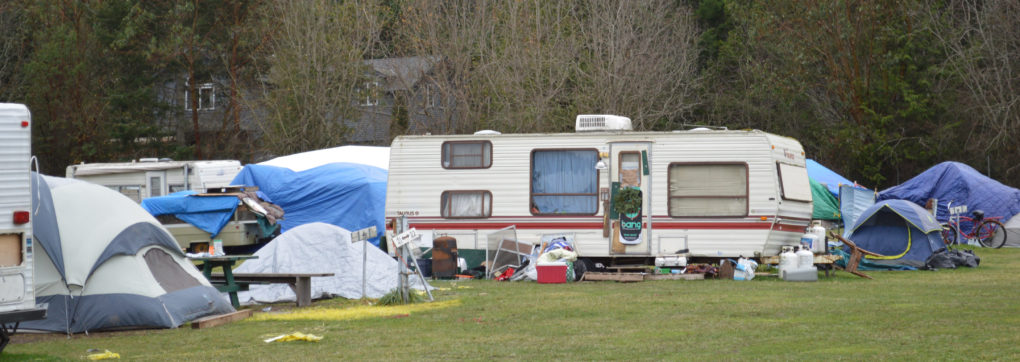
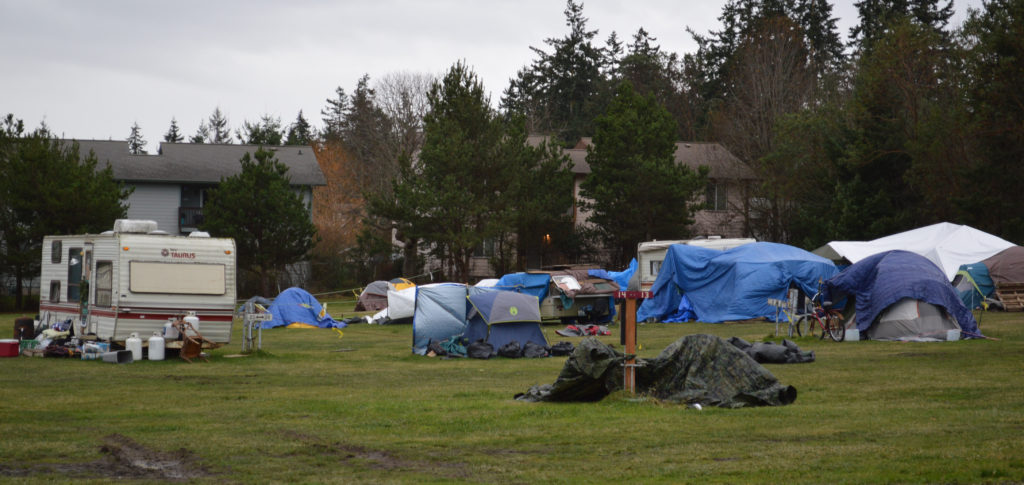
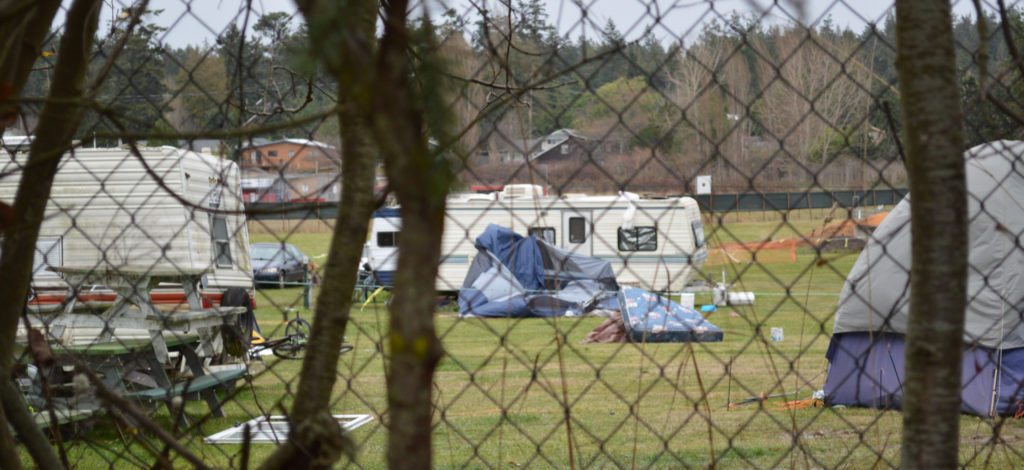
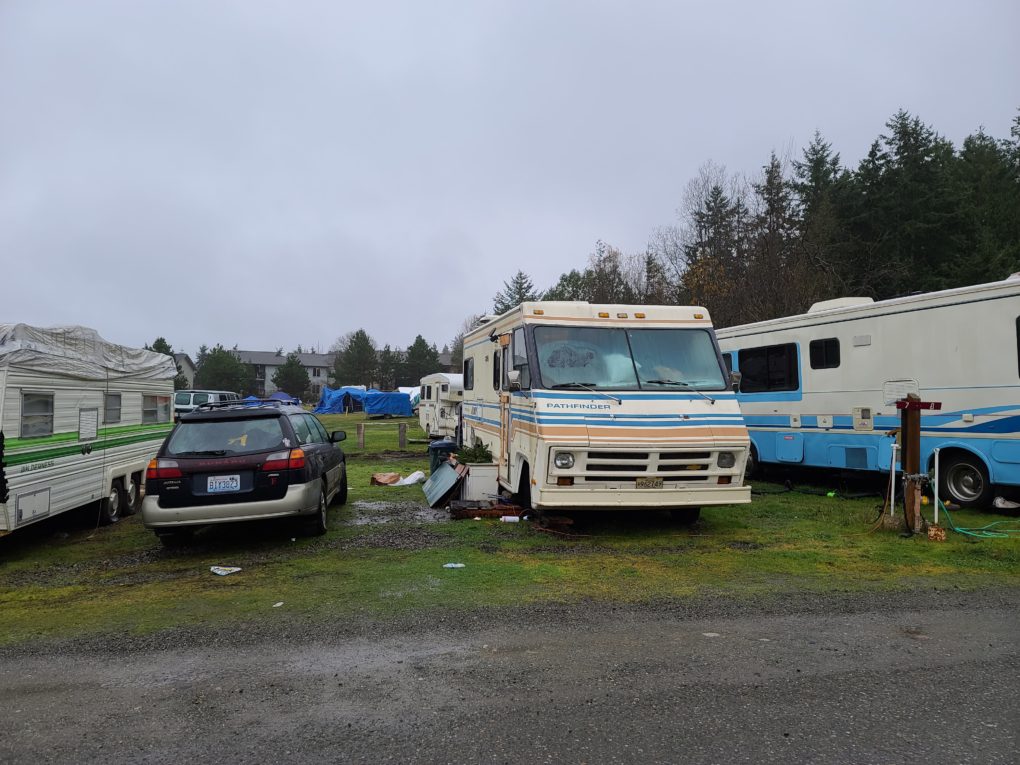
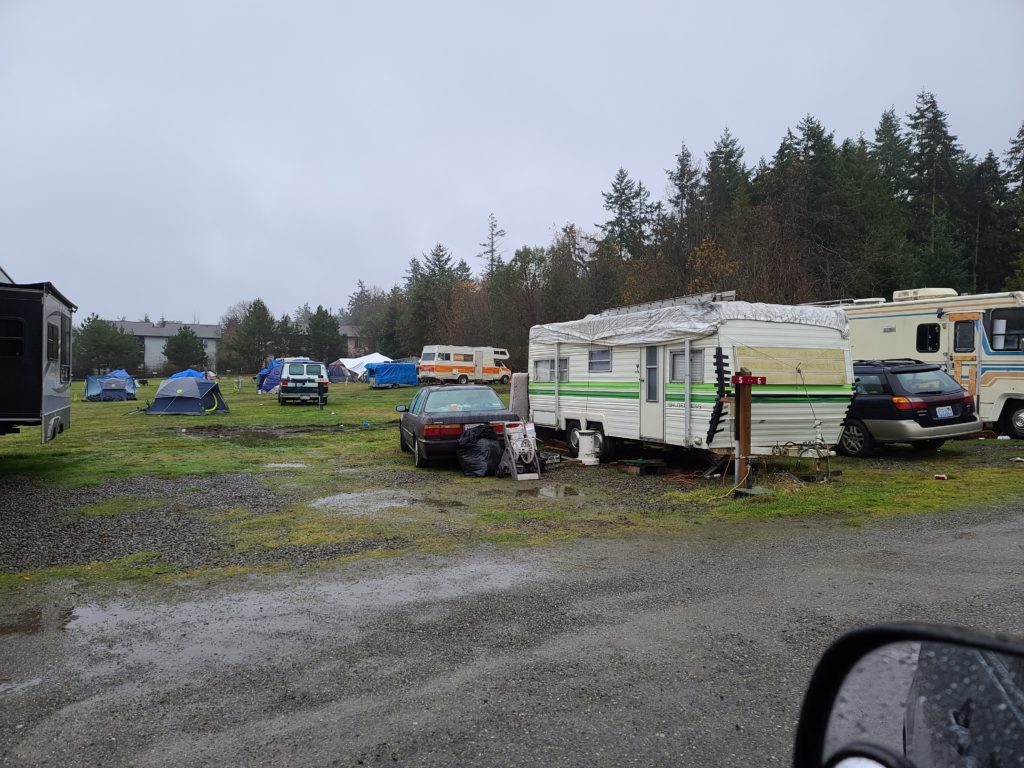
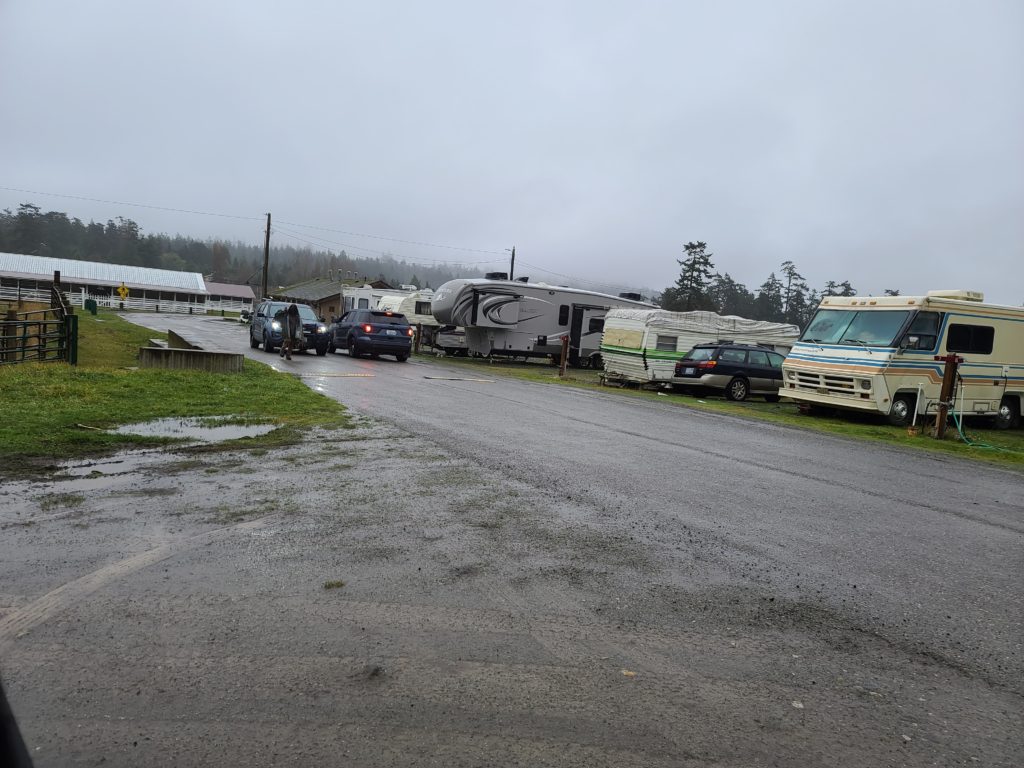
The homeless/transient camp at the Jefferson County Fairgrounds has doubled in size since this summer. I am adding the descriptor “squatters camp” because that is what this is. The occupants of the tents and RVs, whatever the reasons for their circumstances, are squatting. They are taking and using camping spaces, bathrooms, water and sewer utilities and trash collection services without paying for what they are getting.
But almost all of them, maybe all of them, are capable of paying for all or some part of their way. Starting this summer a collective decision was made and word passed through the camp that Governor’s eviction moratorium to address fallout from the COVID crisis meant they could stay without paying. Nobody could could tell them to go.
During my first visit three months ago, the spokesman for the largest faction was cooking steaks for everyone and boasted how he and others had plenty of money to pay but were not going to pay a cent since they could not be evicted. (A female camper complained to the Board of County Commissioners that this man was using his power over the camp’s food supply to punish people who displeased him and was also involved in drug dealing. She requested anonymity. The Commissioners spoke her name out loud in public meeting and she had to flee to the camp in fear of reprisal. Yes, these people watch the BOCC’s Zoom meetings and cruise the Internet where they see stories published here.)
The occupants of the camp are mostly those who will not live in organized shelters. They will not observe rules against drug and alcohol use. Some of them have been thrown out of shelters for their aggressive behavior. They want to keep their pets instead of accepting the charity of a warm, dry bed. They don’t want the accountability that comes with supervised communal living. Some are just criminals. Those “bad apples,” as one of the occupants of the camp called them on my latest visit, “are smearing the rest of us.”
But “the rest of us” are also squatters escaping accountability on various levels.
They have their many problems, many of which are deserving of sympathy. But they also bring big problems with them, problems that get dumped on other people.
Please see our earlier stories for the costs this sprawling camp is imposing on the surrounding neighborhood, the Fairgrounds Association and the camp manager who never signed on for anything like this. He and another helper are caring for, picking up after and cleaning bathrooms for this constantly expanding encampment that has rendered the Fairgrounds unusable and undesirable for anything else.



 .
.