by Jim Scarantino | May 28, 2021 | General
Internal communications between the Port Townsend City Manager, police and the Food Co-op reveal a coordinated effort to use police to suppress dissent. The communications, uncovered through a public records request submitted by Rachelle Merle and shared with Port Townsend Free Press, reveal that she was arrested and is being prosecuted, regardless of the merits of her case, to deter other protests against the county’s and governor’s masking mandates.
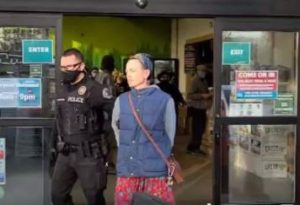
Merle was arrested April 5, 2021 in response to a call to the Port Townsend police from the management of the Food Co-op. Merle had been shopping without wearing a mask and had insisted that as a co-owner of the Co-op (she is a member) she had the right to be in the store to shop for her family. Her actions were a protest against the Co-op’s rules, which she and others contend are fanatical, not science-based and make no exceptions for members who cannot or will not cover their faces. Merle and others have contended that other retail establishments are far more accommodating.
As Ana Wolpin, the first general manager of the Co-op and a past director later wrote the chief of police, Merle’s actions were an attempt “to initiate a long-overdue conversation that the Co-op board and management should be having with its member-owners.” See: The Arrest of Rachelle Merle, PTFP, 5/1/21.
In response to this effort by one of its co-owners to initiate that conversation and challenge Co-op policy, Co-op management called in police. Merle was handcuffed, led out of the store and has been charged with second degree trespassing. If convicted she faces a penalty of up to 90 days in jail and/or a $1,000 fine.
The Co-op has denied that it is pressing charges and has insisted that the decision to prosecute Mrs. Merle is out of its hands and driven exclusively by law enforcement. As I’ve explained previously, that denial strains credulity. A trespassing prosecution requires the co-operation of the property owner (which, in this case, oddly includes Merle herself). Recently received communications further undermine the Co-op’s implausible denial.
In a May 27, 2021 email to the Port Townsend Free Press, the Co-op’s secretary, Claire Thomas, stated, “the policy of the store is to call the police when someone breaks the rules of the store.” Breaks the rules. Not commits a crime. The Co-op’s various rules are not criminal statutes, yet the Co-op admits it will use police to enforce those rules.
In one of the emails Kenna Eaton, the Co-op’s general manager, thanked the then acting chief of police for having “helped us trespass an unmasked person.” Eaton omits the fact that this person is one of the Co-op’s co-owners. A substantial issue exists as to how Merle could be trespassed from property she owns. I’ve written about that significant legal defense to Mrs. Merle’s charges and the fact that Eaton violated the Co-op’s By-laws and Articles of Incorporation by stripping Mrs. Merle’s ownership rights without honoring the protections required by the very documents that created the Co-op.
Eaton added, “As you are now likely aware, it was staged to make us look bad.” Merle sought to initiate a change in Co-op policy, or at least open dialogue. The Co-op claims to and encourages its member-owners to “treat disagreements as a chance to see things from someone else’s point of view and an opportunity to learn.”
Instead, Eaton called in men with guns. She had other options, options taken by other merchants who have unmasked people entering their premises. The most obvious and appropriate option for the general manager may have been to (1) recognize that Merle is an owner who cannot be “trespassed” from her own property, (2) let Merle finish her shopping, then (3) ask the Board to initiate the procedures the By-laws and Articles of Incorporation state are the only way to strip from a member-owner of their rights to use the store.
Mrs. Merle remains a co-owner of the Co-op. But the trespass order obtained by Eaton with the help of the PT police orders her to stay off her own property for the period of a year, with the admonition that she will be arrested if she steps onto the property during that time.
A Coordinated Campaign to Suppress Dissent
Merle is being prosecuted, despite the legal fallacy of the charges against her, in order to suppress other acts of protest. Based on emails obtained by Mrs. Merle, it appears that Dr. Thomas Locke, Jefferson County Public Health Officer, and John Mauro, Port Townsend’s City Manager, are the driving forces behind using the police to deter and punish dissent.
The emails shared by Mrs. Merle show that following her arrest, a decision was made by Locke, Mauro and the police to encourage business owners to call in police if they were faced by any protests of Locke’s edicts. In an email from Mauro to Troy Surber, then acting chief of police, Mauro wrote, “In Dr. Locke’s words, while it’s probably annoying that this may be happening more regularly, he thinks it’s useful for the community to see how law enforcement appropriately responds to these criminal acts in the name of protest.”
The next day, April 8, Mauro emailed Vicki Kirkpatrick, Director of Jefferson County Public Health. He wrote that the acting chief would contact PT Main Street to encourage store owners to “hone their response to similar events, including quickly triggering a trespass.” Once a trespass “was triggered,” police could make an arrest.
Mauro, in an April 7 email, revealed how he also sought to get the Jefferson County Sheriff to adopt the same “trigger trespass” approach to unmasked persons.
Former Acting Chief Surber, in the back-and-forth on adopting a policy to suppress and deter protest against the masking mandate, seems to have recognized the difficulty in using a trespass charge for a protest at the Co-op by a member owner. Apparently, the Saturday before Merle’s protest there had been another expression of protest at another business at or near the Tyler Street Plaza, where weekly protests against the mask mandate had been taking place. While some businesses have welcomed and encouraged the unmasked musicians and protestors, other businesses and their employees have not been pleased. Surber wrote about both incidents, “Unfortunately we need to be careful about how we address the issue for two reason[s], public space and different trespassing rules, and first amendment concerns. These folks want us to respond with a mask ticket, as their goal is to push this issue. It differs from the Co-op as we can go to a trespass immediately and no need to address the mask issue.” He added, “There isn’t an easy solution to this issue and being an unpleasant person isn’t a crime.”
So far, no arrests of mask protestors in any outdoor public space have occurred. Those protests have continued downtown, and also outside the Co-op and at the Farmer’s Market. The “issue” of a “mask ticket,” referred to by Surber, concerns arresting someone for violating the Governor’s mask mandate, which he purported to make a gross misdemeanor, punishable by up to a year in jail. “The issue” is whether the Governor can create a new crime that would imprison a citizen. To my knowledge, there has been no prosecution for violating the Governor’s unilaterally-declared new crime.
More and more research, as reported on this site and elsewhere, shows that mask mandates have made no difference in transmission rates. Texas, where the state was reopened fully and the mask mandate lifted, has been doing better than states maintaining lockdowns and masking mandates. Research, such as the well known Stanford study, confirms that masks are ineffective and create serious health hazards for the wearer. Anecdotal evidence is mounting, including reports of schoolchildren in Port Townsend passing out.
Developments in Merle’s Case
Mrs. Merle reports that she recently received a donation of $5,000 to her legal defense fund. The donation came from a local business owner and a now-former Food Co-op member. Merle’s trial is set for July 1, but rescheduling may be sought by her attorney.
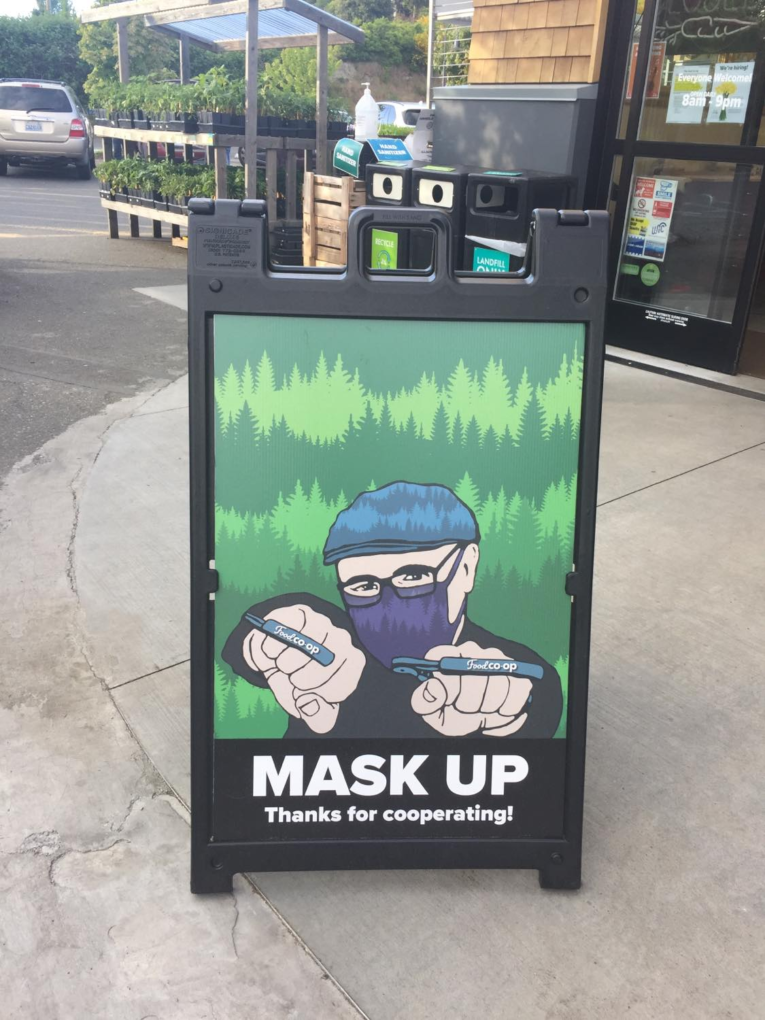
The “All Are Welcome” sign that once hung proudly above the Co-op’s door is gone. The sign in the photo at the head of this article was subsequently seen outside the main entrance.
On an interesting side note, staff in the county prosecutor’s office don’t wear masks. In the course of settling my First Amendment lawsuit against Jefferson County I was twice admitted to the entrance to the prosecutor’s office. I could clearly see that staff were not wearing masks and only put one on when they approached me. They didn’t need to do that, as far I was concerned. I don’t mean to get anyone in trouble, as I think the mask mandate should be lifted or widely ignored. But the office that is prosecuting Mrs. Merle should at least observe the same masking mandate that is the premise for punishing her.
Related from Port Townsend Free Press: Masks Don’t Stop Viruses: The Latest Research
by Gene Farr | May 20, 2021 | General
Why are we constantly being hammered with climate alarmism, Covid alarmism and racial alarmism?
The journalist and social commentator H. L. Mencken explained it decades ago: “The whole aim of practical politics is to keep the populace alarmed (and hence clamorous to be led to safety) by menacing it with an endless series of hobgoblins, all of them imaginary.” Or paraphrasing President Obama’s chief of Staff Rahm Emanuel, “Don’t let a good crisis go to waste, even if you have to invent one.” Of course, the solutions proposed are always more massive government intervention and scrapping our capitalist economic system.
What do Climate Activists Want?
It certainly is not about saving the environment. It is about forcing us to accept a socialist system. Here are a few examples of what key climate alarmists have said.
Maurice Strong, who spearheaded the United Nations 1992 Conference on Environment and Development (UNCED) Earth Summit in Rio de Janeiro where the unveiling of Agenda 21 kicked off the original climate crisis campaign linking dire environmental dangers to Western prosperity has said: “In order to save the planet, isn’t the only hope for the planet that the industrialized civilizations collapse? Isn’t it our responsibility to bring about an economic collapse?”
Christine Stewart, Canada’s former minister of the environment said: “No matter if the science is all phony, there are collateral environmental benefits. … Climate change [provides] the greatest chance to bring about justice and equality in the world.”
Tim Wirth, former U.S. undersecretary of state for global affairs under Bill Clinton and the person most responsible for setting up the Kyoto Protocol, said: “We’ve got to ride the global warming issue. Even if the theory of global warming is wrong, we will be doing the right thing in terms of economic policy and environmental policy.”
“Climate justice” campaigner for Friends of the Earth, Emma Brindal, said bluntly, “A climate change response must have at its heart a redistribution of wealth and resources.” Not protecting earth from manmade carbon-dioxide emissions or natural and manmade climate change, but redistributing wealth and resources, presumably according to formulas self-appointed ruling elites like herself decide are “socially just.”
Ottmar Edenhofer, lead author of the IPCC’s Fourth Assessment Report summed up the situation quite clearly. He advised: “One has to free oneself from the illusion that international climate policy is environmental policy. Instead, climate change policy is about how we redistribute de facto the world’s wealth.”
Or as U.N. climate chief (executive secretary of UN Framework Convention on Climate Change Christiana Figueres candidly remarked, the true aim of the recent Paris climate conference (2014) was “to change the [capitalist] economic development model that has been reigning for at least 150 years, since the Industrial Revolution.”
Chief of Staff for Rep. Alexandria Ocasio-Cortez (D-NY), Saikat Chakrabarti said in 2019: “The interesting thing about the Green New Deal is it wasn’t originally a climate thing at all … Do you guys think this is a climate thing? Because we really think of it as a how do-you-change-the-entire-economy thing.”
Prominent climate activist and meteorologist Eric Holthaus admitted in 2020 that climate change activism is not about climate science, but really about “justice.”
President Biden is trying to sell the UN plan for worldwide socialist government “Build Back Better”. This is the same old UN Agenda 21 plan being marketed with a new name.
Comprehensive coverage of climate facts is found in the book, Climate Change Reconsidered, by the Heartland Institute. All the alarmist deceptions and lies are exposed
What have the proponents of bigger government done in response to the Covid “crisis”?
The Democrat governors and Democrat mayors have used the Covid problem as an excuse to take more control over the people they govern while making special allowances for their major donors. Democrats in the US Congress got the federal government to provide massively more welfare that encourages people to not work, and funds to pay for the debts they incurred paying for ill-advised programs. The sending of senior citizen Covid cases back to the nursing homes by the New York governor looks as if he was channeling Chairman Mao’s cultural revolution to get rid of the elderly and more conservative population.
We also see that teachers unions are demanding that socialist policies be implemented before the teachers will go back to work. They ignore the fact that children have minimal risk of serious problems or death due to the virus as well as that most teachers and parents are in an age group that is not likely to be seriously affected.
What are the Black Lives Matter and other organizations promoting?
The Black Lives Matter organization and their supporters are promoting Marxism. Since the original Marxist class warfare model (workers vs. capitalists) did not sell in the USA, they are using a different class warfare model – blacks vs. whites. This new brand of Marxism is also being presented with the title “Critical Race Theory” in order to obscure its Communistic – Marxist intent. How can causing division and stirring up hatred ever lead to a positive outcome?
If the BLM organization and others really cared about poor black people, they would work to eliminate the black on black violence and inner city crime that disproportionately victimizes black Americans and deprives them of safety in every aspect of their lives. If the BLM organization and others really cared about poor black people they would promote better education options in black communities and stable, strong families. As the late Walter Williams wrote, “marriage, stable families, education and hard work…are immeasurably more important” to black success than divisive identity politics or politicians’ skin color.
In Conclusion
If you agree that these alarmists and their fellow travelers in the media are pushing our country in the wrong direction, then you must become active in spreading the truth and countering their false narratives. You must provide verbal and written testimony to our County Commissioners, City Council members, school boards, the print media and wherever else you see misinformation being presented. You must run for public office or actively work to get kindred souls elected to government positions.
by Jim Scarantino | May 18, 2021 | General
The Food Co-op insists it is not pressing charges against Rachelle Merle. It is soley the prosecutor who’s pushing this, they have asserted in correspondence with Co-op members. But, this doesn’t get the Co-op out of the dock. What will be its position when its general manager is on the stand testifying under oath? Or the President of its Board of Directors? Somebody from the Co-op will have to testify that Rachelle Merle was a trespasser for the case to get past a motion to dismiss.
Are Co-op member-owners owners or not? And, if they are owners, how can they be guilty of trespassing when that offense requires being or remaining upon “the premises of another“? How can the Co-op exclude Mrs. Merle from the Co-op for a year–as it has with a “trespassing” order–if she is a co-owner of that same property?
In my previous article I wrote that the Co-op had not answered written inquiries as to why Mrs. Rachelle Merle was handcuffed, marched out of the store and charged with second degree trespassing. Did not the Co-op’s foundational documents, and the Co-op’s repeated statements that members are “owners,” give her a property and/or contractual right to be in the store during regular hours? And was not her status as a co-owner protected against being stripped except in accordance with the Articles of Incorporation and By-laws of the Co-op? Those documents guarantee that a person remains a member-owner until such time as they have been given notice that the Board will consider terminating their member-ownership for cause, a chance to respond, and no less than a 2/3 vote by the Board in favor of termination.
Now the Co-op has answered….sort of.
Following publication of that article, I received a written response form Claire Thomas, the Co-op’s Secretary. First, my inquiry, then her answer. My inquiry of April 7 was addressed to Owen Rowe, the Co-op’s President:
As a member-owner, as well as editor of Port Townsend Free Press, I would like to know how a member-owner can be charged with trespass and excluded from the property without a 2/3 vote of the Board having occurred as required by the By-laws. Are members owners or not? How can they be trespassing, during regular business hours, on property they own? Did Co-op employees on their own tell the police to file charges against Ms. Merle, or did they consult with you or any members of the Board? Can an employee deprive a member-owner of their property rights without action by the Board that meets the requirements of the By-laws? Was it necessary to summon men armed with deadly weapons to address Mrs. Merle’s actions? Why were not less violent, or implicitly violent means pursued?
On May 13 Ms. Thomas answered:
Thank you for your patience regarding this issue. The Board of Directors wanted to thoughtfully discuss this matter before responding. It is the Co-op’s policy to call the local police department when someone threatens the safety of our customers and staff. At the time of this incident, face masks were required indoors to comply with the county and state mandates. At no point has the Co-op pressed charges regarding this incident. The decision to press charges regarding this incident lies with the county prosecutor. For more information, you can view this blog post from our General Manager on what it means to be a member of a co-op.
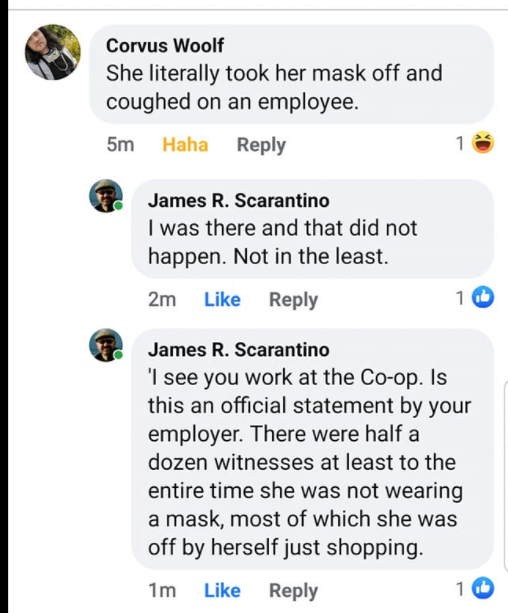
Mrs. Merle had requested observers out of fear that she would be physically harmed or subjected to intimidation or threats of violence. I had been present to cover the event for Port Townsend Free Press. Mrs. Merle had lined up other observers for her protection. Good thing she did. In my previous article I wrote how one Co-op employee, Corvus Woolf, had immediately started spreading flat out lies, stating Mrs. Merle “literally took off her mask and coughed on an employee.” When notified that Mrs. Merle had been under continuous observation by a half dozen witnesses who would expose his lie, he tried to remove that statement from comments to posting of the video of Mrs. Merle’s arrest.
Is the Co-op now adopting a strategy of lying about the incident? From the moment Mrs. Merle, maskless, entered the store she minded her own business and was by herself, away from other customers and staff almost the whole time. She was approached by store employees and the manager. She did not at any time threaten them or any other customer. When she did interact with an employee, it was when she approached the counter in the back and made a request courteously. The response from the employee was also courteous. Mrs. Merle stated her position to management and the police, and did not offer resistance when handcuffed and obliged the officer when he walked her out of the store to his patrol car.
What Mrs. Merle did was try to do her shopping without wearing a mask. That was it.
Is the Co-op going to maintain that not wearing a mask is “threatening the safety of our customers and staff”? Will trial now involve the science of masking? The Co-op only requires a simple cloth mask, nothing more. As reported here and in many medical and scientific studies, those masks are pretty useless in stopping a virus. And, since Mrs. Merle would no doubt testify that she was in fine health and not suffering any symptoms of a viral infection, there was in fact no threat of her harming anyone. Will they have employees testify that they felt threatened by her maskless presence, even though they were wearing masks and she had not approached within six feet of them? Is there a single reported case of someone being infected because a shopper in a store had not worn a mask? The data on transmission from retail store customers is almost nonexistent. Seriously, this could turn into a farce
But Mrs. Merle was not charged with any offense involving making threats or engaging in threatening behavior. She was charged with second degree trespassing. The absolutely necessary element of that offense is that she entered or remained upon “the premises of another.” For the Co-op there’s no avoiding the fact that to this day Mrs. Merle remains a co-owner of the Co-op because the necessary action to terminate that status has not even been started by the Board.
Helpless Bystander Nonsense
The Co-op is not a helpless bystander in this. The prosecution would not be going forward without their support. The Co-op will have to take a position at trial. What it means to be a member-owner is really the only issue in dispute in this case–unless, of course, the Co-op’s witnesses choose to lie on the stand.
The blogpost referred to by Ms. Thomas was written by the Co-op’s general manager, Kenna Eaton. It is entitled, “What it means to be a member of the Co-op” Missing from that title is the word “owner.”
The omission of the word “owner” is not insignificant. Mrs. Merle’s case brings into sharp focus an abandonment of the foundational principles of the Food Co-op that has raised concern among many of its long-time members and some of those who helped create it or steered it in its early years. They were always careful to use the term “member-owner” because it was ownership that made it a co-op. It was supposed to be much, much more than a frequent buyer program for groovy food. The Co-op’s current website devotes an entire page to “Ownership.” “Why Be An Owner?” it asks. Membership is ownership and it is protected by the By-Laws.
But the general manager’s blogpost never mentions those rights and how they are protected. It is all about how members have responsibilities. Not once are the responsibilities of management and the Board mentioned. Not one mention is made of the prohibition against management or the Board depriving an owner of their ownership rights except in accordance with the procedures required in the By-Laws. When she uses the phrase “member-owner” Ms. Eaton says, “Being a member-owner comes with responsibility. Members are expected to treat staff and each other civilly and respectfully, and they must follow rules and procedures.”
The general manager and Board must also follow rules and procedures. They have not in Mrs. Merles’ case.
A Co-op or a Whole Foods with a Rewards Club?
While the Co-op unpersuasively claims no role in the prosecution of Mrs. Merle, it is responsible for “trespassing” Mrs. Merle. At the time of her arrest Mrs. Merle was notified that she was being excluded from the Co-op for one year. Were she to return during that time, she would be charged with trespassing. Police don’t have authority to issue such an order except at the request of the property owner. It is the Co-op that has deprived one of its co-owners of her rights to use the store. Nothing in the Articles of Incorporation or By-laws permit this. It may not be a termination of membership, but it is definitely a suspension. There is no provision in the Co-op’s governing documents for suspension of membership.
Effectively, a one-year trespass order is a termination. A member would have to continue to pay their membership dues for a year even though they would not get anything in return. If they stopped paying for receiving nothing in exchange their membership would expire. Even if they kept up their membership, by not patronizing the store for a year they would no longer be a member in good standing and would be denied their right to vote in any matter submitted to member-owners. If the Co-op holds any member-owner meetings or other events on its property during that year, Mrs. Merle would be arrested for trespassing were she to attend.
Mrs. Merle has entered a not guilty plea. She has a good attorney. There will be a trial, and Mrs. Merle is demanding a jury. The Co-op will be on trial every bit as much as Mrs. Merle. And while it does not face the prospect of jail time (the potential perjury of witnesses aside), it is in jeopardy of becoming just a miniature Whole Foods with a forgotten history of cooperative ownership.
Co-ops were birthed out of a spirit of rebellion and free thinking. They were revolution, an economic uprising and a refusal to conform. They were the alternative to Big Ag and Big Pharma and defiance of government control over our diets and health. The Port Townsend Food Co-op was once an expression of independence and self-determination. It pushed back and sought to cut its own path. Has it been transmogrified by financial success into an expression of affluence and conformity, aligned now with the very powers it once resisted?
Mrs. Merle was challenging the Co-op to change its policies. There have been many complaints that the Co-op has been unnecessarily rigid and draconian–perhaps even fanatical–and has failed to make reasonable accommodations for those who will not or cannot wear a mask. Other stores provide opportunities for such people to shop under controlled conditions. The Co-op makes no exceptions. Mrs. Merle’s peaceful act of civil disobedience, a mother shopping for her children while showing her face, was intended to prompt an internal dialogue and liberalization the Co-op’s leaders have avoided or blocked. It was met by calling in men with guns.
Mrs. Merle’s trial is set for July 1, 2021.
by Jim Scarantino | May 12, 2021 | General
First Amendment violations have been corrected. Policies have been changed so that Jefferson County’s on-line public forum complies with Constitutional protections of freedom of expression.
Last year I sued Jefferson County for violating my First Amendment rights by censoring my comments and blocking me entirely from its Facebook page. This is the county’s on-line public forum, a digital town hall. In a time when government officials were not meeting in person with constituents and conducting much of their public communications via the Internet, I felt it especially critical that the same constitutional protections that govern live, in-person, three dimensional public forums should be defended in the face of on-line censorship by the government.
Unlike a private Facebook page, the government’s page is a pubic forum. The actions of its administrator in censoring a comment, or blocking a citizen from participating, are “state actions” that must comply with the Bill of Rights.
I believe strongly in civil liberties and restraints on government power. In my final act as an active trial attorney I was named the New Mexico ACLU Lawyer of the Year. Now, instead of standing up for someone whose rights need vindication, I was that person needing a lawyer. I wanted to stop Jefferson County from making its on-line public forum a place where dissenting views and inconvenient facts where suppressed.
So I got me a lawyer. I engaged the services of Greg Overstreet. He has plenty of experience suing Jefferson County. He’s Joe D’Amico’s lawyer. He’s very good and brings to the fight a long career of pushing back against government abuses of power. He’s also a great guy to work with. We drafted a short complaint and filed in the U.S. District Court for Western Washington.
We thought we had a pretty clear-cut case and that the county would quickly rectify the situation, change its policies and practices and settle before we ran up significant attorney’s fees. (Under federal law, a prevailing plaintiff in a civil rights case is entitled to an award of attorney fees).
But there’s always a dance at the start of just about every case, particularly when its a government being sued by a citizen. Jefferson County demanded a jury trial and sought to have me pay its attorney fees and costs. That basically said they considered my case frivolous and sanctionable. So we got to work.
Ironically, their answer clarified what was going on. We learned they had a practice of “hiding” comments that they claimed violated one of their rules, such as a comment being “off topic.” That is not an exception to the First Amendment and was used to “hide” my comment linking to a video that pleaded with Americans to never forget 9/11. By “hiding” a comment, only people who are FB friends with the sanctioned commenter could see the comment. The commenter himself would have no idea he had been censored as he could still see his comment. No notice is provided that state action had been taken to censor him. This adds a due process violation on top of a First Amendment violation. Only by sitting down with someone not a FB friend and comparing screens would he learn that his comment had been censored by the practice of “hiding.”
A comment I made about our county’s terrible meth problem, chronic poverty and shrinking job base was also censored.
I was completely blocked at one point from expressing approval or disapproval to any statements made by the county in its on-line public forum. That was done without any notice, statement of justification or ability to appeal–another due process violation.
I heard from another man that he had also been censored and blocked. I set aside a day and read every single post and looked at all the comments on the Jeffco FB page from the time it was launched. I found all sorts of evidence that would help us in the jury trial the county had requested. I found other people who likely also were being subjected to censorship. An enterprising attorney could make a nice piece of change off this situation by bringing a claim for every person and every instance of censorship. Government and government officials just can’t do that, as Donald Trump and Alexandria Ocasio-Cortez have learned.
They were both sued for engaging in censorship in how they managed their on-line public forums, principally their Twitter feeds. Trump lost in District Court and again in the U.S. Court of Appeals for the Second Circuit. AOC folded when she got sued for doing just what Trump had done. The published opinions in the Trump case established clear legal precedents, and paved the way for lots of lawsuits. We submitted extensive public records requests for the activity log of the county’s Facebook page. Those records would reveal every instance of censorship and the identity of those censored, meaning many more claims and additional plaintiffs.
But Jefferson County has a very good attorney. Philip Hunsucker, Chief Civil Deputy Prosecuting Attorney, quickly saw the problems with the county’s position. He welcomed settlement discussions. Greg Overstreet and I prepared a short synopsis of the evidence and legal claims on our side. Mr. Hunsucker, I am certain, shared our presentation with the County Commissioners and Administrator in executive session. The case then moved quickly to settlement.
The county has agreed to cease its censorship practices and to adopt the following policy in how it will manage the public forum of its Facebook page:
Authorized agents shall not restrict individuals from interacting with County-sponsored social media accounts. For purposes of this policy, ” restrict” includes both blocking and hiding comments.
If an authorized agent feels it is necessary to restrict an individual from interacting with County- sponsored social media accounts, they must consult with the Director before doing so. In determining whether an individual will be restricted the Director may consider, among other factors, whether restricting is allowed under these procedures, applicable laws, the nature of the incident on the County sponsored social media account that prompted review, whether restricting would entail viewpoint discrimination, and whether other actions could be attempted to stop or prevent further violations without restricting an individual. If an individual is restricted on authority of the Director, documentation must be kept, such as screenshots of the data that prompted the restriction and the reason for the restriction.
The Director is responsible for conducting an audit of social accounts every six months, to ensure they are being maintained in compliance with this policy.
That is a vast improvement over the wide discretion and unconstitutional practices written into the county’s previous social media policy. There may be some conceivable reason for the county in the future censoring activity on its Facebook page. A threat of violence, for instance, or publication of pornography. Or outright defamation that could subject the county to liability for injuries and losses. The county may decide that censorship, the last resort under the new policy, is unavoidable and worth a possible lawsuit. But that decision will be made only at higher levels in county government and certainly only after consulting with legal counsel.
We withdrew our extensive public records request. We don’t need to and won’t be digging up other potential claims and claimants. That saved county employees a lot of work.
The county is also paying Mr. Overstreet’s fees. I never sought monetary compensation for violation of my civil rights, but my lawyer does need to be paid. We kept our fees and costs down. Punishing the county economically was not the goal. Changing policy to bring it into compliance with the Bill of Rights was the reason for the lawsuit.
The county will pay Mr. Overstreet $12,500. He reduced his fees to facilitate quicker settlement and avoid litigating a higher fee claim–which would have cost the county even more. He would have been awarded not only the higher fee amount to which he was entitled, but also fees for his time in seeking that amount. The county would also have paid for our expert witness. That was not what we wanted and the costs of battle were avoided.
I did a lot of legal and investigative work, as though I were Mr. Overstreet’s associate counsel. I did not seek compensation for my time, though I believe I may have been entitled to an award.
We got want we wanted. Both attorneys did a good job. The county commission wisely listened to their lawyer. This case has set a precedent in Washington that other state, county and municipal governments are likely to follow. It did not produce a judicial ruling, but the example it set shows the way to conduct the business of government on-line while upholding the rights of citizens to engage freely in discussing and debating matters of public interest, even if government very much dislikes what those citizens may have to say.
Related: My First Amendment Lawsuit Against Jefferson County: Update
by Jim Scarantino | May 10, 2021 | General
Four years and $2.3 million in the rearview mirror. And still not one square foot of “affordable” housing out of the Cherry Street Project.
The Jefferson County Republican Party commemorated the project’s fourth anniversary, “and the benefits of one-party rule by Democrats,” with a little ceremony, a cake and a video on Saturday May 8, 2021. They gathered on the grounds of the decaying 1950s building barged here at great expense and trouble from Victoria, B.C. in May 2017.
I was there to cover the event for the PT Free Press.
I learned the place is not completely uninhabited. I saw the rats. A neighbor a couple years ago told me of the “really big rats, lots of them,” but on May 8, 2021, I saw them myself. The racoons, too. In the middle of the day they scurried about, disturbed by the presence of a couple dozen human beings milling around and taking pictures.
The homeless camp in the trees appears to have been abandoned. But a forest of poison hemlock has moved in. Stalks well over six feet tall cover about a quarter acre of land. On any other Port Townsend property, such a prolific display of uncontrolled noxious weeds would draw an army of inspectors, unpleasant, threatening letters and a bombardment of citations.
But the rules under which everyone else struggles never seem to apply to the Cherry Street Project. Not when it was in the hands of the bumbling and untrustworthy Homeward Bound Community Land Trust (Kate Dean, Chair of the Jefferson County Board of County Commissioners, has been a member of HB”s Board since the start of this tale). Nor now that the City of Port Townsend has reclaimed ownership of the asbestos and lead-contaminated hulk after Homeward Bound took taxpayers for a ride. They spent hundreds of thousands and defaulted on their super-generous loan from the city. Taxpayers are now on the hook for the more than $1.4 million charge the city carries on its books.
Taxpayers don’t even get a t-shirt. They just get to pay down the loan for twenty years with nothing to show but receipts and the inescapable cost of eventually crunching and clearing the building and reclaiming the land.
We’ve reported that the total cost of this thing so far tops $2.3 million. (See our articles below.) The last estimate predicted at least another million would be needed before the first “affordable” basement apartment could be occupied–by human beings.
Happy birthday to you, Cherry Street Project. But not everyone wants to acknowledge the anniversary. Not one city councilor responded to invitations to attend the celebration and talk about their contributions to this stunning achievement in addressing PT’s affordable housing crisis.
But almost four years earlier to the day, on May 10, 2017, city councilors and other local leaders gathered in the beer garden of the Pourhouse to watch the old Carmel House roll off its barge and begin its journey to its resting place on wooden blocks on a hillside overlooking the golf course. There it became “The Cherry Street Project.” There it sat for over two years on those wooden blocks. There it sits still, worse for wear as it falls apart, bit by bit.
The doors and some windows have been open for four years. Construction debris is still scattered around the property. The stucco is falling off. The rain spouts on the back are down. The weather protection for the plywood has mostly peeled away. As we reported previously, a city inspection found holes in floors and walls big enough for people to fall through.
The Jeffco Republicans were having fun. They had a bakery paint a digital icing photo of the glorious Carmel House on a cake.
Sure, they were rubbing the uniformly Democrat/liberal/progressive/inept city councilors’ noses in it. But they do have point.
This is what you get with decades of incestuous one-party rule. Nobody in the Democrat monoculture asked a hard question at the beginning. Questions such as, “How much will this cost and may we see a budget from a licensed general contractor before we write the first check?” Or, “Hey, maybe before we bring this thing here, ya think maybe we should get, like, an inspection to see if there’s any problems in the building?” Or, “If this is such a great building, why doesn’t Victoria want it?” Or, “How can we be sure Homeward Bound will get this done and not just dump it back into taxpayers’ laps after they’ve wasted a lot of time and money?”
Nobody asked any questions. It was jump on board the bandwagon and meet you at the Pourhouse.
City councilors responsible for getting taxpayers into this mess don’t publicly talk about the Cherry Street Project. My query for an update last month was ignored. The last time this boondoggle was discussed publicly at one of their meetings was in September 2020 when they instructed the City Manager to hand it over to Bayside Housing, free and clear of all debt, along with more than $300,000 in cash. They don’t even talk about the City Manager turning down a $1 million cash offer to bail the city out of this fiasco. (We reported on that offer from the Marzans of Port Townsend last October).
I can’t tell you what is going on behind the scenes now. I am still waiting for a response to my latest public records request. Getting the files and emails and memos has been the only way to get any accurate information on this deal.
What’s in those files proves that what the public is being told is not true and far, far from the whole story.
As far as I can tell, that transfer to Bayside has not happened and the Cherry Street Project starts its fifth year with its deterioration accelerating.
Other than making fun of Democrats’ gross incompetence and political inbreeding as symbolized by the Cherry Street Project, Republicans point out the truly unfortunate ramifications of this failure. “Since the city did this,” says Craig Durgan, chair of the Jeffco Republicans, “the city has done nothing else about affordable housing. All the dollars are tied up in this.”
He had more to say in a video about “Port Townsend’s one and only affordable housing project.” It’s fun to watch, and maddening at the same time. “For $2 million the city could have built a really nice place,” he argues. “Instead, people are having to camp at the Fairgrounds.” It’s pretty well done and something new from Jefferson County Republicans. As Durgan has argued in articles contributed to this site, much of the area’s affordable housing crisis has been caused by regulations enacted by the same crowd that that gave us the Cherry Street Project as an answer to problems they created.
You can see the video at this link: Cherry Street – YouTube
Here are previous articles on The Cherry Street Project. Just click on the title and you’ll get the article in full:
Latest Cherry Street Giveaway Hits Taxpayers Harder | Port Townsend FreePress
“Completely Bogus” Numbers–More Problems and Delays for Cherry Street Project | Port Townsend FreePress
Multi-Million Dollar Fraud on Taxpayers: The Cherry Street Project Unmasked | Port Townsend FreePress
Cherry Street Project Handover “Not a Done Deal” | Port Townsend FreePress
Cherry Street Handover: Red Flags About Bayside Housing | Port Townsend FreePress
Accomplished Developer Will Donate Time and Services for Cherry Street Project | Port Townsend FreePress
Cherry Street Project Welcomes First Tenants | Port Townsend FreePress
What’s Happening With the Cherry Street Project? | Port Townsend FreePress
The Tragedy of the Cherry Street Project | Port Townsend FreePress
CHERRY STREET “AFFORDABLE” HOUSING TO COST MORE THAN $2 MILLION | Port Townsend FreePress
by Jim Scarantino | May 1, 2021 | General
Calling police to arrest one of its co-owners for trespassing has put the The Food Co-op on trial.
On April 5, 2021, Rachelle Merle, one of the Co-op’s member-owners, refused to wear a mask while shopping in the store. The store’s manager told her she would have to leave. Mrs. Merle said she would not. During the episode she asserted religious, scientific and political reasons for her stance.
The store’s manager called police. Mrs. Merle told the responding officer that she would not wear a mask and gave him her reasons. She also informed him she was “a member.” He informed her that he would arrest her if she did not don a mask or leave. She repeated her refusal to wear a mask and insisted she had the right to be in the store. He handcuffed and arrested her and walked her outside to his patrol car. She continued to state her reasons for refusing to wear a mask and to tell him that what he was doing was wrong.
She was placed in the back seat of his patrol car. A second patrol car arrived. The officers consulted. One went to the street, away from the people observing events, presumably to confer with a supervisor. He returned and stood by the car holding Mrs. Merle while the arresting officer went inside with a clipboard, presumably to confer with store management. He returned and told Merle she was being charged with trespassing and that, at the request of The Food Co-op, she was being “trespassed” from the store for a year. If she returned during that time she would be in violation of the order to stay off the property and arrested.
Merle was arraigned on April 26 on a single count of Trespass in the Second Degree. This is a misdemeanor criminal offense with penalties of up to 90 days in jail and a fine up to $1,000. To understand the offense one must first know what constitutes Trespass in the First Degree: “A person is guilty of trespass in the first degree if he or she knowingly enters or remains unlawfully in a building.” Trespass in the Second Degree is when “he or she knowingly enters or remains unlawfully in or upon the premises of another under circumstances not constituting criminal trespass in the first degree.” (Emphasis added for reasons that follow.)
Merle was not charged with not wearing a mask inside a public place of business, which would be a gross misdemeanor under the Governor’s emergency order. It remains to be seen if the Governor can unilaterally dictate new criminal offenses that could put a citizen in jail for up to a year. Merle’s case does not raise that question.
Mrs. Merle is represented by Caleb Vandebos of Chehalis, Washington. He specializes in criminal defense. Mrs. Merle will be demanding a jury trial.
Eyewitnesses for Good Reason
Merle had told people at the Freedom Rally in downtown Port Townsend the previous Saturday that she would be shopping in The Food Co-op without a mask. Freedom Rallies had been held every Saturday in recent months at the Tyler Street plaza to protest the Governor’s lockdown and masking mandates and distribute information about the vaccines.
I was there that day playing guitar with other musicians.
Merle wanted observers because she was afraid of being assaulted. She said she and, if I recall correctly, an older man had been verbally assaulted and physically intimidated for not wearing masks outside in the Co-op’s parking lot.
I decided to observe and take video for Port Townsend Free Press. I posted a video of her being escorted in handcuffs out of the store. (You can see it at our Facebook page). Shortly afterwards, in comments to the same video posted on my personal FB page, a Co-op employee attempted to start a false narrative that Mrs. Merle “literally took off her mask and coughed on an employee.” I responded that this was false and let the employee know that Mrs. Merle had been watched by a half dozen witnesses, several of whom had video evidence that his statement was false. The Co-op employee attempted to erase his attempt to smear Mrs. Merle, but it was captured by another reader before he could take it down.
Mr. Woolf did not respond to my question. Nor did the President of the Board of Directors respond to my questions about the incident. As a member-owner of The Food Co-op and editor of this site, I wrote him to receive clarification on the rights of member-owners to shop in the store.
I would like to know how a member-owner can be charged with trespass and excluded from the property without a 2/3 vote of the Board having occurred as required by the By-laws. Are members owners or not? How can they be trespassing, during regular business hours, on property they own? Did Co-op employees on their own tell the police to file charges against Ms. Merle, or did they consult with you or any members of the Board? Can an employee deprive a member-owner of their property rights without action by the Board that meets the requirements of the By-laws? Was it necessary to summon men armed with deadly weapons to address Mrs. Merle’s actions? Why were not less violent, or implicitly violent means pursued?
The President, Owen Rowe, who is also a member of the Port Townsend City Council, did not respond. I received a vague and noncommittal response from the secretary, Claire Thomas, who said it was her duty to correspond with members. She wrote:
“As you can imagine, the Board of Directors has gotten several emails regarding the incident involving you and Mrs. Merle last week and we want to read all concerns from our member-owners and have thoughtful conversation about them as a group as well as with our General Manager at the Co-op. I will be answering emails in the order in which they were received and I truly appreciate your patience while we discuss your issue as a board. We take all comments and concerns from our fellow member-owners very seriously and we want to give each person the time and attention they deserve. I will follow up with a more detailed email soon.”
That was April 14. I had written Mr. Rowe on April 7. On April 26 Mrs. Merle was arraigned on the charge of criminal trespass. I still have not received the “more detailed” answer promised by the Co-op. The fact the case is going forward apparently is their answer.
The Food Co-op On Trial
How can the Food Co-op justify having one of its owners arrested for trespassing in a store she co-owns? The definition of criminal trespass requires that the property be “premises of another.” The Food Co-op is her property as much as it is the property of the employee who ejected her, as I am sure all Co-op employees are also member-owners. This will most definitely be a key point of Mrs. Merle’s defense.
Mrs. Merle’s case is not analogous to that of a member-owner caught stealing from the store. The charge would be some level of the criminal offense of theft. The Co-op’s governing documents give its member-owners the right to shop in the store, in addition to voting rights and some other ancillary benefits. Shopping means paying for what is taken, not stealing.
The By-Laws and Articles of Incorporation set forth the rights and responsibilities of being a member-owner. The Articles of Incorporation create a single class of membership. Members of the corporation have the right “To purchase goods from the Corporation at prices generally available to members and otherwise to benefit from participation in the activities of the Corporation.” That right most definitely includes the right to shop in the store during the hours the Co-op is open to other patrons. This right can only be taken away involuntarily, “[f]or reasonable and sufficient cause, including willful violation of the Corporation’s Articles or Bylaws, by a two thirds’ vote of the Board of Directors, after a fair hearing at which the member has had the opportunity to speak and present evidence.”
The By Laws are more expansive on how a member’s ownership rights may be terminated: “Membership may be terminated involuntarily by a two-thirds’ (2/3rds’) vote of the Board for cause after the member-owner is provided fair notice of the reasons for proposed termination and has an opportunity to respond in person or in writing. Cause may include intentional or repeated violation of any provision of the Co-op’s bylaws or policies, actions that will impede the Co-op from accomplishing its purposes, actions or threats that adversely affect the interests of the Co-op or its member-owners, willful obstruction of any lawful purpose or activity of the Co-op, breach of any contract with the Coop, or failure to patronize the business for more than five (5) years.” If a member shoplifts, they could be arrested for shoplifting, but they would not be trespassing and they would retain their ownership rights until revoked by the Board on a 2/3 vote after due process had been provided to the member.
Mrs. Merle was not only charged with trespassing on a property she owns, she was handcuffed and forcibly (although professionally and gently) removed from the store against her will. Furthermore, the Co-op store manager had her “trespassed” from the Co-op, meaning she is denied all of her rights to enter a store she still co-owns. That was done without any due process or action by the Board, as required by the Co-op’s governing documents.
Somebody from the Co-op is going to have to explain themselves at trial and be subject to cross-examination. The Co-op’s actions and internal communications are also fair game for discovery by Mrs. Merle’s defense counsel. Their discussions with the arresting officer and any subsequent communications between Co-op leadership, the Jefferson County Prosecuting Attorney, police and the Jefferson County Health Department, if they occurred, must also be disclosed to the defense, and will be subject to examination at trial.
Did they intentionally disregard Mrs. Merle’s rights under the Co-op’s governing documents to make an example of her? Are they proceeding knowing they could well lose, but with the belief that the deterrent value of taking Mrs. Merle to trial is somehow “worth it”? Are they disregarding Mrs. Merle’s member-owner rights out of malice because of the religious or political beliefs she has asserted in her refusal to wear a mask?
It would be interesting to examine any other cases where the Co-op has called police to remove and arrest a member-owner, and those instances where it might have followed its governing documents in terminating the rights of a member-owner instead of calling police and “trespassing” the member-owner.
Ammunition for the Defense
The Co-op in unambiguous terms tells members they are owners. It has an entire section on its website entitled, “Ownership.” The Co-op provides an “Owners Guide,” that prominently proclaims, “Welcome, Owner!” It goes on to say, “As an owner of The Food Co-op of Port Townsend, you’re part of a community of over 6500 people on the Quimper Peninsula who believe in the value of owning our own grocery store.”
Two important people in the Co-op’s origins and history agree with the view that Mrs. Merle should not have been charged with trespassing. Stephen Schumacher served as Co-op President for two and a half years, was Secretary for four years, and served on the committee that reviewed and revised the Co-op’s governing documents. He is also an expert and published author on the principles of food co-ops. He was a witness to Mrs. Merle’s arrest. He wrote in protest to the acting chief of the Port Townsend Police Department, Troy Surber. His letter is quoted at length:
“I believe the police were misunderstanding the situation when they arrested Rachelle, because as a member-owner of the Co-op she was not and could not have been trespassing while exercising her rights as owner on property she co-owns. As explained in my [attached] article, member-owned cooperatives are a special kind of organization operating on different principles than standard shareholder corporations.
“The Co-op’s attached Bylaws make clear ‘1.2. The Co-op shall be owned by its members’ and its Articles of Incorporation state ‘3. Members of the Corporation shall have the right: (a) To purchase goods from the corporation at prices generally available to members and otherwise to benefit from participation in the activities of the Corporation. That is precisely what Rachelle was peacefully doing when staff illegitimately called in a trespassing complaint against one of their storeowners.
“As Rachelle attempted to explain to the arresting officer, the situation with a cooperative is analogous to a wife asking the police to arrest a husband for trespassing on his own property; if the husband is doing something else wrong, he can be arrested for that, but not for trespassing. Unfortunately Rachelle’s status as co-owner was not made clear, so the arresting officer waved the matter aside along with any grounds for separate offense, saying ‘They can ask you to leave because you are wearing a purple shirt, and you have to leave.’ But that is not true for owners exercising their ownership rights guaranteed in the Co-op’s governing documents.
“This was in fact a matter that should have been handled internally among co-owners without involving the police. Staff had many options, including refusing her check-out at the register, or arranging a meeting to discuss the underlying issues per cooperative principles. The Co-op’s Bylaws themselves provide that ‘2.6. Membership can be terminated non-voluntarily by a two-thirds’ vote of the Board for cause after the member-owner is provided fair notice of the reasons for proposed termination and has an opportunity to respond in person or writing’, after which Rachelle would have been legally subject to a trespassing complaint.
“Given that police were misinformed about how the Co-op’s governing documents make member-owners immune from trespassing complaints, please summarily drop the inapplicable trespassing charge against Co-op co-owner Rachelle Merle and remove it from her legal record. Moreover, it would be good if you could advise the Food Co-op that police will not respond to any future calls from them about member-owners trespassing on their own property.
“If this matter ever comes to court, I would be happy to testify as an expert witness on Rachelle Merle’s behalf that as a co-owner she did not and could not trespass by exercising her ownership rights to shop at the Food Co-op.”
Ana Wolpin was a founder of the Co-op, its first General Manager and a member of its Board of Directors. She also wrote to the acting police chief, likewise citing provisions of the governing document she believes the Co-op violated. She wrote:
“As a member-owned operation, the owners jointly possess the store and its assets. An owner cannot be charged with trespassing on their own property. Ms. Merle was not trespassing, she was challenging an internal Co-op policy. It appears that by involving your department in this dispute, the Food Co-op is in violation of its bylaws. The proper procedure would have been for management to initiate a Termination of Membership through the process described in those bylaws.
I have been a member of the Food Co-op for 46 years; its first General Manager in 1975 and a member of its Board of Directors some decades later. As someone who does not mask, I have not shopped there since the masking policy was put in place nearly a year ago. I have no desire to support an operation where I am no longer welcome. While I choose not to confront this policy as Ms. Merle did, I support her effort to initiate a long-overdue conversation that the Co-op board and management should be having with its member-owners.
It would appear that the Port Townsend Police Department has been erroneously involved in this dispute. The Food Co-op needs to follow its bylaws, and trespassing charges should be dropped.”
Mr. Schumacher and Ms. Wolpin have contributed articles to the Free Press. They provided copies of their letters to the chief, and his response. They also provided copies to the Co-op Board. Former Acting Chief Troy Surber similarly responded to Schumacher and Wolpin. “I understand,” he wrote, that “the Co-op has nuances” and that Mrs. Merle would have the opportunity to present her arguments if the case proceeded to trial and that the prosecutor was aware of the issues they raise.
If the Board reached the 2/3 vote against her, she could then be “trespassed” as the Co-op has trespassed other non-members, principally transients. It would have complied with its governing documents, respected the rights of member-owners, and put Mrs. Merle in a position where, if she returned to the property after being trespassed, her attorney would have little more to do than try to negotiate a plea. But because the Co-op acted in violation of the very documents that brought it into existence, Mrs. Merle’s attorney will have significantly more to work with in her defense.