by Jim Scarantino | May 1, 2021 | General
Calling police to arrest one of its co-owners for trespassing has put the The Food Co-op on trial.
On April 5, 2021, Rachelle Merle, one of the Co-op’s member-owners, refused to wear a mask while shopping in the store. The store’s manager told her she would have to leave. Mrs. Merle said she would not. During the episode she asserted religious, scientific and political reasons for her stance.
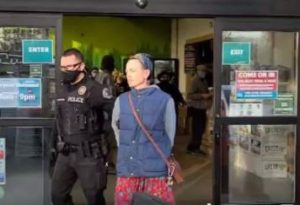
The store’s manager called police. Mrs. Merle told the responding officer that she would not wear a mask and gave him her reasons. She also informed him she was “a member.” He informed her that he would arrest her if she did not don a mask or leave. She repeated her refusal to wear a mask and insisted she had the right to be in the store. He handcuffed and arrested her and walked her outside to his patrol car. She continued to state her reasons for refusing to wear a mask and to tell him that what he was doing was wrong.
She was placed in the back seat of his patrol car. A second patrol car arrived. The officers consulted. One went to the street, away from the people observing events, presumably to confer with a supervisor. He returned and stood by the car holding Mrs. Merle while the arresting officer went inside with a clipboard, presumably to confer with store management. He returned and told Merle she was being charged with trespassing and that, at the request of The Food Co-op, she was being “trespassed” from the store for a year. If she returned during that time she would be in violation of the order to stay off the property and arrested.
Merle was arraigned on April 26 on a single count of Trespass in the Second Degree. This is a misdemeanor criminal offense with penalties of up to 90 days in jail and a fine up to $1,000. To understand the offense one must first know what constitutes Trespass in the First Degree: “A person is guilty of trespass in the first degree if he or she knowingly enters or remains unlawfully in a building.” Trespass in the Second Degree is when “he or she knowingly enters or remains unlawfully in or upon the premises of another under circumstances not constituting criminal trespass in the first degree.” (Emphasis added for reasons that follow.)
Merle was not charged with not wearing a mask inside a public place of business, which would be a gross misdemeanor under the Governor’s emergency order. It remains to be seen if the Governor can unilaterally dictate new criminal offenses that could put a citizen in jail for up to a year. Merle’s case does not raise that question.
Mrs. Merle is represented by Caleb Vandebos of Chehalis, Washington. He specializes in criminal defense. Mrs. Merle will be demanding a jury trial.
Eyewitnesses for Good Reason
Merle had told people at the Freedom Rally in downtown Port Townsend the previous Saturday that she would be shopping in The Food Co-op without a mask. Freedom Rallies had been held every Saturday in recent months at the Tyler Street plaza to protest the Governor’s lockdown and masking mandates and distribute information about the vaccines.
I was there that day playing guitar with other musicians.
Merle wanted observers because she was afraid of being assaulted. She said she and, if I recall correctly, an older man had been verbally assaulted and physically intimidated for not wearing masks outside in the Co-op’s parking lot.
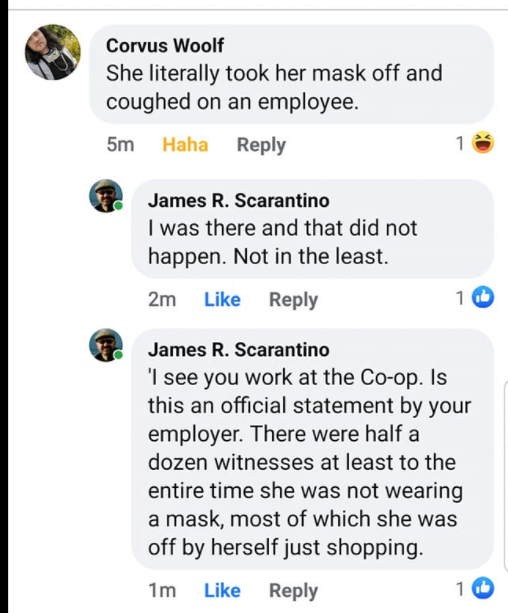
I decided to observe and take video for Port Townsend Free Press. I posted a video of her being escorted in handcuffs out of the store. (You can see it at our Facebook page). Shortly afterwards, in comments to the same video posted on my personal FB page, a Co-op employee attempted to start a false narrative that Mrs. Merle “literally took off her mask and coughed on an employee.” I responded that this was false and let the employee know that Mrs. Merle had been watched by a half dozen witnesses, several of whom had video evidence that his statement was false. The Co-op employee attempted to erase his attempt to smear Mrs. Merle, but it was captured by another reader before he could take it down.
Mr. Woolf did not respond to my question. Nor did the President of the Board of Directors respond to my questions about the incident. As a member-owner of The Food Co-op and editor of this site, I wrote him to receive clarification on the rights of member-owners to shop in the store.
I would like to know how a member-owner can be charged with trespass and excluded from the property without a 2/3 vote of the Board having occurred as required by the By-laws. Are members owners or not? How can they be trespassing, during regular business hours, on property they own? Did Co-op employees on their own tell the police to file charges against Ms. Merle, or did they consult with you or any members of the Board? Can an employee deprive a member-owner of their property rights without action by the Board that meets the requirements of the By-laws? Was it necessary to summon men armed with deadly weapons to address Mrs. Merle’s actions? Why were not less violent, or implicitly violent means pursued?
The President, Owen Rowe, who is also a member of the Port Townsend City Council, did not respond. I received a vague and noncommittal response from the secretary, Claire Thomas, who said it was her duty to correspond with members. She wrote:
“As you can imagine, the Board of Directors has gotten several emails regarding the incident involving you and Mrs. Merle last week and we want to read all concerns from our member-owners and have thoughtful conversation about them as a group as well as with our General Manager at the Co-op. I will be answering emails in the order in which they were received and I truly appreciate your patience while we discuss your issue as a board. We take all comments and concerns from our fellow member-owners very seriously and we want to give each person the time and attention they deserve. I will follow up with a more detailed email soon.”
That was April 14. I had written Mr. Rowe on April 7. On April 26 Mrs. Merle was arraigned on the charge of criminal trespass. I still have not received the “more detailed” answer promised by the Co-op. The fact the case is going forward apparently is their answer.
The Food Co-op On Trial
How can the Food Co-op justify having one of its owners arrested for trespassing in a store she co-owns? The definition of criminal trespass requires that the property be “premises of another.” The Food Co-op is her property as much as it is the property of the employee who ejected her, as I am sure all Co-op employees are also member-owners. This will most definitely be a key point of Mrs. Merle’s defense.
Mrs. Merle’s case is not analogous to that of a member-owner caught stealing from the store. The charge would be some level of the criminal offense of theft. The Co-op’s governing documents give its member-owners the right to shop in the store, in addition to voting rights and some other ancillary benefits. Shopping means paying for what is taken, not stealing.
The By-Laws and Articles of Incorporation set forth the rights and responsibilities of being a member-owner. The Articles of Incorporation create a single class of membership. Members of the corporation have the right “To purchase goods from the Corporation at prices generally available to members and otherwise to benefit from participation in the activities of the Corporation.” That right most definitely includes the right to shop in the store during the hours the Co-op is open to other patrons. This right can only be taken away involuntarily, “[f]or reasonable and sufficient cause, including willful violation of the Corporation’s Articles or Bylaws, by a two thirds’ vote of the Board of Directors, after a fair hearing at which the member has had the opportunity to speak and present evidence.”
The By Laws are more expansive on how a member’s ownership rights may be terminated: “Membership may be terminated involuntarily by a two-thirds’ (2/3rds’) vote of the Board for cause after the member-owner is provided fair notice of the reasons for proposed termination and has an opportunity to respond in person or in writing. Cause may include intentional or repeated violation of any provision of the Co-op’s bylaws or policies, actions that will impede the Co-op from accomplishing its purposes, actions or threats that adversely affect the interests of the Co-op or its member-owners, willful obstruction of any lawful purpose or activity of the Co-op, breach of any contract with the Coop, or failure to patronize the business for more than five (5) years.” If a member shoplifts, they could be arrested for shoplifting, but they would not be trespassing and they would retain their ownership rights until revoked by the Board on a 2/3 vote after due process had been provided to the member.
Mrs. Merle was not only charged with trespassing on a property she owns, she was handcuffed and forcibly (although professionally and gently) removed from the store against her will. Furthermore, the Co-op store manager had her “trespassed” from the Co-op, meaning she is denied all of her rights to enter a store she still co-owns. That was done without any due process or action by the Board, as required by the Co-op’s governing documents.
Somebody from the Co-op is going to have to explain themselves at trial and be subject to cross-examination. The Co-op’s actions and internal communications are also fair game for discovery by Mrs. Merle’s defense counsel. Their discussions with the arresting officer and any subsequent communications between Co-op leadership, the Jefferson County Prosecuting Attorney, police and the Jefferson County Health Department, if they occurred, must also be disclosed to the defense, and will be subject to examination at trial.
Did they intentionally disregard Mrs. Merle’s rights under the Co-op’s governing documents to make an example of her? Are they proceeding knowing they could well lose, but with the belief that the deterrent value of taking Mrs. Merle to trial is somehow “worth it”? Are they disregarding Mrs. Merle’s member-owner rights out of malice because of the religious or political beliefs she has asserted in her refusal to wear a mask?
It would be interesting to examine any other cases where the Co-op has called police to remove and arrest a member-owner, and those instances where it might have followed its governing documents in terminating the rights of a member-owner instead of calling police and “trespassing” the member-owner.
Ammunition for the Defense
The Co-op in unambiguous terms tells members they are owners. It has an entire section on its website entitled, “Ownership.” The Co-op provides an “Owners Guide,” that prominently proclaims, “Welcome, Owner!” It goes on to say, “As an owner of The Food Co-op of Port Townsend, you’re part of a community of over 6500 people on the Quimper Peninsula who believe in the value of owning our own grocery store.”
Two important people in the Co-op’s origins and history agree with the view that Mrs. Merle should not have been charged with trespassing. Stephen Schumacher served as Co-op President for two and a half years, was Secretary for four years, and served on the committee that reviewed and revised the Co-op’s governing documents. He is also an expert and published author on the principles of food co-ops. He was a witness to Mrs. Merle’s arrest. He wrote in protest to the acting chief of the Port Townsend Police Department, Troy Surber. His letter is quoted at length:
“I believe the police were misunderstanding the situation when they arrested Rachelle, because as a member-owner of the Co-op she was not and could not have been trespassing while exercising her rights as owner on property she co-owns. As explained in my [attached] article, member-owned cooperatives are a special kind of organization operating on different principles than standard shareholder corporations.
“The Co-op’s attached Bylaws make clear ‘1.2. The Co-op shall be owned by its members’ and its Articles of Incorporation state ‘3. Members of the Corporation shall have the right: (a) To purchase goods from the corporation at prices generally available to members and otherwise to benefit from participation in the activities of the Corporation. That is precisely what Rachelle was peacefully doing when staff illegitimately called in a trespassing complaint against one of their storeowners.
“As Rachelle attempted to explain to the arresting officer, the situation with a cooperative is analogous to a wife asking the police to arrest a husband for trespassing on his own property; if the husband is doing something else wrong, he can be arrested for that, but not for trespassing. Unfortunately Rachelle’s status as co-owner was not made clear, so the arresting officer waved the matter aside along with any grounds for separate offense, saying ‘They can ask you to leave because you are wearing a purple shirt, and you have to leave.’ But that is not true for owners exercising their ownership rights guaranteed in the Co-op’s governing documents.
“This was in fact a matter that should have been handled internally among co-owners without involving the police. Staff had many options, including refusing her check-out at the register, or arranging a meeting to discuss the underlying issues per cooperative principles. The Co-op’s Bylaws themselves provide that ‘2.6. Membership can be terminated non-voluntarily by a two-thirds’ vote of the Board for cause after the member-owner is provided fair notice of the reasons for proposed termination and has an opportunity to respond in person or writing’, after which Rachelle would have been legally subject to a trespassing complaint.
“Given that police were misinformed about how the Co-op’s governing documents make member-owners immune from trespassing complaints, please summarily drop the inapplicable trespassing charge against Co-op co-owner Rachelle Merle and remove it from her legal record. Moreover, it would be good if you could advise the Food Co-op that police will not respond to any future calls from them about member-owners trespassing on their own property.
“If this matter ever comes to court, I would be happy to testify as an expert witness on Rachelle Merle’s behalf that as a co-owner she did not and could not trespass by exercising her ownership rights to shop at the Food Co-op.”
Ana Wolpin was a founder of the Co-op, its first General Manager and a member of its Board of Directors. She also wrote to the acting police chief, likewise citing provisions of the governing document she believes the Co-op violated. She wrote:
“As a member-owned operation, the owners jointly possess the store and its assets. An owner cannot be charged with trespassing on their own property. Ms. Merle was not trespassing, she was challenging an internal Co-op policy. It appears that by involving your department in this dispute, the Food Co-op is in violation of its bylaws. The proper procedure would have been for management to initiate a Termination of Membership through the process described in those bylaws.
I have been a member of the Food Co-op for 46 years; its first General Manager in 1975 and a member of its Board of Directors some decades later. As someone who does not mask, I have not shopped there since the masking policy was put in place nearly a year ago. I have no desire to support an operation where I am no longer welcome. While I choose not to confront this policy as Ms. Merle did, I support her effort to initiate a long-overdue conversation that the Co-op board and management should be having with its member-owners.
It would appear that the Port Townsend Police Department has been erroneously involved in this dispute. The Food Co-op needs to follow its bylaws, and trespassing charges should be dropped.”
Mr. Schumacher and Ms. Wolpin have contributed articles to the Free Press. They provided copies of their letters to the chief, and his response. They also provided copies to the Co-op Board. Former Acting Chief Troy Surber similarly responded to Schumacher and Wolpin. “I understand,” he wrote, that “the Co-op has nuances” and that Mrs. Merle would have the opportunity to present her arguments if the case proceeded to trial and that the prosecutor was aware of the issues they raise.
If the Board reached the 2/3 vote against her, she could then be “trespassed” as the Co-op has trespassed other non-members, principally transients. It would have complied with its governing documents, respected the rights of member-owners, and put Mrs. Merle in a position where, if she returned to the property after being trespassed, her attorney would have little more to do than try to negotiate a plea. But because the Co-op acted in violation of the very documents that brought it into existence, Mrs. Merle’s attorney will have significantly more to work with in her defense.
by Stephen Schumacher | Apr 22, 2021 | General
Front-page health coverage by The Port Townsend and Jefferson County Leader returns this week with news that, “The third fatality to coronavirus in the county late last week happened at Jefferson Healthcare – the first coronavirus death at the facility. The patient had been critically ill, Locke said, but the coronavirus caused the man’s death. The resident, a man in his 60s, passed away Saturday. ‘COVID was, we believe, the cause of death. Had it not been for the COVID infection, that person would have likely survived,’ Locke said.” [“Locke” is Dr. Thomas Locke, Jefferson County’s Public Health Officer.]
That may be, but there’s room for doubt in the case of this already “critically ill” patient, given special CDC instructions “that COVID-19 be recorded as the primary cause of death even if the decedent had other chronic comorbidities. These special instructions exclusive to COVID-19 skewed death certificate results, effectively reclassifying many deaths from a variety of causes, now classified as COVID-19 deaths.”
Even if COVID-19 was the culprit here, this should actually be considered just the first COVID-19 death in the county, given that the other two supposed deaths were a 90+-year-old in hospice and an 80-year-old suffering from surgery complications in Seattle, who was infected in a hospital wide outbreak and hadn’t been near Jefferson County for two months. See “Jefferson County Still May Have No Deaths from Covid.” Port Townsend Free Press, 1/14/21.
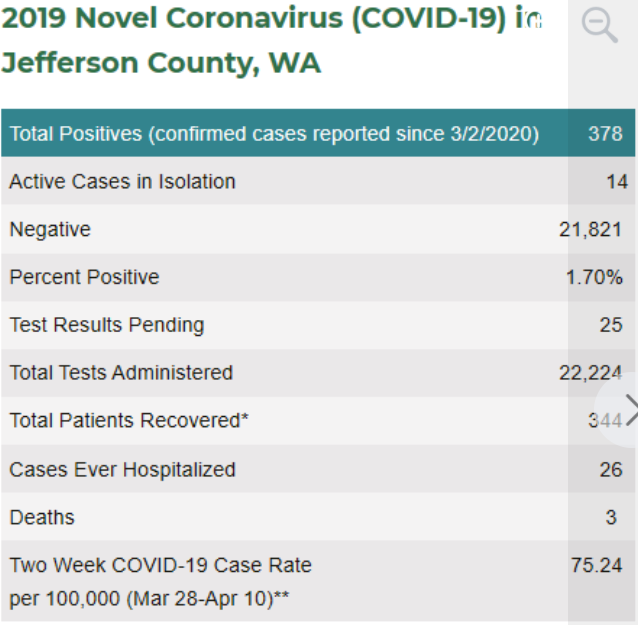
The Leader article continued to say that “The death comes amid a week marked by a steady increase of coronavirus cases nationwide…. In Jefferson County, health officials said the number of confirmed COVID-19 cases rose by 11 over the weekend. Of the 11 new cases, six females and five males tested positive for the coronavirus. The total countywide number of positive COVID-19 tests in Jefferson County Monday was pegged at 374.”
This reporting confuses cases of the disease COVID-19 with positive test results for the virus SARS-CoV-2. Detection of a virus does not constitute a “case” of a disease in lieu of any symptoms, otherwise anyone testing positive for the HIV virus would also count as a full-blown case of AIDS. Moreover, given Jeffco’s unreasonably-high 45 Cycle Threshold for its PCR testing, most of these positive test results may well be false positives. See, “Is Jefferson County Health Department Overstating Covid Case Numbers?” Port Townsend Free Press, 1/25/21.
[Editor’s Note: Our condolences to the family of the deceased. As this death and other deaths being counted as “Covid deaths” are being used to justify restricting the lives and liberties of others it is appropriate to raise questions about whether it is, in fact, a death caused by Covid, and whether it should serve to bolster arguments for extending lockdowns and masking mandates.]
by Jim Scarantino | Apr 20, 2021 | General
“Wow. You people at New Life Church go all out,” said Mike Johnson, who runs Port Townsend’s homeless shelter.
“That’s what Jesus does for us. We just want to spread it around,” replied Melannie Jackson, Executive Pastor of New Life Church as she delivered the days’ hot food and a special treat of “You are Loved,” “You Matter” and “One Day at a Time” cupcakes.
Why do people go out of their way to help the homeless? They don’t know the people they help, who may or may not be responsible for their circumstances in life. Some of the beneficiaries of these acts of kindness may not be the nicest people, or they may be sweethearts simply broken by the weight of a life they cannot shoulder.
The Christian churches that prepare hot meals for residents of the shelter do it because they believe Jesus loves them and wants them to share His love with others.
There are other reasons people help the homeless, other motivations and other agendas. We have a worsening housing affordability and homelessness crisis in Jefferson County that is fast becoming a miniature of Seattle’s situation. More public funds are being chased by groups for building projects, material and salaries. As Christopher Rufo observed in his excellent analysis of Seattle’s example, “Seattle Under Siege,” this creates a perverse incentive: those groups do better when things get worse. Things are getting worse in Seattle, though it annually pours more than $1 billion into the organizations that are supposed to be ending homelessness. That’s nearly $100,000 a year for every homeless individual man, woman and child on Settle’s streets. Yet there are many more people making less than that who are not homeless and hold jobs and build families. They have hard lives, health problems, addictions, and other vulnerabilities. But they have not let themselves or their loved ones join the ranks of the homeless.
Rufo divides the landscape of Seattle’s helpers into four groups. We have the same groups in Jefferson County. I am sure you will associate the names of local activists and officials with each of these categories:
The socialists. “Using homelessness as a symbol of ‘capitalism’s moral failure,’ the socialists hope to build support for their agenda of rent control, public housing, minimum-wage hikes, and punitive corporate taxation.”
The compassion brigades are “the moral crusaders of homelessness policy, the activists who put signs on their lawns that read: ‘In this house, we believe black lives matter, women’s rights are human rights, no human is illegal,’ and so on. They see compassion as the highest virtue; all else must be subordinated to it.”
The homeless-industrial complex are the social service providers who receive the staggering amounts of public funds dedicated to “ending homelessness.” Rufo writes, “When their policy ideas fail to deliver results, they repackage them, write a proposal using the latest buzzwords, and return for more funding. Homelessness might rise or fall, but the leaders of the homeless-industrial complex always get paid….Ultimately, the homeless-industrial complex is a creation of public incentives, constantly on the hunt for bigger contracts.”
The addiction evangelists are “the intellectual heirs of the 1960s counterculture: whereas the beats and hippies rejected bourgeois values but largely confined their efforts to culture—music, literature, photography, and poetry—the addiction evangelists have a more audacious goal: to capture political power and elevate addicts and street people into a protected class. They don’t want society simply to accept their choices; they want society to pay for them.”
Whatever their motivations and methods, whether they get another $100 million or only $1 million, these groups are not producing positive results for Seattle. That city is in a worse crisis every year even though these groups gain more power, influence and resources. None of what they do, Rufo writes, can end homelessness because homelessness is not caused by anything they address as the cause of the problem. It is necessary to quote Rufo at length:
“[T[he reality is that homelessness is a product of disaffiliation. For the past 70 years, sociologists, political scientists, and theologians have documented the slow atomization of society. As family and community bonds weaken, our most vulnerable citizens fall victim to the addiction, mental illness, isolation, poverty, and despair that almost always precipitate the final slide into homelessness. Alice Baum and Donald Burnes, who wrote the definitive book on homelessness in the early 1990s, put it this way:
Homelessness is a condition of disengagement from ordinary society—from family, friends, neighborhood, church, and community. . . . Poor people who have family ties, teenaged mothers who have support systems, mentally ill individuals who are able to maintain social and family relationships, alcoholics who are still connected to their friends and jobs, even drug addicts who manage to remain part of their community do not become homeless. Homelessness occurs when people no longer have relationships; they have drifted into isolation, often running away from the support networks they could count on in the past.”
Missing from the homelessness power and money map Rufo sees in Seattle are churches. They are there, working. They’ve always been at work. But with the annual billion dollars thrown by government at Seattle’s homelessness epidemic, churches seem to have been edged out of the picture, even though what they have to offer may more directly address the forces feeding Seattle’s crises on its streets and public spaces.
It Will Take More Than Cupcakes, or Socks
Food for Port Townsend’s homeless shelter is provided by four or five church groups. They prepare the meals off-site and for the time being just drop it off. There is little more they can do with Covid restrictions in place. The food is set out on tables and residents pretty much help themselves. Before all of the current restrictions, there was more interaction between the Christians and the residents. They made friends, stayed over night, brought residents to church services and classes, took them out for coffee, gave them rides, tried to find answers to their problems. I got to know some of the Shelter’s residents when Marica Reidel, former president of COAST, the coalition of churches supporting the Shelter, invited or brought them to Sunday services.
If what is behind our homelessness crisis is broken people and broken relationships (which comes first?), churches will tell you this is right up God’s alley. Jesus is in the business of fixing brokenness. The Holy Spirit can and will lead people to healing and wholeness.
Those are strange, perhaps offensive statements to many ears, and certainly not the words one hears in the meetings of elected officials or the task forces they have created. We live in a town that is not reluctant to show contempt for Christians and their faith, especially traditional and conservative Christians. One does not have to search long to find local officials mocking Christians on their social media.
But government can’t get it done. Exhibit 1: Seattle.
Our greatest homeless problems seem to be concentrated in the most unchurched cities and areas of this country. That is a reflection of the disaffiliation and disengagement Rufo cites as the driving force in Seattle’s out-of-control homelessness tragedy.
Government, and government-funded programs run by social service agencies, won’t fix the decades of disaffiliation and disengagement that have produced today’s homeless, mental illness and addiction tidal wave. Indeed, as many scholars have shown, government in many ways has created or exacerbated those problems. Vibrant, healthy, sound churches can do much more to address the problem of broken, isolated people than people on government contracts or payrolls.
It would be great if we had a mega-church or even a large church here that could support its own Adult and Teen Challenge Center, a highly successful organization that loudly proclaims its vision of “seeing all people freed from life-controlling issues through the power of Jesus Christ!” The organization has developed a less costly model for areas that cannot support a full residential center, a possibility that may be within reach of our local churches. An energetic Celebrate Recovery program–a Christ-centered 12-step recovery program–is sorely needed in Port Townsend (one has been going in Quilcene for a number of years). Our rural area would be perfect for something like Hope Farms, a residential recovery program for women, many of whom have been victims of rape, sexual abuse, and sex trafficking. These programs work.
The churches behind these programs will insist it is not them producing results. It is God working through them to transform lives. If we truly want to see progress in reducing homelessness and stemming the flow of new recruits to the streets, our secular society needs to put aside its antipathy and respect such statements.
In my limited experience, I’ve seen the benefits of Rescue Missions, a venerable ministry to the homeless operating in many cities. I remember Mark, a young man we found one morning on the loading dock at the back of our church in downtown Albuquerque. He was tweaking terribly. Meth had kept him awake for days. The church brought him in, washed and fed him, gave him some clothes and took him to the Rescue Mission a couple blocks away. I don’t recall exactly how he was enrolled so quickly in their program, but I remember what happened afterwards. He became part of our church family, participated in choir and helped with the weekly feeding of 400 people. The Rescue Mission’s residential program of rigorous Bible study, worship, prayer, life skills training and educational courses was demanding. But it worked. He defeated the streets and worked his way up through an entry level job at a high-rise hotel to be entrusted eventually with the entire operation.
It would be great if we had something like the efforts I’ve described here.
I’ve seen marriages saved, families kept intact, families reunited, children put on the right path, and friendships for life formed in churches. I know of suicides prevented, addictions overcome, and of the lonely and isolated finding a new family that loves them in churches. Government programs don’t and can’t do this. Government doesn’t love. The people you meet in church do because, as Pastor Jackson explained above, they believe Jesus loves them and they want to spread it around.
Revival
Disaffiliation and disengagement have risen as churches have declined. Some churches in the area have dropped their youth and children programs as they’ve failed to attract or keep young families. It may be a revival of healthy, doctrinally sound churches and greater collaboration among the faithful of different denominations that could be the answer to Port Townsend’s growing homelessness, addiction and suicide crises.
Take a look at Seattle. Don’t ever not learn from Seattle. We are still small enough, not yet locked into the errors of that troubled city, that we might still have a chance.
This is not to say government should wrap its arms around churches and fund them. That would be a death embrace. Dependency on government money and the strings that come with it would lead to churches being compromised and losing their truths and power. Look at what European governments have done to churches on that continent. But government can welcome and encourage churches in other ways and pull them more into their discussions and committees. Most churches already have food pantries, homeless outreach and Agape programs–unconditional gifting to help families pay utility bills, rent, buy medicine, etc. They could and should be at the table as respected partners.
Perhaps our small to medium-sized churches could pool resources, or jointly approach one of the national providers of the very successful Christian recovery programs. Or simply come together to buy a car for someone when the cost of the vehicle would exceed the reach of a single congregation.
The excitement about the Port Hadlock Community United Methodist Church welcoming a tiny homes village to its property is a wonderful development. County government showed a willingness to accommodate a unique experiment that did not precisely fit within existing land use regulations. City and county regulations, however, continue to stand in the way of churches doing more. Government could make it possible for churches to provide more services and material support for the homeless by loosening land use regulations. Many Port Townsend churches with large tracts of land are zoned out of doing multi-family or temporary housing. Perhaps a special zoning category for churches/religious organizations could unlock some of that land for very low income and residential recovery program development.
A Fifth Column
Alice Cooper once said that the most radical, rebellious thing he has ever done was become a Christian. Yes, that Alice Cooper.
In a disaffiliating, disengaged society that is producing our rising population of homeless, addicts and the hopeless, a Fifth Column of churches, working behind those enemy lines, sabotaging the forces that push people into despair, building and repairing the bonds that prevent the ups and downs of life from putting someone on the street, this secret weapon may be the only thing that will stem the tide. But it can’t be too secret. It can’t be secret at all.
There’s a lot happening in our local churches already. More is coming. There are many good people here who want to spread the love they profess they know from Jesus Christ. That is the reason they go “all out” for the homeless and others in physical and spiritual need. They’ve watched government try and fail. And it will continue to fail. For government is no substitute for the family and community or the fellowship and friendship of believers that can keep a person afloat in the roughest seas, or pull them out of the water when they are sinking to dark depths below.
(Disclosure: The conversation related at the start of this article came from announcements about the New Life Church homeless ministry. I am a member of that church. I do not intend to suggest that our congregation in any way is doing more or is any better than any other church family. We have much to learn and much, much more to do. Always.)
by Brett Nunn | Apr 16, 2021 | General
For years I have been making the Port Townsend to Coupeville ferry crossing often on a weekly basis. I call it the last great adventure on the west coast available to all. Wind, fog and tides often conspire to make the trip unpredictable.
Yes, it can be an adventure, but it has always been easy, even with the Wuhan virus, until two weeks ago when, on the Coupeville side, I pulled up in my vehicle and found an unfamiliar state employee in the ticket booth. He refused to scan my pre-paid card because I didn’t have a piece of fabric covering my mouth and nose.
I’m not asking for sympathy and I don’t feel the need to explain myself to anyone anymore. I do feel the need to shine a light on how we are being conditioned to give up our freedoms through dictates from state and federal government that are not laws, have not been debated by our political representatives, aren’t supported by scientific research even though the wording in the orders says they are, and often are based, if you bother to look, on nothing more than proclamations made on high by whomever the appointed “expert advisor” of the moment may be.
So what changed on the Port Townsend to Coupeville Ferry route other than the familiar friendly faces in the ticket booth?
You might remember a few months back, with the installation of the new occupant in the Oval Office, a flurry of executive orders. One of these was titled, Executive Order on Protecting the Federal Workforce and Requiring Mask-Wearing. It is a ponderous document ideal for curing insomnia and was pretty much forgotten by most of us as soon as it was signed on January 20. Unnoticed by many, under the authority established with the ruling, Washington State Ferries and the corresponding terminals were identified as part of the federal transportation system.
I read the order and noted that it requires all persons in Federal buildings or on Federal lands to wear masks, maintain physical distance, and other public health measures. Think about that for a moment, all Federal buildings, all Federal lands.
Besides the vast areas that this dictate covers, I will remind you that at the start of this national panic it was wear a mask if you can’t physically distance. Now the executive branch orders us to wear a mask and physically distance. Oh, and one other thing. There is no sunset clause. No end date. So unless someone else is installed as president in the next four to eight years and bothers to rescind this order, we can be required to wear masks forever anywhere the Federal Government and it’s petty tyrants have any influence.
This is only one example of how mass media marketing of China virus fear has been wildly successful in eliminating our freedoms. Think of all we have given up, most of us willingly; family, friends, health, fitness, education, income, jobs, travel, FDA approval of vaccines, and so much more that we have yet to comprehend, for a virus that has been proven to have a 99% plus survival rate,.
You may have thought that living way out on the Olympic Peninsula would insulate us from what happens in the other Washington. I offer my experience as evidence to the contrary.
I was eventually able to board the ferry, but only after a heated back and forth. I played by the rules and stated that health reasons preclude me from wearing a mask. The booth attendant stated that didn’t matter and refused to scan my ticket a second time. I repeated my statement. The attendant threatened to call law enforcement. I shifted my car into park to await the authorities. He made the call and the person on the other end of the line suggested he might scan my ticket from six feet away. He would not extend his scanner outside the confines of his booth. Upon stretching my arm out of my window as far as possible, the scanner read the ticket. I thanked him. He sent me off with the threat that if I persisted in not wearing a mask while seated in my car at the ticket booth, I could be charged with blocking a federal highway.
The whole experience was so completely ridiculous that it should be something to laugh about. It should be, but I am not laughing.
I leave you with this quote from Peter Skurkas writing for The American Thinker.
So today it’s “you shall wear a face mask.” What will the dictate be tomorrow? Perhaps the real story here is that the elites are conditioning Americans for proper behavior under a Harris/Biden administration. That behavior can be summed up in one word. Obey.
by Jim Scarantino | Apr 14, 2021 | General
Hooray for the the Port Townsend Main Street Program! Live music downtown is back!
“Buskers on the Block” music series will bring musicians to play instruments and sing on PT’s streets. The series is part of PT Main Street’s “Love Where You Live Campaign.” The music started April 3 with reed instrument musician Jonathan Doyle and will continue through May, depending on weather. Locations will vary between Tyler Plaza, Haller Fountain area and Uptown. Main Street staff will be on hand with cloth masks for those who want them.
The lead photo was taken April 8 of Buck Ellard, a local favorite with an international following. During recent months, his live shows with Rodger “Crash” Bigelow at Mariner’s Cafe in Sequim have been live-streamed and draw viewers from Ireland, Australia and British Columbia. Buck is one of the best, if not the finest male vocalist on the Peninsula. He knows a thousand country songs. He will be back May 15.
April 10 saw “Fun with Key City Players.
Other musicians are scheduled to play as follows:
April 15 Christian Powers will perform an acoustic set of his originals—with elements of psych rock, modern indie and 60s-70s pop, accompanied by a bandmate.
April 17 Christian Powers will perform an acoustic set of his originals—with elements of psych rock, modern indie and 60s-70s pop, accompanied by a bandmate.
April 22 Flugelhorn Phil plays a variety of blues, jazz and soft rock songs (flugelhornphil.com)
April 24 Jack Dwyer is a multi-instrumentalist, singer/songwriter, and teacher based in the Pacific Northwest. Featuring classic and traditional American repertoire as well as original music.
April 29 Jonathan Doyle is saxophonist, clarinetist, jug blower, bass saxophonist, composer, and arranger.
Before Buskers on the Block, a group of musicians, including the author, had been meeting on the Wings Plaza at Tyler and Water every Saturday for the past month to share music. Those gatherings were part of the Freedom Protests against lockdowns.
Here’s video in a Facebook post of April 8’s live music: Facebook post by PT Main Street Program
by Jim Scarantino | Apr 10, 2021 | General
Calls to police are up 38%. Mental health incidents are up 27%. “Simmer on that for a second,” City Manager John Mauro told City Council at its April 5, 2021, business meeting.
But not a question was raised, not a word of concern was uttered from any of the Councilors. Here’s the link to the video of his report (click on “City Manager Report” on the agenda to get there straightaway.)
There are rarely any questions for the City Manager when he includes in his reports to City Council the number of calls for police. At the April 5 meeting he belittled the attitude that Port Townsend places few demands on its police services. We don’t have crime here, seems to be the fantasy held by a good segment of the community. That’s the fantasy reflected in the naive Nhatt Nichols cartoons on the editorial page of The Leader. The reality is, as Mauro stated, there are about 158 calls to police between his reports to Council.
In its report to the City Council, entitled “21st Century Policing” the Port Townsend Police Department tallied an average of 6,411 calls for service for each of the years from 2017 to 2020. A 38% increase equates to an additional 2,436 calls annually for a police force already short on staff, with sometimes one officer responsible for the entire city. The “21st Century Policing” report was submitted at a time when City Council was examining cutting resources to the police department, even perhaps disarming officers, eliminating the school resource officer position and subjecting officers to other restrictions in their ability to protect and serve. (See our coverage here, here and here.) Council, fortunately for the citizens of Port Townsend, backed off. Good thing, as Port Townsend’s police are now needed more than ever in recent history. One may have to go back to the days of “Bloody Townsend” to find comparable levels of crime, substance abuse, addiction and severe social ills in this little town.
The Leader’s police log reporting, which usually selects only quaint incidents, shows a steady uptick of serious crimes, confrontations with transients and mental health crises. Many of the problems are concentrated in neighborhoods around the Fairgrounds where crime has increased tremendously. As reported here in a review of police reports for 2020 to the end of October, all sorts of crimes are being committed in the homeless/transit camp of the Fairgrounds, ranging from assaults to thefts to drug dealing. After our article was published a 20-year old woman was found by the campground manager face down, dead, cold as ice. In addition to the crimes there are the calls every week for one mental health or substance abuse crisis after another.
The latest information from sources in the campgrounds is that four drug dealers are now operating there. Our past information on the drug dealing was accurate. The name we had for the most active dealer turned out to be a friend of the dead woman. Other information passed on to one of the groups attempting to oversee the Fairgrounds included the name of one of the men later arrested for kidnapping and blinding another man against a backdrop of meth usage and dealing.
The Fairgrounds encampment is becoming a permanent feature of Port Townsend’s landscape.
The problems are not restricted to the Fairgrounds and nearby neighborhoods. Crime is up across the community. Even The Leader has been paying attention with front page coverage of incidents like the kidnapping and torture of a Port Townsend man and the invasion of our county by criminals from elsewhere. We are seeing more burglaries. There are more assaults. Mailboxes are no longer safe from theft (one man pilfered the contents of 50 mailboxes before he was caught). There is a growing perception that Port Townsend today is much less safe than it was a year ago.
Meth use is increasing. With the State Supreme Court’s legalization of possession, a tool police once had for getting addicts into some type of care is gone. Problems related to addiction are on the steady rise.
The famous “Port Townsend Vibe” is experiencing cancelling waves of fear, anxiety, anger and helplessness.
City Council is doing nothing. The City’s growing social ills are never on its agenda.
Port Townsend could barely handle its problems before. We have always lacked the resources and commitment from elected officials to address addiction, substance abuse, crime and mental illness. The problems have been dumped on police and ignored. We don’t have crime here. Port Townsend is not Port Angeles. We’re different. We’re better.
Calls to police are up 38% over last year; mental health incidents are up 27%. Simmer on that for a second.
Related: The Real Epidemic in Port Townsend: Addiction
The Violence that Cost Port Townsend a Man Who Saves Lives
Fairgrounds Police Log