HAAS LASHES OUT AT LAW ENFORCEMENT AFTER FOP ENDORSES KENNEDY [Updated]

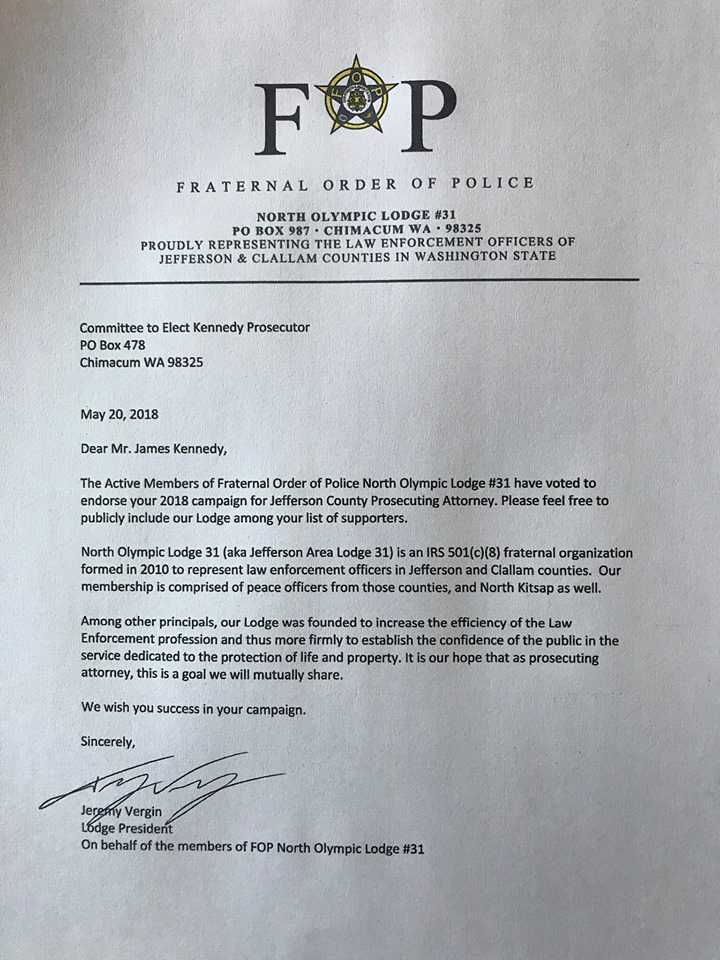
Area law enforcement has broken a tradition of noninvolvement in the Jefferson County Prosecuting Attorney’s race to endorse challenger James Kennedy’s bid to oust incumbent Michael Haas.
On May 20, 2018, the Fraternal Order of Police, North Olympic Lodge #31, issued its endorsement of Kennedy in the race between the two Democrats.  This is reportedly the first time they have ever endorsed a candidate for Prosecuting Attorney.
FOP Lodge #31 represents law enforcement officers in Jefferson, Clallam, and North Kitsap County.
Kennedy’s campaign website also lists individual endorsements from current prosecutors and law enforcement officers and their families.

In response to the FOP endorsement, Haas attacked the organization representing local law enforcement in a post at the Re-elect Haas for Prosecutor Facebook page.

His post links to an article by Paul Butler, a Georgetown University law professor, that attacks the national Federation of Police as a racist institution.  Butler is known for advocating that black jurors refuse to convict black defendants regardless of the evidence.
We asked Haas if he was accusing local law enforcement officers of being racists and how he could work with them as Prosecuting Attorney after this attack.  He has not responded to our request.  We will update this post with any response from Mr. Haas.
Haas’ website lists endorsements from defense attorneys.  We could not identify any endorsements from law enforcement officers or current prosecutors.
In the course of researching this story, we have learned of a growing divide between the Jefferson County Prosecuting Attorney and local law enforcement.  One cause repeatedly mentioned to us has been Mr. Haas’ recent dismissal of rape charges and his treatment of the alleged victim.
On April 26, 2018, on a motion from Haas, rape charges were dismissed against Patrick McAllister.  His previous conviction for rape had been reversed and remanded for retrial.  Haas criticized the previous prosecution and told the court dismissal of the charges without retrial was the right decision to make “legally and ethically.”
Wendy Davis, whose Facebook page identifies her as manager of the Kennedy for Prosecuting Attorney campaign, has described Haas’ handling of that case as “social injustice.”  “In our County,” she wrote on her Facebook page, “women’s and victim’s rights appear to have been set back decades.”  Davis was an employee of the Prosecuting Attorney’s Office when Haas was elected but later resigned.  She is now employed at the Port Townsend Police Department.
Kennedy has accused Haas of failing to protect the victim and acquiescing in highly aggressive defense tactics, which caused Dove House to hire their own attorney and which subjected the woman to unusually intrusive and humiliating treatment.  His charges against Haas’ handling of the case can be read byclicking here.
Mr. Haas has not responded to these accusations.
Port Townsend Free Press will begin looking into the McAllister rape case as this matter will likely surface repeatedly from now until the November election.  We will examine the case file and utilize public records requests and conduct interviews when possible.  Please look for our reporting here.

UPDATE:

Kennedy issued the following statement on Facebook in response to this story:
I understand that this has become rather controversial so I would like to clarify a few points.
1) I am being endorsed by the LOCAL North Olympic Lodge, which only represents members of our LOCAL law enforcement community. This is NOT the national organization, I have nothing to do with them and I do not support the national organizations past endorsements. This is a LOCAL race, so let’s keep things local ok?

2) I did not request this endorsement. I had requested individual officers to endorse me, but many were hesitant. They remember my opponent expressing delight at the opportunity to “fry” a cop, when given the chance. They remember him calling them “keystone kops”, and they also recall his active attempts to get a particular deputy fired and possibly criminally charged after he took office. Consequently, many officers thought it would be better for them to show their support by having their local lodge endorse me, which I graciously accept.

3) I received this endorsement because I fostered an atmosphere of mutual trust and respect with our local law enforcement. That does not mean we see eye to eye on everything all the time, but that we can approach each other honestly and as professionals to find ways to make our respective departments work better. You simply cannot successfully serve the public as Prosecuting Attorney while having an openly hostile relationship your law enforcement community. That helps no one.

SEATTLE’S TAX ON JOBS COULD BE JEFFERSON COUNTY’S GAIN [Updated]

SEATTLE’S TAX ON JOBS COULD BE JEFFERSON COUNTY’S GAIN [Updated]

Area legislators indicate support for tax credit for economically depressed counties.
But Tharinger ridicules.

Jefferson County could use a break.  A Pierce County legislator wants economically struggling counties like Jefferson to get a tax credit equal to the new tax on jobs recently passed in Seattle.

Even more ambitious plans to help rural counties may be in the works.

Senator Steven O’Ban, a Republican representing Pierce County, aims to stimulate rural job growth through a $275 business and occupation tax credit to employers for each new qualifying job they create in those counties suffering the highest unemployment rates.  To qualify for the credit, a job position would have to pay more than the county’s average wage.

O’Ban is preparing the legislation for the 2019 session and wants the credit to take effect next year.

O’Ban’s proposal comes in response to Seattle’s imposition of a $275 tax on full-time jobs at the city’s large employers.  Business leaders and legislators have expressed fears that the adverse economic effects of the tax and the hostility being expressed against the city’s successful businesses could ripple across the state.  “Washington shouldn’t lose jobs because our largest city’s tax policy punishes job growth,” O’Ban says on his official website.

“Our rural counties have low cost housing and a low cost of living,” he said in the press release announcing his plan.  “Concentrating our jobs in one metro area isn’t in the best interest of the state.  It benefits everyone to encourage companies to move out into rural areas.  No one’s going to have to sit in a two-hour commute or pay a toll in Aberdeen.”

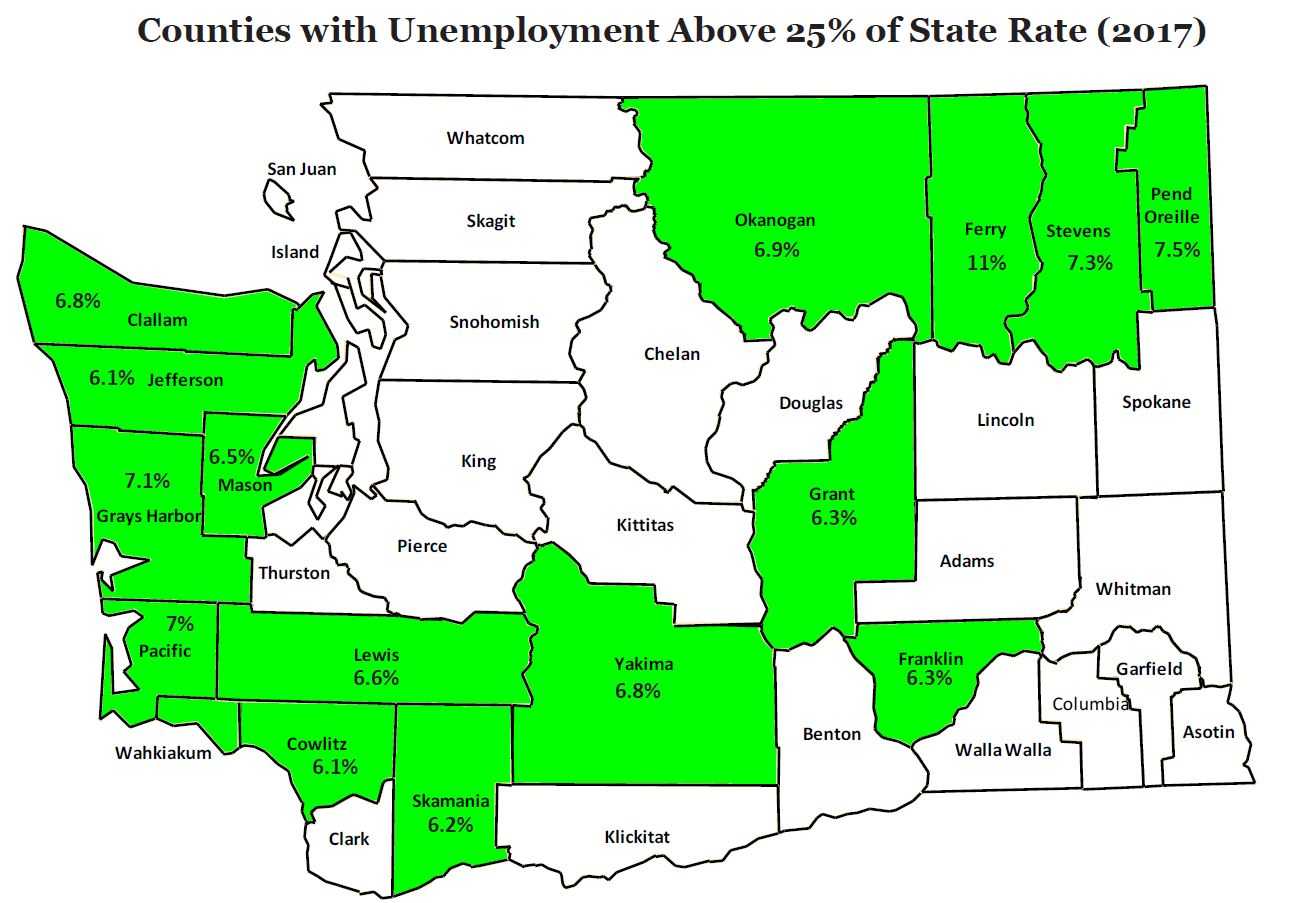
Or Jefferson County, which is suffering an unemployment rate of 6.4%, almost 30% higher than the state average of 4.8%.

Jefferson County also suffers from low wages.  According to the Washington Employment Security Division, the average annual wage in Jefferson County was $36,381, far below the state average of $59,073.

Other counties shown in green stand to benefit under O’Ban’s legislation.

Pierce County recently announced its intention to extend a tax credit for each “family wage” job created.

Port Townsend Free Press reached out to the legislators representing Jefferson County for their response to O’Ban’s proposal and found qualified support for the idea, no outright opposition and even more ambitious plans to boost rural economies.

Mike Chapman(D), State Representative for District 24, said in a written response to The Port Townsend Free Press:  “While this may seem like a good idea to spur economic growth in rural Washington, and while I would probably vote for it if the bill makes it through committee and comes to the full House for a vote, as the Chair of the House Democrats rural economic development team it is not an approach I would champion.  I’m much more committed to long-term, permanent B&O tax reform. A reform I’ve been working on the first two years I’ve been in the Legislature would eliminate all B&O tax for about 80% of the businesses in Washington and even a higher percentage in the 24th Legislative District and all of rural Washington. This reform would spur economic growth, provide meaningful tax relief and lead to increased wages and new jobs in rural Washington. It’s a heavy lift, for sure, but one I remain committed to as long as I’m serving in the Legislature.”

Senator Kevin Van De Wege (D), through his Senior Communications Specialist, Rick Manugian, released the following statement:  “Good local jobs always have been, and always will be, my number-one priority. I look forward to working with my colleague, Sen. O’Ban, and others on any efforts to create jobs.  We have some options for tax credits in this state, and Rep. Mike Chapman has been a leader in small business tax credits. I’m especially supportive of Mike’s efforts because his knowledge of our district puts him in a position him to devise solutions that could create jobs that may be more relevant and practical for our local communities than a statewide, one-size-fits-all approach. We are fortunate to have Mike working for us.”

Steve Tharinger (D), State Representative for District 23, did not respond to our request for his views in time for the first publication of this story.  We have since received his response and here it his.  He sets himself apart from his challenger, Jim McEntire, whose position follows at the end of this report:

Writes Tharinger:  “Creating jobs and opportunity in rural Washington is my top priority. It’s been a pleasure working with my seatmate, Rep. Mike Chapman, who’s leading the effort on rural development. What we’ve learned from touring the state and attending economic development summits in places like Aberdeen, Moses Lake and Port Townsend is that real progress requires a combination of solutions. You need a skilled workforce, better infrastructure and health care along with incentives like tax credits. As chair of the House Capital Budget Committee, I’ve focused my energy on building that infrastructure, including schools, colleges and parks, along with more funding for rural broadband.

“Senator O’Ban’s  $272 per head tax incentive is just a symbolic poke in the eye of Seattle not a real pragmatic solution for rural economic development. We need more pragmatism less symbolism in addressing the  challenges of the job creation in rural Washington.”

Chapman is being challenged for re-election by Republican Jodi Wilke.  She issued this statement:  “Steve O’Ban has provided a clever and appropriate answer to Seattle Democrats’ tax on family wage jobs, commonly referred to as the ‘head tax.’ The bottom line? If you don’t want those jobs, we’ll take them. I couldn’t agree more. As an opener this proposal offers a solution that’s a win for all concerned, except maybe Seattle. Does it solve all of the problems we should address with the B&O tax? No, but it does provide an answer to companies who’ve been given the cold shoulder in the Emerald City–the rural counties love you and we’re open for business!”

Tharinger’s Republican challenger, Jim Mc Entire, issued this statement: “I ‘ve looked at Senator O’Ban’s proposed jobs Business and Occupation tax credit and I like it very much.  I’m in favor of any and all workable ideas to encourage good-paying jobs in high unemployment counties like the three in the 24th Legislative District.  Well done Senator O’Ban!  Further, this is the opposite of the family-wage job-killing tax recently enacted by the Seattle City Council and Mayor.  What were they thinking?”
CHERRY STREET “AFFORDABLE” HOUSING TO COST MORE THAN $2 MILLION

CHERRY STREET “AFFORDABLE” HOUSING TO COST MORE THAN $2 MILLION

$401 per square foot……$167,196 per bedroom……$250,794 per apartment……and counting……

The City of Port Townsend is financing some of the most expensive residential construction in Jefferson County in the name of “affordable” housing. Costs have grown far above early estimates and now a hidden subsidy has pushed the projected price of the Cherry Street project over $2 million.

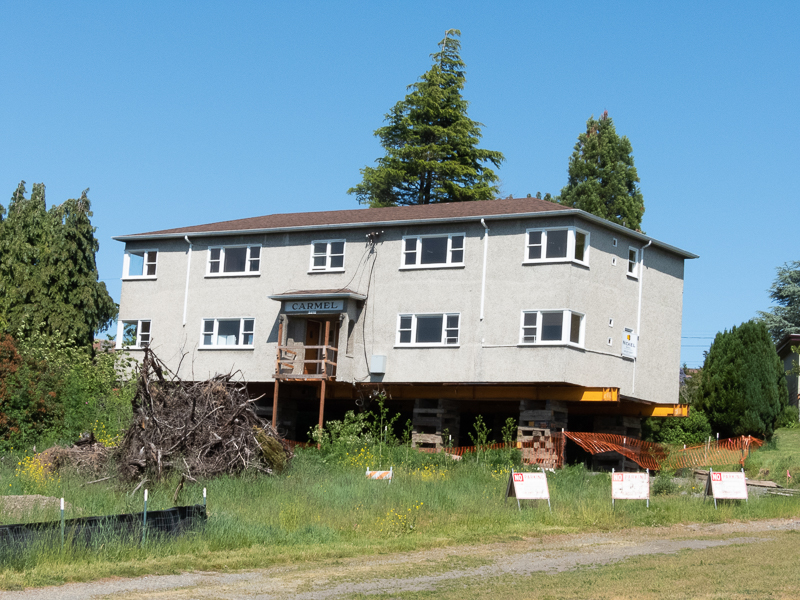
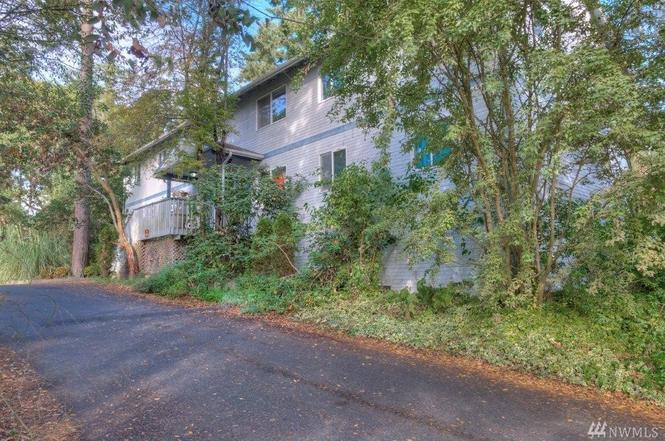
The mid-Twentieth Century building was purchased in Victoria, B.C., barged across the Strait of Juan de Fuca, hauled through a city that had stopped traffic and taken down utility lines, and settled on stacks of wood on May 10, 2017. This is what it looks like more than a year later. It remains unoccupied and without a foundation.

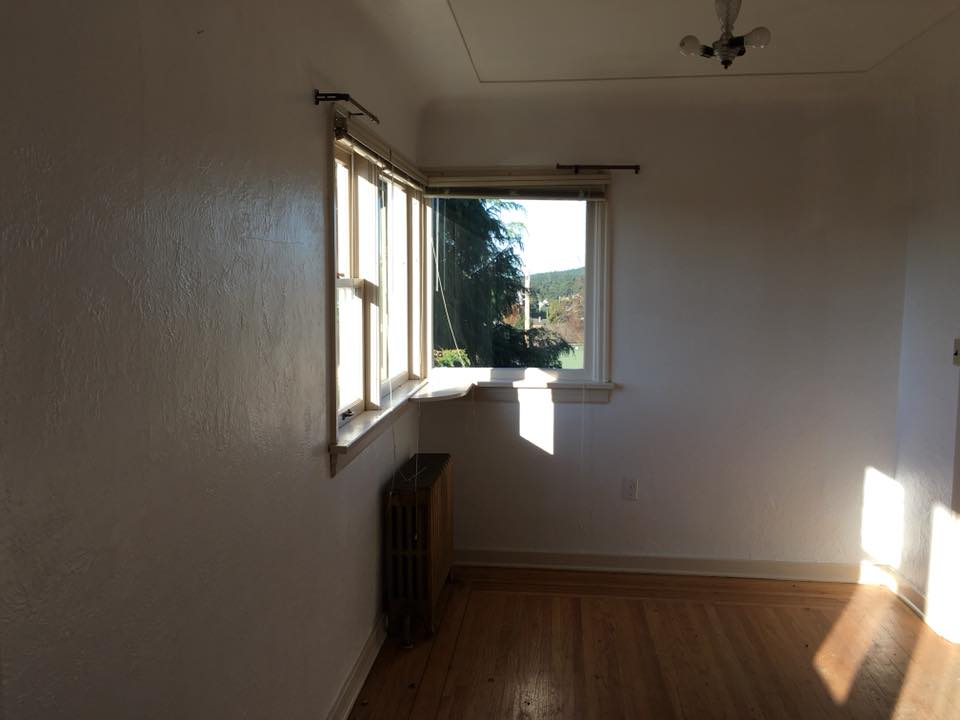
Four new one-bedroom apartments are to be added under the building, in addition to the four two-bedroom units already there.

The cost of the project has grown dramatically.

The first reported total cost was $475,00.  That was April 2017.

In September 2017, David Timmons, PT’s City Manager, said the total cost of the project would be $672,689.  That included a $250,000 loan to Homeward Bound Community Land Trust, a then defunct non-profit that would own and operate the building.  Timmons did not include the land in the estimated project cost.  The 1.36 acre parcel of City-owned land was sold to Homeward Bound for only $1.  Records reviewed at the Development Department Services reveal the land had been appraised at $600,000.

Timmons and the City resisted including the cost of the land in the project cost, even though Michelle Sandoval, a city councilor and prominent realtor, has described that land as “valuable.”  The Port Townsend Leader initially also excluded the value of the land in its reporting on the project’s cost.  The Jefferson County GOP, in a complaint to the city regarding the delay in giving the building a foundation and the unstable appearance of the wood stack supports, was the first entity to insist that the value of the donated land be included in the project’s overall cost.  (The author of this article was part of that effort).  Subsequent to the GOP’s complaint, The Leader began including the cost of the land in its reporting.

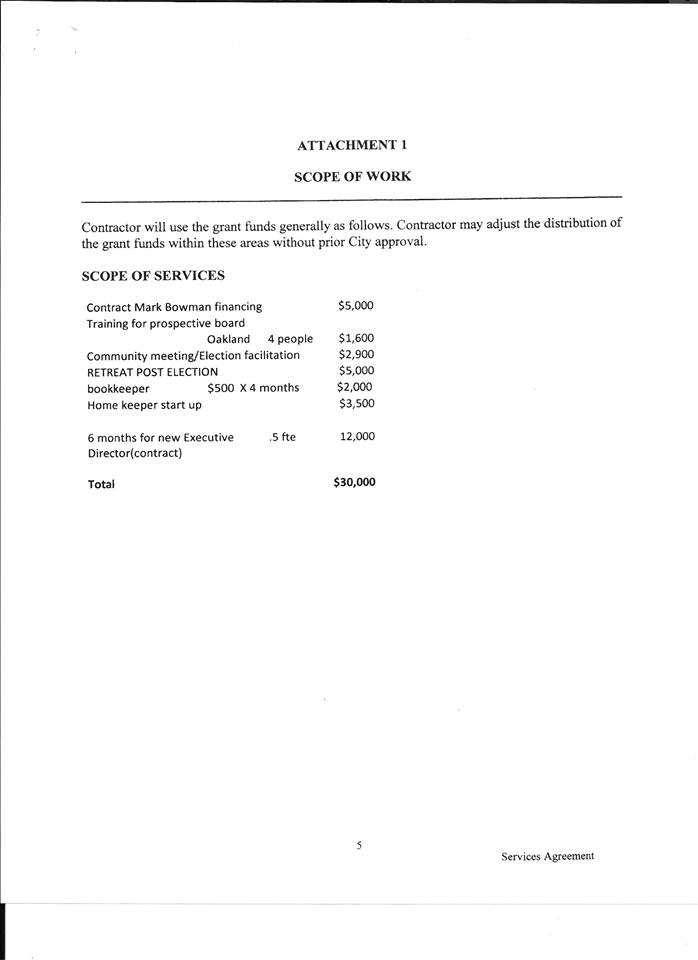
Homeward Bound couldn’t do anything without getting organized.  They were well-meaning people but were in disarray.  They had never undertaken anything of this scale and they needed help.  The City gave them $30,000 to get going.

Fast forward:  May 7, 2018, it is a business meeting of the Port Townsend City Council. (The video of the relevant portion of the meeting can be watched here).  Homeward Bound cannot get a loan to finish the project unless the City acts as guarantor.  To be in a safer position, the City decides to borrow what is needed itself, issue a bond to get it done, then issue a line of credit to Homeward Bound to be repaid over 40 years out of rental income from the project.  The line of credit also replaces the initial loan to Homeward that had already been extended until the end of 2018 because the group had no assets or income with which to pay its debt.  See Agenda Bill AB19-053.

It is a good deal for Homeward Bound.  They have no skin in the game.  If they default or fail to operate the project as affordable housing, they only have to give the property back to the city  (the “reverter” agreement).  Nobody is personally responsible.  Better yet, Homeward Bound need not make any payments for the first two years.

The costs to be covered by the City’s line of credit to Homeward Bound have now ballooned to $834,000, which includes a $130,000 contingency.  That is only the principal amount of the bond.(The City has not conducted its own cost projection and is relying exclusively on numbers provided by Homeward Bound).

Remember, there are other costs that must be added in.  The Leader finally tried getting the math right, concluding that total cost of the project could reach $1.6 million when all costs–such as acquisition, transportation, construction, land and financing–are included.  That came to $200,000 per unit, or $133,333 per bedroom.

But there’s more: Almost another half million dollars from taxpayers will pour into these eight apartments.

About That Hidden Subsidy

At the May 7, 2018 Port Townsend City Council business meeting, City Manager Timmons revealed that the loan between the City and Homeward Bound needed a “subsidy to make the numbers work.”  In other words, after the building was finished and fully leased, it would not generate sufficient income for Homeward Bound to cover its debt.  Over the course of the meeting Mr. Timmons explained that there was a $400,000 subsidy, a form of free financing or debt forgiveness, folded into the agreement.  He also called this “an indirect grant.”

Later in the meeting, he said the subsidy came to $413,000.  But according to the Agenda Bill which provided the statement of the project financing, the subsidy would actually be $451,115.

The vote to issue and sell the bond and make the loan to Homeward Bound was 5-1, with only councilman Robert Gray voting “nay.”  Councilwoman Michelle Sandoval was absent.

The total cost of the bond approved by City Council, as documented on the bond repayment schedule, comes to $1,367,355.  That is the amount the city is obligated to repay.  Add in the value of the land ($600,000)  and the organization grant ($30,000).  The City has also donated free water line work, but we have not seen that reduced to a dollar figure and thus cannot include that expenditure in this tally at this time.

Based on what we know for sure:

The tab for the eight apartments is projected to reach $2,006,355.

—$2,006,355—

Looked at another way, that is $250,794 per apartment.
That is $167,196 per bedroom.
Estimating the Cherry Street project at 5,000 square feet (as reported by the Leader), the cost for the “affordable” Cherry Street project is $401 per square foot.
$401per square foot makes the Cherry Street project one of the priciest residential structures in the area.  It puts these apartments for low and very low income renters in the luxury housing category.  A search of Zillow and Redfin listings for Port Townsend found only two properties that came with a higher cost per square foot than the Cherry Street “affordable housing” project.  Both those homes–they could be called mansions–are less than twenty years old and located on bluffs directly over water that offer million dollar views.

Apartment Hunting

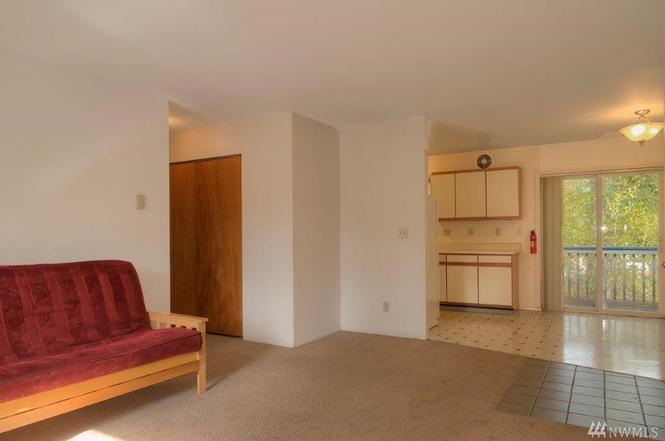
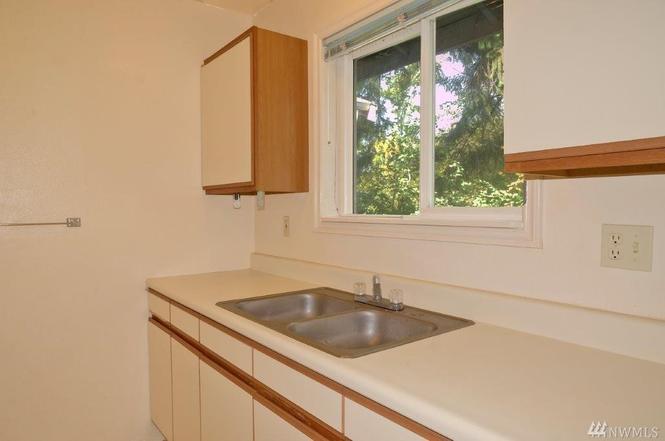
Not far from Cherry Street an apartment complex with 12 3-bedroom apartments (36 bedrooms) is for sale for the asking price of $1.5 million.  It is approximately forty years newer than the Cherry Street building.

In November 2017, City Manager Timmons said the Cherry Street project could have its foundation finished in four months.  Seven months later, no work has begun.

NEXT MONDAY:  Why It Matters