Setting the Guilty Free; The Conclusion of Dumping a Rape Case and Its Victim; State of Washington v. Patrick J. McAllister

Setting the Guilty Free; The Conclusion of Dumping a Rape Case and Its Victim; State of Washington v. Patrick J. McAllister

Jefferson County Prosecutor Michael Haas had a stronger case on retrial than the one that had sent Patrick McAllister to prison 6 years earlier.  At the same time the defense case had gotten weaker.

But Haas threw the case away, turned loose a man with a long history of sexual assaults and revictimized the young woman who had looked to him for justice.

To read the reports leading up to this final installment, please click here.

McAllister’s Defense Stood on a Lie about an Artificial Knee

 The Sheriff’s sergeant who responded to SL’s 911 call from McAllister’s Brinnon home has said she was the most terrified person he has encountered in his career.  After she was removed from the house she began to trust the strangers trying to help her.  Her story of 6 weeks of almost daily rapes, sometimes more than once a day, emerged.  She spoke Waray-Waray, a little Tagalog and very little English.  She moved into Dove House, Port Townsend’s domestic violence shelter. Counselors helped her talk about what happened.

Her story came in fits and starts.  Details and dates translated into English were at times confused and conflicting, but the central facts never wavered.

A medical exam found lesions and evidence of bruising, injuries consistent with rape. The woman who said that she had been a virgin before that first rape in McAllister’s house also now had an STD.

McAllister at trial in 2012 limped to the stand and testified he could not possibly have raped SL. He had an artificial knee that “didn’t work right” and the ankle of the same leg had been injured.  SL had testified that he would sometimes kick her.  She testified he had raped her against the wall when she went into the bath to shower.  He said her story was impossible because of his artificial knee.

This was the first time McAllister had said anything about an artificial knee.  The best the prosecutor managed in closing was to mock McAllister for not presenting medical records or a physician to corroborate his last-minute claim.

Despite inconsistencies in SL’s account and a long delay in conducting a rape exam, the jury found McAllister guilty.  He was sentenced to 250 months in prison.

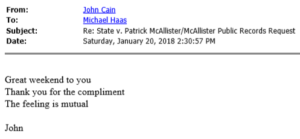
The case was twice upheld on direct appeal.  In a third round, McAllister’s new attorney, John Cain, argued that the trial lawyer had incompetently failed to buttress the artificial knee defense with medical testimony.  Cain had a doctor ready to testify McAllister could not have raped SL because of that artificial knee.  We have reproduced above a key part of that proposed testimony.  The doctor was also willing to testify that the limited range of motion caused by the knee replacement made SL’s story about McAllister kicking her and raping her in the shower impossible.  McAllister, he was willing to testify, could not get into and out of a bathtub without assistance because of his artificial knee.

Problem is, it’s all a lie.

McAllister did not get his artificial knee until a year after the alleged rapes. Indeed, he did not see a doctor about any knee problem until he knew he was under investigation.  The rapes reported by SL occurred in March and April 2010.  The medical records state McAllister:

Haas had this powerful evidence that McAllister was fabricating his main defense.  It was in the medical history attached to the summary of the expert’s proposed testimony.

Here’s more:  McAllister’s attorney perhaps inadvertently disclosed records referring to surveillance videos of McAllister shortly before the alleged rapes. The surveillance had been conducted in connection with McAllister’s claim of a workplace injury.  They show him walking normally when he did not think he was being watched.  They are discussed by the Court of Appeals. Haas knew about the videos but never obtained them for McAllister’s retrial.

And more:  Shortly before SL arrived from the Philippines, McAllister pleaded guilty to sexually assaulting a woman he picked up at an Alcoholics Anonymous meeting.  They went to a bar to go dancing before he brought her to his home where he assaulted her.  Haas never contacted that woman to contradict McAllister’s immobility defense.

And still more:  In his guilty plea in that case, McAllister admitted the facts in the police report as the factual basis for his guilty plea. That report states he had raped three other women he had met at AA meetings.  Haas never contacted those women to contradict McAllister’s physical incapacity claims.

Yes, more:  McAllister’s hired expert contended McAllister could not get into a bathtub without assistance.  But before SL arrived, McAllister lived alone.  Photographs of his house show no ramps, no handrails, no modifications of bathtubs to accommodate mobility limitations. Someone who could not get in and out of a bathtub without assistance would have had great difficulty maintaining McAllister’s mountainside property.


          

It goes on:  McAllister had hiked with SL in the valley above Brinnon.  He took her all over Seattle.  The man who couldn’t bend his leg swam at a resort in the Philippines.

Haas had all of this to destroy McAllister’s fabricated defense, and threw it away.

STD Sleight of Hand

 Early in his efforts to persuade Haas to drop the case, Cain provided test results showing that McAllister did not have an STD.  SL had an STD.  She said she had been a virgin before McAllister. Therefore, the argument went, she got the STD from him.  But a test showing McAllister negative for an STD made SL look like the liar and cast doubt about the rest of her statements.

Problem was, it was a test for the wrong STD.

Cain had sent Haas a test for Chlamydia.  SL had not contracted Chlamydia, but HPV, human papillomavirus.  It is the most common STD in the United States, particularly among sexually active men, as was McAllister.

Curious that a defense lawyer would order a test for only the wrong STD, a determined prosecutor might ask for all medical records to see if anything was being held back.  McAllister’s medical records from five years in prison, where STDs are of particular concern, could have been examined.  Instead, Haas was snookered into believing that McAllister was free of any STD.

Willing Surrender

In his motion to dismiss, Haas told the court that the first jury should never have heard evidence of SL’s vaginal bruises and lesions because they could not possibly have been caused by McAllister.  How could he know with such certainty?  There was nothing to explain those injuries except McAllister’s violence.

Haas had retained no medical experts to work with him.  He made this assertion based solely on the statement of an expert hired by McAllister’s lawyer.  That expert had never examined SL.  He had never been questioned by Haas.  His work had not been evaluated by a medical expert not being paid to help keep McAllister out of jail.

McAllister’s expert witness was not qualified in forensic medicine.  He did not practice in the field of trauma diagnosis and treatment.

The opinion was founded on the single assertion that all signs of bruising disappear in two weeks or less. Period.  No exceptions.

A simple Google search by Haas would have revealed this blanket assertion to be problematic.  It depends very much on the individual and the nature of the injury.  Women take longer to heal. Organs and sensitive areas take longer than arms and legs. SL had testified the rapes happened almost daily, sometimes more than once a day, for about six weeks, and McAllister would take pills to keep or cause an erection.  She is tiny.  McAllister is a much larger man.  The sustained, repeated trauma was inflicted on very sensitive parts of her body.

Haas did not even try to keep this important corroborative evidence.

The Defense Lost Its Motive Argument

McAllister had to explain why SL would be making this all up.

At the first trial, his lawyer argued that this young Filipino woman had studied US immigration law and learned about the “U Visa.”  The argument went like this:  she agreed to marry McAllister to enter the country on a finance’ visa.  She moved into his house knowing his long history of sexually assaulting women because it fit her scheme, even if it exposed her to danger.  His criminal history would make her allegations of rape credible when she sprang her trap.  She endured, waited six weeks, then called 911 alleging rape and abuse.  She no longer needed to marry McAllister. She could stay under a “U Visa,” which ensures that victims of domestic abuse remain in-country to cooperate in the prosecution of sexual offenders.

Sound implausible?  The first jury thought so.

This was the only motive McAllister’s lawyers could concoct.  Now it was gone.

Eight years later SL had not changed her story.  She wanted McAllister punished for what he did to her. She now had a green card that did not require her testimony about rape and abuse. McAllister had no way to explain why she would still be lying.

Conclusion:  Injustice, Incompetence, Indifference

A jury had once found SL credible, beyond a reasonable doubt.  Years later, with her memory fading, Haas nonetheless found her “very credible,” as he said in an email to Cain.

He had a stronger case than the prosecutor before him.  The defense’s already lame case could no longer even limp to the witness stand.

In losing the Court of Appeals argument Haas had the evidence that McAllister was lying about the artificial knee defense, but never brought it up.

The records we have examined show Haas never was serious about retrying McAllister.  He started talking with Cain about dismissal from the moment the case was returned to Jefferson County.  In October of 2017 he told Cain he could not dismiss the case only for the reason “it was too big.”  Yet, he did nothing to try to win.

Months went by, until March 6, 2018, when he finally spoke with SL about the facts of her case fast coming up for trial.  He had a problem.  She would not go away.  She wanted justice.

Cain gave him an out.  In February he sent Haas a polygraph he had arranged for McAllister. Even though McAllister was lying about his artificial knee defense, somehow he passed.

Washington courts have “consistently” recognized polygraphs as unreliable. That is why they cannot be used in court. Sociopaths pass.  It has been shown that prisoners can train themselves to pass polygraphs. (McAllister displayed distress and breathing difficulty from alleged shoulder and arm pain that got worse during the exam).

Haas turned to trained polygrapher Detective Joe Nole of the Sheriff’s Office for advice.  We requested all of the communications between them on this subject.  The response to our public records request from Haas was oddly scant.  He dropped this case in large part because, as he told the court, he “could not ignore” the polygraph. Yet the records he produced contain no written report or memoranda on the reliability of McAllister’s polygraph examination.

The polygraph examination reveals reason to be skeptical.  The examiner asked McAllister if he had ever tried to get a woman “to do something sexual she didn’t want to.”  McAllister was also asked, other than SL, “in the past 20 years have you treated any woman in an abusive manner?”  And, “have you made any woman feel abused or threatened.”

McAllister answered “no” to all these questions.  Yet, he had pled guilty to sexual assault in 2009, admitting as part of his plea a report he had raped three other women; he had been arrested in Kitsap County for rape; and five women had taken out restraining orders against him because he was “violent, abusive and controlling.”

Detective Nole agreed to speak with us.  From what he was provided to review he confirmed the exam did not detect deception. But that was far as he would go. He says he told Haas to pass this along to McAllister’s lawyer.  “Let’s see how confident they are.  Tell them, ‘Let Joe test you.’”

But even more importantly, Nole, like any good polygrapher, cautioned Haas:  Don’t rely on this polygraph to make any decision.  They are not that reliable.

Haas told none of this to the court when he moved to drop the charges.

Haas notified SL by email that he was turning loose the man she says raped and beat her.  In that email, he said he believed her, though the very next day he would tell the court he had to believe McAllister because of the polygraph.

We were not sure how to write the conclusion to this series of reports on how Michael Hass dumped a rape case and its victim. Then it was provided for us. Just as we were struggling for the right closing words we received an email from SL’s brother.  He wrote to let us know that SL was filing a complaint against Haas with the Washington State Bar Association.

[This article has been edited since initial publication for clarification and to correct typographical errors]



Alone and Unprotected; Dumping a Rape Case and Its Victim Part 3; State of Washington v. Patrick J. McAllister

Alone and Unprotected; Dumping a Rape Case and Its Victim Part 3; State of Washington v. Patrick J. McAllister

She couldn’t tell the prosecutor from the defense team.  When SL walked into the room where Jefferson County Prosecutor Michael Haas had told her to appear for a deposition, she saw men so friendly with each other she felt isolated and alone.  She had never met Haas.  They had spoken for the first time ten days earlier.  He had informed her she would have to appear at the Tacoma offices for the lawyer representing Patrick McAllister, who had previously been convicted of raping and assaulting her over a period of six weeks in 2010 and was facing retrial.

She had asked Haas to meet with her, to help her prepare to talk again about terrible things she had been trying to forget.  She wanted to do a good job.  She wanted to see McAllister brought to justice.  But Haas would not help her get ready.  All he did was send her a pile of paper she didn’t have time to look at until thirty minutes before the deposition started.

The deposition lasted over four hours.  The transcript reveals only a single break of some minutes.  It went through the lunch hour, but SL was not given a chance to eat.  It was a grueling, difficult experience.  She was taken again through the rapes, starting on March 18, 2010, when she arrived from the Philippines, a young woman from a small, remote village on the Island of Leyte.  She then spoke and understood very little English.

She had met McAllister through her sister’s husband, an American.  They had spoken by telephone then McAllister had visited.  The men in her family guarded him at night because their poor house was lacking walls.  McAllister grew weary of the village.  He wanted to go to a resort.  SL’s father came along to chaperone.  He made them all sleep in the same room, with his daughter in his bed.  After this he agreed to let her marry McAllister.

McAllister lied about his prior convictions for sexual assault to get SL through customs. (See this report by the Seattle Post-Intelligencer.) He brought her to his Brinnon house (shown above) and the rapes began.  She says that almost every day he forced intercourse upon her.  He grabbed her neck and made her perform oral sex.  He beat and kicked her.  She tried pushing him off, but was overpowered.  She is tiny.  She stands not much taller than a grocery cart.  McAllister had been an iron worker and weighed 170 pounds.

She was raped in the living room and bedroom, beaten in the kitchen, kicked for no reason while she was doing the cooking.  When she locked the bathroom door to take a shower in peace, she says McAllister got the door open and raped her in the bathtub, pinning her against the wall.

She became sore and bruised; it didn’t matter.  When McAllister needed a boost , she says, “he took a pill to make his penis strong.”

McAllister tried to keep her isolated. She was scared to use the telephone—until the day she found the courage to call 911 and ask for help in getting out of his house.  The Sheriff’s sergeant who arrived at the house says she was the most terrified person he has encountered in his law enforcement career.

She answered all the investigator’s questions, never backing down.  Sometimes she asked the meaning of words or couldn’t remember exact dates.  But she always answered, no matter how humiliating the question.

Haas did not help.  He never called for a break.  Contrary to the rules on depositions, he let an investigator grill SL.  He did not stop questions about relationships before and after the incidents.  She was made to name her current boyfriend.  She was made to state the age at which her menstruation began.

SL had asked DeeDee Spann to be present and Spann was there, but only as an observer. Spann was a victim/witness advocate in the Prosecutor’s Office.  She had previously worked at Port Townsend’s domestic violence shelter, Dove House, where SL had stayed and received counseling after she fled McAllister.

Spann was so upset by the mistreatment of SL that with Haas’ Chief Deputy Prosecutor, Julian St. Marie, she sought a judicial order to stop it from happening again.

The motion was necessary because at the end of the deposition, Haas had agreed to give the defense lawyer and his investigator another shot at SL.

Highly Irregular

James Kennedy, a prosecutor in Clallam County and a former prosecutor in Haas’ office, has severely criticized Haas for letting any of this happen.  He is challenging Haas in the November election.  He says that prosecutors should always fight to keep a rape victim from going through something like this.  Haas’ predecessor, Scott Rosekrans, who won the initial rape conviction of McAllister, agrees.

Haas might dismiss their concerns as politically motivated.  But members of his own office also felt that the deposition he permitted veered out of bounds.

Before the second deposition could occur, Spann and St. Marie went to court to try to stop what Haas had agreed to.

Spann told the court that SL “was visibly distraught and tearful at times.”  She described the questioning as “relentless and with a very accusatory tone.” The transcript shows that Haas never called for a break to allow SL to compose herself.  He never objected to the investigator’s conduct.  To the contrary, at several points in the deposition he cracks jokes and makes light-hearted small talk with McAllister’s team.

In her motion, St. Marie argued that the sole purpose of the questioning was “bad faith” and intended “to annoy, embarrass or oppress the victim.”  She pointed out that SL’s relationships before and after the rapes were matters placed off limits by Washington’s rape shield laws and that only lawyers are permitted to take depositions.

Haas has not answered our questions as to why he arranged for and allowed SL to be subjected to such an ordeal.

We asked Rosekrans, who knew SL well from the first trial, why Haas would let the victim he was supposed to be standing up for be subjected to such mistreatment. .

“He must have been hoping she would be worn down and go away,” Rosekrans answered.

If that motive explained Haas’ otherwise inexplicable behavior, it didn’t pan out.

Instead of being worn down, SL demonstrated strength and determination.  Yes, she would endure another deposition.  She would do what it took to see that McAllister was retried.  “I wanted to go to trial,” she has told us.

The case was set for May. Haas was not prepared.  He had retained no expert witnesses nor interviewed any defense witnesses.  He had not secured key evidence that would destroy McAllister’s credibility.  He had not enlisted the assistance of the detective in charge of the case.  He had not even notified SL and her sister, two of the only four witnesses he had named, to make arrangements to travel to Port Townsend.  He had to do something.

Based on our interviews of SL and her brother, and a review of Haas’ correspondence and pleadings, what Haas did was avoid SL.  He never met or spoke with her again before he dropped the charges.

Our next report will show that Haas cut loose a violent, dangerous man when he had a stronger case than the one that sent McAllister to prison six years earlier.

Part 1 of “Dumping a Rape Case, and its Victim”

Part 2 of “Dumping a Rape Case, and its Victim”

The Conclusion of this series, on how Haas threw away evidence that showed McAllister’s defense was a fraud

and, related:

The Questions Michael Haas Won’t Answer

The Questions Michael Haas Won’t Answer; State of Washington v. Patrick J. McAllister

Michael Haas has refused to answer any questions on how he handled the case of State versus McAllister and the woman at the center of that rape case.  As reported previously, Haas dismissed the charges without ever first telling the victim.  He did not speak with her for eight months after getting the case, and then only ten days before her deposition.  He refused to meet with her beforehand, and, as our next report will show, failed to protect her from impermissibly intrusive questioning by an investigator who should not have been allowed to interrogate her in the first place.

Our last report will show how a competent attorney would likely have succeeded in convicting Patrick McAllister.  Contrary to Haas’ representations to the court, without his doing anything, his case had grown considerably stronger and not weaker.  He had much more to work with, thanks to McAllister himself and his attorney.  Instead, Haas dumped the case and dropped all charges against a man with a long history of violently and sexually abusing women.

It is our policy to always contact the subject of a story before publication.  When we receive written answers, we publish them verbatim.

We have twice contacted Mr. Haas with questions and an open invitation for him to speak.  We would say he might have ignored us.  But he has made it clear he is refusing to answer any questions.  On his campaign website, after we invited him to comment on our reporting, he issued a statement accusing us of “mis-stating” facts–but not stating what it was he contends we got wrong.  He also stated he would be answering no questions.

So that our readers know we have attempted to investigate this case fairly and thoroughly, while giving Mr. Haas full opportunity to tell his side, here are the questions we have put to him which he will not answer.  We have summarized then from two lengthy emails to Mr. Haas:

  1.  Has he ever spoken with SL to explain why he dropped the case even though he told her he believes that she was raped and assaulted?
  2. Why did he allow a non-lawyer to interrogate her, why did he require SL to travel 100 miles roundtrip to the defense lawyer’s office, why did he not insist she get a meaningful break during the over 4-hour interrogation and why did he not stop the investigator from asking questions prohibited by Washington’s rape shield law?
  3. What did he do to prepare his own case for trial?  Why did he not obtain assistance from the Sheriff’s office to investigate the defense’s claims and its witnesses?  Why did he not obtain expert help to assess the credibility and accuracy of medical experts the defense intended to call as witnesses?
  4. Did he ever speak with the detective who had conducted the investigation of the rape and assault charges against McAllister?
  5. Did he obtain the files of the federal conviction in which McAllister had admitted to lying to immigration authorities when he brought SL into the country?  Did he obtain the sentencing report which would have detailed McAllister’s full prior criminal history and his statements about his involvement with SL and his crimes?
  6. The defense contended that McAllister was physically unable to have raped SL.  What did Haas do to investigate those claims, such as obtaining evidence from McAllister’s five years in prison as to how he conducted himself or conducting surveillance to determine if McAllister were feigning his physical limitations?
  7. Had he attempted to contact the women before SL who were assaulted by McAllister?  McAllister had overpowered them and their testimony would contradict his claims of being physically unable to rape a woman, especially someone as small as SL.
  8. Lastly, why had he refused to meet with the woman whose rape case he was supposed to be prosecuting?

Our prior reports on this:

Dumping a Rape Case, and its Victim Part 1.

Dumping a Rape Case, and its Victim, Part 2.


Dumping a Rape Case, and Its Victim  Part 2;  State of Washington v. Patrick J. McAllister

Dumping a Rape Case, and Its Victim Part 2; State of Washington v. Patrick J. McAllister

This is the second installment in our investigation of how Jefferson County Prosecutor Micahel Haas handled the case of State of Washington v. Patrick J. McAllister.  Our first report is here:  Part 1.   Also relevant:  The Questions Michael Haas Won’t Answer.

The rape victim did not object to her accused rapist being released without bond.  Hard to believe this could come from the same woman who says that man had raped and assaulted her repeatedly and she lived in constant fear of him.

It made it sound like perhaps she wasn’t telling the truth about what had happened in that small Brinnon house in April 2010.

But that’s what Prosecutor Michael Haas told the court when Patrick McAllister was being arraigned in the Fall of 2017.  He had been convicted five years earlier of 31 counts of the rape and assault of SL, a young Filipino woman he had brought into the country to be his wife.  He was sentenced to 250 months imprisonment.  After a series of appeals upholding his conviction, a panel of the Court of Appeals reversed and sent the matter back to Jefferson County Superior Court. Haas assigned himself the retrial.  He knew the case.  He had lost the argument in the Court of Appeals.

Had SL’s fear dissipated that she cared so little about McAllister being released from custody?  We asked her.

She said when she learned from a victim advocate that McAllister had been released, “I felt like I was in the ocean, being taken out, away into the water.”

But had she told Haas she did not object to a no-bail release for McAllister?

“No! He never talk with me until a little before the deposition.”

That deposition, in which Haas allowed an investigator hired by McAllister’s lawyer to interrogate SL about her current boyfriend (eight years after the incident), a boyfriend in the Philippines before the alleged rapes and the age at which her menstruation began, occurred March 16, 2018.

One Way Street to Dismissal

According to SL and a review of Haas’ emails, he let eight months pass before he spoke with her.  He refused her request to meet in person to help her prepare for a deposition about events she had spent years trying to forget.

But Haas had plenty of communication and friendly lunches with McAllister’s defense lawyer, John Cain of Tacoma. They hit it off after meeting at the Court of Appeals in May 2017.  Their relationship went beyond the professional respect of men who were supposed to be adversaries.  Haas gave Cain and his investigator a tour of the courthouse clocktower.  Cain offered to help Haas build a Wikipedia page.  They shared stories of their personal medical challenges. In an email dated March 23, Cain thanks Haas for a gift of cheese.

Cain offered to buy Haas lunch after SL’s deposition, “My treat.”  Haas joked, “I love to eat—probably too much.”

Haas once joked he hoped to kick Cain’s ass at trial.  Cain, who is decades older and more experienced, sent him a video clip from The Seven Samurai in which a master swordsman cautions an upstart novice not to challenge him with real steel, only to have to kill the fool when he did not back off.  The message was not lost on Haas.  He quickly apologized, saying he hoped he “had not come across as that arrogant.”

It was as though Haas were trying to please McAllister’s attorney.  He spent nearly a year filling defense requests, apologizing when he was tardy.  The correspondence fails to show a single instance of Haas building his own case.  He made not a single request of the defense.  He never objected to anything the defense wanted.  Instead, from the beginning he undermined the prosecution, telling Cain he doubted his case and would consider prosecuting SL for perjury—without ever having spoken with her.

Haas agreed to orders drafted by Cain that took effect unless SL came to court and filed her own objections to stop personal and intimate records from being disclosed.  He agreed to a defense request for Dove House domestic violence shelter records without bothering to first check with Dove House and learn domestic violence shelters were protected under a specific statute.  Dove House was forced to hire its own lawyer.  The executive director sent a letter to the court excoriating Haas for being poorly informed about Washington law.

Haas agreed to let the defense have photographs of SL’s genitals, taken at her sexual assault examination, without any prohibition against the photos being seen by her accused rapist.  SL only learned at her deposition that the photographs had been turned over.

When Cain got what he wanted he flattered Haas.  For instance, after Haas agreed to the order for disclosure of Dove House records—which put the onus on SL to bring her own motion if she objected—Cain told Haas, “The citizens of Jefferson County really do not know how luck[y] they are to have a prosecutor who cooperates with Defense on matters such as this.” “You’re too kind,” Haas responded.

Meanwhile, Haas never told SL or her sister, whom Haas listed as a witness for his case-in-chief, to make arrangements to come to Port Townsend for trial.  SL’s sister lives 3,000 miles away.

Cain worked Haas incessantly, insisting the McAllister was an innocent man who deserved to be left alone.  He attacked SL’s veracity and integrity, called Haas’ predecessor “corrupt,” and suggested that the Sheriff’s office was hiding information, not only from the defense, but from Haas as well.

Not once did Haas point out that McAllister would have a rough time if he took the stand and was anything but an innocent man.  McAllister had a federal conviction for lying to immigration authorities when he brought SL into the country.  He had pled guilty.  He had admitted to being a liar.  McAllister had denied assaulting two other woman only to be proven guilty beyond a reasonable doubt.  He was subject to protective orders from four other women, was alleged to have raped three more he picked up at AA meetings, had been arrested for rape in Kitsap County, and had a string of other convictions for assault, theft and resisting arrest in Pierce County, Oregon and elsewhere. Only about a year had passed between McAllister pleading guilty to assault with sexual motivation and SL calling 911 for police to get her out of his house, the same house where that earlier sexual assault had occurred. (More on this in a coming installment).

McAllister’s house, as it appeared in 2015

March 6, 2018, Haas Finally Speaks with SL

With trial around the corner, when he finally did speak to SL, Haas discovered that she just might be telling the truth.  He emailed Cain that “she came across as very credible.”  Haas had been on the verge of dismissing.  Now he couldn’t.  SL would come for a deposition, even though he would not meet her beforehand to help her prepare.  “For better or worse,” he told his opposing counsel, the case was going to trial.

But he was soon back to undermining a case he had not prepared for trial.  In moving for dismissal, he told the court he “could not ignore” a polygraph examination of McAllister that showed him passing, even though the results could not be admitted into evidence and he had been cautioned by the Sheriff’s polygraph expert not to rely on the results in making any decision (something Haas did not share with the court).  On April 25, by email, he notified SL he was dropping all charges against Patrick McAllister.

When a victim advocate reached her with the news, SL remembers asking, “Can I have another prosecutor?”

Next:  Alone and Unprotected

To read the full series, here all the installments:

Part I of Dumping a Rape Case and Its Victim

Part II:  Just read the story above

Part III Alone and Unprotected

The Conclusion on how Haas threw away evidence that McAllister’s defense was a fraud

Also: The Questions Michael Haas Won’t Answer


Dumping a Rape Case, and Its Victim  Part 2;  State of Washington v. Patrick J. McAllister

Dumping a Rape Case, and Its Victim; State of Washington v. Patrick J. McAllister

On April 26, 2018, in the midst of his reelection campaign, Jefferson County Prosecutor Michael Haas dismissed a rape case rather than take it to trial.  It is the case of SL, a 21-year old Filipino woman brought into this country by a Brinnon man 26 years older.  Court records reveal he had prior convictions for assaulting two women and was subject to restraining orders protecting four others.  After she arrived at his home in 2010, SL says he raped and beat her repeatedly.

A jury had little difficulty believing her.  It returned a guilty verdict on 31 counts of rape and assault.  The man was sentenced to 250 months in jail.  His conviction was upheld by the Washington Court of Appeals and denied review by the Washington Supreme Court.

In 2017 he was released after another panel of the Court of Appeals concluded his trial counsel had been ineffective and the defense had not been given a page in a police report that contradicted parts of SL’s testimony.

The case of State of Washington versus Patrick McAllister was sent back to Jefferson County Superior Court in August 2017.  Prosecutor Haas assigned himself responsibility for the retrial.  Eight months passed before he spoke to SL about the facts of her case.

Haas’s re-election is being opposed by one of the prosecutors who left Haas’s office, which has seen a 130% turnover in staff.  James Kennedy, now a prosecutor in Clallam County, has made Haas’ handling of the McAllister case an issue in the campaign.

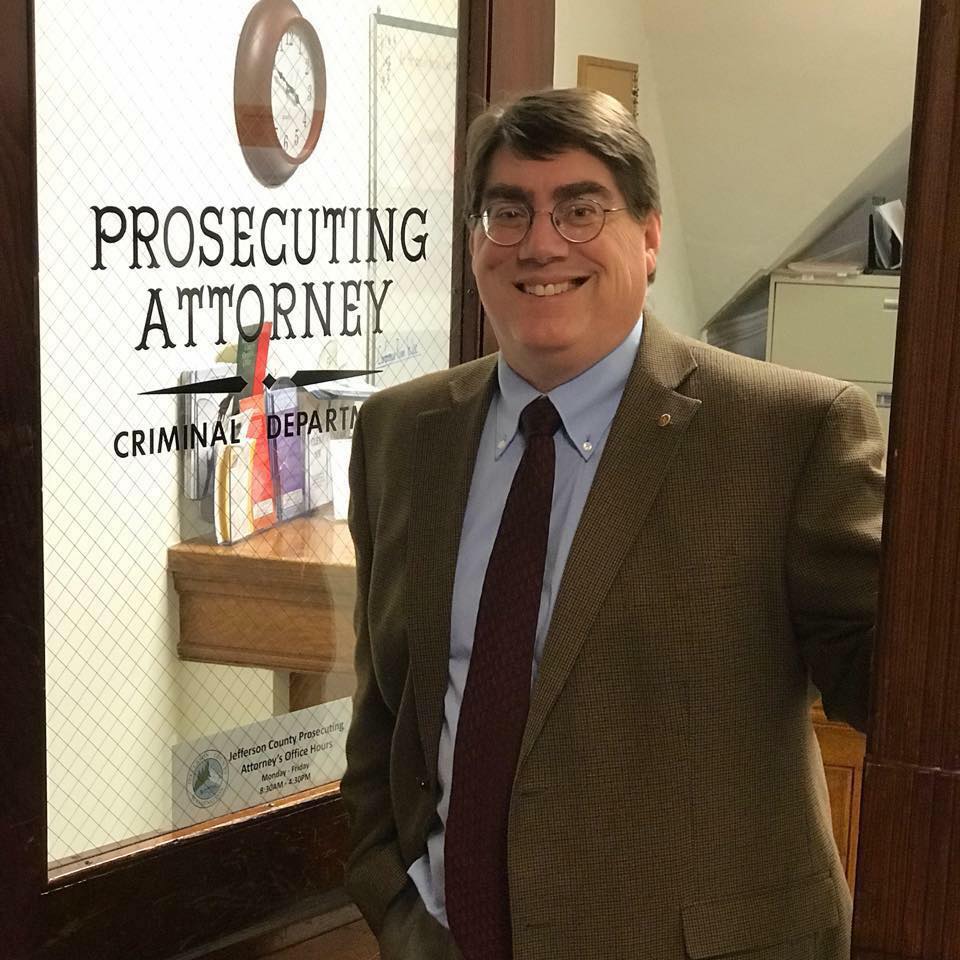
Challenger James Kennedy

Months ago we filed a public records request for all communications between Haas and McAllister’s defense attorney.  We did not receive the last installment, comprising 900 pages, until the day after the primary election, which showed Haas trailing Kennedy by double digits.  We have reviewed the court files and the victim’s deposition. We have spoken with the victim, her brother, and the former prosecutor who succeeded in convicting McAllister in his first trial.  We have spoken with other people who participated in the case, some off the record as their employment situation prevents them from speaking publicly.

Kennedy’s charges (click here) are serious enough.

We found that Haas’ mishandling of the case and his treatment of the victim were worse than Kennedy alleged.

Our report will be released in installments. Haas has not answered any of our questions.  His emails, text messages and court documents will speak for him.

The victim’s name will not be published. She has built a new life and a career outside Jefferson County.  She wanted this case prosecuted again even though Haas’ behavior led her to question his commitment.

In their first conversation, Haas asked her to travel to the defense lawyer’s office in Tacoma for a highly irregular pre-trial deposition.  She wanted to meet in advance, but Haas rebuffed her request. She showed up unprepared.  She was questioned for hours by an investigator and the lawyer for the accused rapist about matters prohibited under the state’s rape shield laws.  Haas never objected.  The deposition lasted over four hours—without a lunchbreak—and ended when Haas said he had an appointment in Port Townsend.

The defense lawyer wanted her back for more questioning.  Haas consented and requested a date from her.  She offered a Saturday when she would not be working.  Before rushing back to Port Townsend, Haas told her he found her courageous and believed her.  He assured her there would at least be a plea bargain. She would get some justice.  The second deposition never occurred.  That was the first and last time she saw the man who was supposed to be prosecuting her rapist.

She heard no more from Haas.  She says she called his office and personal cell phone repeatedly.  She had her brother try. He says Haas ignored him.  She says when she managed to get Haas on the line, he said he was at dinner with his wife and could not talk.  Another time he said he was unable to speak because he was with his children.  She says he called when he knew she’d be at work.  They set a time to talk.  Haas did not keep that appointment.

Then she got “an email bomb” from Haas. Patrick McAllister, previously found guilty beyond a reasonable doubt of raping and assaulting her, a man with a long record of violently abusing women, could rest easy.  Haas was dropping all charges.  In the email Haas said he believed her.  But Haas told the court he believed McAllister.

“I never expected the man who was supposed to be on my side,” SL says, “to be the one to do this.”

Next:  A One-Way Street on the Way to Dismissal.  You can read that story by clicking here.

Also relevant:  The Questions Michael Haas Won’t Answer