by Ana Wolpin and Annette Huenke | Sep 10, 2025 | General
Allowing only days for customer-owner feedback, Jefferson County PUD is proposing a significant hike in fees for those who opted out of smart meters.
In a letter dated September 3, 2025, the PUD just informed customers with non-transmitting electric meters of an impending cost increase — tripling their current $5 per month opt-out fee to $15 per month. Low-income customers who previously had no monthly read fee would see an even greater increase, from zero cost to $15.
The letter invites customer feedback:
“I am reaching out today regarding upcoming changes to our communicating meter opt-out policy. You are receiving this letter because you have been identified as one of our customers who has chosen to opt-out of a communicating electric meter.”
“In an effort to maintain full transparency and receive feedback from community members impacted by possible upcoming changes, I am inviting you to provide feedback to the PUD regarding proposed changes…”
“We want to partner with you. If you have any suggestions or questions, please reach out to us at customerservice@jeffpud.org with the subject line of “Opt-Out Feedback” on or before September 12th, 2025. We will take this feedback into consideration.”
We received this letter on September 6th, leaving six days for feedback. One opt-out customer contacted us today, September 10th, saying they had just gotten the letter, leaving two days to respond. Interestingly enough, at the most recent regular meeting (@139 min. mark) on September 2nd, new General Manager Joe Wilson said we would be given two weeks to provide feedback.
The PUD’s “effort to maintain full transparency and receive feedback” hadn’t materialized as a news alert about the opt-out rate in any of the PUD’s monthly newsletters. Nor can we find this proposed fee increase/invitation for feedback on the PUD’s website. The only notice regarding these proposed changes has come in a last-minute letter offering less than a week for responses.
Why this extra cost?
Scientific evidence remains clear that transmitting (“communicating”) meters affect biological systems, not just in humans, but flora and fauna as well. For those of us opting to avoid the dangers of transmitting meters by choosing either a relatively benign non-communicating digital meter or an even safer analog meter, a meter reader comes to our homes to read electrical usage every month. The $5 fee was established to cover the cost of this monthly read. It was based on what it cost the PUD in 2020 when manual reads were contracted out and the opt-out policy was adopted.
The PUD’s letter informs us that according to a 2025 consultant’s report, the actual cost of the monthly read is now $28.30. The utility’s proposal is to reduce that cost to $15 by cutting the onsite visits in half, “sending technicians to manually read the meters every other month” instead of every month. Six readings a year rather than twelve.
The authors of this article are two of the founders of SMOG — Smart Meter Objectors Group. We worked from 2017 to 2020 to prevent a smart meter rollout in Jefferson County and develop an opt-out from transmitting meters.
Through these efforts, in late 2019 a pause was put on pursuing a smart meter program and in January 2020 the existing opt-out policy was adopted. When Covid lockdowns hit, community input was decimated. The PUD’s Citizen Advisory Board (CAB) was disbanded, in-person PUD meetings ceased, and direct communications with our commissioners was compromised. In the absence of community engagement, the utility resumed its smart meter efforts, starting a rollout in 2022.
Previous articles we’ve written about SMOG’s history, about the smart meter replacement program, and about the dangers of smart meters include Smart Meters Coming to a Neighborhood Near You! and Will a Smart Meter Harm Your Health?
Simple Solutions to Meter Reading Fees Already Exist
According to a recent Public Records Request, there are 486 PUD customer-owners currently opting out of transmitting meters. For many of these customers, this proposed fee hike is significant. Going from $60/year to $180/year, that’s another $120 increase on top of the general rate hikes that began this July. And for low income residents who have not had to pay any extra fees, it will create an even greater hardship, increasing their annual utility costs by $180.
From our research, this financial hit is easily avoidable.
Simple, low-cost alternatives to PUD employees reading meters onsite are already successfully employed by other utilities. These models do not require monthly or even every other month meter reader visits.
A Washington state PUD we spoke to when we first organized SMOG, which then had mostly analog meters, had its customers read their own meters every month — they are called self-reads. A customer could either call in or send their reading to the utility by a certain date. No technician was required onsite for 11 months. Once a year they sent a meter reader to make sure the customer was providing accurate readings. That PUD has since replaced all their analogs with transmitting meters and no longer uses that system.
But an even easier method is currently in use by Snohomish PUD. They began a smart meter rollout in 2023, and expect to complete the installation of 380,000 meters by the end of 2026. They offer two meter reading choices for opt-outs.
From Snohomish PUD’s website:
• Customer can have a PUD meter reader read their meter for a monthly fee of $25, or
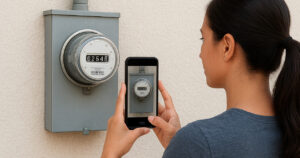
• Customer can submit a picture of their meter and perform a self-read each month for a monthly processing fee of $5 per meter.
Snohomish PUD has 346,094 residential customers. It is the largest of the 28 PUDs in Washington state, the second largest publicly owned utility in the Pacific Northwest and the 12th largest in the nation. We spoke with one of the staff managing the opt-out program for clarification on their photo submission process.
In lieu of a meter reader coming to a customer’s property, the customer submits a photograph once a month showing their power usage through a convenient online portal at SnoPud’s website. Customers are given a 5-day window each month to make their submissions.
Simple. Easy. Snap a photo once a month, submit it electronically.
For Jefferson County PUD customer-owners, all that is needed is for our PUD to set up an online portal and/or provide an email address where we can submit the meter photo. A five-minute or less effort for the customer twelve times a year.
On the PUD’s end, no PUD meter reader is needed. No travel is required, no fuel is consumed, there are no complicated meter access issues.
That’s one consideration. But there is also an argument to be made that the current meter-reading program is more than fair — without increasing opt-out charges.
The True Cost of Opt-Outs Versus Smart Meters
Before Jefferson County’s smart meter rollout, we argued for a self-read option like the one described above as a NO-cost solution to minimize the need for monthly meter readers. Management felt that a $5 read fee was reasonable enough to bypass that approach. And low-income customers were given a break from that extra $5 charge.
The $5 figure was based on what the PUD was already contractually paying Landis+Gyr for reading a large portion of the meters that still had Puget Sound Electric transmitters on them. The cost they charged the PUD for reading each meter, many of which were failing, was actually slightly less than $5. While they were using a mechanical interrogation method for the transmitters still functioning, a significant number had to be physically read.
Now they claim we are not bearing the true cost of our choice to opt out. “Without these necessary changes,” the letter reads, “the option to opt-out of our communicating meters is not financially sustainable.”
But what ARE opt-out customers costing the utility versus smart meter customers? Are the opt-outs an unreasonable drag on the line?
To start, the $28.30 cost for monthly meter reads estimated by the consulting firm is debatable. On August 5th a special PUD meeting was held to discuss the opt-out policy (video here). The consultant presented their report and some discussion followed the presentation.
Of that $28.30, the expense for actually reading the meter — which the PUD paid less than $5 for in 2020 — is itemized as now costing $16.37. The remaining $12 includes items such as administrative overhead.
An example of administrative overhead given by the consultant at the August 5th presentation was the cost of “the commissioners spending time discussing this topic”! But these costs are already covered in our base rate, what one commissioner rightly described as “double dipping.”
Whatever the true cost, it doesn’t begin to compensate for the increased energy rates that opt-out customers are already bearing for a $5 million rollout of smart meters we don’t use or need. And beyond this massive outlay which has driven higher rates that we are ALL paying, we are also subsidizing extra costs from failure of the smart meter technology to live up to its hype.
Issues we warned about like meters failing to “communicate” likely create more demands on staffing than 486 non-transmitting meter reads once a month. On any given day, according to our recent Public Records Request (PRR), 300 or more smart meters may need attending to because they are “experiencing connectivity issues.”
As shown in this screenshot, on August 14 there were 310 smart meters offline (see blue bar, far right). Representing “a moment-in-time yesterday,” wrote the PUD Administrative Assistant who responded to the PRR, “310, this number fluctuates continually.” Sometimes it will be lower, sometimes it will be higher.
That figure is 64% of the total number of opt-outs! How much staff time is required to respond to hundreds of smart meters with connectivity issues that are not performing as needed? No such problem plagues our steady, reliable “non-communicating” analog and digital meters.
At the September 2nd regular meeting, staff gave a PowerPoint presentation that included this verbiage on a slide:
Continuing to allow Jefferson County Customers to offset the cost of customers choosing not to have a communicating meter goes against our desire to have customers generating the cost pay for the cost.
The opt-out fee is being treated as though it’s an anomalous inequity within the system. But is it? The fee is punitive, though not intentionally on the part of the PUD. It’s a misguided attempt to level a playing field that cannot be leveled.
• It is not fair that everyone is paying the same base rate that covers the cost of that $5 million smart meter rollout, when we who opt out aren’t using it.
• It’s not fair that when a few hundred of those meters regularly fail to communicate, those truck-rolls are considered the cost of doing business… but the truck-rolls for reading analog meters is considered a privileged gift.
• It is not fair that electric customers subsidized the build-out of broadband. How many hours (administrative overhead) did the commissioners spend in meetings discussing broadband? How will electric customers be reimbursed for that, applying the formula that was used to arrive at the opt-out cost?
• There’s unfairness in the higher cost of delivering services to all those spread-out homesteads in the south county.
These disparities cannot easily be remedied. That’s what the base rate is for.
Providing Feedback on Proposed Opt-Out Rates
The September 3rd unsigned letter quoted at the beginning of this article — “I am reaching out today” — appears to have come from staff, not from the PUD commissioners or the general manager whose names are at the top of the letterhead. It outlines the proposed rate hike discussed the day before at the September 2nd general meeting.
For those inclined toward number-crunching, here is the spreadsheet provided to the Commissioners by PUD consultant, FCS, to support their findings.
It was agreed at that meeting that a resolution on these proposed rates would soon be presented to the commissioners, possibly for a vote at their Tuesday, September 16th regular meeting, which takes place from 4pm-6pm. The meeting room is at the 310 Four Corners Road office building, to the right of reception.
We have learned through calls to the commissioners that feedback to them does not have to be received by September 12th, despite that deadline being given to respond to customer service. But it is critical that commissioners hear from opt-out customer-owners both AHEAD OF and AT the upcoming meeting. They plan to vote on this resolution at that meeting.
Email and phone contacts for our three PUD commissioners are:
Jeff Randall, District 1 – jrandall@jeffpud.org / 360-316-6694
Kenneth Collins, District 2 – kcollins@jeffpud.org / 360-316-1475
Dan Toepper, District 3 – dtoepper@jeffpud.org / 360-302-0448
You can cc emails to GM Joe Wilson at jwilson@jeffpud.org
Written feedback to the commissioners should be sent by Monday, September 15th to receive considered attention. At the meeting on Tuesday public comments are limited to three minutes. You can comment in person or via Zoom. More information about the meeting and about joining Zoom can be found here.
Addendum / Friday, September 12:
A Violation of Trust
At the PUD’s September 2 general meeting, when GM Joe Wilson said that a letter to opt-out customers would be going out with a two-week window for responses, he explained that after that two-week collection period, staff would go through a process of incorporating the feedback into a proposed resolution he would bring to the commissioners:
“After a two-week period hearing feedback, staff would attempt to incorporate that feedback into a proposal and bring it back to the board as a resolution for consideration.”
No such process took place. Not only was the stated two-week response time reduced to a matter of days, NO public feedback has been incorporated as part of the proposed rate changes.
Wilson did not even wait for the truncated Sept. 12 deadline to pass before putting the resolution that had been recommended on Sept. 2 in the Sept. 16 agenda packet. This morning, a full working day before the feedback deadline, the opt-out resolution was posted as an agenda item for Tuesday night’s meeting with the “Recommended Action” that the commissioners approve it as previously presented:
8.2 Opt-Out Presentation, Resolution & Calculations
Presenter: Joe Wilson, General Manager
Recommended Action: Make a motion to approve the Opt-Out Program Resolution as presented.
The resolution (p. 69) is exactly as discussed on Sept. 2 — no consideration or inclusion of customer feedback. The accompanying materials in the packet show the same staff recommendations made at that meeting where GM Wilson assured the commissioners a proposal would be drafted after gathering customer feedback and incorporating it. His actions demonstrate an effort to advance a predetermined outcome while his words professed otherwise.
How can the public believe staff was sincere in their letter requesting input and their stated desire to “partner” with us when our feedback has been ignored?
How can our new GM — completely disregarding a process he claimed would be followed — be trusted?
by Ana Wolpin and Annette Huenke | Sep 13, 2022 | General
“By anyone’s assessment, traditional electromechanical [analog] meters are an amazing piece of engineering work. Refined over a hundred years, the design of a standard residential electricity meter became an impressive combination of economy, accuracy, durability and simplicity.”
– Electric Power Research Institute
——————————-
A program is now underway in Jefferson County to replace existing utility meters with two-way communicating Smart meters.
You have a choice, though. Because of an Opt-Out Policy created several years ago, PUD customers can reject a Smart meter and opt for a non-transmitting analog meter instead.
According to the “Grid Modernization – Meter Replacement Process” page on JeffPUD’s website:
Utility-wide replacement of aging meters with new advanced metering infrastructure (AMI) [Smart meters] will begin on September 19th in Kala Point. Meter replacement will be done in zones over time, with full replacement projected by early-2024.
General Manager Kevin Streett reported at the PUD regular meeting on Sept. 6th that the ‘Gateways’ — a system-critical piece of hardware used for data relay between the consumer and the utility — are in short supply, thus are being rationed by the manufacturers. The speed of the county-wide rollout to 20,000 customer/owners will depend upon that supply chain, and that of the so-called Smart meters themselves.
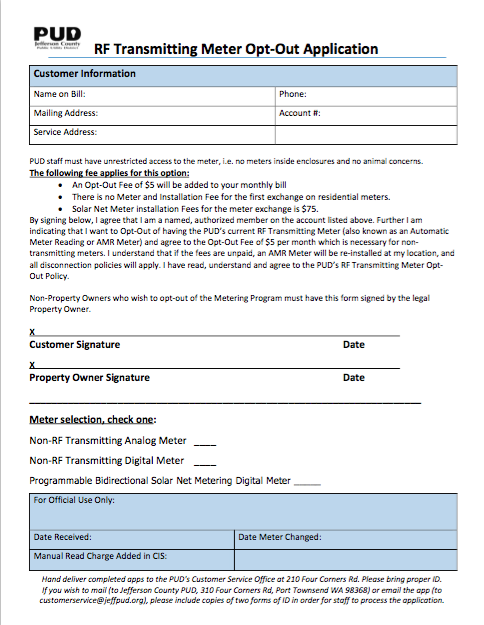
If you know you do not want a Smart meter, you don’t have to wait until you are notified of the rollout reaching you. You can request an analog meter at any time using the PUD’s “RF Transmitting Meter Opt-Out Application” (see below).
——————————-
How We Got Here
In 2017, AMI technology, more commonly known as Smart meters, was rejected by more than a thousand county utility customers on a petition titled “We Want Analogs. No Smart Meters.” Over the course of two years, a group called SMOG — Smart Meter Objectors Group — challenged the PUD’s intended Smart meter rollout.
In response to concerns put forward by SMOG, in 2018 the meter replacement plan was put on pause. In November of 2019 and 1,000 signatures later, PUD commissioners granted utility customers the choice of opting for a non-transmitting analog meter, then or at any time in the future. Since that time about 175 customer-owners have requested that their existing one-way transmitting meters known as AMR — Automatic Meter Reading, not AMI/Smart meters — be replaced with analogs.
Now that the commissioners have decided to move forward with the AMI “Grid Modernization”, unless you opt out, your one-way transmitting AMR meter will be replaced with what many critics consider a far-more problematic two-way transmitting Smart meter.
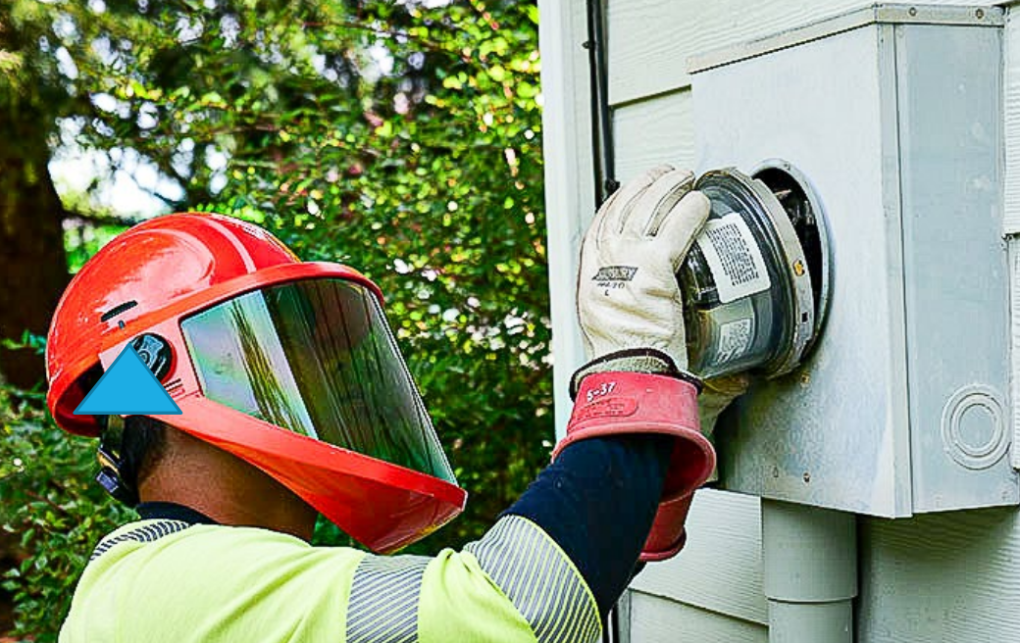
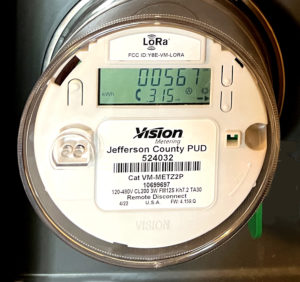
One of approximately 40 Smart meters installed to date by Jefferson County PUD. The county-wide rollout begins Sept. 19th.
The authors are two of SMOG’s co-founders (Annette continues to monitor and participate in PUD meetings), and are among the early opt-outs. This article will describe the concerns around Smart meters and why you might want to opt for an analog when the meter replacement program comes to your neighborhood.
——————————-
Utility companies love Smart meters,
but are they better for the customers?
2017 SMOG information sheet
There are multiple issues with Smart meter technology that SMOG initially addressed:
- High costs for new infrastructure to support this technology that generally leads to utility rate hikes;
- Short meter lifespan, with frequent meter replacement adding to utility costs;
- Safety issues – the meters’ lack of grounding potentially causing house fires and the shorting out of household appliances;
- Questions about smart meter accuracy, affecting utility bills;
- The potential surveillance by Smart technology, gathering information on household habits;
- Control of meters remotely by the utility;
- Time-of-Use rate adjustments increasing utility bills;
- Health concerns resulting from the electromagnetic radiation emitted by Smart meters.
We won’t dwell on the first four concerns for the following reasons:
1) JeffPUD has already decided to go down this road, with a workplan budget of $4,060,000 for this 2+ year project. Cost overruns can be in the millions with these rollouts, particularly additional infrastructure expenses where there are terrain issues like we have in Jefferson County. Time will tell how this affects our rates.
2) If the Smart meter obsolescence figure of 5-7 years given in Congressional testimony in 2015 holds true, with costs shared among the PUD’s customer base, even those who opt out will see rate increases if their Smart-metered neighbors require more frequent replacements.
3) The incidence of fires following smart meter installations was alarming in the early rollout years, but not much news has surfaced the past few years. It remains one reason to choose an analog, though, if you want the safest possible tech on your property.
4) A 2017 study showed that Smart meters gave false readings from 30% too low to 582% too high. That could mean you pay more or less than your actual usage. We just don’t know. We do know that analog meters have stood the test of time, holding their accuracy within industry standards for decades.
The issues we can clearly address by opting out of a Smart meter at this point include:
Invasion of Privacy,
Surveillance and Data Collecting
A major difference between two-way Smart meter technology and our current one-way-transmitting meters is in their ability to communicate detailed data wirelessly to our utility.
An analog meter does not broadcast any frequencies at all, it is read manually on-site by a meter reader.
Our current one-way meters broadcast infrequently, sending overall energy usage to a collector, recorded by a meter reader in the field.
A Smart meter broadcasts RF frequencies 24/7, every few seconds or even faster, up to 190,000 bursts of pulsed radiation per day.
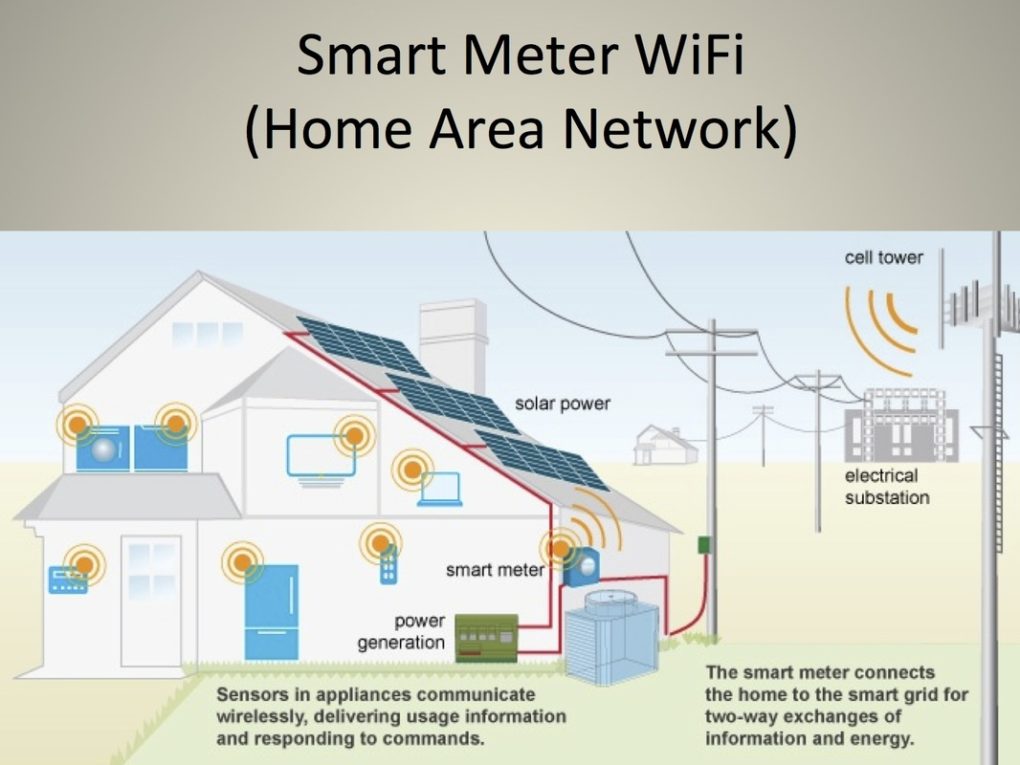
While our PUD has not added this feature to the AMI meters being purchased, one of the promises of Smart technology is its potential to not only broadcast our usage remotely to the utility, but to communicate with any Smart gadget or device — appliances, heating and cooling systems, lights, video doorbells, security cameras, door locks, an ever-expanding array of Smart tech — and send detailed information to our utility about how and when we use energy.
That is seen as a benefit by some, potentially offering the customer more specific data on their power consumption to encourage better energy habits. But that doesn’t play out in real life. As studies like this one from Keele University show, Smart Meters Have Little Impact on People’s Energy Usage Habits.
What detailed data collection does achieve is in-home surveillance, sending personal information to the “Cloud” that potentially allows your utility — or a hacker — to monitor your household’s private habits in real time. It can reveal when you are home or not, when and how much you use specific appliances, in some cases even your TV viewing habits. It’s been dubbed “the household device that spies on you 24/7.”
The data collected can be sold to third parties. Miles Keogh, Director of Research at the National Association of Regulatory Utility Commissioners, warns, “I think the [smart meter] data is going to be worth a lot more than the [electricity] commodity that’s being consumed to collect the data.”
As previously stated, this information will not be available with these new Smart meters — the PUD has assured us that it is not their intent to carry out this kind of data-mining on us, or to sell it for profit. It will require an upgrade for that capability.
It is, however, a slippery slope. We take the PUD’s current management at their word, but once this technology is in place, it opens a Pandora’s box for future abuse.
Remote Disconnects, Control and
Rationing of Your Energy Use
One of the upsides for the utility in switching over to a Smart meter network is the remote disconnect feature. If the PUD needs or wants to turn off your power, no one has to physically come to your property; your service can be disconnected remotely by the utility.
This feature is prominently displayed on the new Vision Smart meters.
And with additional hardware installed, there is also the potential for the PUD to control your power use in other ways. For example, as 22,000 utility customers in Colorado were recently shocked to discover, thermostat settings can be overridden remotely. During a heat wave just weeks ago, we saw the headline Power Company Seizes Control Of Thermostats In Colorado During Heatwave.
“After temperatures soared past 90 degrees, residents were left confused when they tried to adjust their air conditioning and found locked controls displaying a message that said ‘energy emergency’.” Utility customers discovered that their thermostats were locked in at 78 or 79 degrees. Those with heat-related health issues were unable to adjust for their comfort level; temperature regulation was completely out of their control.
Again, this is not something that will be possible with the initial Smart meter rollout in Jefferson County. But the infrastructure will be in place for increasing control and energy rationing by our utility in the future.
Current Billing Structure
and Proposed Time-of-Use Rates
At present, we are charged a flat fee (base rate) for the privilege of connection to the electric grid, and a kilowatt-per-hour usage fee (you’ll easily find these on your power bill).
It’s elementary that there are typical peak times in most households when far more energy is consumed — most commonly between 4pm and 9pm — when families get home from work and school and prepare dinner, turn on lights, televisions, computers, EV chargers, appliances etc. Power generators charge more to utilities when these peaks stress their systems.
Time-of-use billing aims to pass most of those cost increases directly on to the consumer in order to nudge them to modify their usage behavior by shifting much of their consumption to the shoulder lower-peak hours, or better yet, midnight-to-6am off-peak hours. (Some of us have been doing this voluntarily for years or even decades.)
Sounds reasonable enough, but there are caveats. What about people who are disabled, at home all day with elderly parents or small children, or underemployed and constantly juggling jobs?
A study published in Nature Energy in December 2019, titled “Varied Health and Financial Impacts of Time-of-Use Energy Rates Across Sociodemographic Groups Raise Equity Concerns,” summarized their findings in this way:
“The elderly and those with disabilities face greater increases in electricity bills and worse health outcomes under some time-of-use electricity rates. This suggests that vulnerable groups should be considered separately in time-of-use rate design, and future rate designs should be tested to ensure that they do not increase hardship.”
The paper pointed to typical hardships in lower income, rural counties like ours — inefficient appliances, leaky homes and the prevalence of rentals rather than home-ownership — which effectively prohibit the consumer from improving their comfort through increased energy efficiency. This can contribute to negative health outcomes for those who are forced to suffer through cold winters, hot summers and higher overall bills.
What I can’t see can’t hurt me.
Right?
Perhaps the most controversial aspect of this technology relates to the health impacts from the high-intensity pulsed radiation (RF transmissions) that Smart meters emit. Many decades of research have established that electromagnetic fields (EMFs) can cause profound health issues.
When Smart meters first began rolling out in the U.S., the incidence of people reporting new health challenges spiked dramatically. Former Silicon Valley engineer Jeromy Johnson is one who experienced a decline so debilitating after a Smart meter was installed that he turned EMF educator. Within a week of its installation, the meter’s impacts changed him from an early-adopter tech enthusiast to someone unable to function in his normal work and home environments.
As described in Johnson’s acclaimed 16-minute TED Talk (with thousands of corroborating comments), the most common adverse health effects linked to EMF exposures from these meters include:
-
-
- Headaches
- Insomnia
- Fatigue
- Tinnitus
- Heart arrhythmia/palpitations
- Decreased immune function
- Irritability
- Decreased cognitive function
Estimates of those who suffer from electrosensitivity range from 3 to 10 percent of the population. This concern was a major reason our PUD commissioners agreed to create an Opt-Out Policy. A future article will explore this issue in more depth.
——————————-
Why Choose an Analog Meter?
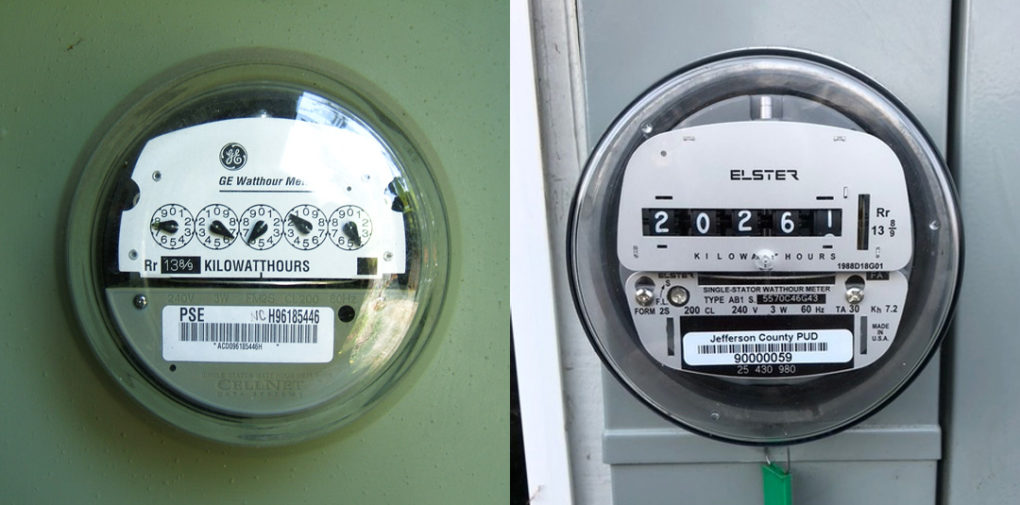
Two styles of analog meters our PUD is using for opt-outs — the original “clock face” style that records usage on small dials and a later style with a numerical display.
Local craftsman and contractor, Sebastian (Seb) Eggert, is nearing completion of his ElectroMagnetic Radiation Specialist (EMRS) certification with the Building Biology Institute and was a founding member of SMOG. He is the host of a semi-monthly Zoom call with other working EMRS professionals in which they discuss their cases and host guests, among them many of the most well known leaders in the field. He is hired by business and home owners to ‘survey’ offices and domiciles for the unseen presence of electrical, magnetic and radio frequency radiation (RF) as well as high frequency voltage transients emitted by wiring, known as dirty electricity (DE). He shares this primer, beginning with the beauty of analog technology:
“Electromechanical (analog) meters were the mainstay of the national electrical system for more than a hundred years. The amount of electricity used is indicated on a series of small dials or a digital display. The electrical current moving through the device constantly turns the mechanism in proportion to the amount of electricity consumed. A miniscule amount of friction in the system is the only loss of energy in the device.
If calibrated properly they are highly accurate and have been known to run reliably for as many as fifty years. They produce no other nuisance radiation of any kind, other than that created by the electricity in and moving through the wires.”
Traditional analog meters are safer, less expensive, more reliable, longer lasting and more secure than wireless Smart meters. With an analog meter there is zero chance for Smart surveillance, no possibility of the utility remotely disconnecting or controlling your energy use, no way to impose Time-of-Use rate structures, and no harmful radiation or dirty electricity is ever generated.
Unfortunately, manufacturing of new analog meters came to an end as industry’s push for ‘smart grid’ technology was prioritized. However, even according to Randy Austin, CEO of Vision Meters (our new supplier), refurbished analogs operate reliably and within industry standards for 25-35 years.
Non-transmitting Analog
or Non-transmitting Digital?
Our PUD also offers a second type of non-radiating meter as part of its opt-out program: digital non-transmitting meters. Eggert explains:
“These meters look like the new two-way transmitting [Smart] meters but do not have radio transmitters or receivers, thus — like analog meters — have to be read monthly by a meter reader. The switch mode power supply that measures the electricity used and displays it on the meter does generate some high frequency voltage transients, also known as ‘dirty electricity’, or ‘DE’. This is considered objectionable current by the building biology community and some electrically sensitive people are negatively affected by this form of radio frequency radiation.
The digital non-transmitting meters average the current used by sampling the amperage moving through the device over time and taking an average of those readings. Some engineers suggest that spikes from power surges (such as when a refrigerator starts up) can skew the average to be higher than what the usage is, resulting in higher electricity bills.”
Analog meters do not use this kind of averaging which can inflate your utility bills, nor do they generate dirty electricity — more reasons they are the superior meter choice.
Analog advocate Jeromy Johnson says, “I encourage you to do everything possible to opt-out of your Smart meter.” And with our hard-won Opt-Out Policy in place, we have that choice in Jefferson County.
Sign Up for Your Analog
Opt-Out Meter
If you want an analog meter for any or all of the above reasons, we are happy to report that our PUD has made it an easy process with a simple one-page opt-out form.
Opt-Out Application is on the last page of the packet here.
Our utility is offering non-transmitting analog meters for no initial installation charge and only a $5.00 monthly fee added to the power bill. The $5 surcharge goes towards the cost of a meter reader coming to your property every month to manually read your power usage.
Some caveats apply. From the PUD’s website:
Net metering (solar power) customers are limited to the [non-transmitting] digital meter, and must pay a $75 installation fee.
PUD customers who rent their homes will need to have their Opt-Out applications signed by the property owner in order for the application to be processed.
You’ll find the AMI/Smart meter opt-out form here. It cannot be filled out online, rather must be downloaded and printed out, or picked up at the customer service counter at 310 Four Corners Road.
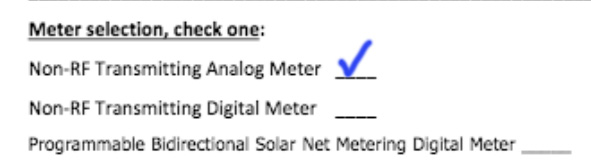
Except for a point of confusion over whether to choose the non-transmitting analog or non-transmitting digital, we’ve not heard of any snags from others who have already opted out. We strongly suggest the analog option as the safest, most robust meter available.
Analog meters are available for most customers, but our PUD states that only the non-transmitting digital option will work with solar systems.
We will be happy to answer questions in the comments below.
——————————–
Top photo from PUD website

 The authors of this article are two of the founders of SMOG — Smart Meter Objectors Group. We worked from 2017 to 2020 to prevent a smart meter rollout in Jefferson County and develop an opt-out from transmitting meters.
 Simple. Easy. Snap a photo once a month, submit it electronically.