
Opt-Out Customer-Owners in the Crosshairs:
Inequities Confirm Smart Meter Agenda
When Jefferson County PUD customer-owners who opted out of “communicating” smart meters were notified between September 6th and 12th that their $5 monthly opt-out fee was proposed to triple, more than 70 letters responded to a request for feedback.
Most letter writers raised objections to the proposed hike, with concerns voiced that not enough time was given for feedback — asking for a delay on the decision slated for the meeting just days later on Sept. 16. Some questioned the validity of the fees proposed based on consultant FCS’s report. Many suggested that a simple self-read option be made available as described in our Sept. 10 article, PUD to Triple Monthly Smart Meter Opt-Out Fee?
This article will examine:
- the Sept. 16 PUD meeting and decisions,
- the inflated costs attributed to opt-out customers for manual meter reads,
- the focus on opt-out customers in the larger context of the PUD’s overall outlays,
- cost recovery inequities, and
- the industry agenda to create a punitive climate to discourage opt-outs and force all electric customers into the smart grid.
Recap of the September 16th Meeting
It was announced at the outset of the Sept. 16 meeting that staff had come with an alternative resolution to the one initially proposed. The new proposal still called for the immediate implementation of every-other-month reads, done by meter readers on even-numbered months, with usage charges estimated on odd-numbered months.
However the implementation of the $15 opt-out fee increase would be postponed until July 2026. Staff continued to recommend that the low-income discount no longer apply to the opt-out fee.
Eight opt-out supporters showed up to the meeting, with an additional dozen or so appearing on the Zoom platform, some wishing to voice their opinions. Between that modest in-person showing and those on Zoom, commission chair Jeff Randall decided to reduce the time for public comments from three minutes to two, even though it was unclear how many of that total would want to speak.
Most commenters mentioned the desire to assist the PUD in lowering costs by reading their own meter, as is available with the Snohomish PUD. After the comment period closed, General Manager Joe Wilson explained the genesis of Snohomish PUD’s self-read program (at 105 min.).
The reasons given for why we will not be going down the SnoPud “take a photo of your meter” path was as follows, in GM Wilson’s words:
“[At] Jefferson PUD, we’re very stretched financially, and we’re using off-the-shelf utility software. We don’t customize it, we’re trying to be economical in our software expenses. So while I understand that it was being perceived in the community to be very straight-forward, staff at Jefferson PUD don’t see a clear path to be able to feasibly do this economically. We believe that there’d be software development charges, union negotiations because this would transfer from a particular union representing the meter readers to a different union, may transfer to a different union processing internally or we’d still have to have the meter readers sit in a terminal. So we have to be respectful to our unions where this work is potentially bridging a gap, and develop new processes to make this happen. At a high level, it doesn’t seem economic to try to do that work, and frankly, then we, following these same cost of service principles, expect the folks that are requesting the service to cover those costs. I see a very high probability that those costs would be higher than the costs of this [current proposal].”
SnoPud has roughly 18 times the customer base of JPUD, which confers a great deal more resources, many more employees and a much larger budget. Wilson pointed out that this affords them the luxury of “specialized products like this” (customized software to accept photographic reads).
Little did we know, the notion of self-reads of any sort was Dead On Arrival.
Regarding staff’s stated plan to allow two weeks for feedback and incorporation of that input into subsequent resolutions not being honored, GM Wilson offered “apologies for if I misspoke.”
Staff was tasked by the commission to bring the finalized resolution to the regular meeting on October 21st, with Commissioners Jeff Randall and Dan Toepper expressing their sustained reservations about the $15 fee.
GM Wilson recommended comments be sent to the commissioners and staff by October 15th for consideration of incorporation into the new resolution. You can write your commissioners at any time to express your concerns.
What Does a Manual Read Actually Cost?
Consultant FCS asserted that it costs the PUD $28.30 to provide on-site meter reads. Staff’s proposal to raise the current $5 charge to $15 is based on reducing those on-site reads by half to every other month.
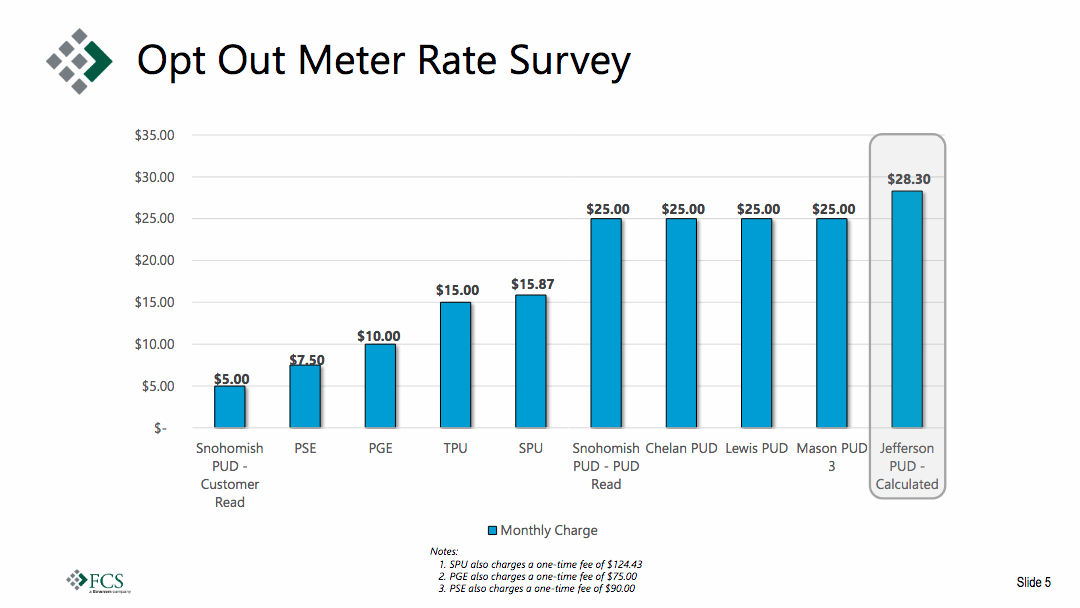
But that $28 figure is inflated. Regional corporate utilities price their manual reads from $7.50 to $10, as we will see below.
Let’s look at FCS’s cost breakdown of the $28.30.
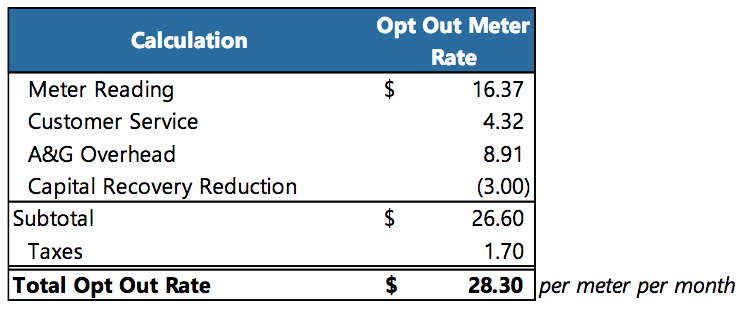
We’ll discuss just two of these categories here.
$16.37 Meter Reading:
When the opt-out policy was adopted in 2019, the PUD was paying meter company Landis+Gyr somewhere in the $4.50-$4.80 range for their meter readers to manually read some hundreds of our meters every month. If it is now costing in excess of $16 for a PUD meter reader to do the same, there are clearly efficiency issues that have not been addressed.
According to former GM Kevin Streett, every opt-out read requires an individual service order to be generated every month. From the discussion at the PUD’s Aug. 5 special meeting it also appears the reads are mixed in with other business in the field.
Why is there not a schedule and program designed to maximize efficiency? The same question applies to the customer service charge. Why no automated system?
$8.91 A & G Overhead:
Commissioner Randall noted at the August 5 special meeting that administrative overhead such as “the commissioners spending time discussing this topic” (an example the consultant used to justify this charge) is already built into electric customers’ base rate. The recent hike in that base rate, now set at $33.50 for residential customers, covers meeting time and all other administrative costs. And, as we will see below, it also subsidizes other non-electric services within the PUD.
Charging opt-out customers a second time for administrative overhead when we are already paying for that in our base rate is “double dipping,” Randall rightly contended. FCS arguing to charge us twice for this demonstrates an agenda that we will speak to later.
Opt-Out Customers Singled Out for Scrutiny
At the Sept. 16 meeting, co-author Annette Huenke commented on the PUD’s outsized focus on the relatively piddly cost of the opt-out program compared to the multi-million-dollar broadband project. She challenged the PUD to run the same fine-toothed comb through that service category’s figures and ask the broadband customers to cover all the costs the electric customers have borne for them for the last five years — including the time commissioners have spent at broadband meetings.
GM Wilson highlighted that comment, saying that “cost recovery in our service lines is an area of passion for me, too.” He continued, “the reason we’re not doing that well in broadband is that the community sees an opportunity to capture a lot of grant money, but I agree with you that we need to get back to cost recovery in our service lines.”
One doesn’t hear the same sense of urgency for correcting that situation, though the cost to the PUD and the customer-owners is orders of magnitude greater.
What about those “smart” meters that are currently requiring manual reads?
When the Smart Meter Objectors’ Group (SMOG) first got involved at the PUD, the utility had enlisted meter manufacturer Itron to begin replacing the malfunctioning meters within the leftover PSE inventory. Itron was also a front-runner for winning the contract for upgrading our system to smart meters.
Our digging revealed that a Radio Frequency Propagation Study (Rf Prop Study) had been requisitioned some years earlier. These studies are critical to understanding how terrain could impact frequency transmissions from distances promised by industry. Iowa and Nebraska — where the landscape is flat as far as the eye (or radio frequency) can see — is one thing; the Pacific Northwest and specifically Jefferson County is another.
We’d already heard of the tens of thousands of meters that were failing to communicate with receivers in the massive rollout in British Columbia, where the terrain is very similar to western Washington. Radio frequencies are hampered by moisture, foliage and elevation changes. Over greater distances, structures can be problematic, too.
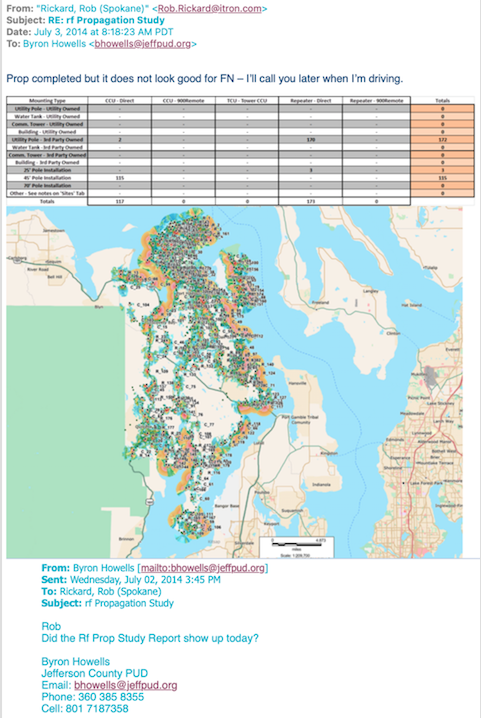
Itron conducted its Rf Prop Study using satellite data, rather than an on-site visit, in 2014. A records request revealed that, on July 2, 2014, JPUD’s contracted representative, Byron Howells, wrote to Itron’s rep, inquiring about that matter:
Rob —
Did the Rf Prop Study Report show up today?
Itron’s rep, Rob Rickard, responds:
Prop completed but it does not look good for FN [frequency network] — I’ll call you later when I’m driving.
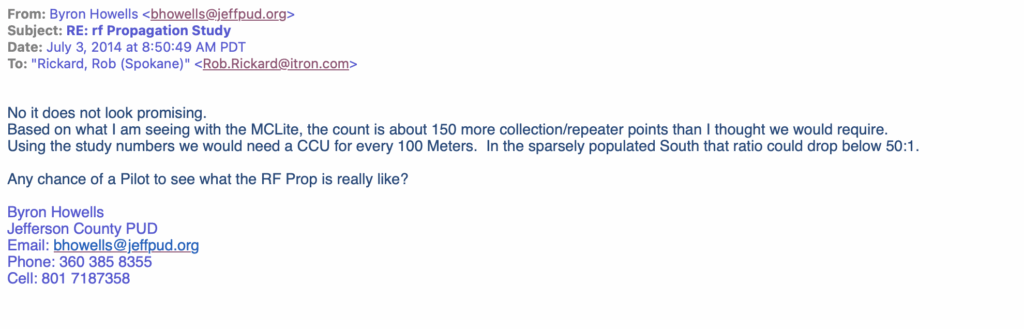
Half an hour later, Byron Howells replies:
No it does not look promising.
Based on what I am seeing with the MCLite, the count is about 150 more collection/repeater points than I thought we would require.
Using the study numbers we would need a CCU for every 100 Meters. In the sparsely populated South that ratio could drop below 50:1.Any chance of a Pilot to see what the RF Prop is really like?
The rest of the discussion was off the record, in a phone call. Though this contains a lot of industry jargon, our research at the time showed that the collectors were quite expensive. This may help explain why this system that serves roughly 21,000 customers cost $5 million.
What we learn from this is that our PUD knew more than a decade ago that, at best, there would be holes in their mesh network, and a significant number of meters would have difficulty communicating with radio receivers assigned to them. Thus the meters would have to be read manually.
Why don’t we have consultant FCS run their fine-tooth comb over those manual reads and give us an estimate of what they are costing the utility each month? As reported in our Sept. 10 article, a records request from August 14th showed 310 meters “offline” at that particular moment in time, ie. not communicating with the PUD. That’s 60% of the opt-out meter customers! Surely they also require a service order to initiate the truck rolls. What happens if the meter transmission is simply not capable of reaching the collectors?
Opt-out customers are basically being told they will have to subsidize the smart meters that can’t function as designed, as well as those that do. It should be noted here that the commissioners have asked staff what the cost savings amount to from the smart meter rollout, and are told that this number is not known.
Cost Recovery Across Service Divisions is a Pipe Dream
A brief discussion ensued at the Oct. 6, 2025 budget hearing regarding the fiscal status of the PUD’s water and broadband divisions. There are roughly 5,000 water customers (versus ~21,000 electric customers) and the department runs a chronic deficit. The electric side, primarily through the base rate, is fully subsidizing the water side.
Fewer than half of county residents needed the PUD’s broadband program, as they were already being served by various carriers. The broadband division is also running a deficit. The electric side is subsidizing broadband, too.
It gets worse.
The percentage of property taxes Jefferson County allocates to the PUD (.75) amounted to $605,702 for 2025 (assessed in 2024). A full 80% of that is going to broadband; 20% goes to the water department. Exactly zero of the property taxes we pay go to offset the base rate for electric customers.
GM Wilson noted that “opt-out [meter] readers are not doing a task that benefits all electric customers.” Neither are broadband technicians and water meter readers. And technicians that attend to malfunctioning “smart” meters are not doing a task that benefits those who chose not to have a transmitting meter.
When we raise the issue of the unfairness of opt-out customer-owners having to help foot the bill for a system they don’t benefit from in addition to the one they do, commissioners nod in agreement and say “you’ve got a point.” When the commissioners raise the issue of the electric side subsidizing the other services, staff nods, makes modest excuses and goes back to work. That’s just the way it is, fellas.
The playing field cannot be leveled. So let’s stop the pretense that parity is possible, and accept the existing inequalities — across the board.
The Planned Phase-out of Analogs Continues Apace
The PUD has now halved the cost to the utility for opt-out reads by reading meters every other month. At the last several meetings, GM Wilson has made it abundantly clear that he intends to phase out the electro-mechanical (analog) meters before long. The reason drifts from there not being spare parts, or that we won’t be refurbishing “obsolete” meters (though the near-new malfunctioning digital meters are regularly refurbished), to the need for all the meters to be the same. However, at the Sept. 16 meeting, one of the commissioner questions that Wilson read aloud asked if there was a charge for installing an electro-mechanical meter. He said that was not an option, and that “the PUD has an inventory of Itron non-communicating meters that would get deployed.”
Those non-communicating meters are digital one-way transmitting meters, the same type that the PUD was using prior to the smart meter rollout. So the meters won’t all be the same after all — until they insist that we submit to having smart meters installed with the outgoing transmitter turned off.
They will still need to be read manually (just like all the smart meters around the county that don’t work properly now), but the incoming transmitter will not be turned off. What you do in your home will not be secure from surveillance, and voltage transients (dirty electricity) will be transferred throughout the home’s wiring by the meter’s power supply (SMPS).
The Industry Agenda Behind the Singular Opt-Out Scrutiny
The FCS consultant emphasized the four utilities on their comparison slide showing $25 opt-out fees (bars at right) as a way to justify their inflated $28.30 figure (far right) at Jefferson PUD.
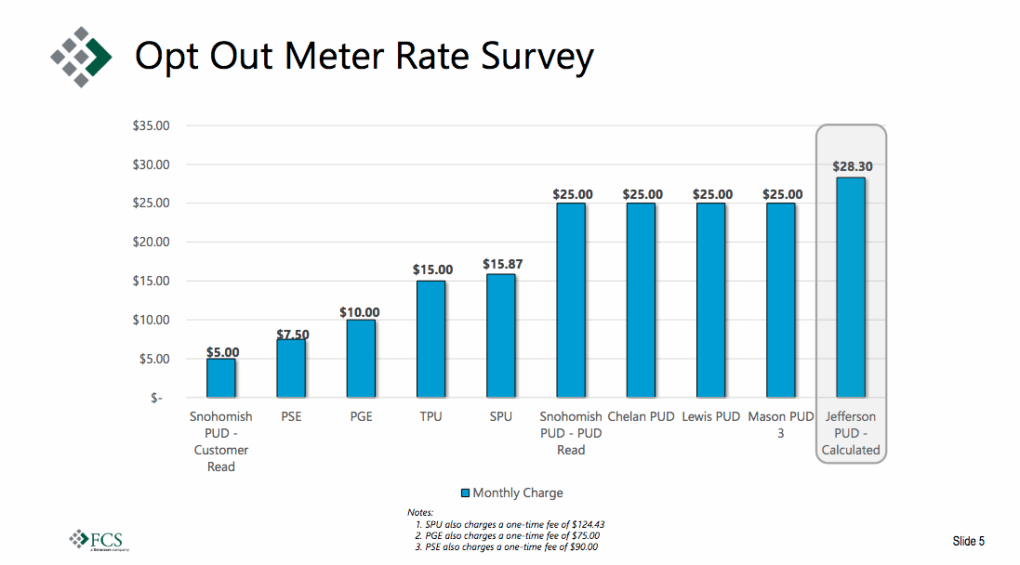
We know that’s what many utilities typically charge, but that those $25 fees are not based on costs. It is a nationwide strategy to discourage—and eventually eliminate—opt-outs by an industry that does not want holes in its smart grid.
In our prior process, when JPUD initiated an opt-out survey of all Washington state PUDs, one utility even said it out loud — they added a written note that they’d set their punitive fee “to discourage opt-outs.” And it worked. Very few customers had opted out.
One need only look at true costs for manual meter reads identified by for-profit corporate utilities PSE (Puget Sound Electric) and PG&E (Pacific Gas & Electric) to see the game. PSE and PG&E charge initial one-time fees (see chart above), but ongoing monthly charges are modest. PSE’s monthly read fee is $7.50; PG&E’s is $10. Those costs are all-inclusive — meter reading, customer service, overhead and taxes.
At Jefferson PUD, opt-outs are the only group of customer-owners accused of not paying their fair share. The much larger subsets of water and broadband customers, both subsidized by electric customers, do not receive equivalent treatment. Inflated calculations for opt-out customers are contrived to relieve a supposed burden on the larger customer base — costs which are minuscule in the context of the utility’s spending. That is in keeping with the industry narrative to drive opt-outs from the mix.
The PUD’s announcement proposing to triple the current $5 charge had the desired effect. Quite a few customers responding to the request for feedback said they couldn’t afford the increase and would be forced to accept a smart meter instead.
Given the volume of inequities within the system, those who choose to opt-out need to stand firm that we should not be the sole targets of the PUD’s sudden fiscal scrutiny.
Keep the fee at $5/month until the other, far costlier inequalities within the system are resolved. If this doesn’t happen, we can presume that the opt-out fee is indeed punitive, intended to drive everyone into the smart grid, despite our legitimate concerns around the “smart” meter technology.